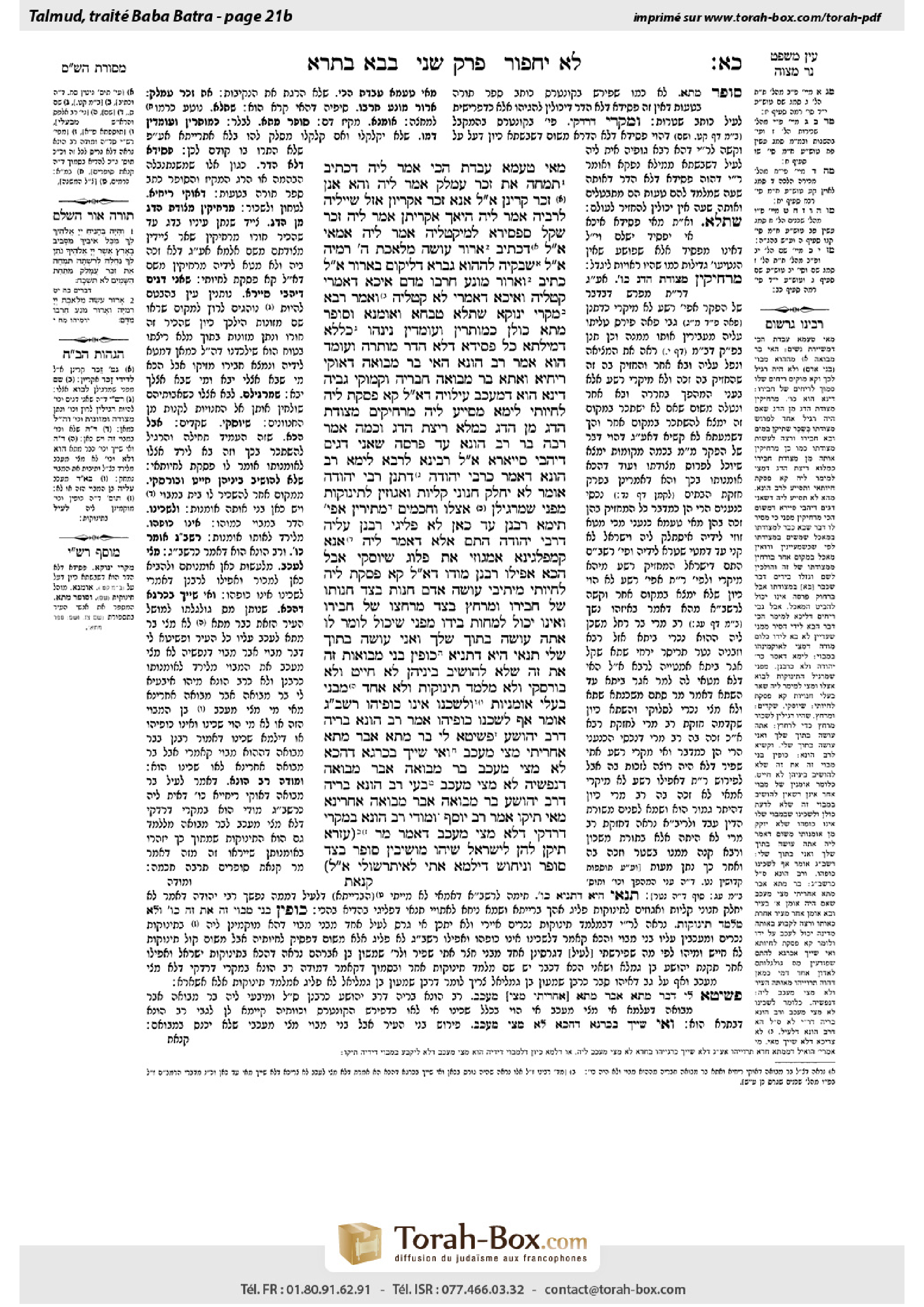
Bava Batra 21b: Talmud study for Daf Yomi
Study the Talmud for Daf Yomi with scanned pages, Hebrew text, English translations from Sefaria and AI-generated French translations.
Passage selection and English or AI-generated French translation are available where the scan has annotations. Daf Study is independent of Torah-Box and Sefaria.
Browse Bava Batra · בבא בתרא · All tractatesBava Batra 21b text and translations
This page of Bava Batra includes the Aramaic text, an English translation and an AI-generated French translation, alongside the scan above.
בבא בתרא כ״א ב · Aramaic and Hebrew text
מַאי טַעְמָא עֲבַדְתְּ הָכִי? אֲמַר לֵיהּ, דִּכְתִיב: ״תִּמְחֶה אֶת זְכַר עֲמָלֵק״. אֲמַר לֵיהּ: וְהָא אֲנַן ״זֵכֶר״ קָרֵינַן! אֲמַר לֵיהּ: אֲנָא ״זְכַר״ אַקְרְיוּן. אֲזַל שַׁיְילֵיהּ לְרַבֵּיהּ, אֲמַר לֵיהּ: הֵיאַךְ אַקְרִיתַן? אֲמַר לֵיהּ: ״זֵכֶר״.
שְׁקַל סַפְסִירָא לְמִיקְטְלֵיהּ. אֲמַר לֵיהּ: אַמַּאי? אֲמַר לֵיהּ, דִּכְתִיב: ״אָרוּר עֹשֶׂה מְלֶאכֶת ה׳ רְמִיָּה״. אֲמַר לֵיהּ: שִׁבְקֵיהּ לְהָהוּא גַּבְרָא דְּלֵיקוּם בְּאָרוּר! אֲמַר לֵיהּ, כְּתִיב: ״וְאָרוּר מֹנֵעַ חַרְבּוֹ מִדָּם״! אִיכָּא דְּאָמְרִי: קַטְלֵיהּ, וְאִיכָּא דְאָמְרִי: לָא קַטְלֵיהּ.
וְאָמַר רָבָא: מַקְרֵי יָנוֹקָא, שַׁתָּלָא, טַבָּחָא, וְאוּמָּנָא, וְסוֹפֵר מָתָא – כּוּלָּן כְּמוּתְרִין וְעוֹמְדִין נִינְהוּ. כְּלָלָא דְּמִילְּתָא: כׇּל פְּסֵידָא דְּלָא הָדַר – מוּתְרֶה וְעוֹמֵד הוּא.
אָמַר רַב הוּנָא: הַאי בַּר מְבוֹאָה דְּאוֹקִי רִיחְיָא, וַאֲתָא בַּר מְבוֹאָה חַבְרֵיהּ וְקָמוֹקֵי גַּבֵּיהּ – דִּינָא הוּא דִּמְעַכֵּב עִילָּוֵיהּ. דְּאָמַר לֵיהּ: קָא פָּסְקַתְּ לֵיהּ לְחַיּוּתִי.
לֵימָא מְסַיַּיע לֵיהּ: מַרְחִיקִים מְצוּדַת הַדָּג מִן הַדָּג – כִּמְלֹא רִיצַת הַדָּג. וְכַמָּה? אָמַר רַבָּה בַּר רַב הוּנָא: עַד פַּרְסָה. שָׁאנֵי דָּגִים, דְּיָהֲבִי סְיָיארָא.
אֲמַר לֵיהּ רָבִינָא לְרָבָא: לֵימָא רַב הוּנָא דְּאָמַר כְּרַבִּי יְהוּדָה – דִּתְנַן, רַבִּי יְהוּדָה אוֹמֵר: לֹא יְחַלֵּק חֶנְוָנִי קְלָיוֹת וֶאֱגוֹזִין לְתִינוֹקוֹת, מִפְּנֵי שֶׁמֵּרְגִילָן אֶצְלוֹ. וַחֲכָמִים מַתִּירִין.
אֲפִילּוּ תֵּימָא רַבָּנַן; עַד כָּאן לָא פְּלִיגִי רַבָּנַן עֲלֵיהּ דְּרַבִּי יְהוּדָה הָתָם – אֶלָּא דַּאֲמַר לֵיהּ: אֲנָא קָמְפַלֵּגְינָא אַמְגּוֹזֵי, אַתְּ פְּלוֹג שְׁיוּסְקֵי. אֲבָל הָכָא – אֲפִילּוּ רַבָּנַן מוֹדוּ, דַּאֲמַר לֵיהּ: קָא פָּסְקַתְּ לֵיהּ לְחַיּוּתִי.
מֵיתִיבִי: עוֹשֶׂה אָדָם חֲנוּת בְּצַד חֲנוּתוֹ שֶׁל חֲבֵירוֹ, וּמֶרְחָץ בְּצַד מֶרְחָצוֹ שֶׁל חֲבֵירוֹ; וְאֵינוֹ יָכוֹל לִמְחוֹת בְּיָדוֹ, מִפְּנֵי שֶׁיָּכוֹל לוֹמַר לוֹ: אַתָּה עוֹשֶׂה בְּתוֹךְ שֶׁלְּךָ, וַאֲנִי עוֹשֶׂה בְּתוֹךְ שֶׁלִּי!
תַּנָּאֵי הִיא, דְּתַנְיָא: כּוֹפִין בְּנֵי מְבוֹאוֹת זֶה אֶת זֶה – שֶׁלֹּא לְהוֹשִׁיב בֵּינֵיהֶן לֹא חַיָּיט, וְלֹא בּוּרְסְקִי, וְלֹא מְלַמֵּד תִּינוֹקוֹת, וְלֹא אֶחָד מִבְּנֵי בַּעֲלֵי אוּמָּנִיּוֹת; וְלִשְׁכֵנוֹ אֵינוֹ כּוֹפֵיהוּ. רַבָּן שִׁמְעוֹן בֶּן גַּמְלִיאֵל אוֹמֵר: אַף לִשְׁכֵנוֹ כּוֹפֵיהוּ.
אָמַר רַב הוּנָא בְּרֵיהּ דְּרַב יְהוֹשֻׁעַ: פְּשִׁיטָא לִי – בַּר מָתָא אַבַּר מָתָא אַחֲרִיתִי, מָצֵי מְעַכֵּב. וְאִי שָׁיֵיךְ בִּכְרָגָא דְּהָכָא, לָא מָצֵי מְעַכֵּב. בַּר מְבוֹאָה אַבַּר מְבוֹאָה דְּנַפְשֵׁיהּ – לָא מָצֵי מְעַכֵּב.
בָּעֵי רַב הוּנָא בְּרֵיהּ דְּרַב יְהוֹשֻׁעַ: בַּר מְבוֹאָה אַבַּר מְבוֹאָה אַחֲרִינָא, מַאי? תֵּיקוּ. אָמַר רַב יוֹסֵף: וּמוֹדֵי רַב הוּנָא בְּמַקְרֵי דַרְדְּקֵי – דְּלָא מָצֵי מְעַכֵּב, דְּאָמַר מָר: עֶזְרָא תִּיקֵּן לָהֶן לְיִשְׂרָאֵל שֶׁיְּהוּ מוֹשִׁיבִין סוֹפֵר בְּצַד סוֹפֵר.
וְנֵיחוּשׁ דִּילְמָא אָתֵי לְאִיתְרַשּׁוֹלֵי! אֲמַר לֵיהּ:
Bava Batra 21b · English translation
What is the reason that you did that? Why did you kill only the males? Joab said to him: As it is written: You shall blot out the males [zakhar] of Amalek, i.e., the male descendants of Amalek, who descend from Edom. David said to him: But we read the verse as stating: “You shall blot out the remembrance [zekher] of Amalek” (Deuteronomy 25:19). Joab said to him: I was taught to read it as zakhar. Joab went and asked his childhood Bible teacher. Joab said to him: How did you read this word to us? The teacher said to him: I read it as zekher. The teacher had read it the proper way, but he failed to notice that his student had learned it incorrectly.
Joab took a sword to kill him. The teacher said to him: Why do you want to kill me? Joab said to him: As it is written: “Cursed is he who does the work of the Lord with a slack hand” (Jeremiah 48:10), and you taught me incorrectly. The teacher said to him: Leave that man to remain as cursed. This is a sufficient punishment; there is no need to kill me. Joab said to him: It is also written: “And cursed is he who keeps back his sword from blood” (Jeremiah 48:10). There are those who say that Joab killed him, and there are those who say that he did not kill him. In any event, this episode demonstrates that an error learned in one’s childhood stays with him his whole life.
And Rava says: With regard to a teacher of children, a professional tree planter, a butcher, a bloodletter, and a town scribe, all these are considered forewarned. In other words, they need not be exhorted to perform their jobs correctly, as if they err in the performance of their duties they can be dismissed immediately. The principle of the matter is: With regard to any case where loss is irreversible, the individual is considered forewarned.
§ Rav Huna said: There was a certain resident of an alleyway who set up a mill in the alleyway and earned his living grinding grain for people. And subsequently another resident of the alleyway came and set up a mill next to his. The halakha is that the first one may prevent him from doing so if he wishes, as he can say to him: You are disrupting my livelihood by taking my customers.
The Gemara suggests: Let us say that a baraita supports his opinion: One must distance fish traps from fish, i.e., from other fish traps, as far as the fish travels, i.e., the distance from which the fish will travel. The Gemara asks: And how much is this distance? Rabba bar Rav Huna says: Up to a parasang [parsa]. This indicates that one must distance himself from the place where another has established his business. The Gemara responds that this is no proof: Perhaps fish are different, as they look around. One fish explores the area ahead of the others, indicating to them where to go. Once they encounter the first trap they will not approach the second.
Ravina said to Rava: Shall we say that Rav Huna spoke in accordance with the opinion of Rabbi Yehuda? As we learned in a mishna (Bava Metzia 60a): Rabbi Yehuda says: A storekeeper may not hand out toasted grain and nuts to children who patronize his store, due to the fact that he thereby accustoms them to come to him at the expense of competing storekeepers. And the Rabbis permit doing so. This indicates that according to the opinion of Rabbi Yehuda, all forms of competition are prohibited, which would include the scenario concerning the mill.
The Gemara rejects this suggestion: You may even say that Rav Huna holds in accordance with the opinion of the Rabbis. The Rabbis disagree with Rabbi Yehuda only there, as the storekeeper can say to his competitor: If I distribute walnuts, you can distribute almonds [shiyuskei]. But here, with regard to a resident of an alleyway who sets up a mill in that alleyway where another mill already exists, even the Rabbis concede that the owner of the first mill can say to him: You are disrupting my livelihood, as beforehand whoever required grinding came to me, and you have provided them with another option.
The Gemara raises an objection from a baraita: A man may establish a shop alongside the shop of another, and a bathhouse alongside the bathhouse of another, and the other cannot protest, because the newcomer can say to him: You operate in your space, and I operate in my space.
The Gemara answers: This entire matter is a dispute between tanna’im, as it is taught in a baraita: The residents of an alleyway can compel one another to agree not to allow among them in that alleyway a tailor, a tanner, a teacher of children, nor any type of craftsman. They can bar outside craftsmen from plying their trade in that alleyway. But one cannot compel his neighbor, i.e., one who already lives in the alleyway, to refrain from practicing a particular occupation there. Rabban Shimon ben Gamliel says: One can even compel his neighbor not to conduct such work in the alleyway. Rav Huna holds in accordance with the opinion of Rabban Shimon ben Gamliel.
Rav Huna, son of Rav Yehoshua, says: It is obvious to me that a resident of one town can prevent a resident of another town from establishing a similar business in the locale of the first individual. But if he pays the tax of that first town, he cannot prevent him from doing business there, as he too is considered a resident of the town. The resident of an alleyway cannot prevent a resident of his alleyway from practicing a particular trade there, in accordance with the opinion of the Rabbis in the baraita, and contrary to the opinion of Rabban Shimon ben Gamliel.
With these conclusions in mind, Rav Huna, son of Rav Yehoshua, raises a dilemma: With regard to a resident of one alleyway protesting about a resident of another alleyway conducting business there, what is the halakha? No answer was found, and the Gemara states that the dilemma shall stand unresolved. Rav Yosef said: And Rav Huna, who said that a resident of an alleyway can prevent another from setting up an additional mill, concedes with regard to those who teach children that one cannot prevent him from working, as the Master said: Ezra instituted an ordinance for the Jewish people requiring that they establish one teacher alongside another teacher, to raise the standard of teaching.
The Gemara challenges: And let us be concerned lest the teachers will thereby come to be negligent. Rav Yosef said to the Sage who raised this objection:
Bava Batra 21b · Traduction française (IA)
Quelle est la raison pour laquelle tu as fait cela ? Pourquoi as-tu tué seulement les mâles ? Joab répondit à lui : Comme il est écrit : « Tu éradiques les mâles [zakhar] d'Amalék », c'est-à-dire les descendants mâles d'Amalék, qui descendent d'Édom. David répondit à lui : Mais nous lisons la versette comme disant : « Tu éradiques la mémoire [zekher] d'Amalék » (Deutéronome 25:19). Joab répondit à lui : J'ai appris à le lire comme zakhar. Joab alla demander à son maître de Bible d'enfance. Joab dit à lui : Comment as-tu lu ce mot pour nous ? Le maître répondit à lui : J'ai lu comme zekher. Le maître avait lu correctement, mais il n'avait pas remarqué que son élève avait appris de manière erronée.
Joab prit une épée pour le tuer. Le maître dit à lui : Pourquoi veux-tu me tuer ? Joab répondit à lui : Comme il est écrit : « Maudit soit celui qui fait le travail du Seigneur avec une main lâche » (Jérémie 48:10), et tu m'as appris de manière erronée. Le maître dit à lui : Laisse cet homme rester maudit. C'est une punition suffisante ; il n'y a pas besoin de me tuer. Joab répondit à lui : Il est aussi écrit : « Et maudit soit celui qui retient son épée de sang » (Jérémie 48:10). Certains disent que Joab l'a tué, d'autres disent qu'il ne l'a pas tué. En tout cas, cet épisode montre que l'erreur apprise dans l'enfance reste avec une personne toute sa vie.
Et Rava dit : En ce qui concerne un maître d'enfants, un professionnel qui plante des arbres, un boucher, un saigneur, et un scribe de ville, tous ces individus sont considérés comme avertis. En d'autres termes, ils n'ont pas besoin d'être exhortés à accomplir correctement leurs tâches, car s'ils commettent une erreur dans l'exécution de leurs fonctions, ils peuvent être immédiatement licenciés. Le principe de la question est : En ce qui concerne toute situation où la perte est irréversible, l'individu est considéré comme averti.
§ Rav Huna dit : Il y avait un résident d'un passage qui a installé une meule dans le passage et a gagné sa vie en meulant du grain pour les gens. Et ensuite un autre résident du passage est venu et a installé une meule à côté de la sienne. La halakha est que le premier peut empêcher cela s'il le souhaite, car il peut dire à lui : Tu perturbes mon revenu en prenant mes clients.
La Guemara suggère : Disons qu'une baraïta soutient son opinion : On doit éloigner les filets de pêche des poissons, c'est-à-dire des autres filets de pêche, à la distance que les poissons peuvent parcourir, c'est-à-dire la distance à partir de laquelle les poissons se déplaceront. La Guemara demande : Et quelle est cette distance ? Rabba bar Rav Huna dit : Jusqu'à un parasang [parsa]. Cela indique qu'on doit s'éloigner du lieu où un autre a établi son commerce. La Guemara répond que cela n'est pas une preuve : Peut-être les poissons sont différents, car ils regardent autour d'eux. Un poisson explore l'aire avant les autres, indiquant à ceux-ci où aller. Une fois qu'ils rencontrent la première embuscade, ils ne s'approcheront pas de la seconde.
Ravina dit à Rava : Devons-nous dire que Rav Huna a parlé selon l'opinion de Rabbi Yehuda ? Comme nous avons appris dans une mitsva (Bava Metzia 60a) : Rabbi Yehuda dit : Un marchand ne doit pas distribuer du grain grillé et des noix aux enfants qui fréquentent son magasin, car cela l'habitue à venir chez lui au détriment des marchands concurrents. Et les Rabbins permettent cela. Cela indique que selon l'opinion de Rabbi Yehuda, toutes les formes de concurrence sont interdites, ce qui inclurait la situation concernant la meule.
La Guemara rejette cette suggestion : On peut même dire que Rav Huna suit l'opinion des Rabbins. Les Rabbins s'opposent à Rabbi Yehuda uniquement dans ce cas précis, car le marchand peut dire à son concurrent : Si je distribue des noix, tu peux distribuer des amandes [shiyuskei]. Mais ici, concernant un résident d'un passage qui installe une meule dans ce passage où une autre meule existe déjà, même les Rabbins reconnaissent que le propriétaire de la première meule peut dire à l'autre : Tu perturbes mon revenu, car avant, ceux qui avaient besoin de meuler venaient chez moi, et tu as offert à ceux-ci une autre option.
La Guemara soulève une objection tirée d'une baraïta : Un homme peut établir un magasin à côté du magasin d'un autre, et un bain à côté du bain d'un autre, et l'autre ne peut pas protester, car le nouveau venu peut dire à lui : Tu opères dans ton espace, et je opère dans le mien.
La Guemara répond : Cette affaire entière est un débat entre les tannaïm, car il est enseigné dans une baraïta : Les résidents d'un passage peuvent obliger les uns les autres à convenir de ne pas permettre dans ce passage un tailleur, un tannant, un maître d'enfants, ni aucun type d'artisan. Ils peuvent interdire aux artisans extérieurs de pratiquer leur métier dans ce passage. Mais on ne peut obliger son voisin, c'est-à-dire celui qui vit déjà dans le passage, à s'abstenir de pratiquer une occupation particulière là. Rabban Shimon ben Gamliel dit : On peut même obliger son voisin à ne pas pratiquer ce travail dans le passage. Rav Huna suit l'opinion de Rabban Shimon ben Gamliel.
Rav Huna, fils de Rav Yehoshua, dit : Il me semble évident qu'un résident d'une ville peut empêcher un résident d'une autre ville d'établir un commerce similaire dans le lieu du premier individu. Mais s'il paie l'impôt de cette première ville, il ne peut pas l'empêcher de faire ce commerce là, car il est considéré comme un résident de la ville. Le résident d'un passage ne peut pas empêcher un résident de son passage de pratiquer un métier particulier là, selon l'opinion des Rabbins dans la baraïta, et contrairement à l'opinion de Rabban Shimon ben Gamliel.
Avec ces conclusions en tête, Rav Huna, fils de Rav Yéhoshua, pose un dilemme : concernant un résident d'un couloir qui proteste contre un résident d'un autre couloir qui y exerce son commerce, quelle est la halakha ? Aucune réponse n'a été trouvée, et la Guemara indique que ce dilemme restera sans solution. Rav Yosef dit : Et Rav Huna, qui affirmait qu'un résident d'un couloir peut empêcher un autre de construire un autre moulin, reconnaît concernant ceux qui enseignent aux enfants qu'on ne peut pas l'empêcher de travailler, car le Maître a dit : Ezra a institué un décret pour le peuple juif exigeant qu'ils établissent un enseignant à côté d'un autre enseignant, afin d'augmenter le niveau de l'enseignement.
La Guemara soulève un défi : et craignons que les enseignants ne deviennent ainsi négligents. Rav Yosef dit au sage qui a soulevé cette objection :
Traduction française générée par IA à partir de l’édition anglaise de Sefaria. Vérifie toujours un passage avec le texte source.
Text from Sefaria: William Davidson Edition - Vocalized Aramaic (CC BY NC); William Davidson Edition - English (CC BY NC).