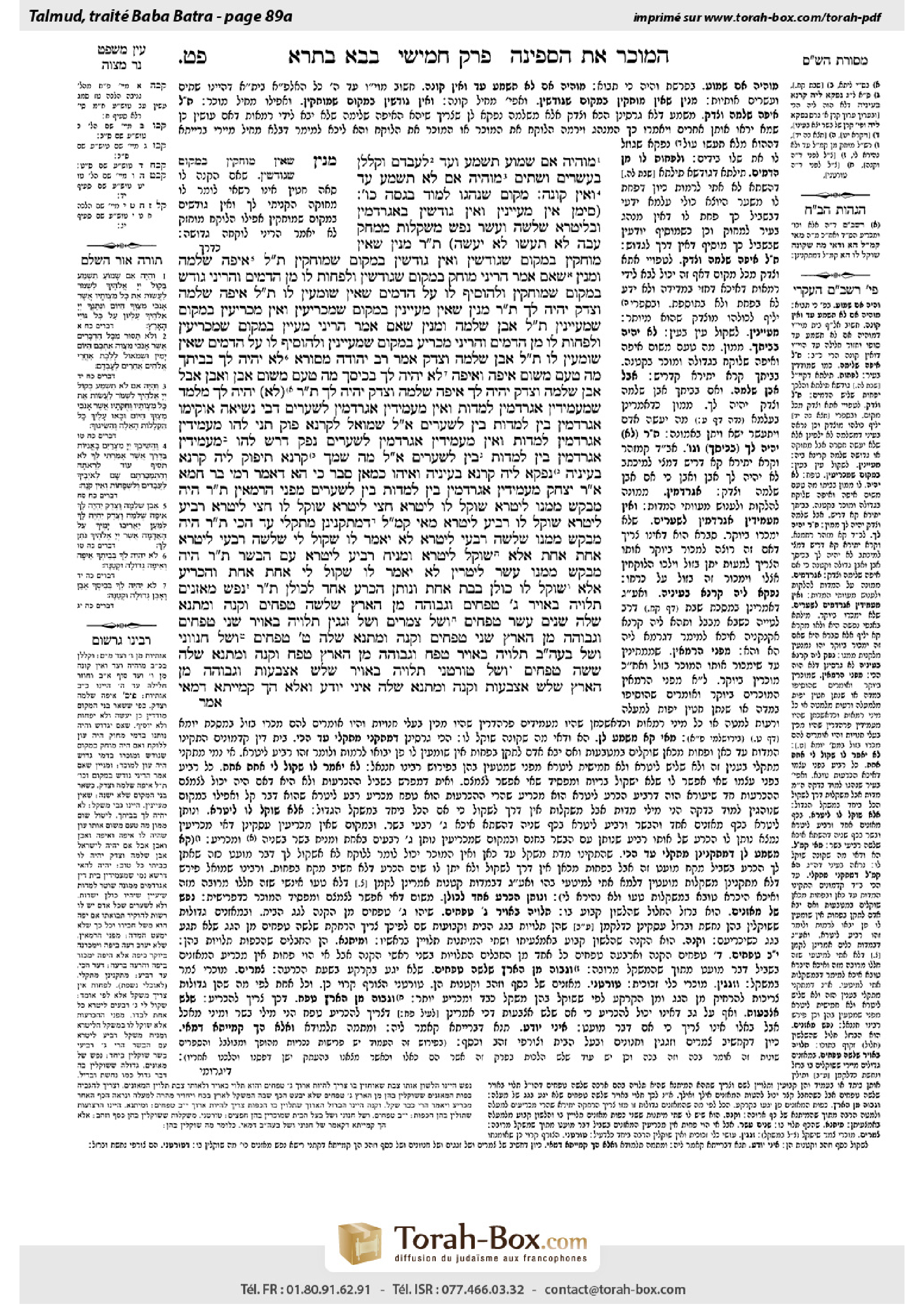
Bava Batra 89a: Talmud study for Daf Yomi
Study the Talmud for Daf Yomi with scanned pages, Hebrew text, English translations from Sefaria and AI-generated French translations.
Passage selection and English or AI-generated French translation are available where the scan has annotations. Daf Study is independent of Torah-Box and Sefaria.
Browse Bava Batra · בבא בתרא · All tractatesBava Batra 89a text and translations
This page of Bava Batra includes the Aramaic text, an English translation and an AI-generated French translation, alongside the scan above.
בבא בתרא פ״ט א · Aramaic and Hebrew text
מִ״וְּהָיָה אִם שָׁמוֹעַ תִּשְׁמַע״, וְעַד ״לְעׇבְדָם״; וְקִלְּלָן בְּעֶשְׂרִים וּשְׁתַּיִם – מִ״וְּהָיָה אִם לֹא תִשְׁמַע״ עַד ״וְאֵין קֹנֶה״.
מָקוֹם שֶׁנָּהֲגוּ לָמוֹד בְּגַסָּה כּוּ׳. (סִימָן: אֵין מְעַיְּינִין, וְאֵין גּוֹדְשִׁין, בַּאֲגַרְדְּמִין, וּבְלִיטְרָא, שְׁלֹשָׁה, וָעֶשֶׂר, נֶפֶשׁ, מִשְׁקָלוֹת, מִמֶּחָק, עָבֶה, לֹא תַעֲשׂוּ, לֹא יַעֲשֶׂה.)
תָּנוּ רַבָּנַן: מִנַּיִן שֶׁאֵין מוֹחֲקִין בִּמְקוֹם שֶׁגּוֹדְשִׁין, וְאֵין גּוֹדְשִׁין בִּמְקוֹם שֶׁמּוֹחֲקִין? תַּלְמוּד לוֹמַר: ״אֵיפָה שְׁלֵמָה״.
וּמִנַּיִן שֶׁאִם אָמַר: הֲרֵינִי מוֹחֵק בִּמְקוֹם שֶׁגּוֹדְשִׁין – וְלִפְחוֹת לוֹ מִן הַדָּמִים, וַהֲרֵינִי גּוֹדֵשׁ בִּמְקוֹם שֶׁמּוֹחֲקִין – וּלְהוֹסִיף לוֹ עַל הַדָּמִים; שֶׁאֵין שׁוֹמְעִין לוֹ? תַּלְמוּד לוֹמַר: ״אֵיפָה שְׁלֵמָה וָצֶדֶק יִהְיֶה לָּךְ״.
תָּנוּ רַבָּנַן: מִנַּיִן שֶׁאֵין מְעַיְּינִין בִּמְקוֹם שֶׁמַּכְרִיעִין, וְאֵין מַכְרִיעִין בִּמְקוֹם שֶׁמְּעַיְּינִין? תַּלְמוּד לוֹמַר: ״אֶבֶן שְׁלֵמָה״.
וּמִנַּיִן שֶׁאִם אָמַר: הֲרֵינִי מְעַיֵּין בִּמְקוֹם שֶׁמַּכְרִיעִין – וְלִפְחוֹת לוֹ מִן הַדָּמִים, וַהֲרֵינִי מַכְרִיעַ בִּמְקוֹם שֶׁמְּעַיְּינִין – וּלְהוֹסִיף לוֹ עַל הַדָּמִים; שֶׁאֵין שׁוֹמְעִין לוֹ? תַּלְמוּד לוֹמַר: ״אֶבֶן שְׁלֵמָה וָצֶדֶק״.
אָמַר רַב יְהוּדָה מִסּוּרָא: ״לֹא יִהְיֶה לְךָ בְּבֵיתְךָ״ – מָה טַעַם? מִשּׁוּם ״אֵיפָה וְאֵיפָה״.
״לֹא יִהְיֶה לְךָ בְּכִיסְךָ״ – מָה טַעַם? מִשּׁוּם ״אֶבֶן וָאָבֶן״. אֲבָל ״אֶבֶן שְׁלֵמָה וָצֶדֶק יִהְיֶה לָּךְ, אֵיפָה שְׁלֵמָה וָצֶדֶק יִהְיֶה לָּךְ״.
תָּנוּ רַבָּנַן: ״(לֹא) יִהְיֶה לְךָ״ – מְלַמֵּד שֶׁמַּעֲמִידִין אֲגַרְדְּמִין לַמִּדּוֹת, וְאֵין מַעֲמִידִין אֲגַרְדְּמִין לַשְּׁעָרִים. דְּבֵי נְשִׂיאָה אוֹקִימוּ אֲגַרְדְּמִין בֵּין לַמִּדּוֹת בֵּין לַשְּׁעָרִים, אֲמַר לֵיהּ שְׁמוּאֵל לְקַרְנָא: פּוֹק תְּנִי לְהוּ: מַעֲמִידִין אֲגַרְדְּמִין לַמִּדּוֹת, וְאֵין מַעֲמִידִין אֲגַרְדְּמִין לַשְּׁעָרִים.
נְפַק דְּרַשׁ לְהוּ: מַעֲמִידִין אֲגַרְדְּמִין בֵּין לַמִּדּוֹת בֵּין לַשְּׁעָרִים. אֲמַר לֵיהּ: מָה שְׁמָךְ? קַרְנָא. תִּיפּוֹק לֵיהּ קַרְנָא בְּעֵינֵיהּ. נְפַקָא לֵיהּ קַרְנָא בְּעֵינֵיהּ. וְאִיהוּ כְּמַאן סָבַר? כִּי הָא דְּאָמַר רָמֵי בַּר חָמָא אָמַר רַבִּי יִצְחָק: מַעֲמִידִין אֲגַרְדְּמִין בֵּין לַמִּדּוֹת בֵּין לַשְּׁעָרִים, מִפְּנֵי הָרַמָּאִין.
תָּנוּ רַבָּנַן: הָיָה מְבַקֵּשׁ מִמֶּנּוּ לִיטְרָא – שׁוֹקֵל לוֹ לִיטְרָא. חֲצִי לִיטְרָא – שׁוֹקֵל לוֹ חֲצִי לִיטְרָא. רְבִיעַ לִיטְרָא – שׁוֹקֵל לוֹ רְבִיעַ לִיטְרָא. מַאי קָא מַשְׁמַע לַן? דִּמְתַקְּנִינַן מַתְקָלֵי עַד הָכִי.
תָּנוּ רַבָּנַן: הָיָה מְבַקֵּשׁ מִמֶּנּוּ שְׁלֹשָׁה רִבְעֵי לִיטְרָא, לֹא יֹאמַר לוֹ: שְׁקוֹל לִי שְׁלֹשָׁה רִבְעֵי לִיטְרָא אַחַת אַחַת. אֶלָּא שׁוֹקֵל לִיטְרָא, וּמַנִּיחַ רְבִיעַ לִיטְרָא עִם הַבָּשָׂר.
תָּנוּ רַבָּנַן: הָיָה מְבַקֵּשׁ מִמֶּנּוּ עֶשֶׂר לִיטְרִין, לֹא יֹאמַר לוֹ: שְׁקוֹל לִי אַחַת אַחַת וְהַכְרִיעָהּ; אֶלָּא שׁוֹקֵל לוֹ כּוּלָּן בְּבַת אַחַת, וְנוֹתֵן הֶכְרֵעַ אֶחָד לְכוּלָּן.
תָּנוּ רַבָּנַן: נֶפֶשׁ מֹאזְנַיִם – תְּלוּיָה בָּאֲוִיר שְׁלֹשָׁה טְפָחִים, וּגְבוֹהָה מִן הָאָרֶץ שְׁלֹשָׁה טְפָחִים, וְקָנֶה וּמִתְנָא שֶׁלָּהּ שְׁנֵים עָשָׂר טְפָחִים. וְשֶׁל צַמָּרִים וְשֶׁל זַגָּגִין – תְּלוּיָה בָּאֲוִיר שְׁנֵי טְפָחִים, וּגְבוֹהָה מִן הָאָרֶץ שְׁנֵי טְפָחִים, וְקָנֶה וּמִתְנָא שֶׁלָּהּ תִּשְׁעָה טְפָחִים.
וְשֶׁל חֶנְווֹנִי וְשֶׁל בַּעַל הַבַּיִת – תְּלוּיָה בָּאֲוִיר טֶפַח, וּגְבוֹהָה מִן הָאָרֶץ טֶפַח, וְקָנֶה וּמִתְנָא שֶׁלָּהּ שִׁשָּׁה טְפָחִים. וְשֶׁל טוּרְטָנִי – תְּלוּיָה בָּאֲוִיר שָׁלֹשׁ אֶצְבָּעוֹת, וּגְבוֹהָה מִן הָאָרֶץ שָׁלֹשׁ אֶצְבָּעוֹת, וְקָנֶה וּמִתְנָא שֶׁלָּהּ אֵינִי יוֹדֵעַ.
וְאֶלָּא הָךְ קַמַּיְיתָא – דְּמַאי?
Bava Batra 89a · English translation
from the letter vav that begins the verse: “And it shall come to pass [vehaya], if you shall hearken diligently” (Deuteronomy 28:1), until: “To serve them [le’ovdam]” (Deuteronomy 28:14), which ends with the letter mem. And he cursed them with twenty-two letters, from the letter vav that begins the verse: “But it shall come to pass [vehaya], if you will not hearken to the voice of the Lord” (Deuteronomy 28:15), until: “And no man shall buy [koneh]” (Deuteronomy 28:68). This verse ends with a letter heh, which comes just before vav in the alphabet. Starting with a vav and ending with a heh encompasses the twenty-two letters of the alphabet.
§ The mishna teaches that in a place where they were accustomed to measure with one large measuring vessel, one may not measure with several small measuring vessels. In a place where the custom is to level the top of the measuring vessel to remove substances heaped above its edges, one may not heap it; and where they are accustomed to heap it, one may not level it. The Gemara provides a mnemonic for the ensuing halakhot: One may not balance with precision; and one may not heap it; with market inspectors [ba’agardamin]; and with a litra; three; and ten; fulcrum; weights; a thick leveler; you may not do; one may not do.
The Sages taught: From where is it derived that one may not level a measuring vessel in a place where they are accustomed to heap it and that one may not heap it in a place where they are accustomed to level it? The verse states: “A perfect weight” (Deuteronomy 25:15), which indicates that one must use whatever is considered a perfect measuring vessel in that locale, as this ensures that there is no deception or trickery.
And from where is it derived that if the seller said in a place where they heap: I am hereby leveling and am willing in exchange to reduce the price for you, or said, in a place where they level: I am hereby heaping and am willing to increase the price for you, that the court does not listen to him? The verse states: “A perfect and just weight you shall have” (Deuteronomy 25:15). The addition of the term “just,” beyond the requirement that the weight be “perfect,” teaches that one must keep his weights in a just manner, i.e., that employed by the people of that locale.
The Sages taught: From where is it derived that one may not balance a scale so that it will balance with precision [me’ayyenin] in a place where they are accustomed to let the scales tilt a handbreadth for the benefit of the buyer, and that one may not let the scales tilt a handbreadth in a place where they are accustomed to balance with precision? The verse states: “A perfect weight” (Deuteronomy 25:15), which teaches that the weight must be considered perfect in that locale.
And from where is it derived that if a seller said, in a place where it is the custom to let the scales tilt a handbreadth: I am hereby balancing with precision and am willing to reduce the price for the buyer; or, in a place where it is the custom to balance with precision: I am hereby letting the scales tilt a handbreadth and am willing to increase the price for the buyer, that the court does not listen to him? The verse states: “A perfect and just weight” (Deuteronomy 25:15), which teaches that the just way of acting is to weigh in accordance with the practice in that locale.
Rav Yehuda of Sura says a homiletic interpretation of the phrase: “You shall not have in your house diverse measures” (Deuteronomy 25:14): “You shall not have in your house” means that you will become a pauper, who has nothing in his house. What is the reason for this? It is due to the fact that you used diverse measures, buying with a large vessel and selling with a small one.
The phrase: “You shall not have in your purse diverse weights” (Deuteronomy 25:13), is interpreted in a similar fashion: “You shall not have in your purse,” i.e., you will become a pauper, who has nothing in his purse. What is the reason for this? It is due to the fact that you used diverse weights. But if you possess only “a perfect and just weight,” then “you shall have” wealth. Likewise, if you possess only “a perfect and just measure,” then “you shall have” wealth.
§ The Sages taught that the phrase: “You shall not have,” teaches that the court appoints market inspectors to supervise the accuracy of measures. The Gemara infers: But the court does not appoint market inspectors for supervising market prices. The Gemara relates: The house of the Nasi appointed market inspectors for supervising both measures and prices. Shmuel said to his student, the Sage Karna: Go out and teach them that one appoints market inspectors for supervising measures but one does not appoint market inspectors for prices.
Karna went out and taught them that one appoints market inspectors for supervising both measures and prices. Shmuel, hearing what he had done, said to him: What is your name? He replied: Karna. Shmuel said: Let a horn [karna] emerge in his eye. A horn, i.e., a growth of flesh, emerged in his eye. The Gemara asks: And Karna, in accordance with whose opinion did he hold, which led him to disregard his teacher’s statement? He held in accordance with that which Rami bar Ḥama says that Rabbi Yitzḥak says: One appoints market inspectors for supervising both measures and prices, due to swindlers, to prevent people from using smaller measures or from selling at a steep price while falsely claiming that they are selling superior-quality merchandise.
The Gemara discusses several halakhot related to the cases of the mishna. The Sages taught: If the buyer requested from the seller a litra of a specific item, he weighs for him using a litra weight. If he asks for half a litra, he weighs for him using a half-litra weight. If he wants one-quarter of a litra, he weighs for him using a quarter-litra weight. The Gemara asks: Isn’t this obvious? What is this baraita teaching us? The Gemara explains: It teaches that one sets weights until this amount, one-quarter of a litra, but not less. If a buyer asks the seller to weigh a smaller amount for him, his request is not granted.
Furthermore, the Sages taught: If the buyer requested from him three-quarters of a litra, and there is no weight equal to this amount, the buyer may not say to him: Weigh for me three units using a quarter-litra weight, one by one, so that the seller lets the scales tilt by a handbreadth as he measures each quarter-litra weight. Rather, he weighs the merchandise all at once, as he places a litra weight on one pan of the scale, and places on the other pan of the scale a quarter-litra weight together with the meat that is being sold.
The Sages likewise taught: In a case where the buyer requested from the seller ten litra of merchandise, the buyer may not say to him: Weigh for me each litra one by one, and let the scales tilt each time, as on every occasion that the seller does this the buyer receives more than that for which he paid. Rather, he weighs all the merchandise at the same time and lets the scales tilt once for all the merchandise.
§ The Sages taught: The fulcrum of a scale must be suspended in the air so that the point the lever goes through it is at a distance of three handbreadths from the ceiling, and the pans of the scale must be three handbreadths above the ground. And the scale’s lever and cord, from which each pan is suspended, must be twelve handbreadths long. And the fulcrum of a scale of wool-weavers and glassmakers must be suspended in the air at a distance of two handbreadths from the ceiling, and the pans of the scale must be two handbreadths above the ground. And its lever and cord must be nine handbreadths long.
And the fulcrum of a scale of a storekeeper and of a homeowner must be suspended in the air at a distance of one handbreadth from the ceiling, and the pans of the scale must be one handbreadth above the ground. And its lever and cord must be six handbreadths long. And the fulcrums of small scales [turtanei] used for weighing gold and silver must be suspended in the air at a distance of three fingerbreadths from the ceiling, and the pans of the scales must be three fingerbreadths above the ground. The tanna continues: But with regard to its lever and cord, I do not know their required length.
Since the function of each type of balance scale is mentioned with the exception of the first type, the Gemara asks: And that large balance scale, which is mentioned first, for what is it used?
Bava Batra 89a · Traduction française (IA)
de la lettre vav qui commence la verset: « Et il arrivera [vehaya], si tu écouteras attentivement » (Deutéronome 28:1), jusqu'à: « Pour les servir [le’ovdam] » (Deutéronome 28:14), qui se termine avec la lettre mem. Et il les a maudits avec vingt-deux lettres, du lettre vav qui commence la verset: « Mais il arrivera [vehaya], si tu n'écoutes pas la voix du Seigneur » (Deutéronome 28:15), jusqu'à: « Et personne ne pourra acheter [koneh] » (Deutéronome 28:68). Ce verset se termine avec la lettre heh, qui vient juste avant vav dans l'alphabet. Commencer avec un vav et finir avec un heh englobe les vingt-deux lettres de l'alphabet.
§ La mitsva enseigne que dans un lieu où ils étaient habitués à mesurer avec un seul récipient grand, on ne peut pas mesurer avec plusieurs récipients petits. Dans un lieu où la coutume est de niveler le bord du récipient pour enlever les substances empilées au-dessus de ses bords, on ne peut pas empiler ; et où ils sont habitués à empiler, on ne peut pas niveler. La Guemara fournit un mnémonique pour les halakhot suivantes : On ne peut pas équilibrer avec précision ; et on ne peut pas empiler ; avec les inspecteurs de marché [ba’agardamin] ; avec un litra ; trois ; dix ; levier ; poids ; un nivelleur épais ; tu ne dois pas faire ; on ne doit pas faire.
Les Sages enseignent : D'où est tiré que l'on ne peut pas niveler un récipient de mesure dans un lieu où ils sont habitués à empiler et que l'on ne peut pas empiler dans un lieu où ils sont habitués à niveler ? La verset dit : « Un poids parfait » (Deutéronome 25:15), ce qui indique qu'on doit utiliser ce qui est considéré comme un récipient de mesure parfait dans ce lieu, car cela assure qu'il n'y a pas de tromperie ou de tricherie.
D'où est-il tiré que si le vendeur dit dans un lieu où ils empilent : « Je nivelle ici et je suis prêt à réduire le prix pour vous », ou dit dans un lieu où ils nivellent : « Je m'empile ici et je suis prêt à augmenter le prix pour vous », la cour n'écoute pas ce qu'il dit ? La versette dit : « Un poids parfait et juste » (Deutéronome 25:15). L'ajout du terme « juste », au-delà de la nécessité que le poids soit « parfait », enseigne que l'on doit garder ses poids dans un mode juste, c'est-à-dire celui utilisé par les habitants de ce lieu.
Les Sages enseignent : D'où est-il tiré que l'on ne peut pas équilibrer une balance de manière précise dans un lieu où les gens sont habitués à laisser la balance pencher d'un tefach pour le bénéfice de l'acheteur, et que l'on ne peut pas laisser la balance pencher d'un tefach dans un lieu où les gens sont habitués à équilibrer avec précision ? La versette dit : « Un poids parfait » (Deutéronome 25:15), ce qui enseigne que le poids doit être considéré comme parfait dans ce lieu.
D'où est-il tiré que si un vendeur dit, dans un lieu où la coutume est de laisser la balance pencher d'un tefach : « Je balance ici avec précision et je suis prêt à réduire le prix pour l'acheteur », ou, dans un lieu où la coutume est de balancer avec précision : « Je laisse la balance pencher d'un tefach ici et je suis prêt à augmenter le prix pour l'acheteur », la cour n'écoute pas ce qu'il dit ? La versette dit : « Un poids parfait et juste » (Deutéronome 25:15), ce qui enseigne que la manière juste d'agir est de peser selon la pratique de ce lieu.
Rav Yehuda de Sura dit une interprétation allégorique de la phrase : « Tu n'auras pas dans ta maison des mesures diverses » (Deutéronome 25:14) : « Tu n'auras pas dans ta maison » signifie que tu deviendras un pauvre, qui n'a rien dans sa maison. Quelle est la raison de cela ? C'est en raison du fait que tu as utilisé des mesures diverses, achetant avec un récipient grand et vendant avec un récipient petit.
La phrase : « Tu n'auras pas dans ton sac des poids divers » (Deutéronome 25:13), est interprétée de manière similaire : « Tu n'auras pas dans ton sac », c'est-à-dire que tu deviendras un pauvre, qui n'a rien dans son sac. Quelle est la raison de cela ? C'est en raison du fait que tu as utilisé des poids divers. Mais si tu possèdes seulement « un poids parfait et juste », alors « tu auras » de la richesse. De même, si tu possèdes seulement « une mesure parfait et juste », alors « tu auras » de la richesse.
§ Les Sages enseignent que la phrase : « Tu n'auras pas », enseigne que la cour désigne des inspecteurs de marché pour surveiller la précision des mesures. La Guemara déduit : Mais la cour ne désigne pas d'inspecteurs de marché pour surveiller les prix du marché. La Guemara rapporte : La maison du Nasi désigna des inspecteurs de marché pour surveiller à la fois les mesures et les prix. Shmuel dit à son élève, le Sage Karna : Sortez et enseignez-leur que l'on désigne des inspecteurs de marché pour surveiller les mesures mais pas pour les prix.
Karna sortit et enseigna qu'on désigne des inspecteurs de marché pour surveiller à la fois les mesures et les prix. Shmuel, après avoir entendu ce qu'il avait fait, lui demanda : Quel est ton nom ? Il répondit : Karna. Shmuel dit : Qu'un corne émerge dans son œil. Un corne, c'est-à-dire une croissance de chair, émerge dans son œil. La Guemara pose la question : Et Karna, selon l'opinion de qui était-il, qui l'a conduit à ignorer l'avis de son maître ? Il suivait l'opinion de Rami bar Ḥama, qui dit que Rabbi Yitzḥak a dit : On désigne des inspecteurs de marché pour surveiller à la fois les mesures et les prix, en raison des escrocs, afin d'empêcher les gens d'utiliser des mesures plus petites ou de vendre à un prix élevé tout en prétendant vendre des marchandises de meilleure qualité.
La Guemara discute plusieurs halakhot liées aux cas de la mitsna. Les Sages enseignent : Si l'acheteur demande au vendeur un litra d'un objet spécifique, il pèse pour lui avec un poids de litra. Si il demande la moitié d'un litra, il pèse pour lui avec un poids de demi-litra. Si il veut un quart d'un litra, il pèse pour lui avec un poids de quart-litra. La Guemara pose la question : Ce n'est pas évident ? Quel est ce baraïta qui nous enseigne ? La Guemara explique : Il enseigne qu'on ajuste les poids jusqu'à ce montant, un quart de litra, mais pas moins. Si un acheteur demande au vendeur de peser une quantité plus petite pour lui, sa demande n'est pas acceptée.
De plus, les Sages ont enseigné : Si l'acheteur demande à l'acheteur trois-quarts de litra, et qu'il n'y ait pas de poids égal à cette quantité, l'acheteur ne peut pas dire au vendeur : Pèse-moi trois unités en utilisant un poids de quart de litra, un par un, de sorte que le vendeur laisse les balances pencher d'un tefach à chaque fois qu'il pèse chaque poids de quart de litra. Au contraire, il pèse le produit d'un seul coup, en plaçant un poids de litra sur un plateau des balances et en plaçant sur l'autre plateau un poids de quart de litra avec la viande qui est vendue.
Les Sages ont également enseigné : Dans le cas où l'acheteur demande au vendeur dix litra de marchandise, l'acheteur ne peut pas dire au vendeur : Pèse-moi chaque litra un par un, et laisse les balances pencher à chaque fois, car chaque fois que le vendeur fait cela, l'acheteur reçoit plus que ce qu'il a payé. Au contraire, il pèse toute la marchandise en même temps et laisse les balances pencher une seule fois pour toute la marchandise.
§ Les Sages ont enseigné : Le point d'appui d'une balance doit être suspendu dans l'air de sorte que le point par lequel le levier passe soit à une distance de trois tefachim du plafond, et les plateaux de la balance doivent être à trois tefachim du sol. Et le levier et le fil de la balance, par lesquels chaque plateau est suspendu, doivent être de douze tefachim de long. Et le point d'appui d'une balance utilisée par les tisseurs de laine et les vitriers doit être suspendu dans l'air à une distance de deux tefachim du plafond, et les plateaux de la balance doivent être à deux tefachim du sol. Et son levier et son fil doivent être de neuf tefachim de long.
Et le point d'appui d'une balance utilisée par un marchand et un propriétaire doit être suspendu dans l'air à une distance d'un tefachim du plafond, et les plateaux de la balance doivent être à un tefachim du sol. Et son levier et son fil doivent mesurer six tefachim de long. Et les points d'appui des petites balances [turtanei] utilisées pour peser l'or et l'argent doivent être suspendus dans l'air à une distance de trois tefachim du plafond, et les plateaux des balances doivent être à trois tefachim du sol. Le tanna continue : Mais concernant la longueur du levier et du fil, je ne sais pas leur mesure requise.
Puisque la fonction de chaque type de balance est mentionnée, sauf le premier type, la Guemara demande : Et cette grande balance, qui est mentionnée en premier, à quoi est-elle utilisée ?
Traduction française générée par IA à partir de l’édition anglaise de Sefaria. Vérifie toujours un passage avec le texte source.
Text from Sefaria: William Davidson Edition - Vocalized Aramaic (CC BY NC); William Davidson Edition - English (CC BY NC).