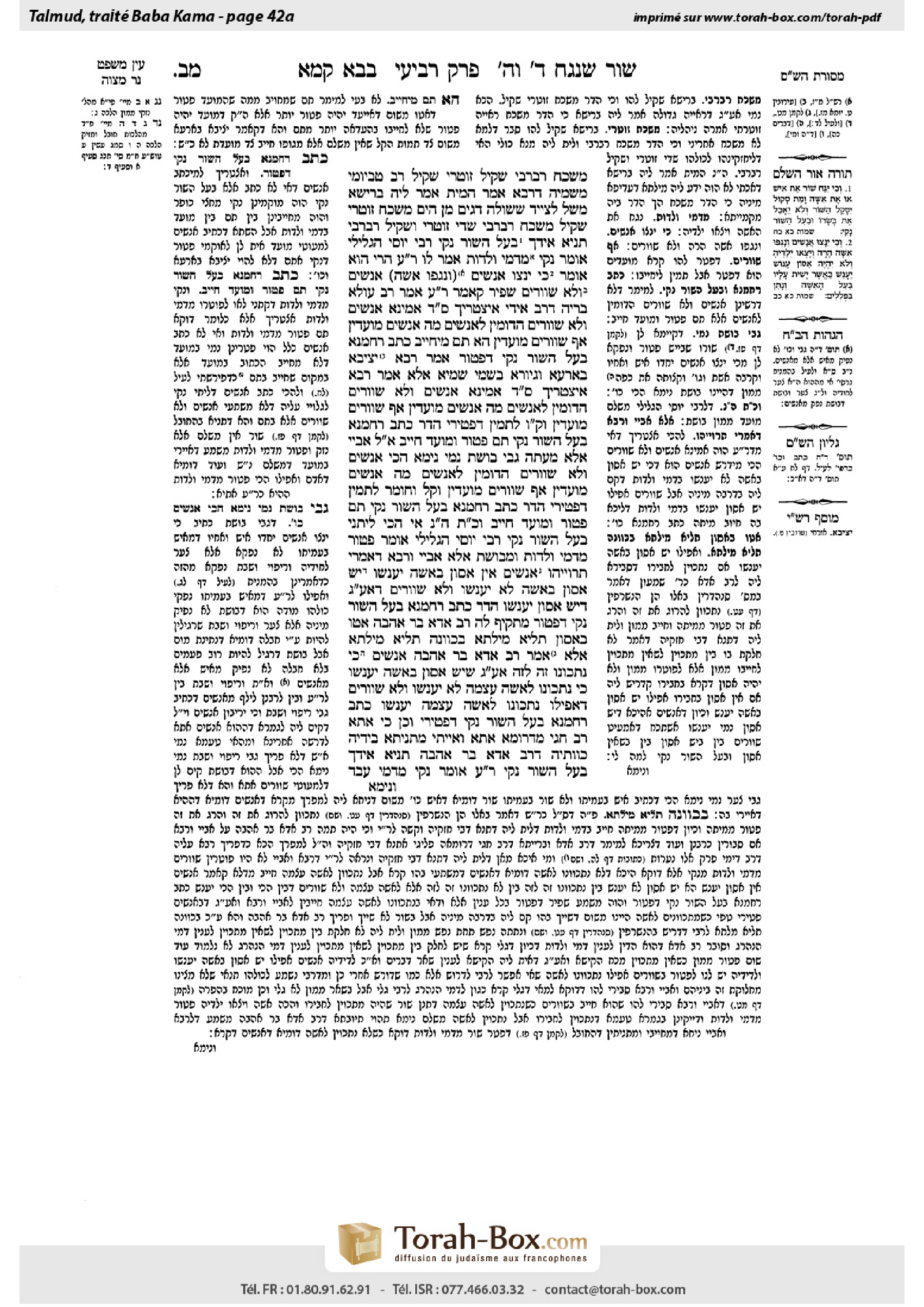
Bava Kamma 42a: Talmud study for Daf Yomi
Study the Talmud for Daf Yomi with scanned pages, Hebrew text, English translations from Sefaria and AI-generated French translations.
Passage selection and English or AI-generated French translation are available where the scan has annotations. Daf Study is independent of Torah-Box and Sefaria.
Browse Bava Kamma · בבא קמא · All tractatesBava Kamma 42a text and translations
This page of Bava Kamma includes the Aramaic text, an English translation and an AI-generated French translation, alongside the scan above.
בבא קמא מ״ב א · Aramaic and Hebrew text
מַשְׁכַּח רַבְרְבֵי – שָׁקֵיל, זוּטְרֵי – שָׁקֵיל.
רַב טָבְיוֹמֵי מִשְּׁמֵיהּ דְּרָבָא אָמַר ״הֵמִית״ אֲמַר לֵיהּ בְּרֵישָׁא – מָשָׁל לְצַיָּיד שֶׁשּׁוֹלֶה דָּגִים מִן הַיָּם, מַשְׁכַּח זוּטְרֵי – שָׁקֵיל, מַשְׁכַּח רַבְרְבֵי – שָׁדֵי זוּטְרֵי וְשָׁקֵיל רַבְרְבֵי.
תַּנְיָא אִידַּךְ: ״בַּעַל הַשּׁוֹר נָקִי״ – רַבִּי יוֹסֵי הַגְּלִילִי אוֹמֵר: נָקִי מִדְּמֵי וְלָדוֹת.
אָמַר לוֹ רַבִּי עֲקִיבָא, הֲרֵי הוּא אוֹמֵר: ״כִּי יִנָּצוּ אֲנָשִׁים וְנָגְפוּ אִשָּׁה״ – אֲנָשִׁים, וְלֹא שְׁוָורִים.
שַׁפִּיר קָאָמַר רַבִּי עֲקִיבָא!
אָמַר רַב עוּלָּא בְּרֵיהּ דְּרַב אִידִי: אִיצְטְרִיךְ, סָלְקָא דַּעְתָּךְ אָמֵינָא: אֲנָשִׁים – וְלֹא שְׁוָורִים הַדּוֹמִין לַאֲנָשִׁים; מָה אֲנָשִׁים מוּעָדִין – אַף שְׁוָורִים מוּעָדִין, הָא תָּם – מִיחַיַּיב; כְּתַב רַחֲמָנָא ״בַּעַל הַשּׁוֹר נָקִי״ – דְּפָטוּר.
אָמַר רָבָא: יַצִּיבָא בְּאַרְעָא, וְגִיּוֹרָא בִּשְׁמֵי שְׁמַיָּא?!
אֶלָּא אָמַר רָבָא: אִיצְטְרִיךְ, סָלְקָא דַּעְתָּךְ אָמֵינָא: אֲנָשִׁים – וְלֹא שְׁוָורִים הַדּוֹמִין לַאֲנָשִׁים; מָה אֲנָשִׁים מוּעָדִין – אַף שְׁוָורִים מוּעָדִין, וְקַל וָחוֹמֶר לְתַמִּין דִּפְטִירִי; הֲדַר כְּתַב רַחֲמָנָא ״בַּעַל הַשּׁוֹר נָקִי״ – תָּם פָּטוּר, וּמוּעָד חַיָּיב.
אֲמַר לֵיהּ אַבָּיֵי: אֶלָּא מֵעַתָּה, גַּבֵּי בּוֹשֶׁת נָמֵי נֵימָא הָכִי: אֲנָשִׁים – וְלֹא שְׁוָורִים הַדּוֹמִין לַאֲנָשִׁים; מָה אֲנָשִׁים מוּעָדִין – אַף שְׁוָורִים מוּעָדִין, וְקַל וָחוֹמֶר לְתַמִּין דִּפְטִירִי; הֲדַר כְּתַב רַחֲמָנָא ״בַּעַל הַשּׁוֹר נָקִי״ – תָּם פָּטוּר, וּמוּעָד חַיָּיב!
וְכִי תֵּימָא הָכִי נָמֵי, אִי הָכִי, לִיתְנֵי: ״בַּעַל הַשּׁוֹר נָקִי״ – רַבִּי יוֹסֵי הַגְּלִילִי אוֹמֵר: פָּטוּר מִדְּמֵי וְלָדוֹת וּמִבּוֹשֶׁת!
אֶלָּא אַבָּיֵי וְרָבָא דְּאָמְרִי תַּרְוַיְיהוּ: אֲנָשִׁים – אֵין אָסוֹן בְּאִשָּׁה יֵעָנְשׁוּ, יֵשׁ אָסוֹן בָּאִשָּׁה לֹא יֵעָנְשׁוּ. וְלֹא שְׁוָורִים – דְּאַף עַל גַּב דְּיֵשׁ אָסוֹן, יֵעָנְשׁוּ. הֲדַר כְּתַב רַחֲמָנָא ״בַּעַל הַשּׁוֹר נָקִי״ – דְּפָטוּר.
מַתְקֵיף לַהּ רַב אַדָּא בַּר אַהֲבָה: אַטּוּ בְּאָסוֹן תַּלְיָא מִילְּתָא? בְּכַוָּונָה תַּלְיָא מִילְּתָא!
אֶלָּא אָמַר רַב אַדָּא בַּר אַהֲבָה: אֲנָשִׁים – כִּי נִתְכַּוְּנוּ זֶה לָזֶה, אַף עַל גַּב שֶׁיֵּשׁ אָסוֹן בָּאִשָּׁה, יֵעָנְשׁוּ; כִּי נִתְכַּוְּנוּ לָאִשָּׁה עַצְמָהּ, לֹא יֵעָנְשׁוּ. וְלֹא שְׁוָורִים – דַּאֲפִילּוּ נִתְכַּוְּנוּ לָאִשָּׁה עַצְמָהּ, ״יֵעָנְשׁוּ״. כְּתַב רַחֲמָנָא ״בַּעַל הַשּׁוֹר נָקִי״ – דִּפְטִירִי.
וְכֵן כִּי אֲתָא רַב חַגַּי מִדָּרוֹמָא, אֲתָא וְאַיְיתִי מַתְנִיתָא בִּידֵיהּ כְּווֹתֵיהּ דְּרַב אַדָּא בַּר אַהֲבָה.
תַּנְיָא אִידַּךְ: ״בַּעַל הַשּׁוֹר נָקִי״ – רַבִּי עֲקִיבָא אוֹמֵר: נָקִי מִדְּמֵי עֶבֶד.
Bava Kamma 42a · English translation
When he finds big ones he takes them, and when he finds small ones he takes them as well. Here too, although Rabbi Eliezer’s first explanation was sufficient, he added an additional response, despite the fact that it was not as good as the first.
By contrast, Rav Tavyumei said in the name of Rava that he first said to him the explanation involving inconclusive testimony asserting that the ox killed, since this is analogous to a fisherman pulling fish from the sea, who finds small ones and takes them, and when he then finds big ones, he discards the small ones and takes only the big ones. Here too, once Rabbi Eliezer thought of a better response to Rabbi Akiva’s question, he suggested it instead of the first.
§ It is taught in another baraita with regard to the verse: “The owner of the ox shall be clear,” that Rabbi Yosei HaGelili says: It means he shall be clear from paying compensation for miscarried offspring. In other words, if an innocuous ox causes a woman to miscarry, the owner is not liable to pay half the compensation for the miscarried offspring.
Rabbi Akiva said to him: It is unnecessary for the verse to teach this. Doesn’t it say with regard to paying compensation for miscarried offspring: “If men struggle and hurt a pregnant woman and her offspring emerge, and there is no tragedy, he shall be punished as the husband of the woman shall impose upon him and he shall give as the judges determine” (Exodus 21:22); from which it is inferred that men who cause a woman to miscarry are liable to pay compensation for the offspring, but the owner of oxen who cause a woman to miscarry is not liable?
The Gemara comments: Rabbi Akiva is saying well; he states a reasonable objection. What would Rabbi Yosei HaGelili have responded to him?
Rav Ulla, son of Rav Idi, said: It was necessary for the verse to teach this exemption, as otherwise it might enter your mind to say that this inference should be limited, as follows: Men are liable to pay compensation for miscarried offspring, but the owner of oxen that are comparable to men is not liable. Only some oxen are excluded from this halakha. Just as men are categorically considered forewarned, so too the oxen, which are contrasted with men in this case, are considered forewarned as well. But in the case of miscarriage caused by an innocuous ox, its owner would be liable to pay compensation for miscarried offspring. Therefore, the Merciful One wrote with regard to an innocuous ox: “The owner of the ox shall be clear,” to teach us that he is exempt from liability.
Rava said, in objection to this answer: The native is on the ground and the stranger is in the heavens! The aforementioned suggestion contradicts the principle that the halakha of a forewarned ox is more stringent than that of an innocuous ox.
Rather, Rava said a different way for Rabbi Yosei HaGelili to counter Rabbi Akiva’s objection: It was necessary for the verse to teach this exemption, as otherwise it might enter your mind to say that only men are liable to pay for miscarried offspring, but the owner of oxen that are comparable to men is not liable. Just as men are categorically considered forewarned, so too the oxen, which are contrasted with men in this case, are considered forewarned as well. And for miscarriage caused by innocuous oxen, their owners are also exempt due to an a fortiori inference. The Merciful One then wrote that the owner of the innocuous ox shall be clear, indicating that only for an innocuous ox is one exempt from paying compensation for miscarried offspring, but for a forewarned ox the owner is liable.
Abaye said to him: If that is so, then with regard to compensation for humiliation, which is derived from the verse: “When men struggle together, a man and his brother, and the wife of one drew near to deliver her husband from the hand of the one who smites him, and extended her hand, and grabbed his genitals” (Deuteronomy 25:11), let us say this as well: Only men are liable to pay for humiliation, but the owner of oxen that are comparable to men is not liable. Just as men are categorically considered forewarned, so too the oxen, which are contrasted with men in this case, are considered forewarned as well. And for humiliation caused by innocuous oxen, their owners are also exempt due to an a fortiori inference. The Merciful One then wrote that the owner of the innocuous ox shall be clear, indicating that only for an innocuous ox is one exempt from paying compensation for humiliation, but for a forewarned ox the owner is liable.
And if you would say that indeed that is the halakha according to Rabbi Yosei HaGelili, if so, let the baraita teach that with regard to the verse: “The owner of the ox shall be clear,” Rabbi Yosei HaGelili says: He is exempt both from paying compensation for miscarried offspring and from paying compensation for humiliation.
Rava then retracted this explanation of Rabbi Yosei HaGelili’s opinion. Rather, Abaye and Rava both say that Rabbi Akiva’s inference is correct, according to Rabbi Yosei HaGelili, but with regard to the continuation of the verse: “But if any harm follows, you shall give life for life” (Exodus 21:22). With regard to men, if there is no harm caused to the woman, i.e., she is not killed, they shall be punished financially and are liable to pay compensation for miscarried offspring. But if there is harm caused to the woman and she dies, they shall not be punished financially, as they are liable to receive court-imposed capital punishment. This distinction applies only with regard to men but not with regard to oxen, as even if there is harm caused to the woman, the owners shall be punished financially. In order to preclude this inference, the Merciful One then wrote: “The owner of the ox shall be clear,” to teach that he is exempt from paying compensation for miscarried offspring.
Rav Adda bar Ahava objects to this: Is that to say that the issue of financial liability is dependent on whether or not there was harm caused to the woman? Clearly, the issue is dependent on the intent to strike the woman.
Rather, Rav Adda bar Ahava said a different inference: With regard to men, in a case where they intended to strike each other, even if there is harm caused to the woman, i.e., she dies, they shall be punished financially, and are liable to pay compensation for miscarried offspring. But when they intended to strike the woman herself they shall not be punished financially, as they are liable to receive court-imposed capital punishment. But this distinction does not apply with regard to oxen, as even if they intended to strike the woman herself, their owners shall be punished. In order to preclude this inference, the Merciful One wrote: “The owner of the ox shall be clear,” to teach that the owners are exempt from paying compensation for miscarried offspring.
And similarly, when Rav Ḥaggai came from the South, he came and brought a baraita in his hand that interprets the verse in accordance with the explanation of Rav Adda bar Ahava.
§ It is taught in another baraita with regard to the verse “The owner of the ox shall be clear” that Rabbi Akiva says: This statement teaches that if an innocuous ox kills a Canaanite slave, its owner shall be clear from paying compensation for the slave, unlike the case of a forewarned ox that killed a Canaanite slave, where the ox’s owner is liable.
Bava Kamma 42a · Traduction française (IA)
Lorsqu'il trouve des bêtes grandes, il les prend, et lorsqu'il trouve des bêtes petites, il les prend également. Ici aussi, bien que l'explication initiale du Rabbi Eliezer fût suffisante, il a ajouté une réponse supplémentaire, malgré le fait qu'elle ne soit pas aussi bonne que la première.
Par contraste, Rav Tavyumei a dit en nom de Rava qu'il avait d'abord dit à lui l'explication concernant le témoignage incertain affirmant que la bête avait tué, puisque cela est analogue à un pêcheur qui tire des poissons de la mer, qui trouve des petits et les prend, et lorsqu'il trouve des grands, il jette les petits et ne prend que les grands. Ici aussi, une fois que le Rabbi Eliezer avait pensé à une meilleure réponse à la question du Rabbi Akiva, il a proposé celle-ci à la place de la première.
§ Il est enseigné dans une autre baraïta concernant la versette : « L'homme qui possède la bête sera clair », que le Rabbi Yosei HaGelili dit : Cela signifie qu'il sera clair de ne pas devoir payer la compensation pour les fœtus abortés. En d'autres termes, si une bête inoffensive cause à une femme un avortement, l'propriétaire n'est pas tenu de payer la moitié de la compensation pour les fœtus abortés.
Le Rabbi Akiva a dit à lui : Il n'est pas nécessaire que la versette nous enseigne cela. N'est-ce pas dit concernant la compensation pour les fœtus abortés : « Si des hommes s'affrontent et blessent une femme enceinte et son enfant sort, et qu'il n'y a pas de tragédie, il sera puni comme le mari de la femme le lui imposera et il donnera comme les juges le décideront » (Exode 21:22) ; d'où on déduit que les hommes qui causent à une femme un avortement sont tenus de payer la compensation pour l'enfant, mais l'propriétaire des bêtes qui causent à une femme un avortement n'est pas tenu ?
Le Guemara commente : Le Rabbi Akiva dit bien ; il formule une objection raisonnable. Qu'aurait répondu le Rabbi Yosei HaGelili à cela ?
Rav Ulla, fils de Rav Idi, a dit : Il était nécessaire que la versette nous enseigne cette exemption, autrement on pourrait penser que cette déduction devrait être limitée, comme suit : Les hommes sont tenus de payer la compensation pour les fœtus abortés, mais l'propriétaire des bêtes comparables aux hommes n'est pas tenu. Seulement certaines bêtes sont exclues de cette halakha. Aussi bien que les hommes sont considérés comme avertis, ainsi les bêtes, qui sont contrées aux hommes dans ce cas, sont également considérés comme avertis. Mais dans le cas d'un avortement causé par une bête inoffensive, son propriétaire serait tenu de payer la compensation pour les fœtus abortés. Ainsi, le Tout-Puissant a écrit concernant une bête inoffensive : « L'homme qui possède la bête sera clair », pour nous enseigner qu'il est exempt de responsabilité.
Rava a dit, en objection à cette réponse : Le résident est sur la terre et l'étranger est dans les cieux ! La suggestion précédente contredit le principe que la halakha d'une bête avertie est plus stricte que celle d'une bête inoffensive.
Plutôt, Rava a dit une autre manière pour que le Rabbi Yosei HaGelili réponde à l'objection du Rabbi Akiva : Il était nécessaire que la versette nous enseigne cette exemption, autrement on pourrait penser que seul les hommes sont tenus de payer pour les fœtus abortés, mais l'propriétaire des bêtes comparables aux hommes n'est pas tenu. Aussi bien que les hommes sont considérés comme avertis, ainsi les bêtes, qui sont contrées aux hommes dans ce cas, sont également considérés comme avertis. Et pour l'avortement causé par des bêtes inoffensives, leurs propriétaires sont également exemptés par une déduction a fortiori. Le Tout-Puissant a alors écrit que l'propriétaire de la bête inoffensive sera clair, indiquant que seul pour une bête inoffensive est-on exempt de payer la compensation pour les fœtus abortés, mais pour une bête avertie, l'propriétaire est tenu.
Abaye dit à lui : Si c'est ainsi, alors concernant la compensation pour l'humiliation, qui est tirée de la versette : « Quand des hommes s'affrontent ensemble, un homme et son frère, et la femme d'un s'approche pour délivrer son mari de la main de celui qui le frappe, et étend sa main, et saisit ses organes génitaux » (Lévitique 25:11), disons cela aussi : Seuls les hommes sont tenus de payer pour l'humiliation, mais l'propriétaire des bêtes comparables aux hommes n'est pas tenu. Aussi bien que les hommes sont considérés comme avertis, ainsi les bêtes, qui sont contrées aux hommes dans ce cas, sont également considérés comme avertis. Et pour l'humiliation causée par des bêtes inoffensives, leurs propriétaires sont également exemptés par une déduction a fortiori. Le Tout-Puissant a alors écrit que l'propriétaire de la bête inoffensive sera clair, indiquant que seul pour une bête inoffensive est-on exempt de payer la compensation pour l'humiliation, mais pour une bête avertie, l'propriétaire est tenu.
Et si vous dites que c'est effectivement la halakha selon le Rabbi Yosei HaGelili, si c'est ainsi, disons que la baraïta enseigne cela concernant la versette : « L'homme qui possède la bête sera clair », le Rabbi Yosei HaGelili dit : Il est exempt à la fois de payer la compensation pour les fœtus abortés et de payer la compensation pour l'humiliation.
Rava a ensuite rétracté cette explication de l'opinion du Rabbi Yosei HaGelili. En réalité, Abaye et Rava disent tous les deux que l'inférence du Rabbi Akiva est correcte, selon l'opinion du Rabbi Yosei HaGelili, mais concernant la continuation de la versette : « Mais si un dommage suit, vous donnerez la vie pour la vie » (Exode 21:22). Concernant les hommes, si aucun dommage n'est causé à la femme, c'est-à-dire qu'elle n'est pas tuée, ils seront punis financièrement et doivent payer la compensation pour les fœtus abortés. Mais si un dommage est causé à la femme et qu'elle meurt, ils ne seront pas punis financièrement, car ils sont tenus de recevoir une peine de mort imposée par le tribunal. Cette distinction s'applique uniquement aux hommes mais pas aux bêtes, car même si un dommage est causé à la femme, les propriétaires seront punis financièrement. Afin d'exclure cette inférence, le Tout-Puissant a alors écrit : « L'homme qui possède la bête sera clair », pour nous enseigner qu'il est exempt de payer la compensation pour les fœtus abortés.
Rav Adda bar Ahava s'oppose à cela : Est-ce que cela signifie que la question de la responsabilité financière dépend de savoir si une femme a subi un préjudice ? Bien sûr, la question dépend de l'intention de frapper la femme.
En réalité, Rav Adda bar Ahava a fait une autre déduction : En ce qui concerne les hommes, dans un cas où ils avaient l'intention de s'attacker mutuellement, même si un préjudice est causé à la femme, c'est-à-dire qu'elle meurt, ils seront punis financièrement et doivent indemniser les enfants non nés. Mais lorsqu'ils avaient l'intention de frapper la femme elle-même, ils ne seront pas punis financièrement, car ils sont tenus de recevoir la peine de mort imposée par le tribunal. Cependant, cette distinction ne s'applique pas aux bœufs, car même s'ils avaient l'intention de frapper la femme elle-même, leurs propriétaires seront punis. Afin d'exclure cette déduction, le Tout-Puissant a écrit : « L'propriétaire du bœuf sera clair », pour enseigner que les propriétaires sont exemptés de payer l'indemnité pour les enfants non nés.
De même, lorsque Rav Ḥaggai est venu du Sud, il est venu et a apporté une baraïta dans sa main qui interprète la parole selon l'explication de Rav Adda bar Ahava.
§ Il est enseigné dans une autre baraïta concernant la parole « L'propriétaire du bœuf sera clair » que Rabbi Akiva dit : Cette déclaration enseigne que si un bœuf inoffensif tue un esclave cananéen, son propriétaire ne sera pas tenu responsable de l'indemnité pour l'esclave, contrairement au cas d'un bœuf averti qui a tué un esclave cananéen, où le propriétaire du bœuf est responsable.
Traduction française générée par IA à partir de l’édition anglaise de Sefaria. Vérifie toujours un passage avec le texte source.
Text from Sefaria: William Davidson Edition - Vocalized Aramaic (CC BY NC); William Davidson Edition - English (CC BY NC).