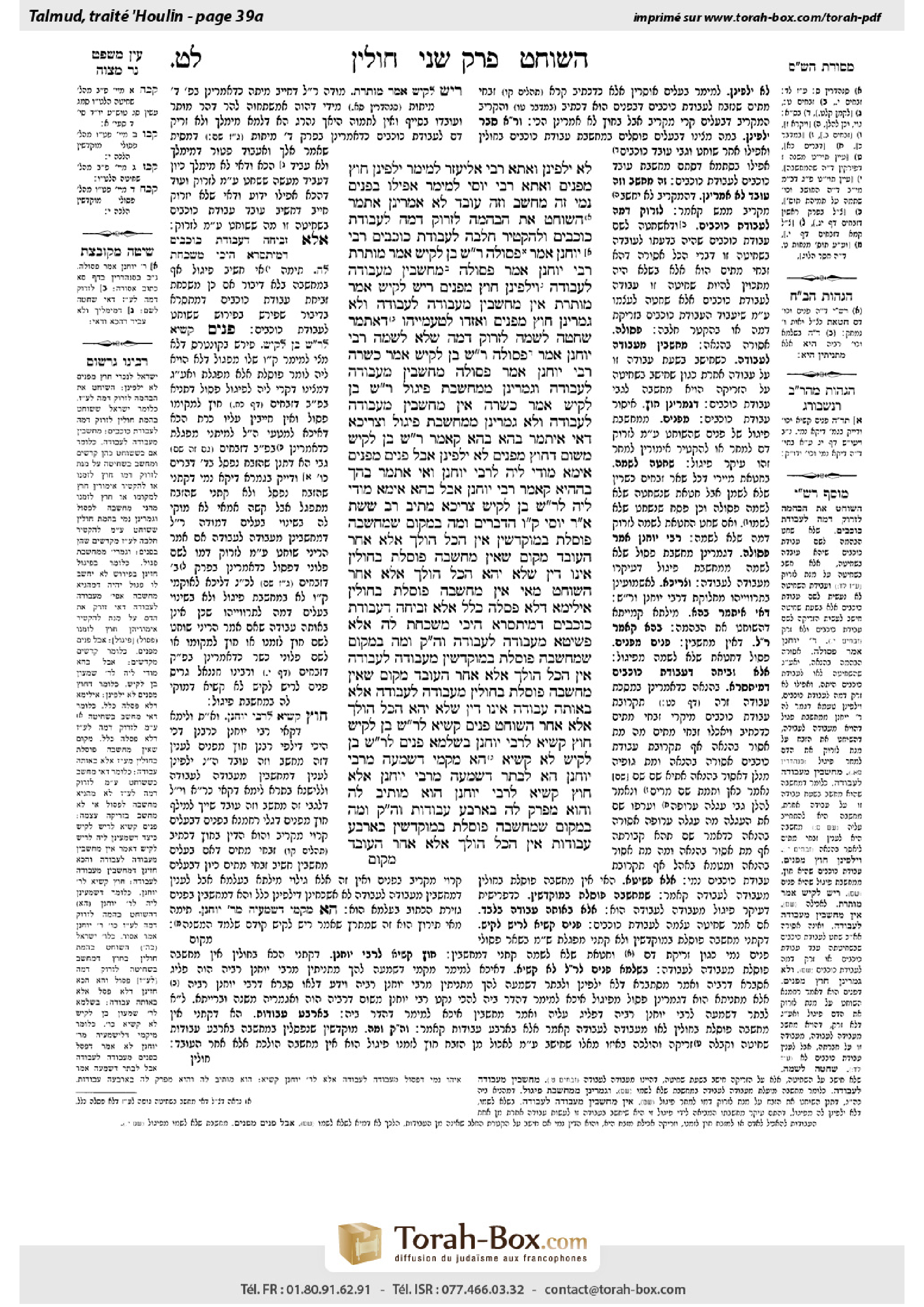
Chullin 39a: Talmud study for Daf Yomi
Study the Talmud for Daf Yomi with scanned pages, Hebrew text, English translations from Sefaria and AI-generated French translations.
Passage selection and English or AI-generated French translation are available where the scan has annotations. Daf Study is independent of Torah-Box and Sefaria.
Browse Chullin · חולין · All tractatesChullin 39a text and translations
This page of Chullin includes the Aramaic text, an English translation and an AI-generated French translation, alongside the scan above.
חולין ל״ט א · Aramaic and Hebrew text
לָא יָלְפִינַן. וַאֲתָא רַבִּי אֱלִיעֶזֶר לְמֵימַר: יָלְפִינַן חוּץ מִפְּנִים, וַאֲתָא רַבִּי יוֹסֵי לְמֵימַר: אֲפִילּוּ בִּפְנִים נָמֵי ״זֶה מְחַשֵּׁב וְזֶה עוֹבֵד״ לָא אָמְרִינַן.
אִתְּמַר: הַשּׁוֹחֵט אֶת הַבְּהֵמָה לִזְרוֹק דָּמָהּ לַעֲבוֹדָה זָרָה, וּלְהַקְטִיר חֶלְבָּהּ לַעֲבוֹדָה זָרָה – רַבִּי יוֹחָנָן אָמַר: פְּסוּלָה, רַבִּי שִׁמְעוֹן בֶּן לָקִישׁ אָמַר: מוּתֶּרֶת.
רַבִּי יוֹחָנָן אָמַר פְּסוּלָה: מְחַשְּׁבִין מֵעֲבוֹדָה לַעֲבוֹדָה, וְיָלְפִינַן חוּץ מִפְּנִים.
רֵישׁ לָקִישׁ אָמַר מוּתֶּרֶת: אֵין מְחַשְּׁבִין מֵעֲבוֹדָה לַעֲבוֹדָה, וְלָא גָּמְרִינַן חוּץ מִפְּנִים.
וְאָזְדוּ לְטַעְמַיְיהוּ, דְּאִתְּמַר: שְׁחָטָהּ לִשְׁמָהּ לִזְרוֹק דָּמָהּ שֶׁלֹּא לִשְׁמָהּ – רַבִּי יוֹחָנָן אָמַר: פְּסוּלָה, רַבִּי שִׁמְעוֹן בֶּן לָקִישׁ אָמַר: כְּשֵׁרָה.
רַבִּי יוֹחָנָן אָמַר פְּסוּלָה: מְחַשְּׁבִין מֵעֲבוֹדָה לַעֲבוֹדָה, וְגָמְרִינַן מִמַּחְשֶׁבֶת פִּיגּוּל. רַבִּי שִׁמְעוֹן בֶּן לָקִישׁ אָמַר כְּשֵׁרָה: אֵין מְחַשְּׁבִין מֵעֲבוֹדָה לַעֲבוֹדָה, וְלָא גָּמְרִינַן מִמַּחְשֶׁבֶת פִּיגּוּל.
וּצְרִיכָא, דְּאִי אִיתְּמַר בְּהָא, בְּהָא קָאָמַר רַבִּי שִׁמְעוֹן בֶּן לָקִישׁ, מִשּׁוּם דְּחוּץ מִפְּנִים לָא יָלְפִינַן, אֲבָל פְּנִים מִפְּנִים – אֵימָא מוֹדֵי לֵיהּ לְרַבִּי יוֹחָנָן.
וְאִי אִתְּמַר בְּהָךְ, בְּהַהִיא קָאָמַר רַבִּי יוֹחָנָן, אֲבָל בְּהָא – אֵימָא מוֹדֵי לֵיהּ לְרַבִּי שִׁמְעוֹן בֶּן לָקִישׁ, צְרִיכָא.
מֵתִיב רַב שֵׁשֶׁת: אָמַר רַבִּי יוֹסֵי: קַל וָחוֹמֶר הַדְּבָרִים, וּמָה בִּמְקוֹם שֶׁמַּחְשָׁבָה פּוֹסֶלֶת בְּמוּקְדָּשִׁין – אֵין הַכֹּל הוֹלֵךְ אֶלָּא אַחַר הָעוֹבֵד, מְקוֹם שֶׁאֵין מַחְשָׁבָה פּוֹסֶלֶת בְּחוּלִּין – אֵינוֹ דִּין שֶׁלֹּא יְהֵא הַכֹּל הוֹלֵךְ אֶלָּא אַחַר הַשּׁוֹחֵט?
מַאי ״אֵין מַחְשָׁבָה פּוֹסֶלֶת בְּחוּלִּין״? אִילֵּימָא דְּלָא פָּסְלָה כְּלָל, אֶלָּא זְבִיחָה דַּעֲבוֹדָה זָרָה דְּמִיתַּסְרָא, הֵיכִי מַשְׁכַּחַתְּ לַהּ?
אֶלָּא פְּשִׁיטָא מֵעֲבוֹדָה לַעֲבוֹדָה, וְהָכִי קָאָמַר: וּמָה בִּמְקוֹם שֶׁמַּחְשָׁבָה פּוֹסֶלֶת בְּמוּקְדָּשִׁין מֵעֲבוֹדָה לַעֲבוֹדָה – אֵין הַכֹּל הוֹלֵךְ אֶלָּא אַחַר הָעוֹבֵד, מְקוֹם שֶׁאֵין מַחְשָׁבָה פּוֹסֶלֶת בְּחוּלִּין מֵעֲבוֹדָה לַעֲבוֹדָה, אֶלָּא בְּאוֹתָהּ עֲבוֹדָה – אֵינוֹ דִּין שֶׁלֹּא יְהֵא הַכֹּל הוֹלֵךְ אֶלָּא אַחַר הַשּׁוֹחֵט?
פְּנִים קַשְׁיָא לְרַבִּי שִׁמְעוֹן בֶּן לָקִישׁ, חוּץ קַשְׁיָא לְרַבִּי יוֹחָנָן!
בִּשְׁלָמָא פְּנִים, לְרַבִּי שִׁמְעוֹן בֶּן לָקִישׁ לָא קַשְׁיָא: הָא מִקַּמֵּי דְּשַׁמְעַהּ מֵרַבִּי יוֹחָנָן, הָא לְבָתַר דְּשַׁמְעַהּ מֵרַבִּי יוֹחָנָן. אֶלָּא חוּץ, קַשְׁיָא לְרַבִּי יוֹחָנָן!
הוּא מוֹתֵיב לַהּ וְהוּא מְפָרֵק לַהּ, בְּאַרְבַּע עֲבוֹדוֹת, וְהָכִי קָאָמַר: וּמָה בִּמְקוֹם שֶׁמַּחְשָׁבָה פּוֹסֶלֶת בְּמוּקְדָּשִׁין בְּאַרְבַּע עֲבוֹדוֹת – אֵין הַכֹּל הוֹלֵךְ אֶלָּא אַחַר הָעוֹבֵד,
Chullin 39a · English translation
we do not derive in this manner. And Rabbi Eliezer comes to say that we derive the halakhot of non-sacred slaughter outside the Temple from the halakhot of slaughter of sacrificial animals inside the Temple, and therefore the intent of the gentile invalidates non-sacred slaughter. And Rabbi Yosei comes to say that even inside the Temple, in a case where this owner has improper intent and that other person is performing the slaughter, we do not say that the intent of the owner invalidates the slaughter.
§ It was stated that there is an amoraic dispute with regard to one who slaughtered an animal in order to sprinkle its blood for idol worship, or to burn its fat for idol worship. Rabbi Yoḥanan says: The slaughter is not valid, and benefit from the animal is forbidden. Rabbi Shimon ben Lakish says: The slaughter is valid and deriving benefit from the animal is permitted.
The Gemara elaborates. Rabbi Yoḥanan says: The slaughter is not valid and benefit from the animal is forbidden. He holds that one transfers intent from one sacrificial rite to another sacrificial rite. If, while slaughtering a sacrificial animal, one intends to perform one of the other sacrificial rites in an improper manner the offering is invalidated. And Rabbi Yoḥanan holds that we derive the halakhot of non-sacred slaughter outside the Temple from the halakhot of slaughter of sacrificial animals inside the Temple. Since that intent invalidates the slaughter of sacrificial animals inside the Temple, it invalidates the slaughter of non-sacred animals outside the Temple as well.
Reish Lakish says: The slaughter is valid, and deriving benefit from the animal is permitted. He holds that one does not transfer intent from one sacrificial rite to another sacrificial rite. Therefore, while slaughtering the animal, only intent to perform the slaughter improperly invalidates the offering, but intent to perform another sacrificial rite improperly does not invalidate the offering. And Reish Lakish holds that we do not derive the halakhot of non-sacred slaughter outside the Temple from the halakhot of slaughter of sacrificial animals inside the Temple.
And Rabbi Yoḥanan and Reish Lakish follow their standard line of reasoning, as it was stated: If one slaughtered a sin offering for its own sake, but with intent to sprinkle its blood not for its own sake but for the sake of another type of offering, Rabbi Yoḥanan says that the offering is unfit, and Rabbi Shimon ben Lakish says that the offering is fit.
The Gemara elaborates: Rabbi Yoḥanan says that the offering is unfit. He holds that one transfers intent from one sacrificial rite to another sacrificial rite, and the reason is that we derive the halakha of slaughter of a sin offering not for its sake from the halakha of intent for piggul, i.e., performance of one of the sacrificial rites with the intent to sprinkle the blood of the offering beyond its appointed time. And Rabbi Shimon ben Lakish says that the offering is fit because he holds that one does not transfer intent from one sacrificial rite to another sacrificial rite, and the reason is that we do not derive the halakha of any other improper intent from the halakha of intent for piggul.
The Gemara notes: And it is necessary to state the dispute between Rabbi Yoḥanan and Reish Lakish in both cases. As, if it were stated only with regard to that case of one who slaughters an animal in order to sprinkle its blood for idol worship, perhaps one would conclude that it is specifically in that case that Rabbi Shimon ben Lakish states his opinion that the slaughter is valid, due to the fact that we do not derive the halakhot of non-sacred slaughter outside the Temple from the halakhot of slaughter of sacrificial animals inside the Temple. But in the case of one who slaughters an offering for the sake of another offering, where we would be deriving the halakhot of slaughter of sacrificial animals inside the Temple from the halakhot of another case of slaughter of sacrificial animals inside the Temple, say that Reish Lakish concedes to Rabbi Yoḥanan that the offering is unfit.
And if their dispute was stated with regard to this case of one who slaughters an offering for the sake of another offering, perhaps one would conclude that it is specifically in this case that Rabbi Yoḥanan said that the offering is unfit, because he holds that one derives the halakhot of slaughter of sacrificial animals inside the Temple from the halakhot of another case of slaughter of sacrificial animals inside the Temple. But in that case of one who slaughters an animal in order to sprinkle its blood for idol worship, say that Rabbi Yoḥanan concedes to Rabbi Shimon ben Lakish that the offering is fit due to the fact that the halakhot of non-sacred slaughter outside the Temple are not derived from the halakhot of slaughter of sacrificial animals inside the Temple. Therefore, it is necessary to state the dispute between Rabbi Yoḥanan and Reish Lakish in both cases.
Rav Sheshet raises an objection to both Rabbi Yoḥanan and Reish Lakish from the statement in the mishna with regard to one who slaughters for a gentile when the intent of the gentile is for idol worship. Rabbi Yosei says: The matter of the intent of the gentile is irrelevant in this case as can be derived by means of an a fortiori inference. If in a place where intent while slaughtering the animal invalidates the slaughter, i.e., in sacrificial animals, such as when slaughtering an offering with the intent to sacrifice it beyond its designated time, everything follows only the intent of the priest performing the service and not the intent of the owner, then in a place where intent does not invalidate the slaughter, i.e., in non-sacred animals, is it not right that everything should follow only the intent of the one who slaughters the animal?
Rav Sheshet elaborates: What is the meaning of: Intent does not invalidate the slaughter in non-sacred animals? If we say that it means that intent does not invalidate the slaughter of non-sacred animals at all, but then how can you find a case of slaughter with intent for idol worship where the animal is forbidden?
Rather, it is obvious that the meaning of that phrase in the statement of Rabbi Yosei is that one does not transfer intent from one sacrificial rite to another sacrificial rite, and this is what Rabbi Yosei is saying: If in a place where intent invalidates, i.e., in sacrificial animals, from one sacrificial rite to another sacrificial rite, everything follows only the intent of the one performing the slaughter, and the intent of the owners is irrelevant, in a place where intent does not invalidate, i.e., in non-sacred animals, from one rite to another rite but it does so only within the same rite, is it not right that everything should follow only the intent of the one who slaughters the animal?
According to this understanding of the contention of Rabbi Yosei in the mishna, the case of the slaughter of a sacrificial animal inside the Temple is difficult for Rabbi Shimon ben Lakish, as contrary to his opinion, Rabbi Yosei says that in that case one transfers intent from one sacrificial rite to another sacrificial rite. The case of slaughter of a non-sacred animal outside the Temple is difficult for Rabbi Yoḥanan, as contrary to his opinion, Rabbi Yosei says that in that case one does not transfer intent from one rite to another rite.
Rav Sheshet continues: Granted, the case of inside the Temple is not difficult for Rabbi Shimon ben Lakish, because one can explain that he stated this statement that one does not transfer intent from one sacrificial rite to another sacrificial rite before he heard the mishna from Rabbi Yoḥanan, his teacher, and he stated that one transfers intent from one sacrificial rite to another sacrificial rite after he heard the mishna from Rabbi Yoḥanan. His dispute with Rabbi Yoḥanan is limited to transfer of intent for idol worship from rite to rite. But the case of slaughter of a non-sacred animal outside the Temple is difficult for Rabbi Yoḥanan.
Rav Sheshet raises the objection, and he resolves it. That which Rabbi Yosei said, that intent inside the Temple disqualifies the slaughter of a sacrificial animal but intent outside the Temple does not disqualify the slaughter of a non-sacred animal, is unrelated to transfer of intent from one rite to another. Rather, Rabbi Yosei is referring to a case where one performed any of the four sacrificial rites with improper intent, e.g., to eat the offering beyond its appointed time. And this is what Rabbi Yosei is saying: If in a place where intent while slaughtering the animal invalidates the slaughter in sacrificial animals, if that intent was during performance of any of the four sacrificial rites, i.e., slaughter, receiving the blood, conveying the blood to the altar, and sprinkling the blood on the altar, everything follows only the intent of the priest performing the service and not the intent of the owner,
Chullin 39a · Traduction française (IA)
Nous ne dérivons pas ainsi. Et le maître Eliezer affirme que nous dérivons les halakhot de la boucherie non sacrée en dehors du Temple à partir des halakhot de la boucherie des animaux sacrés à l'intérieur du Temple, et donc l'intention du gentil invalide la boucherie non sacrée. Et le maître Yosei affirme que même à l'intérieur du Temple, dans un cas où cet propriétaire a une intention incorrecte et que cette autre personne effectue la boucherie, nous ne disons pas que l'intention du propriétaire invalide la boucherie.
§ Il a été dit qu'il y a un débat entre les amoraïm concernant celui qui a tué un animal afin de verser son sang pour l'idolâtrie, ou afin de brûler sa graisse pour l'idolâtrie. Le maître Yoḥanan dit : La boucherie n'est pas valide et le bénéfice de l'animal est interdit. Le maître Shim'on ben Lakish dit : La boucherie est valide et le bénéfice de l'animal est permis.
La Guemara développe. Le maître Yoḥanan dit : La boucherie n'est pas valide et le bénéfice de l'animal est interdit. Il considère que l'intention est transférée d'un rite sacré à un autre rite sacré. Si, pendant la boucherie d'un animal sacré, l'on veut effectuer l'un des autres rites sacrés de manière incorrecte, l'offrande est invalidée. Et le maître Yoḥanan considère que nous dérivons les halakhot de la boucherie non sacrée en dehors du Temple à partir des halakhot de la boucherie des animaux sacrés à l'intérieur du Temple. Puisque cette intention invalide la boucherie des animaux sacrés à l'intérieur du Temple, elle invalide également la boucherie des animaux non sacrés en dehors du Temple.
Reish Lakish dit : La boucherie est valide, et l'usage de l'animal est permis. Il considère que l'intention ne se transfère pas d'un rite sacré à un autre rite sacré. Ainsi, pendant la boucherie de l'animal, seule l'intention de réaliser la boucherie de manière incorrecte invalide l'offrande, mais l'intention de réaliser un autre rite sacré de manière incorrecte n'invalide pas l'offrande. Et Reish Lakish considère que nous ne dérivons pas les halakhot de la boucherie non sacrée en dehors du Temple à partir des halakhot de la boucherie des animaux sacrés à l'intérieur du Temple.
Et Rabbi Yoḥanan et Reish Lakish suivent leur raisonnement standard, comme il a été dit : Si l'on a bouché un sacrifice expiatoire à son propre sujet, mais avec l'intention de verser son sang pas à son propre sujet mais à celui d'un autre type d'offrande, Rabbi Yoḥanan dit que l'offrande est inadaptée, et Rabbi Shimon ben Lakish dit que l'offrande est adaptée.
La Guemara développe : Rabbi Yoḥanan dit que l'offrande est inadaptée. Il considère que l'intention se transfère d'un rite sacré à un autre rite sacré, et la raison est que nous dérivons la halakha de la boucherie d'un sacrifice expiatoire non à son propre sujet à partir de la halakha de l'intention pour piggul, c'est-à-dire la réalisation d'un des rites sacrés avec l'intention de verser le sang de l'offrande au-delà de son temps déterminé. Et Rabbi Shimon ben Lakish dit que l'offrande est adaptée car il considère que l'intention ne se transfère pas d'un rite sacré à un autre rite sacré, et la raison est que nous ne dérivons pas la halakha de toute autre intention incorrecte à partir de la halakha de l'intention pour piggul.
La Guemara note : Il est nécessaire d'énoncer le débat entre le maître Yoḥanan et Reish Lakish dans les deux cas. Car, si on avait dit seulement concernant le cas d'une personne qui bache un animal afin de verser son sang pour l'idolâtrie, peut-être conclurait-on que c'est spécifiquement dans ce cas que le maître Shim'on ben Lakish affirme son opinion que la boucherie est valide, en raison du fait que nous ne dérivons pas les halakhot de la boucherie non sacrée en dehors du Temple à partir des halakhot de la boucherie des animaux sacrés à l'intérieur du Temple. Mais dans le cas d'une personne qui bache un offrande à l'intention d'un autre offrande, où nous dérivons les halakhot de la boucherie des animaux sacrés à l'intérieur du Temple à partir des halakhot d'un autre cas de boucherie d'animaux sacrés à l'intérieur du Temple, disons que Reish Lakish reconnaît à Yoḥanan que l'offrande est inadaptée.
Et si leur débat avait été énoncé concernant ce cas d'une personne qui bache un offrande à l'intention d'un autre offrande, peut-être conclurait-on que c'est spécifiquement dans ce cas que le maître Yoḥanan a dit que l'offrande est inadaptée, car il considère que l'on dérive les halakhot de la boucherie des animaux sacrés à l'intérieur du Temple à partir des halakhot d'un autre cas de boucherie d'animaux sacrés à l'intérieur du Temple. Mais dans ce cas d'une personne qui bache un animal afin de verser son sang pour l'idolâtrie, disons que le maître Yoḥanan reconnaît à Shim'on ben Lakish que l'offrande est adaptée en raison du fait que les halakhot de la boucherie non sacrée en dehors du Temple ne sont pas dérivées des halakhot de la boucherie des animaux sacrés à l'intérieur du Temple. Par conséquent, il est nécessaire d'énoncer le débat entre le maître Yoḥanan et Reish Lakish dans les deux cas.
Rav Sheshet émet un objet contre les deux, Rabbi Yoḥanan et Reish Lakish, à partir de l'affirmation de la mitsna concernant celui qui bache pour un gentil lorsque l'intention du gentil est pour l'idolâtrie. Rabbi Yosei dit : La question de l'intention du gentil est sans importance dans ce cas, comme on peut le déduire par une inférence a fortiori. Si, dans un lieu où l'intention pendant la boucherie de l'animal invalide la boucherie, c'est-à-dire dans les animaux sacrés, comme lors de la boucherie d'un holocauste avec l'intention de le sacrifier au-delà de son temps déterminé, tout suit uniquement l'intention du prêtre effectuant le service et non celle du propriétaire, alors dans un lieu où l'intention n'invalidé pas la boucherie, c'est-à-dire dans les animaux non sacrés, est-il juste que tout suive uniquement l'intention de celui qui bache l'animal ?
Rav Sheshet développe : Quelle est la signification de : L'intention n'invalidé pas la boucherie des animaux non sacrés ? Si nous disons que cela signifie que l'intention n'invalidé pas la boucherie des animaux non sacrés du tout, mais alors comment peut-on trouver un cas de boucherie avec intention pour l'idolâtrie où l'animal est interdit ?
En réalité, il est évident que le sens de cette phrase dans l'édit de Rabbi Yosei est que l'on ne transfère pas l'intention d'un rite sacré à un autre rite sacré, et c'est cela que Rabbi Yosei affirme : Si dans un lieu où l'intention annule, c'est-à-dire dans les animaux sacrés, d'un rite sacré à un autre rite sacré, tout suit uniquement l'intention de celui qui effectue la bête, et l'intention des propriétaires est sans importance, dans un lieu où l'intention n'annule pas, c'est-à-dire dans les animaux non sacrés, d'un rite à un autre rite mais cela ne se produit que dans le même rite, n'est-il pas juste que tout suive uniquement l'intention de celui qui tue l'animal ?
Selon cette compréhension de la contestation de Rabbi Yosei dans la mitsna, le cas de la bête sacrée tuée à l'intérieur du Temple est difficile pour Rabbi Shimon ben Lakish, car contraire à son avis, Rabbi Yosei affirme que dans ce cas l'intention est transférée d'un rite sacré à un autre rite sacré. Le cas de la bête non sacrée tuée à l'extérieur du Temple est difficile pour Rabbi Yoḥanan, car contraire à son avis, Rabbi Yosei affirme que dans ce cas l'intention n'est pas transférée d'un rite à un autre rite.
Rav Sheshet continue : D'accord, le cas d'intérieur du Temple n'est pas difficile pour Rabbi Shimon ben Lakish, car on peut expliquer qu'il a dit cette affirmation que l'on ne transfère pas l'intention d'un rite sacré à un autre rite sacré avant d'avoir entendu la mitsna de Rabbi Yoḥanan, son maître, et qu'il a dit qu'on transfère l'intention d'un rite sacré à un autre rite sacré après avoir entendu la mitsna de Rabbi Yoḥanan. Son débat avec Rabbi Yoḥanan est limité au transfert d'intention pour l'idolâtrie d'un rite à un autre rite. Mais le cas de la bête non sacrée tuée à l'extérieur du Temple est difficile pour Rabbi Yoḥanan.
Rav Sheshet éleve l'objection et la résout. Ce que Rabbi Yosei a dit, que l'intention à l'intérieur du Temple annule la bête sacrée, mais que l'intention à l'extérieur du Temple n'annule pas la bête non sacrée, est indépendant du transfert d'intention d'un rite à un autre. Plutôt, Rabbi Yosei fait référence à un cas où l'on a effectué l'un des quatre rites sacrés avec une intention incorrecte, par exemple, pour manger l'offrande au-delà de son temps assigné. Et c'est cela que Rabbi Yosei affirme : Si dans un lieu où l'intention pendant la bête annule la bête sacrée, si cette intention était durant l'accomplissement de l'un des quatre rites sacrés, c'est-à-dire la bête, la réception du sang, la transmission du sang à l'autel et la dispersion du sang sur l'autel, tout suit uniquement l'intention du prêtre effectuant le service et non l'intention du propriétaire,
Traduction française générée par IA à partir de l’édition anglaise de Sefaria. Vérifie toujours un passage avec le texte source.
Text from Sefaria: William Davidson Edition - Vocalized Aramaic (unknown); William Davidson Edition - English (CC BY NC).