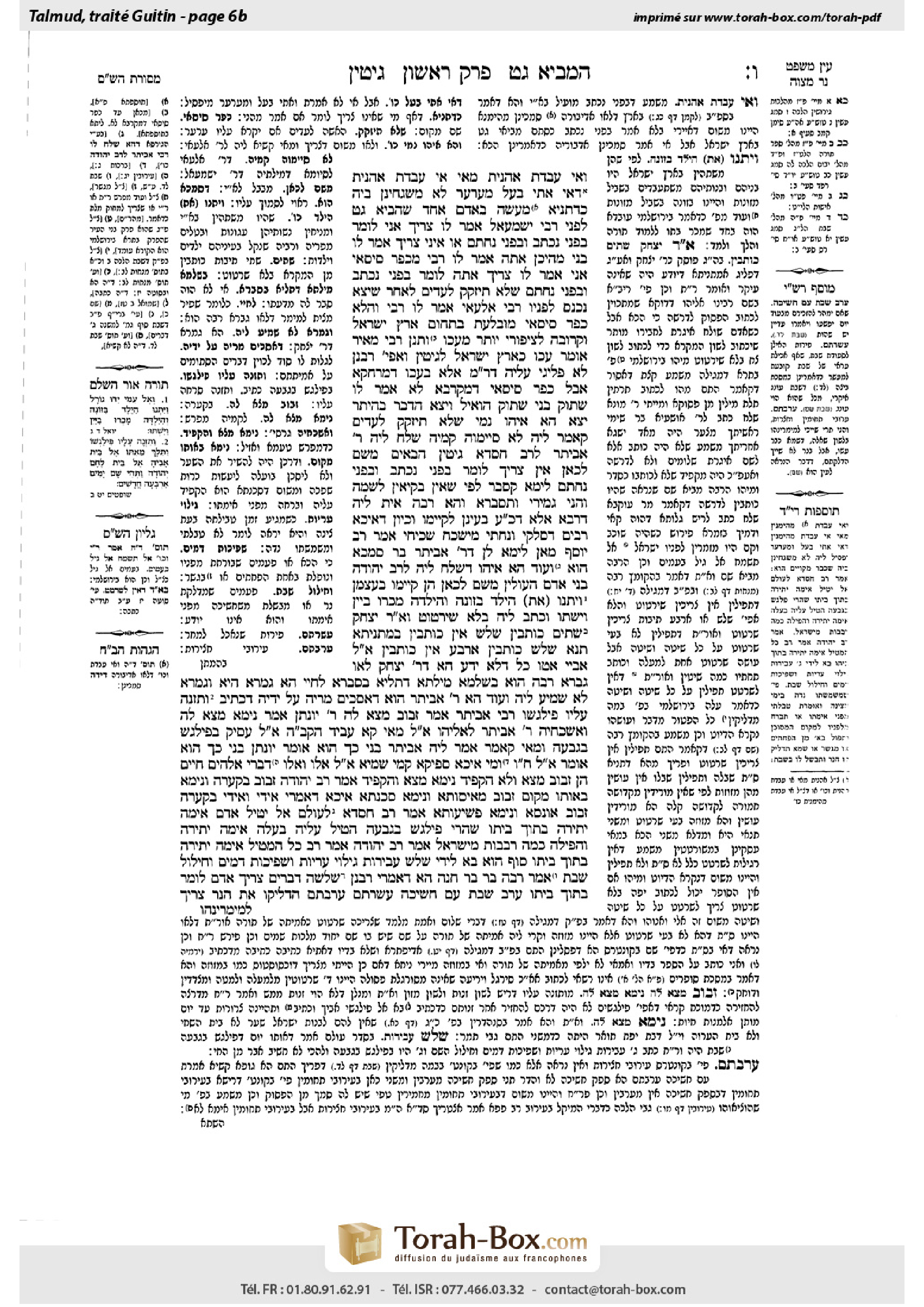
Gittin 6b: Talmud study for Daf Yomi
Study the Talmud for Daf Yomi with scanned pages, Hebrew text, English translations from Sefaria and AI-generated French translations.
Passage selection and English or AI-generated French translation are available where the scan has annotations. Daf Study is independent of Torah-Box and Sefaria.
Browse Gittin · גיטין · All tractatesGittin 6b text and translations
This page of Gittin includes the Aramaic text, an English translation and an AI-generated French translation, alongside the scan above.
גיטין ו׳ ב · Aramaic and Hebrew text
וְאִי עֲבַדְתְּ – אַהְנֵית. מַאי ״אִי עֲבַדְתְּ אַהְנֵית״? דְּאִי אָתֵי בַּעַל מְעַרְעַר, לָא מַשְׁגְּחִינַן בֵּיהּ.
כִּדְתַנְיָא: מַעֲשֶׂה בְּאָדָם אֶחָד שֶׁהֵבִיא גֵּט לִפְנֵי רַבִּי יִשְׁמָעֵאל, אָמַר לוֹ: צָרִיךְ אֲנִי לוֹמַר ״בְּפָנַי נִכְתַּב וּבְפָנַי נֶחְתַּם״, אוֹ אֵינִי צָרִיךְ? אָמַר לוֹ: בְּנִי, מֵהֵיכָן אַתָּה? אָמַר לוֹ: רַבִּי, מִכְּפַר סִיסַאי אָנִי. אָמַר לוֹ: צָרִיךְ אַתָּה לוֹמַר ״בְּפָנַי נִכְתַּב וּבְפָנַי נֶחְתַּם״, שֶׁלֹּא תִּיזָּקֵק לְעֵדִים.
לְאַחַר שֶׁיָּצָא, נִכְנַס לְפָנָיו רַבִּי אִלְעַאי, אָמַר לוֹ: רַבִּי, וַהֲלֹא כְּפַר סִיסַאי מוּבְלַעַת בִּתְחוּם אֶרֶץ יִשְׂרָאֵל, וּקְרוֹבָה לְצִיפּוֹרִי יוֹתֵר מֵעַכּוֹ; וּתְנַן, רַבִּי מֵאִיר אוֹמֵר: עַכּוֹ – כְּאֶרֶץ יִשְׂרָאֵל לְגִיטִּין, וַאֲפִילּוּ רַבָּנַן לָא פְּלִיגִי עֲלֵיהּ דְּרַבִּי מֵאִיר אֶלָּא בְּעַכּוֹ דִּמְרַחֲקָא, אֲבָל כְּפַר סִיסַאי דִּמְקָרְבָא – לָא!
אָמַר לוֹ: שְׁתוֹק בְּנִי, שְׁתוֹק, הוֹאִיל וְיָצָא הַדָּבָר בְּהֶיתֵּר – יָצָא.
הָא אִיהוּ נָמֵי, ״שֶׁלֹּא תִּיזָּקֵק לְעֵדִים״ קָאָמַר לֵיהּ! לָא סַיְּימוּהָ קַמֵּיהּ.
שְׁלַח לֵיהּ רַבִּי אֶבְיָתָר לְרַב חִסְדָּא: גִּיטִּין הַבָּאִים מִשָּׁם לְכָאן, אֵין צָרִיךְ לוֹמַר ״בְּפָנַי נִכְתַּב וּבְפָנַי נֶחְתַּם״. לֵימָא קָסָבַר לְפִי שֶׁאֵין בְּקִיאִין לִשְׁמָהּ, וְהָנֵי גְּמִירִי?
וְתִסְבְּרָא?! וְהָא רַבָּה אִית לֵיהּ דְּרָבָא! אֶלָּא, דְּכוּלֵּי עָלְמָא בָּעֵינַן לְקַיְּימוֹ, וְכֵיוָן דְּאִיכָּא רַבִּים דְּסָלְקִי וְנָחֲתִי – מִישְׁכָּח שְׁכִיחִי.
אָמַר רַב יוֹסֵף: מַאן לֵימָא לַן דְּרַבִּי אֶבְיָתָר בַּר סַמְכָא הוּא? וְעוֹד, הָא אִיהוּ דִּשְׁלַח לֵיהּ לְרַב יְהוּדָה: בְּנֵי אָדָם הָעוֹלִין מִשָּׁם לְכָאן, הֵן קִיְּימוּ בְּעַצְמָן: ״וַיִּתְּנוּ (אֶת) הַיֶּלֶד בַּזּוֹנָה וְהַיַּלְדָּה מָכְרוּ בַיַּיִן וַיִּשְׁתּוּ״, וּכְתַב לֵיהּ בְּלָא שִׂירְטוּט;
וְאָמַר רַבִּי יִצְחָק: שְׁתַּיִם כּוֹתְבִין, שָׁלֹשׁ אֵין כּוֹתְבִין; בְּמַתְנִיתָא תָּנָא: שָׁלֹשׁ כּוֹתְבִין, אַרְבַּע אֵין כּוֹתְבִין!
אֲמַר לֵיהּ אַבָּיֵי: אַטּוּ כֹּל דְּלָא יָדַע הָא דְּרַבִּי יִצְחָק, לָאו גַּבְרָא רַבָּה הוּא?! בִּשְׁלָמָא מִילְּתָא דְתַלְיָא בִּסְבָרָא – לְחַיֵּי; הָא – גְּמָרָא הִיא, וּגְמָרָא לָא שְׁמִיעַ לֵיהּ.
וְעוֹד, הָא רַבִּי אֶבְיָתָר הוּא דְּאַסְכֵּים מָרֵיהּ עַל יְדֵיהּ; דִּכְתִיב: ״וַתִּזְנֶה עָלָיו פִּילַגְשׁוֹ״, רַבִּי אֶבְיָתָר אָמַר: זְבוּב מָצָא לָהּ. רַבִּי יוֹנָתָן אָמַר: נִימָא מָצָא לָהּ.
וְאַשְׁכְּחֵיהּ רַבִּי אֶבְיָתָר לְאֵלִיָּהוּ, אֲמַר לֵיהּ: מַאי קָא עָבֵיד הַקָּדוֹשׁ בָּרוּךְ הוּא? אֲמַר לֵיהּ: עָסֵיק בְּפִילֶגֶשׁ בַּגִּבְעָה. וּמַאי קָאָמַר? אֲמַר לֵיהּ: אֶבְיָתָר בְּנִי כָּךְ הוּא אוֹמֵר, יוֹנָתָן בְּנִי כָּךְ הוּא אוֹמֵר.
אֲמַר לֵיהּ: חַס וְשָׁלוֹם, וּמִי אִיכָּא סְפֵיקָא קַמֵּי שְׁמַיָּא?! אֲמַר לֵיהּ: אֵלּוּ וָאֵלּוּ דִּבְרֵי אֱלֹהִים חַיִּים הֵן – זְבוּב מָצָא וְלֹא הִקְפִּיד, נִימָא מָצָא וְהִקְפִּיד.
אָמַר רַב יְהוּדָה: זְבוּב בַּקְּעָרָה, וְנִימָא בְּאוֹתוֹ מָקוֹם; זְבוּב – מְאִיסוּתָא, וְנִימָא – סַכַּנְתָּא. אִיכָּא דְּאָמְרִי: אִידֵּי וְאִידֵּי בַּקְּעָרָה; זְבוּב – אוּנְסָא, וְנִימָא – פְּשִׁיעוּתָא.
אָמַר רַב חִסְדָּא: לְעוֹלָם אַל יָטִיל אָדָם אֵימָה יְתֵירָה בְּתוֹךְ בֵּיתוֹ, שֶׁהֲרֵי פִּילֶגֶשׁ בַּגִּבְעָה הֵטִיל עָלֶיהָ בַּעֲלָהּ אֵימָה יְתֵירָה, וְהִפִּילָה כַּמָּה רְבָבוֹת מִיִּשְׂרָאֵל.
אָמַר רַב יְהוּדָה אָמַר רַב: כׇּל הַמֵּטִיל אֵימָה יְתֵירָה בְּתוֹךְ בֵּיתוֹ, סוֹף הוּא בָּא לִידֵי שָׁלֹשׁ עֲבֵירוֹת: גִּילּוּי עֲרָיוֹת, וּשְׁפִיכוּת דָּמִים, וְחִילּוּל שַׁבָּת.
אָמַר רַבָּה בַּר בַּר חָנָה: הָא דְּאָמְרִי רַבָּנַן: שְׁלֹשָׁה דְּבָרִים צָרִיךְ אָדָם לוֹמַר בְּתוֹךְ בֵּיתוֹ עֶרֶב שַׁבָּת עִם חֲשֵׁיכָה: עִשַּׂרְתֶּם? עֵרַבְתֶּם? הַדְלִיקוּ אֶת הַנֵּר! צָרִיךְ
Gittin 6b · English translation
But if you do this then you provide benefit. The Gemara asks: What is the meaning of the expression: If you do this you provide benefit? This means that if the husband comes to contest the validity of the bill of divorce, we pay no attention to him and his claim.
As it is taught in the Tosefta (1:3): An incident occurred involving a man who brought a bill of divorce before Rabbi Yishmael, and said to him: Am I required to say: It was written in my presence and it was signed in my presence, or am I not required to state that declaration? Rabbi Yishmael said to him: My son, where are you from? He said to Rabbi Yishmael: My teacher, I am from the village of Sisai. Rabbi Yishmael said to him: You are required to say: It was written in my presence and it was signed in my presence, so that you will not cause the woman to need to find witnesses if the husband contests its validity.
After that man left, Rabbi Elai entered before Rabbi Yishmael and said to him: My teacher, but isn’t the village of Sisai located within the boundary of Eretz Yisrael, and it is even closer to Tzippori, which is within the main portion of Eretz Yisrael, more so than Akko. And we learned in the mishna that Rabbi Meir says: Akko is like Eretz Yisrael with regard to bills of divorce. And even the Rabbis disagree with Rabbi Meir only with regard to Akko, which is distant. However, with regard to the village of Sisai, which is close, no, they do not dispute the ruling of Rabbi Meir.
Rabbi Yishmael said to Rabbi Elai: Be silent my son, be silent. Since the matter of her divorce was issued as permitted, it was issued, and her divorce is valid. This incident proves that the declaration: It was written in my presence and it was signed in my presence, is effective to the extent that the divorce is considered to have been performed in an entirely permitted manner, and the husband cannot contest its validity at a later stage.
The Gemara asks: Why was it necessary for Rabbi Yishmael to explain the meaning of his ruling to Rabbi Elai? But after all, when he issued his ruling Rabbi Yishmael also stated his reason, as he said to the man: Do this so that you will not cause the woman to need to find witnesses. The Gemara answers: Those who were present did not conclude Rabbi Yishmael’s statement before Rabbi Elai. Rabbi Elai was unaware of Rabbi Yishmael’s reasoning, and therefore he questioned him.
§ The Gemara relates that Rabbi Evyatar sent a letter from Eretz Yisrael to Babylonia to Rav Ḥisda in which he wrote the following: With regard to bills of divorce that come from there, Babylonia, to here, Eretz Yisrael, the agent is not required to say: It was written in my presence and it was signed in my presence. The Gemara asks: Shall we say that Rabbi Evyatar holds that the reason for the declaration: It was written in my presence and it was signed in my presence, is because they are not experts in writing a bill of divorce for her sake, and these residents of Babylonia are learned with regard to this issue?
The Gemara challenges: And can you understand it in this way? After all, Rabba is of the opinion that the reason is also in accordance with the opinion of Rava, that the declaration serves to ratify the bill of divorce. Rather, everyone agrees that we require the declaration to ratify the document. But since there are many people who ascend to Eretz Yisrael and descend from there to Babylonia, witnesses are frequently available, and there is no reason to be concerned about the ratification of the bill of divorce.
Rav Yosef said: Who will tell us that Rabbi Evyatar is a reliable authority? And furthermore, there is good reason to question his statement: He is the one who sent a letter to Rav Yehuda, and wrote: People who ascend from there, Babylonia, to here, Eretz Yisrael, fulfill by themselves the verse: “And they have given a boy for a prostitute, and sold a girl for wine, and have drunk” (Joel 4:3), i.e., these people abandon their families. And Rabbi Evyatar wrote him this verse without scoring, i.e., etching lines into, the parchment upon which he wrote the letter.
And Rabbi Yitzḥak says with regard to the writing of a verse from the Torah: One may write two words without scoring the parchment, but one may not write three words without scoring the parchment. Instead, one scores the parchment before writing the verse, as one does when writing a Torah scroll. This ensures that the writing will be done on a straight line, thereby rendering it more beautiful. And it was taught in a baraita: One may write three, but one may not write four. Since Rabbi Evyatar wrote more than three words from a verse without scoring the parchment, his halakhic rulings are evidently unreliable.
Abaye said to him: Is that to say that anyone who does not know this halakha of Rabbi Yitzḥak is not a great man? Granted, with regard to a matter that depends on reasoning, it is well, as it is possible to say that an individual who does not know a halakha that can be inferred by logical reasoning cannot be considered a reliable authority. However, this halakha is a tradition, and it is possible that Rabbi Evyatar simply did not hear this tradition.
And furthermore, Rabbi Evyatar is the one that his Master, the Holy One, Blessed be He, agreed with in his interpretation of a verse, as it is written with regard to the episode involving the concubine in Gibeah: “And his concubine went away from him” (Judges 19:2). The Sages discussed what occurred that caused her husband to become so angry with her that she left him, and Rabbi Evyatar says: He found her responsible for a fly in the food that she prepared for him, while Rabbi Yonatan says: He found her responsible for a hair [nima].
And Rabbi Evyatar found Elijah the prophet and said to him: What is the Holy One, Blessed be He, doing now? Elijah said to him: He is currently engaged in studying the episode of the concubine in Gibeah. Rabbi Evyatar asked him: And what is He saying about it? Elijah said to him that God is saying the following: Evyatar, My son, says this and Yonatan, My son, says that. It is seen here that God saw fit to cite the statement of Rabbi Evyatar.
Rabbi Evyatar said to him: God forbid, is there uncertainty before Heaven? Doesn’t God know what happened? Why does He mention both opinions? Elijah said to him: Both these and those are the words of the living God, i.e., both incidents happened. The incident occurred in the following manner: He found a fly in his food and did not take umbrage, and later he found a hair and took umbrage.
Rav Yehuda says a different explanation: The man found a fly in the dish that she cooked for him, and he found a hair in that place, i.e., in her genital area. When he found a fly it produced a reaction of disgust, and he did not grow angry with her, but the hair was a matter of danger, as he might be hurt by it, and therefore he became angry with her. There are those who say: This and that were found in a dish. The difference is that the fly was a result of circumstances beyond her control, as it fell into the dish on its own, but the hair was found in the dish due to her negligence.
Rav Ḥisda says: A person should never impose excessive fear upon the members of his household, as the husband of the concubine of Gibeah imposed excessive fear upon her and this ultimately caused the downfall of many tens of thousands of Jews in the resulting war (see Judges 19–20).
Rav Yehuda says that Rav says: Anyone who imposes excessive fear upon the members of his household will ultimately come to commit three sins: Engaging in forbidden sexual intercourse, as the wife will be so fearful of her husband that she will sometimes tell him that she has immersed in a ritual bath after her menstruation has ended when she has not done so; and he will also end up committing bloodshed, as she is likely to run away from him and expose herself to dangers; and desecration of Shabbat, as she will cook for him on Shabbat because she is scared that he will be angry with her for neglecting to do so beforehand.
Rabba bar bar Ḥana said a halakha with regard to this statement that the Sages said: There are three matters a person must say in his home on Shabbat eve at nightfall. He should ask the members of his household: Have you tithed the produce that required tithing? Have you placed the eiruv for joining the courtyards? If you have already done so, light the lamp in honor of Shabbat. Rabba bar bar Ḥana said that one must
Gittin 6b · Traduction française (IA)
Mais si vous faites cela, vous apportez un bénéfice. La Guemara demande : Quelle est la signification de l'expression : Si vous faites cela, vous apportez un bénéfice ? Cela signifie que si le mari vient contester la validité du contrat de divorce, nous ne prêtons pas attention à lui et à sa revendication.
Comme il est enseigné dans la Tosefta (1:3) : Un incident est survenu concernant un homme qui a présenté un contrat de divorce devant Rabbi Yishmael, et lui a dit : Ai-je l'obligation de dire : Il a été écrit devant moi et il a été signé devant moi, ou n'ai-je pas l'obligation de faire cette déclaration ? Rabbi Yishmael lui a répondu : Mon fils, d'où viens-tu ? Il a répondu à Rabbi Yishmael : Mon maître, je viens de la ville de Sisai. Rabbi Yishmael lui a dit : Tu as l'obligation de dire : Il a été écrit devant moi et il a été signé devant moi, afin que tu ne causes pas à la femme de devoir trouver des témoins si le mari conteste sa validité.
Après que cet homme soit parti, Rabbi Elai est entré devant Rabbi Yishmael et lui a dit : Mon maître, mais n'est-ce pas que la ville de Sisai est située à l'intérieur des limites de la Terre d'Israël, et elle est même plus proche de Tzippori, qui est dans la partie principale de la Terre d'Israël, que d'Akkô. Et nous avons appris dans la mitsna que Rabbi Meir dit : Akko est comme la Terre d'Israël concernant les contrats de divorce. Et même les Rabbins ne s'opposent pas à Rabbi Meir concernant Akko, qui est éloigné. Cependant, concernant la ville de Sisai, qui est proche, non, ils ne contestent pas la décision de Rabbi Meir.
Rabbi Yishmael a dit à Rabbi Elai : Sois silencieux mon fils, sois silencieux. Puisque la question du divorce a été traitée comme permise, elle a été traitée, et le divorce est valide. Cet incident prouve que la déclaration : Il a été écrit devant moi et il a été signé devant moi, est efficace dans la mesure où le divorce est considéré comme ayant été accompli de manière entièrement permise, et le mari ne peut pas contester sa validité ultérieurement.
La Guemara demande : Pourquoi était-il nécessaire que Rabbi Yishmael explique la signification de son arrêt à Rabbi Elai ? Mais après tout, lorsque Rabbi Yishmael a rendu son arrêt, il a également indiqué sa raison, comme il l'a dit à l'homme : Fais cela afin que tu ne causes pas à la femme de devoir trouver des témoins. La Guemara répond : Ceux qui étaient présents n'ont pas compris la déclaration de Rabbi Yishmael devant Rabbi Elai. Rabbi Elai ne savait pas la raison de Rabbi Yishmael, et c'est pourquoi il l'a questionné.
§ La Guemara rapporte que Rabbi Evyatar a envoyé une lettre de la Terre d'Israël à Babylone à Rav Ḥisda, dans laquelle il a écrit ceci : Concernant les contrats de divorce qui viennent d'ici, Babylone, vers là, la Terre d'Israël, l'agent n'est pas obligé de dire : Il a été écrit devant moi et il a été signé devant moi. La Guemara demande : Devons-nous dire que Rabbi Evyatar considère que la raison de la déclaration : Il a été écrit devant moi et il a été signé devant moi, est parce qu'ils ne sont pas experts pour écrire un contrat de divorce à son intention, et ces habitants de Babylone sont savants concernant cette question ?
La Guemara conteste : Et pouvez-vous comprendre cela ainsi ? Après tout, Rabba est d'avis que la raison est également conforme à l'opinion de Rava, que la déclaration sert à valider le contrat de divorce. Plutôt, tout le monde convient que nous exigeons la déclaration pour valider le document. Cependant, puisque beaucoup de personnes montent en Terre d'Israël et descendent de là vers Babylone, des témoins sont fréquemment disponibles, et il n'y a pas de raison de s'inquiéter de la validation du contrat de divorce.
Rav Yosef a dit : Qui nous dira que Rabbi Evyatar est une autorité fiable ? Et de plus, il y a une bonne raison de douter de son déclaration : Il est celui qui a envoyé une lettre à Rav Yehuda, et a écrit : Les gens qui montent d'ici, Babylone, vers là, la Terre d'Israël, accomplissent eux-mêmes la parole : « Et ils ont donné un fils pour une prostituée, et vendu une fille pour du vin, et ont bu » (Joël 4:3), c'est-à-dire que ces gens abandonnent leur famille. Et Rabbi Evyatar a écrit cette parole sans marquer, c'est-à-dire sans graver des lignes sur le parchemin sur lequel il a écrit la lettre.
Et Rabbi Yitzḥak dit concernant l'écriture d'une parole de la Torah : On peut écrire deux mots sans marquer le parchemin, mais on ne peut pas écrire trois mots sans marquer le parchemin. Au contraire, on marque le parchemin avant d'écrire la parole, comme on le fait lors de l'écriture d'un rouleau de Torah. Cela assure que l'écriture sera faite sur une ligne droite, ce qui le rend plus beau. Et il a été enseigné dans une baraïta : On peut écrire trois, mais on ne peut pas écrire quatre. Puisque Rabbi Evyatar a écrit plus de trois mots d'une parole sans marquer le parchemin, ses décisions halakhiques sont clairement douteuses.
Abaye dit à lui : Est-ce que cela signifie que quiconque ne connaît pas cette halakha de Rabbi Yitzḥak n'est pas un grand homme ? Bien sûr, concernant une question qui dépend de la raison, c'est bien, car il est possible de dire qu'une personne qui ne connaît pas une halakha qui peut être déduite par la raison logique ne peut pas être considérée comme une autorité fiable. Cependant, cette halakha est une tradition, et il est possible que Rabbi Evyatar n'ait simplement pas entendu cette tradition.
Et de plus, Rabbi Evyatar est celui dont son Maître, le Saint, le Béni soit-il, a approuvé l'interprétation d'une parole, comme il est écrit concernant l'incident avec la concubine à Gibeah : « Et sa concubine est partie de lui » (Juges 19:2). Les Sages ont discuté de ce qui s'est produit qui a causé à son mari de devenir si en colère contre elle qu'elle est partie, et Rabbi Evyatar dit : Il a trouvé qu'elle était responsable d'une mouche dans la nourriture qu'elle avait préparée pour lui, tandis que Rabbi Yonatan dit : Il a trouvé qu'elle était responsable d'un cheveu [nima].
Et le Rabbi Evyatar a rencontré Elie le prophète et lui a dit : Que fait le Saint, le Bienheureux, maintenant ? Elie lui a répondu : Il est actuellement occupé à étudier l'incident de la concubine de Gibéa. Le Rabbi Evyatar lui a demandé : Et que dit-il à ce sujet ? Elie lui a répondu que Dieu dit ceci : Evyatar, mon fils, dit cela et Yonatan, mon fils, dit cela. On voit ici que Dieu a jugé bon de citer la déclaration du Rabbi Evyatar.
Le Rabbi Evyatar lui a dit : Dieu forbid, y a-t-il une incertitude devant le Ciel ? Dieu ne sait-il pas ce qui s'est passé ? Pourquoi mentionne-t-il les deux opinions ? Elie lui a répondu : Ces deux et celles-ci sont les paroles du Dieu vivant, c'est-à-dire que ces deux incidents sont survenus. L'incident s'est produit ainsi : Il a trouvé un moucheron dans son aliment et n'a pas été offensé, et plus tard il a trouvé un cheveu et s'est offensé.
Rav Yéhuda dit une autre explication : L'homme a trouvé un moucheron dans le plat qu'elle avait préparé pour lui, et il a trouvé un cheveu dans cet endroit, c'est-à-dire dans son sexe. Quand il a trouvé un moucheron, cela a produit une réaction de dégoût, et il n'a pas eu de colère contre elle, mais le cheveu était une question de danger, car il pouvait être blessé par lui, et donc il est devenu en colère contre elle. Il y a ceux qui disent : Ce et cela ont été trouvés dans un plat. La différence est que le moucheron était le résultat de circonstances hors de son contrôle, car il est tombé dans le plat tout seul, mais le cheveu a été trouvé dans le plat en raison de son négligence.
Rav Ḥisda dit : Une personne ne doit jamais imposer une peur excessive aux membres de sa famille, car le mari de la concubine de Gibéa a imposé une peur excessive à elle et cela a finalement causé la chute de plusieurs dizaines de milliers d'Israélites dans la guerre qui en a résulter (voir Juges 19-20).
Rav Yéhuda dit que Rav dit : Quiconque impose une peur excessive aux membres de sa famille finira par commettre trois péchés : l'acte sexuel interdit, car la femme, étant si effrayée de son mari, dira parfois qu'elle a accompli le bain rituel après la fin de ses règles, alors qu'elle n'a pas fait cela ; et il finira par commettre un meurtre, car elle risque de s'échapper de lui et d'être exposée à des dangers ; et la violation du Sabbat, car elle cuisinera pour lui le Sabbat parce qu'elle a peur qu'il ne soit en colère contre elle pour avoir négligé de le faire auparavant.
Rabba bar bar Ḥana a dit une halakha concernant cette déclaration des Sages : Il y a trois choses qu'une personne doit dire dans sa maison le soir de Shabbat. Il doit demander aux membres de sa famille : Avez-vous titré les produits qui exigeaient une titrée ? Avez-vous mis l'eiruv pour rejoindre les courtyards ? Si vous l'avez déjà fait, allumez la lampe en honneur du Shabbat. Rabba bar bar Ḥana a dit que l'on doit allumer la lampe en honneur du Shabbat.
Traduction française générée par IA à partir de l’édition anglaise de Sefaria. Vérifie toujours un passage avec le texte source.
Text from Sefaria: William Davidson Edition - Vocalized Aramaic (CC BY NC); William Davidson Edition - English (CC BY NC).