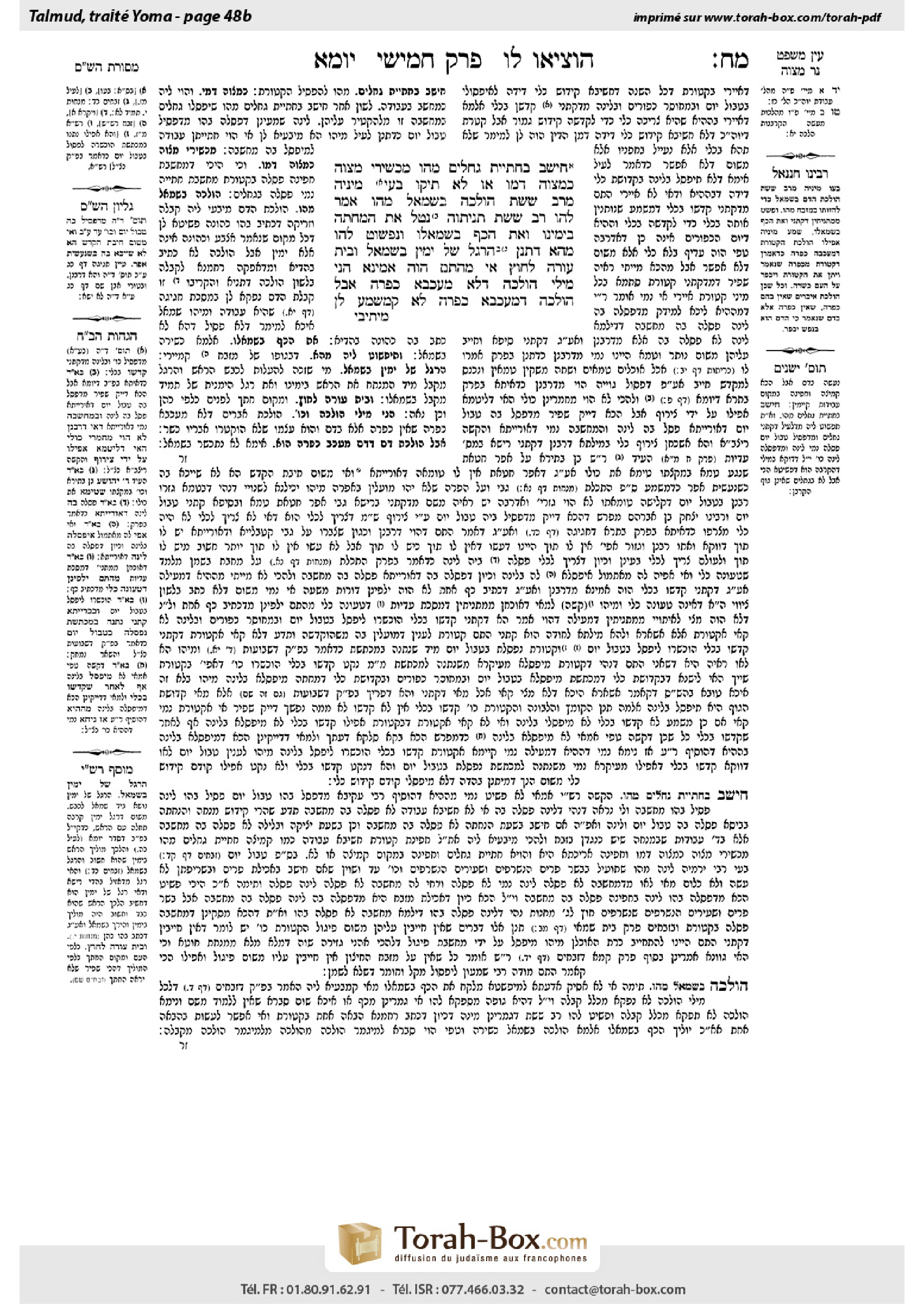
Yoma 48b: Talmud study for Daf Yomi
Study the Talmud for Daf Yomi with scanned pages, Hebrew text, English translations from Sefaria and AI-generated French translations.
Passage selection and English or AI-generated French translation are available where the scan has annotations. Daf Study is independent of Torah-Box and Sefaria.
Browse Yoma · יומא · All tractatesYoma 48b text and translations
This page of Yoma includes the Aramaic text and an English translation, alongside the scan above.
יומא מ״ח ב · Aramaic and Hebrew text
חִישֵּׁב בַּחֲתִיַּית גֶּחָלִים, מַהוּ? מַכְשִׁירֵי מִצְוָה כְּמִצְוָה דָּמוּ, אוֹ לָא? תֵּיקוּ.
בְּעוֹ מִינֵּיהּ מֵרַב שֵׁשֶׁת: הוֹלָכָה בִּשְׂמֹאל, מַהוּ? אֲמַר לְהוּ רַב שֵׁשֶׁת, תְּנֵיתוּהָ: נָטַל אֶת הַמַּחְתָּה בִּימִינוֹ וְאֶת הַכַּף בִּשְׂמֹאלוֹ.
וְנִפְשׁוֹט לְהוּ מֵהָא דִּתְנַן: הָרֶגֶל שֶׁל יָמִין בִּשְׂמֹאל וּבֵית עוֹרָהּ לַחוּץ!
אִי מֵהָתָם, הֲוָה אָמֵינָא: הָנֵי מִילֵּי הוֹלָכָה דְּלָא מְעַכְּבָא כַּפָּרָה, אֲבָל הוֹלָכָה דִּמְעַכְּבָא כַּפָּרָה — לָא, קָמַשְׁמַע לַן.
Yoma 48b · English translation
What is the halakha if he thought invalidating thoughts during the raking of the coals? Does this thought invalidate the incense? The Gemara elaborates: The question here is whether actions that facilitate the performance of a mitzva are considered like the mitzva itself. If so, merely raking the coals, which facilitates the mitzva of the incense, is like burning the incense itself; therefore, an improper thought would disqualify the incense. Or perhaps actions that facilitate the performance of a mitzva are not considered part of the mitzva itself. No answer was found for this question either, and the Gemara once again concludes: Let it stand unresolved.
§ The Sages raised a dilemma before Rav Sheshet: What is the halakha with regard to carrying the blood in one’s left hand? Is this action valid, or is carrying, like receiving and sprinkling the blood, an act that must be performed with the right hand? Rav Sheshet said to them: We already learned it; there is an answer to this question from the mishna: He took the coal pan in his right hand and the spoon in his left hand. This proves that although the spoon is carried in the left hand to the place of the service, the rite is valid.
The Gemara asks: And let us resolve this dilemma for them from that which we learned in a mishna: The priest who is privileged to carry the head and the leg of the daily offering to the ramp carried the right leg in his left hand, with its entire hide facing outward and the place of the slaughter on the neck facing the priest. This mishna also proves that carrying with the left hand is acceptable.
The Gemara rejects this contention: If the proof is from there, I would have said: That applies only to a type of carrying that does not invalidate atonement, as even if the limbs are not carried up to the altar, atonement is nevertheless achieved through the sprinkling of the blood. The rite is valid even if the limbs of the daily offering are not burned at all. However, with regard to the type of carrying that does invalidate atonement, e.g., carrying the blood to the altar, no, perhaps it must be done specifically with the right hand. Rav Sheshet therefore teaches us from the mishna that although carrying the spoon is necessary for the mitzva, the rite is nevertheless valid if it is carried in the left hand.
Text from Sefaria: William Davidson Edition - Vocalized Aramaic (CC BY NC); William Davidson Edition - English (CC BY NC).