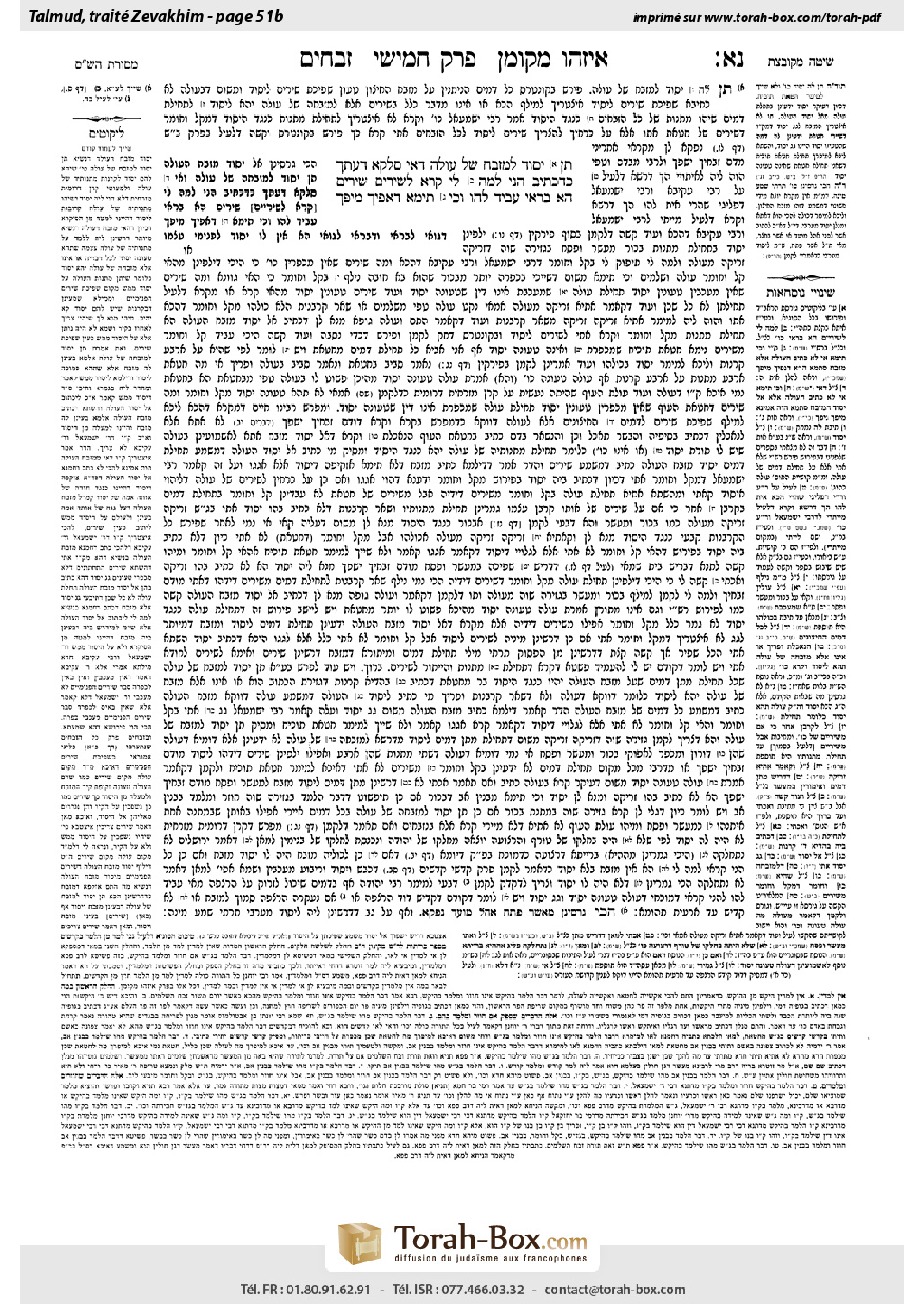
Zevachim 51b: Talmud study for Daf Yomi
Study the Talmud for Daf Yomi with scanned pages, Hebrew text, English translations from Sefaria and AI-generated French translations.
Passage selection and English or AI-generated French translation are available where the scan has annotations. Daf Study is independent of Torah-Box and Sefaria.
Browse Zevachim · זבחים · All tractatesZevachim 51b text and translations
This page of Zevachim includes the Aramaic text and an English translation, alongside the scan above.
זבחים נ״א ב · Aramaic and Hebrew text
תֵּן יְסוֹד לַמִּזְבֵּחַ שֶׁל עוֹלָה.
דְּאִי סָלְקָא דַעְתָּךְ כְּדִכְתִיב; הָנֵי לְמָה לִי קְרָא – לְשִׁירַיִם?! שִׁירַיִם הָא בָּרַאי עָבֵיד לְהוּ!
וְכִי תֵּימָא דְּאָפֵיךְ מֵיפָךְ –
Zevachim 51b · English translation
This teaches that you must give a base to the altar of the burnt offering, i.e., that the remainder of any blood placed on the altar must be poured on the base.
The Gemara explains: Because if it enters your mind that the verse states this simply to teach as it is written, concerning this offering alone, why do I need these verses with regard to the sin offering of a king? If you would answer: The verses are needed to teach the halakha that the remainder of the blood must be poured on the external altar rather than on the inner altar, then the question remains: Is there any need for the Torah to teach this about the remainder? But the sprinklings of blood themselves are performed on the external altar, so why would one think that the remainder of the blood should be poured on the inner altar?
And if you would say that one might mistakenly say that the priest reverses the sprinklings,
Text from Sefaria: William Davidson Edition - Vocalized Aramaic (CC BY NC); William Davidson Edition - English (CC BY NC).