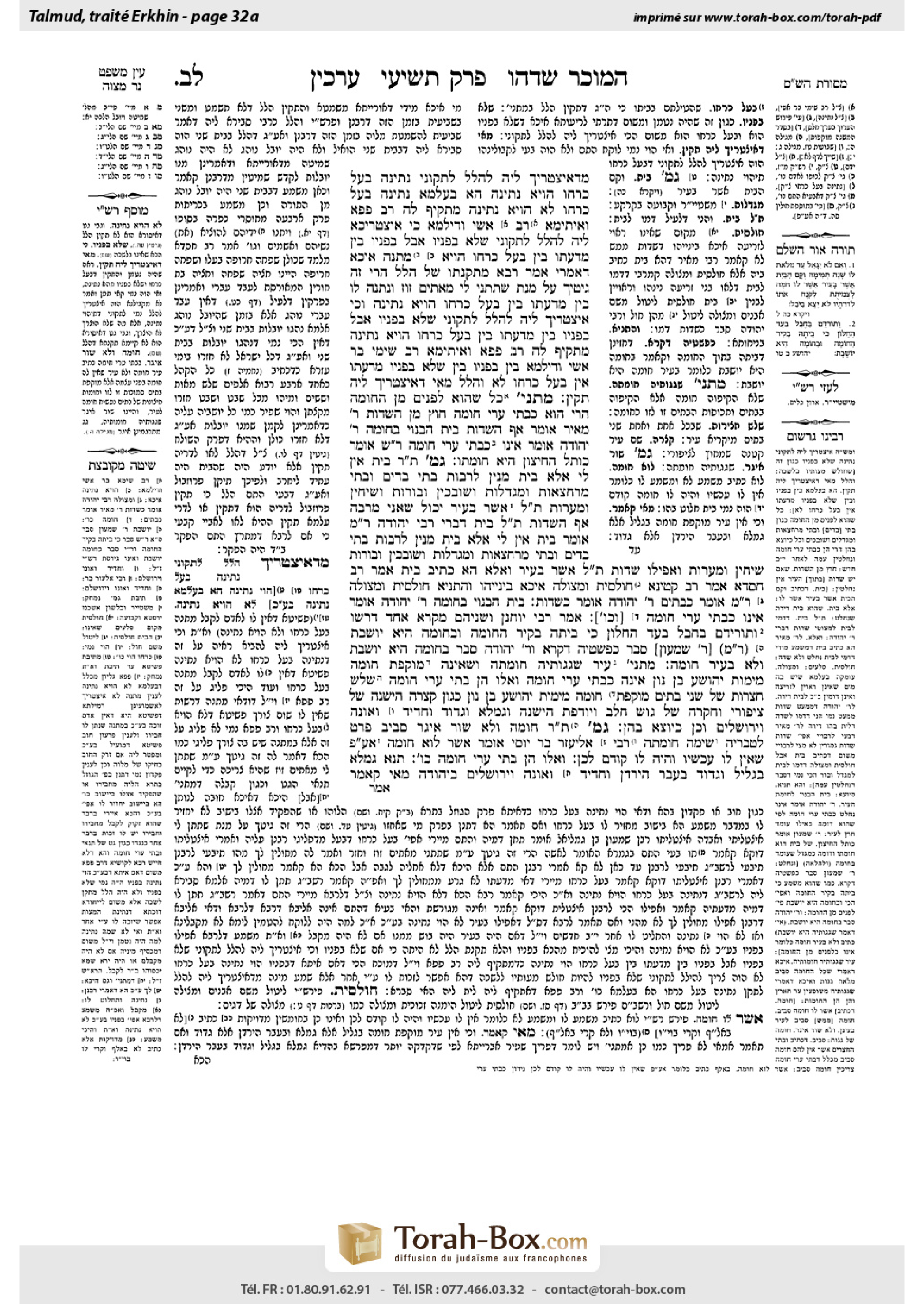
Arakhin 32a: Talmud study for Daf Yomi
Study the Talmud for Daf Yomi with scanned pages, Hebrew text, English translations from Sefaria and AI-generated French translations.
Passage selection and English or AI-generated French translation are available where the scan has annotations. Daf Study is independent of Torah-Box and Sefaria.
Browse Arakhin · ערכין · All tractatesArakhin 32a text and translations
This page of Arakhin includes the Aramaic text, an English translation and an AI-generated French translation, alongside the scan above.
ערכין ל״ב א · Aramaic and Hebrew text
מִדְּאִיצְטְרִיךְ לֵיהּ לְהִלֵּל לְתַקּוֹנֵי נְתִינָה בְּעַל כׇּרְחוֹ הָוְיָא נְתִינָה, הָא בְּעָלְמָא נְתִינָה בְּעַל כׇּרְחוֹ לָא הָוְיָא נְתִינָה.
מַתְקֵיף לַהּ רַב פָּפָּא, וְאִיתֵּימָא רַב אָשֵׁי: וְדִילְמָא כִּי אִיצְטְרִיכָא לֵיהּ לְהִלֵּל לְתַקּוֹנֵי שֶׁלֹּא בְּפָנָיו, אֲבָל בְּפָנָיו — בֵּין מִדַּעְתּוֹ בֵּין בְּעַל כׇּרְחוֹ הָוְיָא מַתָּנָה!
אִיכָּא דְּאָמְרִי, אָמַר רָבָא: מִתַּקָּנָתוֹ שֶׁל הִלֵּל — ״הֲרֵי זֶה גִּיטִּיךְ עַל מְנָת שֶׁתִּתְּנִי לִי מָאתַיִם זוּז״, וּנְתָנָהּ לוֹ, בֵּין מִדַּעְתּוֹ בֵּין בְּעַל כׇּרְחוֹ — הָוְיָא נְתִינָה. וְכִי אִיצְטְרִיךְ לֵיהּ לְהִלֵּל לְתַקּוֹנֵי — שֶׁלֹּא בְּפָנָיו, אֲבָל בְּפָנָיו — בֵּין מִדַּעְתּוֹ בֵּין בְּעַל כׇּרְחוֹ הָוְיָא נְתִינָה.
מַתְקֵיף לַהּ רַב פָּפָּא, וְאִיתֵּימָא רַב שִׁימִי בַּר אָשֵׁי: וְדִילְמָא בֵּין בְּפָנָיו בֵּין שֶׁלֹּא בְּפָנָיו, מִדַּעְתּוֹ — אִין, בְּעַל כׇּרְחוֹ — לָא, וְהִלֵּל מַאי דְּאִיצְטְרִיךְ לֵיהּ תַּקֵּין!
מַתְנִי׳ כׇּל שֶׁהוּא לִפְנִים מִן הַחוֹמָה — הֲרֵי הוּא כְּבָתֵּי עָרֵי חוֹמָה, חוּץ מִן הַשָּׂדוֹת. רַבִּי מֵאִיר אוֹמֵר: אַף הַשָּׂדוֹת. בַּיִת הַבָּנוּי בַּחוֹמָה — רַבִּי יְהוּדָה אוֹמֵר: אֵינוֹ כְּבָתֵּי עָרֵי חוֹמָה. רַבִּי שִׁמְעוֹן אוֹמֵר: כּוֹתֶל הַחִיצוֹן הִיא חוֹמָתוֹ.
גְּמָ׳ תָּנוּ רַבָּנַן: בַּיִת — אֵין לִי אֶלָּא בַּיִת, מִנַּיִן לְרַבּוֹת בָּתֵּי בַדִּים וּבָתֵּי מֶרְחֲצָאוֹת וּמִגְדָּלוֹת וְשׁוֹבָכִין וּבוֹרוֹת וְשִׁיחִין וּמְעָרוֹת? תַּלְמוּד לוֹמַר: ״אֲשֶׁר בָּעִיר״. יָכוֹל שֶׁאֲנִי מְרַבֶּה אַף הַשָּׂדוֹת? תַּלְמוּד לוֹמַר: ״בַּיִת״, דִּבְרֵי רַבִּי יְהוּדָה.
רַבִּי מֵאִיר אוֹמֵר: נֶאֱמַר ״בַּיִת״ — אֵין לִי אֶלָּא בַּיִת, מִנַּיִן לְרַבּוֹת בָּתֵּי בַדִּים וּבָתֵּי מֶרְחֲצָאוֹת, וּמִגְדָּלוֹת וְשׁוֹבָכִין, וּבוֹרוֹת שִׁיחִין וּמְעָרוֹת, וַאֲפִילּוּ שָׂדוֹת? תַּלְמוּד לוֹמַר: ״אֲשֶׁר בָּעִיר״.
וְאֶלָּא הָא כְּתִיב ״בַּיִת״! אָמַר רַב חִסְדָּא אָמַר רַב קַטִּינָא: חוֹלְסִית וּמְצוּלָה אִיכָּא בֵּינַיְיהוּ, וְהָתַנְיָא: חוֹלְסִית וּמְצוּלָה, רַבִּי מֵאִיר אוֹמֵר: כְּבָתִּים, רַבִּי יְהוּדָה אוֹמֵר: כְּשָׂדוֹת.
בַּיִת הַבָּנוּי בַּחוֹמָה, רַבִּי יְהוּדָה אוֹמֵר: אֵינוֹ כְּבָתֵּי עָרֵי חוֹמָה. אָמַר רַבִּי יוֹחָנָן: וּשְׁנֵיהֶם מִקְרָא אֶחָד דָּרְשׁוּ, ״וַתּוֹרִידֵם בַּחֶבֶל בְּעַד הַחַלּוֹן כִּי בֵיתָהּ בְּקִיר הַחוֹמָה וּבַחוֹמָה הִיא יוֹשָׁבֶת״. רַבִּי שִׁמְעוֹן סָבַר כִּפְשָׁטֵיהּ דִּקְרָא, וְרַבִּי יְהוּדָה סָבַר: ״בַּחוֹמָה הִיא יוֹשָׁבֶת״ וְלֹא בְּעִיר חוֹמָה.
מַתְנִי׳ עִיר שֶׁגַּגּוֹתֶיהָ חוֹמָתָהּ, וְשֶׁאֵינָהּ מוּקֶּפֶת חוֹמָה מִימוֹת יְהוֹשֻׁעַ בִּן נוּן, אֵינָהּ כְּבָתֵּי עָרֵי חוֹמָה. וְאֵלּוּ הֵן בָּתֵּי עָרֵי חוֹמָה: שָׁלֹשׁ חֲצֵרוֹת שֶׁל שְׁנֵי בָתִּים, מוּקֶּפֶת חוֹמָה מִימוֹת יְהוֹשֻׁעַ בִּן נוּן, כְּגוֹן קַצְרָה הַיְּשָׁנָה שֶׁל צִיפּוֹרִי, וְחַקְרָה שֶׁל גּוּשׁ חָלָב, וְיוֹדְפַת הַיְּשָׁנָה, וְגַמְלָא, וּגְדוֹד, וְחָדִיד, וְאוֹנוֹ, וִירוּשָׁלַיִם, וְכֵן כְּיוֹצֵא בָּהֶן.
גְּמָ׳ תָּנוּ רַבָּנַן: ״חוֹמָה״ — וְלֹא שׁוּר אִיגָּר, ״סָבִיב״ — פְּרָט לִטְבֶרְיָה שֶׁיַּמָּהּ חוֹמָתָהּ.
רַבִּי אֱלִיעֶזֶר בַּר יוֹסֵי אוֹמֵר: ״אֲשֶׁר לוֹא חוֹמָה״ — אַף עַל פִּי שֶׁאֵין לוֹ עַכְשָׁיו וְהָיָה לוֹ קוֹדֶם לָכֵן.
וְאֵלּוּ הֵן בָּתֵּי עָרֵי חוֹמָה כּוּ׳. תָּנָא: גַּמְלָא בַּגָּלִיל, וּגְדוֹד בְּעֵבֶר הַיַּרְדֵּן, וְחָדִיד וְאוֹנוֹ וִירוּשָׁלַיִם בִּיהוּדָה. מַאי קָאָמַר?
Arakhin 32a · English translation
The Gemara elaborates: From the fact that it was necessary for Hillel to institute that giving against the will of the receiver is considered giving, in the case of houses of walled cities, one may infer that in general, giving against the will of the recipient is not considered giving.
Rav Pappa objects to this, and some say that it was Rav Ashi who objected: But perhaps when it was necessary for Hillel to institute this ordinance, it was specifically for a case where the seller gives the money not in the presence of the buyer; but if he repays the buyer in his presence, then whether the buyer was repaid with his consent or whether it was against his will, it is considered a valid act of giving.
There are those who say an opposite version of this discussion, i.e., that Rava says: One may infer from the ordinance of Hillel that if one says to his wife: This is your bill of divorce on the condition that you will give me two hundred dinars, and she gave it to him, whether it was with his consent or whether it was against his will, it is a valid act of giving. And this is because when it was necessary for Hillel to institute this ordinance, it was specifically for a case where the seller gives the money not in the presence of the buyer. But if the seller repays him in his presence, whether the buyer was repaid with his consent or whether it was against his will, it is considered a valid act of giving.
Rav Pappa objects to this, and some say it was Rav Shimi bar Ashi who objected: But perhaps, whether she gives him the money in his presence or not in his presence, if she gives it with his consent, yes, it is valid, but if she gives it against his will, it is not considered a valid act of giving. And Hillel instituted what was necessary, to remedy the practical occurrence that buyers would hide themselves at the end of the year. But even if the seller finds the buyer and the buyer refuses to accept payment, it would be necessary for Hillel to institute an ordinance.
MISHNA The halakhic status of any area that is located within the city wall is like that of the houses of walled cities in terms of its redemption, except for the fields located therein. Rabbi Meir says: Even the fields are included in this category. With regard to a house that is built in the wall itself, Rabbi Yehuda says: Its halakhic status is not like that of the houses of walled cities. Rabbi Shimon says: The outer wall of the house is considered the city wall, and therefore it has the status of a house in a walled city.
GEMARA The Sages taught: The verse states: “Then the house that is in the walled city shall stand in possession of the one who bought it in perpetuity” (Leviticus 25:30). I have derived only that this is the halakha with regard to a house; from where is it derived to include olive presses, bathhouses, towers, dovecotes, pits, ditches, and caves? The verse states: “That is in the walled city,” indicating that anything situated within the city is included. If so, one might have thought that I should include even the fields that are inside the city. Therefore, the verse states: “House,” which excludes a field; it does not resemble a house in any way, since it does not contain any items. This is the statement of Rabbi Yehuda.
Rabbi Meir says: The verse states: “House.” I have derived only a house; from where is it derived to include olive presses, bathhouses, towers, dovecotes, pits, ditches, and caves, and even fields? The verse states: “That is in the walled city,” to include anything inside the city.
The Gemara questions the statement of Rabbi Meir: But isn’t it written: “House”? If Rabbi Meir includes even a field, what is excluded by the word “house”? Rav Ḥisda said that Rav Ketina said: Actually, everyone agrees that the term “house” serves to exclude a field. The difference of opinion between Rabbi Meir and Rabbi Yehuda is with regard to a quarry and a sand bed. According to Rabbi Meir, such areas are considered similar to houses and are therefore included in the halakha. The Gemara adds: And it is likewise taught in a baraita: With regard to a quarry and a sand bed inside the walls of a city, Rabbi Meir says: They are considered like houses, and Rabbi Yehuda says: They are considered like fields.
§ The mishna teaches: With regard to a house that is built in the wall itself, Rabbi Yehuda says: Its halakhic status is not like that of the houses of walled cities, and Rabbi Shimon says: The outer wall of the house is considered the city wall. Rabbi Yoḥanan says: And both of them derived their opinions from one verse: “Then she let them down by a cord through the window; for her house was upon the side of the wall; and she dwelt upon the wall” (Joshua 2:15). Rabbi Shimon holds that the last phrase should be understood in accordance with the simple meaning of the verse, that her house was attached to the outer wall and it was considered inside the walled city; and Rabbi Yehuda holds that “she dwelt upon the wall” means she was a resident of the wall itself, but not a resident of the city enclosed within the wall.
MISHNA The halakhic status of a house in a city whose houses are attached and their rooftops constitute the top of its wall, and likewise, the status of a house in a city that is not surrounded by a wall from the era of Joshua, son of Nun, even if a surrounding wall was constructed during a later period, is not like that of the houses of walled cities. And these are the houses of walled cities: Any city in which there are at least three courtyards, each containing two houses, and which is surrounded by a wall from the era of Joshua, son of Nun, e.g., the ancient fort [katzra] of Tzippori, and the fortress [ḥakra] of Gush Ḥalav, and ancient Yodfat, and Gamla, and Gedod, and Ḥadid, and Ono, and Jerusalem, and likewise other similar cities.
GEMARA With regard to the statement of the mishna that the halakhic status of a house in a city whose rooftops constitute the top of its wall is not like that of the houses of walled cities, the Sages taught: When the verse states: “The house that is in the city that has a wall” (Leviticus 25:30), this is referring specifically to a city that has an actual wall and not merely a wall of roofs. When the next verse states: “But the houses of the villages that have no wall round about them shall be reckoned with the fields of the country,” this serves to exclude Tiberias from being considered a walled city, as the sea is its wall on one side and it is not fully encircled by a physical wall.
Rabbi Eliezer bar Yosei says: Since the verse states: “Which has [lo] a wall,” with lo written with an alef, according to which the verse may also be taken to mean: Which does not have a wall, this indicates that even if a city does not have a wall now, but it had a wall before, in the era of Joshua, son of Nun, it retains its status as a walled city.
§ The mishna teaches: And these are the houses of walled cities: The ancient fort of Tzippori, and the fortress of Gush Ḥalav, and ancient Yodfat, and Gamla, and Gedod, and Ḥadid, and Ono, and Jerusalem, and likewise other similar cities. The Sages taught in a baraita: Gamla is in the Galilee, and Gedod is in Transjordan, and Ḥadid and Ono and Jerusalem are in Judea. The Gemara asks: What is the tanna of this baraita saying? Are these the only walled cities in the Galilee, Transjordan, and Judea?
Arakhin 32a · Traduction française (IA)
La Guemara développe : On peut en déduire que Hillel a institué que donner contre la volonté du receveur est considéré comme un don, dans le cas des maisons des villes murées, qu'en général, donner contre la volonté du receveur n'est pas considéré comme un don.
Rav Pappa s'oppose à cela, et certains disent que c'est Rav Ashi qui s'est opposé : Mais peut-être que lorsqu'il a été nécessaire pour Hillel d'instituer cette ordonnance, c'était spécifiquement pour un cas où le vendeur donne l'argent en présence du acheteur ; mais si il rembourse l'acheteur en sa présence, alors que l'acheteur est remboursé avec son accord ou contre sa volonté, cela est considéré comme un acte valide de don.
Certains disent une version opposée de cette discussion, c'est-à-dire que Rava dit : On peut en déduire de l'ordonnance de Hillel que si l'on dit à sa femme : C'est ton acte de divorce, à la condition que tu me donnes deux cents drachmes, et elle le lui donne, qu'il soit avec son accord ou contre sa volonté, c'est un acte valide de don. Et cela est parce que lorsqu'il a été nécessaire pour Hillel d'instituer cette ordonnance, c'était spécifiquement pour un cas où le vendeur donne l'argent en présence du acheteur. Mais si le vendeur rembourse en sa présence, qu'il soit avec son accord ou contre sa volonté, cela est considéré comme un acte valide de don.
Rav Pappa s'oppose à cela, et certains disent que c'était Rav Shimi bar Ashi qui s'est opposé : Mais peut-être, qu'elle donne l'argent devant lui ou non, si elle le fait avec son accord, oui, c'est valide, mais si elle le fait contre sa volonté, cela n'est pas considéré comme un acte valide de don. Et Hillel a institué ce qui était nécessaire, pour résoudre l'occurrence pratique que les acheteurs se cachaient à la fin de l'année. Mais même si le vendeur trouve l'acheteur et que l'acheteur refuse de recevoir le paiement, il aurait été nécessaire pour Hillel d'instituer une ordonnance.
MICHNA Le statut halakhique d'une zone située à l'intérieur des murs d'une ville est comme celui des maisons des villes murées en ce qui concerne sa rédemption, sauf les champs situés à l'intérieur. Rabbi Meir dit : Même les champs sont inclus dans cette catégorie. En ce qui concerne une maison construite dans les murs eux-mêmes, Rabbi Yéhuda dit : Son statut halakhique n'est pas comme celui des maisons des villes murées. Rabbi Shimon dit : La façade extérieure de la maison est considérée comme le mur de la ville, et par conséquent, elle a le statut d'une maison dans une ville murée.
GUEMARA Les Sages enseignent : La parabole dit : « Alors la maison qui est dans la ville murée restera dans la possession de celui qui l'a achetée à perpétuité » (Lévitique 25:30). J'ai déduit seulement que c'est la halakha concernant une maison ; d'où est-elle déduite pour inclure les presses d'olive, les bains, les tours, les colombiers, les puits, les fossés et les grottes ? La parabole dit : « Qui est dans la ville murée », indiquant que tout ce qui est situé à l'intérieur de la ville est inclus. Si tel est le cas, on pourrait penser que je dois inclure même les champs qui sont à l'intérieur de la ville. Par conséquent, la parabole dit : « Maison », ce qui exclut un champ ; il ne ressemble pas à une maison de toute façon, car il ne contient aucun objet. C'est la déclaration de Rabbi Yéhuda.
Rabbi Meir dit : La Torah dit : « Maison ». J'ai déduit seulement une maison ; d'où est-elle déduite pour inclure les presses d'olive, les bains, les tours, les colombiers, les puits, les fossés et les grottes, et même les champs ? La Torah dit : « Qui est dans la ville murée », pour inclure tout ce qui est à l'intérieur de la ville.
La Guemara questionne la déclaration de Rabbi Meir : Mais n'est-il pas écrit : « Maison » ? Si Rabbi Meir inclut même un champ, qu'est-ce qui est exclu par le mot « maison » ? Rav Ḥisda a dit que Rav Ketina a dit : En réalité, tout le monde convient que le terme « maison » sert à exclure un champ. La différence d'opinion entre Rabbi Meir et Rabbi Yéhuda est concernant un carrière et un lit de sable. Selon Rabbi Meir, ces zones sont considérées comme semblables aux maisons et sont donc incluses dans la halakha. La Guemara ajoute : Et il est également enseigné dans une baraïta : Concernant un carrière et un lit de sable à l'intérieur des murs d'une ville, Rabbi Meir dit : Ils sont considérés comme des maisons, et Rabbi Yéhuda dit : Ils sont considérés comme des champs.
§ La mitsna enseigne : Concernant une maison construite dans le mur lui-même, Rabbi Yéhuda dit : Son statut halakhique n'est pas comme celui des maisons des villes murées, et Rabbi Shimon dit : La façade extérieure de la maison est considérée comme le mur de la ville. Rabbi Yoḥanan dit : Et tous deux ont déduit leurs opinions d'une seule versette : « Alors elle les laissa descendre par une corde par la fenêtre ; car sa maison était sur le côté du mur ; et elle habitait sur le mur » (Josué 2:15). Rabbi Shimon considère que la dernière phrase doit être comprise selon le sens simple de la versette, que sa maison était attachée au mur extérieur et qu'elle était considérée comme à l'intérieur de la ville murée ; et Rabbi Yéhuda considère que « elle habitait sur le mur » signifie qu'elle était une résidente du mur lui-même, mais pas une résidente de la ville enfermée dans le mur.
MICHNA Le statut halakhique d'une maison dans une ville dont les maisons sont accolées et leurs toits constituent le sommet de son mur, et de même, le statut d'une maison dans une ville qui n'est pas entourée d'un mur depuis l'époque de Josué, fils de Nun, même si un mur a été construit ultérieurement, n'est pas comme celui des maisons des villes murées. Et ces sont les maisons des villes murées : toute ville dont il y a au moins trois courtyards, chacun contenant deux maisons, et qui est entourée d'un mur depuis l'époque de Josué, fils de Nun, par exemple, le fort [katzra] de Tzippori, et le fort [ḥakra] de Gush Ḥalav, et l'ancienne Yodfat, et Gamla, et Gedod, et Ḥadid, et Ono, et Jérusalem, et de même d'autres villes similaires.
GUEMARA Concernant la déclaration de la michna selon laquelle le statut halakhique d'une maison dans une ville dont les toits forment le sommet de son mur n'est pas comme celui des maisons des villes murées, les Sages enseignent : Lorsque la parole divine dit : « La maison qui est dans la ville qui a un mur » (Lévitique 25:30), cela fait référence spécifiquement à une ville qui possède un mur réel et non simplement un mur de toits. Lorsque le verset suivant dit : « Mais les maisons des villages qui n'ont pas de mur autour d'eux seront comptées avec les champs du pays », cela sert à exclure Tibériade de considération comme une ville murée, car la mer est son mur d'un côté et elle n'est pas entièrement entourée d'un mur physique.
Rabbi Eliezer bar Yosei dit : Puisque la versette dit : « Qui a [lo] un mur », avec lo écrit avec un aleph, d'après lequel la versette peut aussi être prise à signifier : « Qui n'a pas de mur », cela indique que même si une ville n'a pas de mur aujourd'hui, mais qu'elle en avait un avant, à l'époque de Josué, fils de Nun, elle conserve son statut de ville murée.
§ La michna enseigne : Et ces sont les maisons des villes murées : Le fort antique de Tzippori, et le fort de Gush Ḥalav, et l'ancienne Yodfat, et Gamla, et Gedod, et Ḥadid, et Ono, et Jérusalem, et de même d'autres villes semblables. Les Sages enseignèrent dans une baraïta : Gamla est en Galilée, et Gedod est en Transjordan, et Ḥadid et Ono et Jérusalem sont en Judée. La Guemara demande : Quel est le tanna de cette baraïta ? Sont-ce les seules villes murées en Galilée, Transjordan et Judée ?
Traduction française générée par IA à partir de l’édition anglaise de Sefaria. Vérifie toujours un passage avec le texte source.
Text from Sefaria: William Davidson Edition - Vocalized Aramaic (CC BY NC); William Davidson Edition - English (CC BY NC).