Arakhin 31b: Talmud study for Daf Yomi
Study the Talmud for Daf Yomi with scanned pages, Hebrew text, English translations from Sefaria and AI-generated French translations.
Passage selection and English or AI-generated French translation are available where the scan has annotations. Daf Study is independent of Torah-Box and Sefaria.
Browse Arakhin · ערכין · All tractatesArakhin 31b text and translations
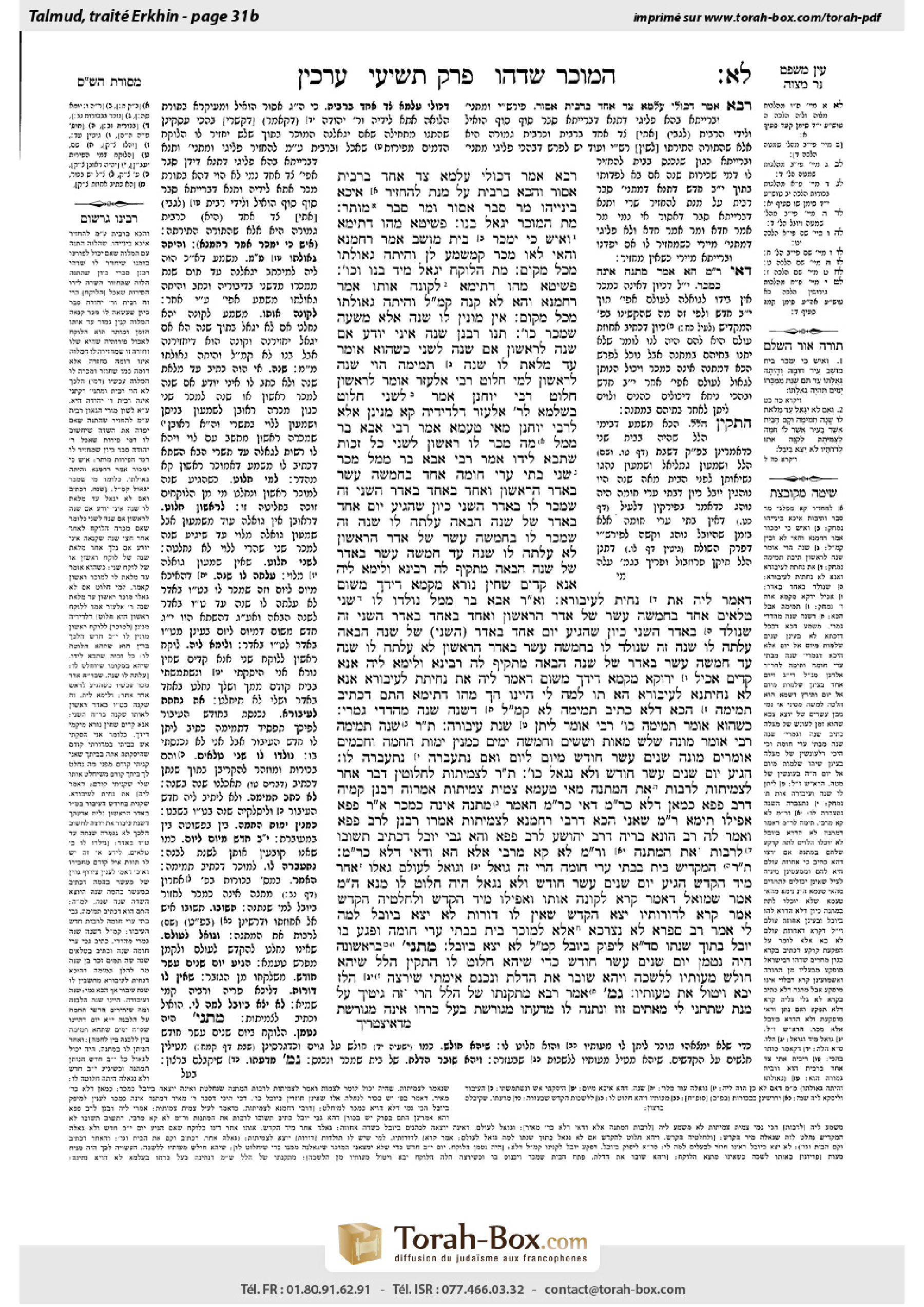
This page of Arakhin includes the Aramaic text, an English translation and an AI-generated French translation, alongside the scan above.
ערכין ל״א ב · Aramaic and Hebrew text
רָבָא אָמַר: דְּכוּלֵּי עָלְמָא צַד אֶחָד בְּרִבִּית אָסוּר, וְהָכָא בְּרִבִּית עַל מְנָת לְהַחְזִיר אִיכָּא בֵּינַיְיהוּ — מָר סָבַר: אָסוּר, וּמָר סָבַר: מוּתָּר.
מֵת הַמּוֹכֵר יִגְאַל בְּנוֹ. פְּשִׁיטָא! מַהוּ דְּתֵימָא: ״וְאִישׁ כִּי יִמְכֹּר בֵּית מוֹשַׁב״ אָמַר רַחֲמָנָא, וְהַאי לָאו מְכַר, קָמַשְׁמַע לַן: ״וְהָיְתָה גְּאֻלָּתוֹ״ — מִכׇּל מָקוֹם.
מֵת הַלּוֹקֵחַ יִגְאַל מִיָּד בְּנוֹ וְכוּ׳. פְּשִׁיטָא! מַהוּ דְּתֵימָא: ״לַקּוֹנֶה אוֹתוֹ״ אָמַר רַחֲמָנָא, וְהָא לָא קְנָה — קָא מַשְׁמַע לַן: ״וְהָיְתָה גְּאֻלָּתוֹ״ מִכׇּל מָקוֹם.
אֵין מוֹנִין לוֹ שָׁנָה אֶלָּא מִשָּׁעָה שֶׁמָּכַר כּוּ׳. תָּנוּ רַבָּנַן: שָׁנָה — אֵינִי יוֹדֵעַ אִם שָׁנָה לָרִאשׁוֹן אִם שָׁנָה לַשֵּׁנִי, כְּשֶׁהוּא אוֹמֵר ״עַד מְלֹאת לוֹ שָׁנָה תְמִימָה״ — הֱוֵי שָׁנָה לָרִאשׁוֹן.
לְמִי חָלוּט? רַבִּי אֶלְעָזָר אוֹמֵר: לָרִאשׁוֹן חָלוּט, רַבִּי יוֹחָנָן אָמַר: לַשֵּׁנִי חָלוּט. בִּשְׁלָמָא לְרַבִּי אֶלְעָזָר דִּלְדִידֵיהּ קָא מָנֵינַן, אֶלָּא לְרַבִּי יוֹחָנָן מַאי טַעְמָא? אָמַר רַבִּי אַבָּא בַּר מֶמֶל: מָה מָכַר לוֹ רִאשׁוֹן לְשֵׁנִי — כׇּל זְכוּת שֶׁתָּבֹא לְיָדוֹ.
אָמַר רַבִּי אַבָּא בַּר מֶמֶל: מָכַר שְׁנֵי בָּתֵּי עָרֵי חוֹמָה, אֶחָד בַּחֲמִשָּׁה עָשָׂר בַּאֲדָר הָרִאשׁוֹן וְאֶחָד בְּאֶחָד בַּאֲדָר הַשֵּׁנִי; זֶה שֶׁמָּכַר לוֹ בַּאֲדָר הַשֵּׁנִי, כֵּיוָן שֶׁהִגִּיעַ יוֹם אֶחָד בַּאֲדָר שֶׁל שָׁנָה הַבָּאָה — עָלְתָה לוֹ שָׁנָה; זֶה שֶׁמָּכַר לוֹ בַּחֲמִשָּׁה עָשָׂר שֶׁל אֲדָר הָרִאשׁוֹן — לֹא עָלְתָה לוֹ שָׁנָה עַד חֲמִשָּׁה עָשָׂר בַּאֲדָר שֶׁל שָׁנָה הַבָּאָה.
מַתְקֵיף לַהּ רָבִינָא, וְלֵימָא לֵיהּ: ״אֲנָא קָדֵים שָׁחֵין נוּרָא מִקַּמֵּא דִּידָךְ״! מִשּׁוּם דַּאֲמַר לֵיהּ: ״אַתְּ נְחֵית לְעִיבּוּרָא״.
וְאָמַר רַבִּי אַבָּא בַּר מֶמֶל: נוֹלְדוּ לוֹ שְׁנֵי טְלָאִים, אֶחָד בַּחֲמִשָּׁה עָשָׂר שֶׁל אֲדָר הָרִאשׁוֹן וְאֶחָד בְּאֶחָד בַּאֲדָר הַשֵּׁנִי, זֶה שֶׁנּוֹלַד בַּאֲדָר הַשֵּׁנִי, כֵּיוָן שֶׁהִגִּיעַ יוֹם אֶחָד בַּאֲדָר שֶׁל שָׁנָה הַבָּאָה — עָלְתָה לוֹ שָׁנָה, זֶה שֶׁנּוֹלַד לוֹ בַּחֲמִשָּׁה עָשָׂר בַּאֲדָר הָרִאשׁוֹן — לֹא עָלְתָה לוֹ שָׁנָה עַד חֲמִשָּׁה עָשָׂר בַּאֲדָר שֶׁל שָׁנָה הַבָּאָה.
מַתְקֵיף לַהּ רָבִינָא, וְלֵימָא לֵיהּ: אֲנָא קָדֵים אָכֵיל יְרוּקָּא מִקַּמָּךְ דִּידָךְ! מִשּׁוּם דַּאֲמַר לֵיהּ: אַתְּ נְחֵיתְתְּ לְעִיבּוּרָא, אֲנָא לָא נְחֵיתְנָא לְעִיבּוּרָא.
הָא תּוּ לְמָה לִי? הַיְינוּ הָךְ! מַהוּ דְּתֵימָא: הָתָם, דִּכְתִיב ״תְּמִימָה״, הָכָא, דְּלָא כְּתִיב ״תְּמִימָה״ — לָא. קָא מַשְׁמַע לַן, דְּ״שָׁנָה״ ״שָׁנָה״ מֵהֲדָדֵי גָּמְרִי.
כְּשֶׁהוּא אוֹמֵר ״תְּמִימָה״ כּוּ׳. רַבִּי אוֹמֵר: לִיתֵּן שְׁנַת עִיבּוּרָהּ. תָּנוּ רַבָּנַן: ״שָׁנָה תְּמִימָה״, רַבִּי אוֹמֵר: מוֹנֶה שְׁלֹשׁ מֵאוֹת וְשִׁשִּׁים וַחֲמִשָּׁה יָמִים כְּמִנְיַן יְמוֹת הַחַמָּה, וַחֲכָמִים אוֹמְרִים: מוֹנֶה שְׁנֵים עָשָׂר חוֹדֶשׁ מִיּוֹם לְיוֹם, וְאִם נִתְעַבְּרָה — נִתְעַבְּרָה לוֹ.
הִגִּיעַ יוֹם שְׁנֵים עָשָׂר חוֹדֶשׁ וְלֹא נִגְאָל כּוּ׳. תָּנוּ רַבָּנַן: ״לַצְּמִיתוּת״ — לַחֲלוּטִין. דָּבָר אַחֵר: ״לַצְּמִיתוּת״ — לְרַבּוֹת אֶת הַמַּתָּנָה. מַאי טַעְמָא? ״צְמִית״ ״צְמִיתוּת״.
אַמְרוּהָ רַבָּנַן קַמֵּיהּ דְּרַב פָּפָּא, כְּמַאן? דְּלָא כְּרַבִּי מֵאִיר, דְּאִי כְּרַבִּי מֵאִיר — הָאָמַר מַתָּנָה אֵינָהּ כְּמֶכֶר! אָמַר רַב פָּפָּא: אֲפִילּוּ תֵּימָא רַבִּי מֵאִיר, שָׁאנֵי הָכָא דְּרַבִּי רַחֲמָנָא ״לַצְּמִיתוּת״.
אֲמַרוּ רַבָּנַן לְרַב פָּפָּא, וַאֲמַר לַהּ רַב הוּנָא בְּרֵיהּ דְּרַב יְהוֹשֻׁעַ לְרַב פָּפָּא: וְהָא גַּבֵּי יוֹבֵל, דִּכְתִיב ״תָּשׁוּבוּ״ לְרַבּוֹת אֶת הַמַּתָּנָה, וְרַבִּי מֵאִיר לָא קָא מְרַבֵּי! אֶלָּא הָא וַדַּאי דְּלָא כְּרַבִּי מֵאִיר.
תָּנוּ רַבָּנַן: הַמַּקְדִּישׁ בַּיִת בְּבָתֵּי עָרֵי חוֹמָה — הֲרֵי זֶה גּוֹאֵל, וְגוֹאֵל לְעוֹלָם. גְּאָלוֹ אַחֵר מִיַּד הֶקְדֵּשׁ, הִגִּיעַ יוֹם שְׁנֵים עָשָׂר חוֹדֶשׁ וְלֹא נִגְאַל — הָיָה חָלוּט לוֹ.
מְנָא הָנֵי מִילֵּי? אָמַר שְׁמוּאֵל, דְּאָמַר קְרָא: ״לַקּוֹנֶה אוֹתוֹ״, וַאֲפִילּוּ מִיַּד הֶקְדֵּשׁ. וְלַחְלְטֵיהּ הֶקְדֵּשׁ? אָמַר קְרָא: ״לְדוֹרוֹתָיו״, יָצָא הֶקְדֵּשׁ שֶׁאֵין לוֹ דּוֹרוֹת.
לֹא יֵצֵא בַּיּוֹבֵל, לְמָה לִי? אָמַר רַב סָפְרָא: לֹא נִצְרְכָא אֶלָּא לְמוֹכֵר בַּיִת בְּבָתֵּי עָרֵי חוֹמָה, וּפָגַע בּוֹ יוֹבֵל בְּתוֹךְ שְׁנָתוֹ. סָלְקָא דַּעְתָּךְ אָמֵינָא: לִיפּוֹק בְּיוֹבֵל, קָא מַשְׁמַע לַן: ״לֹא יֵצֵא בַּיּוֹבֵל״.
מַתְנִי׳ בָּרִאשׁוֹנָה הָיָה נִטְמָן יוֹם שְׁנֵים עָשָׂר חוֹדֶשׁ, כְּדֵי שֶׁיְּהֵא חָלוּט לוֹ. הִתְקִין הִלֵּל שֶׁיְּהֵא חוֹלֵשׁ מְעוֹתָיו לַלִּשְׁכָּה, וִיהֵא שׁוֹבֵר אֶת הַדֶּלֶת וְנִכְנָס, אֵימָתַי שֶׁיִּרְצֶה הַלָּז יָבֹא וְיִטּוֹל אֶת מְעוֹתָיו.
גְּמָ׳ אָמַר רָבָא: מִתַּקָּנָתוֹ שֶׁל הַלֵּל — ״הֲרֵי זֶה גִּיטִּיךְ עַל מְנָת שֶׁתִּתְּנִי לִי מָאתַיִם זוּז״, וּנְתָנָהּ לוֹ מִדַּעְתּוֹ — מְגוֹרֶשֶׁת, בְּעַל כׇּרְחוֹ — אֵינָהּ מְגוֹרֶשֶׁת.
Arakhin 31b · English translation
Rava said: Everyone agrees that uncertain interest is prohibited; and here, the dispute between Rabbi Yehuda and the Rabbis concerns the permissibility of interest given on the condition that it will be returned. That is, in addition to the arrangement described in the baraita, the parties agreed that the buyer will consume the produce, and if the sale will later be nullified, then the buyer will reimburse the seller for the value of the produce. One Sage, the first tanna, holds that although the interest is subsequently refunded, this practice is prohibited, and one Sage, Rabbi Yehuda, holds that this is permitted.
§ The mishna teaches: With regard to one who sells a house from among the houses of walled cities, if the seller died, his son may redeem the house from the buyer. The Gemara asks: This is obvious, as a son inherits his father’s property. The Gemara responds: Lest you say that when the Merciful One states: “And if a man sells a dwelling house in a walled city, then he may redeem it until the completion of the year after it is sold” (Leviticus 25:29), this indicates that the man who redeems the house must be the same man who sold it, and this son did not sell; therefore, the same verse teaches us: “And he shall have the right of redemption,” indicating that the right of redemption applies in any case, either to the seller or his son.
The mishna further teaches: If the buyer died, the seller may redeem the house from the possession of the buyer’s son. The Gemara asks: This, too, is obvious. The Gemara responds: Lest you say that the Merciful One states: “Then the house that is in the walled city shall stand in possession of the one who bought it in perpetuity” (Leviticus 25:30), and as this son did not buy the house, the buyer cannot redeem it from him; therefore, the previous verse teaches us: “He shall have the right of redemption,” indicating that this right applies in any case, even from the buyer’s son.
§ The mishna teaches that if the buyer sold the house to another, one calculates the year only from the time that the owner sold the house to the first buyer, as it is stated: “And if it is not redeemed until the passage of a full year for him” (Leviticus 25:30). The Sages taught: When the verse states “year,” I do not know if one counts the year from when the owner sold it to the first buyer, or if one counts the year from when the first buyer sold it to the second. When the verse states: “Until the passage of a full year for him,” you must say that it is a year from when the owner sold it to the first buyer.
The Gemara asks: In such a case, if the owner did not redeem the house within one year of the first sale, to whom does it belong in perpetuity? Rabbi Elazar says: It belongs in perpetuity to the first buyer. Rabbi Yoḥanan says: It belongs in perpetuity to the second buyer. The Gemara asks: Granted, according to the opinion of Rabbi Elazar, it is understandable why the house belongs to the first buyer, as one calculates the year according to his acquisition. But according to the opinion of Rabbi Yoḥanan, what is the reason that the house belongs to the second buyer after the conclusion of one year from the acquisition of the first buyer? Rabbi Abba bar Memel says: What did the first buyer sell to the second buyer? He sold him any right to the field that will come into his possession. This includes the fact that the house will belong to him in perpetuity after the conclusion of one year from the first purchase.
Rabbi Abba bar Memel says: If one sold two houses of walled cities, one on the fifteenth day of the first month of Adar in a leap year, and the other one on the first day of the second Adar, then the halakha is as follows: With regard to this house that he sold to him on the first day of the second Adar, once the first day of Adar of the next year arrives, it is counted as though a full year has elapsed. With regard to this house that he sold to him on the fifteenth day of the first Adar, it is not counted as though a full year has elapsed until the fifteenth day of Adar of the next year.
Ravina objects to this: But let the first buyer say to the second: I preceded you and kindled a fire before you, i.e., I bought my house before you acquired yours. How, then, can you gain possession in perpetuity before me? The Gemara responds: This is due to the fact that the second buyer can say to him: You descended to the house during the intercalated month, i.e., the first Adar, and as it is taught in the mishna, the seller has the right to redeem the house for an entire year, including the intercalated month.
And Rabbi Abba bar Memel says: If two lambs were born to a single owner, one on the fifteenth day of the first Adar, and the other one on the first day of the second Adar, then the halakha is as follows: With regard to this lamb that was born on the first day of the second Adar, once the first day of Adar of the next year arrives, it is counted as though a full year has elapsed, and if it was a firstborn it should be sacrificed before that time arrives ab initio. With regard to this lamb that was born to him on the fifteenth day of the first Adar, it is not counted as though a full year has elapsed until the fifteenth day of Adar of the next year.
Ravina again objects to this: But let the lamb that was born first say to the other lamb: I preceded you and ate vegetables before you, i.e., I was born first. The Gemara responds: This is due to the fact that the second lamb can say to the first: You descended to the world during the intercalated month, which is added to the year, whereas I did not descend to the world during the intercalated month.
The Gemara asks: Why do I also need this second halakha? This halakha with regard to the lambs is identical to that halakha concerning the houses. The Gemara answers: Lest you say that there, with regard to houses of walled cities, where it is written: “A full year” (Leviticus 25:30), this is indeed the halakha, but here, with regard to lambs, where it is not written: A full year, perhaps this is not the case; Rabbi Abba bar Memel therefore teaches us that by means of a verbal analogy between the words “year” and “year” the two cases derive their halakhot from each other. With regard to houses of walled cities, it is written: “And if it is not redeemed until the passage of a full year for him” (Leviticus 25:30), and it is written with regard to lambs: “Your lamb shall be without blemish, a male of the first year” (Exodus 12:5).
§ The mishna teaches: When it states: “A full year” (Leviticus 25:30), this serves to include the intercalated month in the year calculated from the sale. Rabbi Yehuda HaNasi says: This serves to give the seller a year and its addition. With regard to this matter, the Sages taught in a baraita: “A full year”; Rabbi Yehuda HaNasi says: This means that one counts 365 days, in accordance with the number of days in a solar year, which are eleven more than in a lunar year. And the Rabbis say: One counts twelve months from day to day, and if an additional month was intercalated into the year, then the month was intercalated to the benefit of the seller, i.e., he has thirteen months to redeem his house.
§ The mishna teaches: If the final day of the twelve-month period arrived and the house was not redeemed, it becomes the property of the buyer in perpetuity. This is the halakha with regard to one who buys a house in a walled city and one to whom it is given as a gift, as it is stated: “In perpetuity [latzemitut]” (Leviticus 25:30). With regard to this matter, the Sages taught: “Latzemitut” means in perpetuity; that is, the seller can no longer redeem the house against the buyer’s will, nor does it return to his possession in the Jubilee Year. Another matter derived from this verse is that “latzemitut” serves to include a house given as a gift. What is the reason, i.e., how is this derived from “latzemitut”? The verse could have stated tzemit, but instead it states tzemitut. The expanded term serves to include a house given as a gift.
The Sages said the above baraita before Rav Pappa, and then asked: In accordance with whose opinion is this ruling? Ostensibly, it is not in accordance with the opinion of Rabbi Meir, as if it is in accordance with the opinion of Rabbi Meir, doesn’t he say with regard to the return of an ancestral field in the Jubilee Year that a gift is not like a sale, i.e., an ancestral field given as a gift does not return to the original owner in the Jubilee Year? Likewise, a house in a walled city given as a gift should not become the perpetual property of the buyer after twelve months. Rav Pappa said: You may even say that the baraita is in accordance with the opinion of Rabbi Meir, and it is different here, as the Merciful One includes a house given as a gift through the term “latzemitut.”
The Sages said to Rav Pappa, and some say that Rav Huna, son of Rav Yehoshua, said to Rav Pappa: But consider the case of the Jubilee Year, as it is written: “In this year of Jubilee you shall return every man unto his possession” (Leviticus 25:13), and the Sages teach that this verse serves to include the gift, and yet Rabbi Meir does not include a gift. Rather, this baraita is certainly not in accordance with the opinion of Rabbi Meir.
§ The Sages taught: With regard to one who consecrates a house among the houses of walled cities, this individual may redeem it from the Temple treasury, and he may always redeem it, even after the first year, unlike a sale. If another redeemed the house from the possession of the Temple treasury, and the final day of the twelve-month period from its redemption arrived and the house was not redeemed by its owner, the house has become the property of the other individual in perpetuity.
The Gemara asks: From where is this matter derived? Shmuel says: As the verse states: “And if it is not redeemed until the passage of a full year for him, then the house that is in the walled city shall stand in possession of the one who bought it in perpetuity, throughout his generations; it shall not go out in the Jubilee” (Leviticus 25:30). The verse indicates that the house belongs in perpetuity to “the one who bought it,” even if he purchased it from the possession of the Temple treasury. The Gemara asks: But why is the consecrator always capable of redeeming the house from the possession of the Temple treasury? Let it belong to the Temple treasury in perpetuity if it is not redeemed within one year. The Gemara answers that the verse states: “Throughout his generations.” Excluded, therefore, is the Temple treasury, as it is not a person and it does not have generations.
The Gemara asks: Why do I need the phrase in the above verse: “It shall not go out in the Jubilee”? After all, it already stated: “In perpetuity.” Rav Safra said: This phrase is necessary only for the case of one who sells a house among the houses of walled cities and the Jubilee Year arrived during the year of the sale. It might enter your mind to say that the house should leave the possession of the buyer to enter the possession of its owner in the Jubilee Year. Therefore, the verse teaches us: “It shall not go out in the Jubilee,” to teach that this is not the case.
MISHNA At first, the buyer would conceal himself on the final day of the twelve-month period, in order to ensure that it would become his in perpetuity. Hillel instituted that the seller would place [ḥolesh] his money in the chamber of the court and that he will break the door and enter the house, and when the other individual, i.e., the buyer, will wish to do so, he may come to the chamber and take his money.
GEMARA Rava says: It may be inferred from the ordinance of Hillel in the mishna that if one says to his wife: This is your bill of divorce on the condition that you will give me two hundred dinars, and she gave the money to him with his consent, then she is divorced. But if she gave it to him against his will, she is not divorced.
Arakhin 31b · Traduction française (IA)
Rava a dit : Tout le monde convient que l'intérêt incertain est interdit ; et ici, le débat entre Rabbi Yéhuda et les Sages porte sur la permissibilité de l'intérêt donné sous condition qu'il sera remboursé. C'est-à-dire, en plus de l'arrangement décrit dans la baraïta, les parties ont convenu que l'acheteur consommerait les produits, et si la vente sera ultérieurement annulée, alors l'acheteur rembourserait au vendeur la valeur des produits. Un Sage, le premier tanna, affirme que bien que l'intérêt soit ultérieurement remboursé, cette pratique est interdite, et un autre Sage, Rabbi Yéhuda, affirme qu'elle est permise.
§ La mitsva enseigne : Concernant celui qui vend une maison parmi les maisons des villes murées, si le vendeur meurt, son fils peut racheter la maison auprès de l'acheteur. La Guemara demande : Cela est évident, car le fils hérite de la propriété de son père. La Guemara répond : Pour éviter de penser que lorsque le Miséricordieux dit : « Et si un homme vend une maison de ville murée, alors il peut racheter cette maison jusqu'à la fin de l'année suivant sa vente » (Lévitique 25:29), cela indique que celui qui rachète la maison doit être la même personne qui l'a vendue, et ce fils n'a pas vendu ; donc, le même verset nous apprend : « Et il aura le droit de racheter », indiquant que le droit de racheter s'applique dans tous les cas, soit au vendeur, soit à son fils.
La mitsva enseigne également : Si l'acheteur meurt, le vendeur peut racheter la maison à la possession du fils de l'acheteur. La Guemara demande : Cela est également évident. La Guemara répond : Pour éviter de penser que le Miséricordieux dit : « Et la maison qui est dans la ville murée restera en possession de celui qui l'a achetée en perpetuité » (Lévitique 25:30), et comme ce fils n'a pas acheté la maison, l'acheteur ne peut pas la racheter auprès de lui ; donc, le verset précédent nous apprend : « Il aura le droit de racheter », indiquant que ce droit s'applique dans tous les cas, même auprès du fils de l'acheteur.
§ La mitsva enseigne que si l'acheteur a vendu la maison à un autre, on compte l'année uniquement à partir du moment où l'acheteur a vendu la maison au premier acheteur, comme il est dit : « Et s'il n'a pas racheté avant la fin d'un année complète pour lui » (Lévitique 25:30). Les Sages ont enseigné : Lorsque le verset dit « année », je ne sais pas si on compte l'année à partir du moment où l'acheteur l'a vendue au premier acheteur, ou si on compte l'année à partir du moment où le premier acheteur l'a vendue au second. Lorsque le verset dit : « Jusqu'à la fin d'une année complète pour lui », vous devez dire qu'il s'agit d'une année à partir du moment où l'acheteur l'a vendue au premier acheteur.
La Guemara demande : Dans un tel cas, si l'acheteur n'a pas racheté la maison dans l'année suivant la première vente, à qui appartient la maison en perpetuité ? Rabbi Eléazar dit : Elle appartient en perpetuité au premier acheteur. Rabbi Yoḥanan dit : Elle appartient en perpetuité au second acheteur. La Guemara demande : D'accord, selon l'opinion de Rabbi Eléazar, cela est compréhensible pourquoi la maison appartient au premier acheteur, car on compte l'année selon son acquisition. Mais selon l'opinion de Rabbi Yoḥanan, quelle est la raison pour laquelle la maison appartient au second acheteur après la fin d'une année à partir de l'acquisition du premier acheteur ? Rabbi Abba bar Memel dit : Qu'est-ce que le premier acheteur a vendu au second acheteur ? Il lui a vendu tout droit sur le champ qui lui appartiendra. Cela inclut le fait que la maison appartiendra à lui en perpetuité après la fin d'une année à partir de la première acquisition.
Rabbi Abba bar Memel dit : Si l'on a vendu deux maisons de villes murées, l'une le quinzième jour du premier mois d'Adar dans une année bissextile, et l'autre le premier jour du second Adar, alors la halakha est la suivante : Concernant cette maison qu'il a vendue le premier jour du second Adar, une fois que le premier jour d'Adar de l'année suivante arrive, cela est compté comme si une année complète avait écoulé. Concernant cette maison qu'il a vendue le quinzième jour du premier Adar, il n'est pas compté comme si une année complète avait écoulé jusqu'au quinzième jour d'Adar de l'année suivante.
Ravina s'oppose à cela : Mais laissez le premier acheteur dire au second : J'ai précédé toi et j'ai allumé un feu avant toi, c'est-à-dire j'ai acheté ma maison avant que tu n'acquires la tienne. Comment alors peux-tu avoir la possession en perpetuité avant moi ? La Guemara répond : Cela est dû au fait que le second acheteur peut dire au premier : Tu as descendu dans la maison durant le mois intercalaire, c'est-à-dire le premier Adar, et comme il est enseigné dans la mitsva, le vendeur a le droit de racheter la maison pendant un année, y compris le mois intercalaire.
Et Rabbi Abba bar Memel dit : Si deux agneaux sont nés à un même propriétaire, l'un le quinzième jour du premier Adar, et l'autre le premier jour du second Adar, alors la halakha est la suivante : Concernant cet agneau né le premier jour du second Adar, une fois que le premier jour d'Adar de l'année suivante arrive, cela est compté comme si une année complète avait écoulé, et s'il est le premier-né, il doit être sacrifié avant que cette époque ne arrive ab initio. Concernant cet agneau né le quinzième jour du premier Adar, il n'est pas compté comme si une année complète avait écoulé jusqu'au quinzième jour d'Adar de l'année suivante.
Ravina s'oppose à cela à nouveau : Mais laissez l'agneau né en premier dire à l'autre agneau : J'ai précédé toi et j'ai mangé des légumes avant toi, c'est-à-dire j'étais né en premier. La Guemara répond : Cela est dû au fait que l'agneau second peut dire au premier : Tu es descendu dans le monde durant le mois intercalaire, qui est ajouté à l'année, tandis que je n'ai pas descendu dans le monde durant le mois intercalaire.
La Guemara pose la question : Pourquoi ai-je besoin de cette deuxième halakha ? Cette halakha concernant les agneaux est identique à celle concernant les maisons. La Guemara répond : afin de ne pas dire que là, concernant les maisons des villes murées, où il est écrit : « Un an entier » (Lévitique 25:30), c’est effectivement la halakha, mais ici, concernant les agneaux, où il n’est pas écrit : « Un an entier », peut-être cela n’est pas le cas ; Rabbi Abba bar Memel enseigne donc que par analogie verbale entre les mots « année » et « année », les deux cas tirent leur halakha l’un de l’autre. Concernant les maisons des villes murées, il est écrit : « Et s’il n’est pas racheté avant la fin d’un an entier pour lui » (Lévitique 25:30), et concernant les agneaux, il est écrit : « Ton agneau sera sans tache, un mâle du premier année » (Ex 12:5).
§ La mitsna enseigne : Lorsqu’il est dit : « Un an entier » (Lévitique 25:30), cela sert à inclure le mois intercalaire dans l’année calculée à partir de la vente. Rabbi Yehuda HaNasi dit : cela sert à donner au vendeur un an et ses additions. Concernant cette question, les Sages ont enseigné dans une baraïta : « Un an entier » ; Rabbi Yehuda HaNasi dit : cela signifie qu’on compte 365 jours, conformément au nombre de jours d’une année solaire, qui sont onze de plus qu’une année lunaire. Et les Rabbins disent : on compte douze mois, jour après jour, et si un mois supplémentaire a été intercalé dans l’année, alors ce mois a été intercalé au bénéfice du vendeur, c’est-à-dire qu’il a treize mois pour racheter sa maison.
§ La mitsva enseigne : Si la dernière journée de la période de douze mois est arrivée et que la maison n’a pas été rachetée, elle devient la propriété de l’acheteur à perpétuité. C’est la halakha concernant celui qui achète une maison dans une ville murée et celui à qui elle est donnée en cadeau, comme il est dit : « À perpétuité [latzemitut] » (Lévitique 25:30). Concernant cette question, les Sages ont enseigné : « Latzemitut » signifie à perpétuité ; c’est-à-dire que le vendeur ne peut plus racheter la maison contre la volonté de l’acheteur, ni ne la récupère dans l’année sabbatique. Une autre question dérivée de cette verset est que « latzemitut » sert à inclure une maison donnée en cadeau. Quelle est la raison, c’est-à-dire comment cette question est dérivée de « latzemitut » ? Le verset aurait pu dire tzemit, mais il dit tzemitut. Le terme étendu sert à inclure une maison donnée en cadeau.
Les Sages dirent la baraïta ci-dessus devant Rav Pappa, et puis ils demandèrent : selon l’opinion de qui est cette décision ? Apparemment, ce n’est pas selon l’opinion de Rabbi Meir, car si c’est selon l’opinion de Rabbi Meir, ne dit-il pas concernant le retour d’un champ ancestral en l’année sabbatique que le cadeau n’est pas comme la vente, c’est-à-dire un champ ancestral donné en cadeau ne revient pas à l’original propriétaire en l’année sabbatique ? De même, une maison dans une ville murée donnée en cadeau ne devrait pas devenir la propriété perpétuelle de l’acheteur après douze mois. Rav Pappa dit : Vous pouvez même dire que la baraïta est selon l’opinion de Rabbi Meir, et c’est différent ici, car l’Éternel inclut une maison donnée en cadeau par le terme « latzemitut ».
Les Sages dirent à Rav Pappa, et certains disent que Rav Huna, fils de Rav Yehoshua, dit à Rav Pappa : Mais considérez le cas de l’année sabbatique, comme il est écrit : « En cette année sabbatique, vous rendrez à chacun son possession » (Lévitique 25:13), et les Sages enseignent que ce verset sert à inclure le cadeau, et pourtant Rabbi Meir ne l’inclut pas. Plutôt, cette baraïta est certainement contraire à l’opinion de Rabbi Meir.
§ Les Sages enseignèrent : Concernant celui qui consacre une maison parmi les maisons des villes murées, cette personne peut la racheter du trésor du Temple, et il peut toujours la racheter, même après la première année, contrairement à une vente. Si un autre a racheté la maison du trésor du Temple, et que la dernière journée de la période de douze mois depuis sa rachat est arrivée et que la maison n’a pas été rachetée par son propriétaire, la maison devient la propriété de l’autre individu à perpétuité.
La Guemara pose la question : D’où cette question est-elle dérivée ? Shmuel dit : Comme le verset dit : « Et s’il n’est pas racheté avant la fin d’un an entier pour lui, alors la maison qui est dans la ville murée restera en possession de celui qui l’a acheté à perpétuité, durant ses générations ; elle ne sortira pas en l’année sabbatique » (Lévitique 25:30). Le verset indique que la maison appartient à perpétuité à « celui qui l’a acheté », même s’il l’a achetée du trésor du Temple. La Guemara pose la question : Mais pourquoi est-ce que le consacrator est toujours capable de racheter la maison du trésor du Temple ? Que la maison appartienne au trésor du Temple à perpétuité si elle n’est pas rachetée dans un an. La Guemara répond que le verset dit : « Durant ses générations ». Le trésor du Temple est donc exclu, car il n’est pas une personne et il n’a pas de générations.
La Guemara pose la question : Pourquoi a-t-on besoin de la phrase dans le verset ci-dessus : « Elle ne sortira pas en l’année sabbatique » ? Après tout, il a déjà dit : « À perpétuité ». Rav Safra dit : Cette phrase est nécessaire uniquement pour le cas d’un vendeur d’une maison parmi les maisons des villes murées et l’année sabbatique est arrivée pendant l’année de la vente. Il pourrait entrer en vous l’idée que la maison devrait quitter la possession de l’acheteur pour entrer en possession de son propriétaire en l’année sabbatique. Par conséquent, le verset nous enseigne : « Elle ne sortira pas en l’année sabbatique », pour enseigner que cela n’est pas le cas.
§ La Mitsva enseigne : D’abord, l’acheteur se cachait le dernier jour de la période de douze mois, afin de s’assurer qu’elle deviendrait la sienne à perpétuité. Hillel institua que le vendeur placerait son argent dans la salle du tribunal et qu’il briserait la porte et entrerait dans la maison, et lorsque l’autre individu, c’est-à-dire l’acheteur, voudrait le faire, il pourrait venir à la salle et prendre son argent.
La Guemara : Rava dit : On peut déduire de l'ordonnance de Hillel dans la Michna que si l'on dit à sa femme : « C'est votre acte de divorce, à condition que tu me donnes deux cents dinars », et qu'elle lui donne l'argent avec son consentement, alors elle est divorcée. Mais si elle lui donne l'argent contre son gré, elle n'est pas divorcée.
Traduction française générée par IA à partir de l’édition anglaise de Sefaria. Vérifie toujours un passage avec le texte source.
Text from Sefaria: William Davidson Edition - Vocalized Aramaic (CC BY NC); William Davidson Edition - English (CC BY NC).