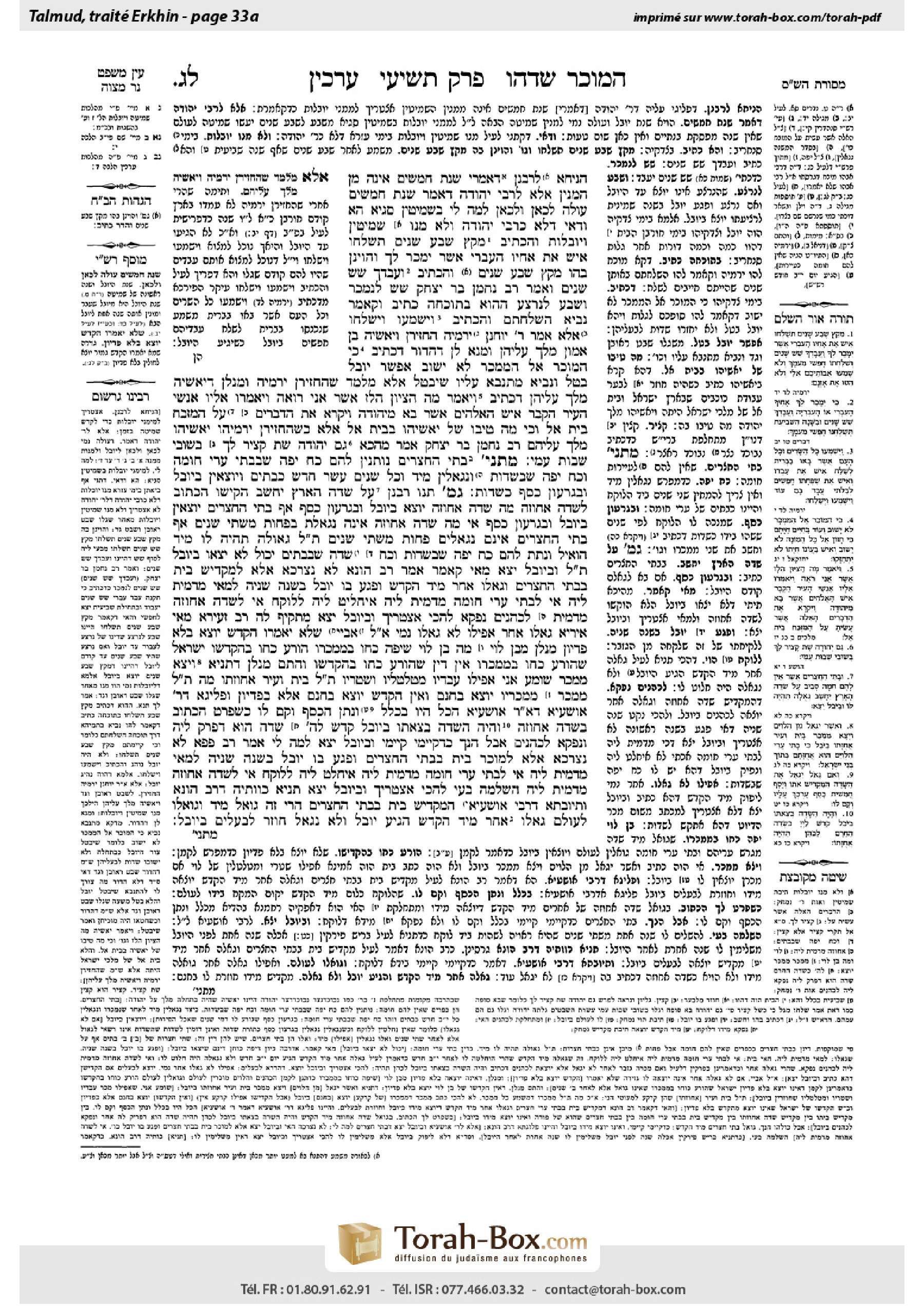
Arakhin 33a: Talmud study for Daf Yomi
Study the Talmud for Daf Yomi with scanned pages, Hebrew text, English translations from Sefaria and AI-generated French translations.
Passage selection and English or AI-generated French translation are available where the scan has annotations. Daf Study is independent of Torah-Box and Sefaria.
Browse Arakhin · ערכין · All tractatesArakhin 33a text and translations
This page of Arakhin includes the Aramaic text, an English translation and an AI-generated French translation, alongside the scan above.
ערכין ל״ג א · Aramaic and Hebrew text
הָנִיחָא לְרַבָּנַן דְּאָמְרִי: שְׁנַת חֲמִשִּׁים אֵינָהּ מִן הַמִּנְיָן, אֶלָּא לְרַבִּי יְהוּדָה דְּאָמַר: שְׁנַת חֲמִשִּׁים עוֹלָה לְכָאן וּלְכָאן, לְמָה לִי? בִּשְׁמִיטִּין סַגִּיא! הָא וַדַּאי דְּלָא כְּרַבִּי יְהוּדָה.
וְלֹא מָנוּ שְׁמִיטִּין וְיוֹבְלוֹת? וְהָכְתִיב: ״מִקֵּץ שֶׁבַע שָׁנִים תְּשַׁלְּחוּ אִישׁ אֶת אָחִיו הָעִבְרִי אֲשֶׁר יִמָּכֵר לְךָ״!
וְהָוֵינַן בְּהוּ: ״מִקֵּץ שֶׁבַע שָׁנִים״? וְהָכְתִיב: ״וַעֲבָדְךָ שֵׁשׁ שָׁנִים״! וְאָמַר רַב נַחְמָן בַּר יִצְחָק: שֵׁשׁ לַנִּמְכָּר, וְשֶׁבַע לַנִּרְצָע.
הָהוּא בְּתוֹכָחָה כְּתִיב, וְקָאָמַר נָבִיא: הֲשִׁלַּחְתֶּם? וְהָכְתִיב: ״וַיִּשְׁמְעוּ וַיְשַׁלֵּחוּ״!
אֶלָּא אָמַר רַבִּי יוֹחָנָן: יִרְמְיָה הֶחְזִירָן, וְיֹאשִׁיָּה בֶּן אָמוֹן מָלַךְ עֲלֵיהֶן. וּמְנָא לַן דַּהֲדוּר? דִּכְתִיב: ״כִּי הַמּוֹכֵר אֶל הַמִּמְכָּר לֹא יָשׁוּב״. אֶפְשָׁר יוֹבֵל בָּטֵל, וְנָבִיא מִתְנַבֵּא עָלָיו שֶׁיִּבְטַל? אֶלָּא מְלַמֵּד שֶׁהֶחְזִירָן יִרְמְיָה.
וּמְנָלַן דְּיֹאשִׁיָּה מָלַךְ עֲלֵיהֶן? דִּכְתִיב: ״וַיֹּאמֶר מָה הַצִּיּוּן הַלָּז אֲשֶׁר אֲנִי רוֹאֶה, וַיֹּאמְרוּ אֵלָיו אַנְשֵׁי הָעִיר הַקֶּבֶר אִישׁ הָאֱלֹהִים אֲשֶׁר בָּא מִיהוּדָה וַיִּקְרָא אֶת הַדְּבָרִים עַל הַמִּזְבֵּחַ בֵּית אֵל״.
וְכִי מָה טִיבוֹ שֶׁל יֹאשִׁיָּהוּ בְּבֵית אֵל? אֶלָּא כְּשֶׁהֶחְזִירָן יִרְמְיָהוּ, יֹאשִׁיָּהוּ מָלַךְ עֲלֵיהֶם. רַב נַחְמָן בַּר יִצְחָק אָמַר מֵהָכָא: ״גַּם יְהוּדָה שָׁת קָצִיר לָךְ בְּשׁוּבִי שְׁבוּת עַמִּי״.
מַתְנִי׳ בָּתֵּי הַחֲצֵרִים נוֹתְנִין לָהֶם כֹּחַ יָפֶה שֶׁבְּבָתֵּי עָרֵי חוֹמָה וְכֹחַ יָפֶה שֶׁבַּשָּׂדוֹת, וְנִגְאָלִין מִיָּד וְכׇל שְׁנֵים עָשָׂר חֹדֶשׁ כְּבָתִּים, וְיוֹצְאִין בַּיּוֹבֵל וּבְגִרְעוֹן כֶּסֶף כְּשָׂדוֹת.
גְּמָ׳ תָּנוּ רַבָּנַן: ״עַל שְׂדֵה הָאָרֶץ יֵחָשֵׁב״ — הִקִּישׁוֹ הַכָּתוּב לִשְׂדֵה אֲחוּזָּה, מָה שְׂדֵה אֲחוּזָּה יוֹצֵא בַּיּוֹבֵל וּבְגִרְעוֹן כֶּסֶף, אַף בָּתֵּי הַחֲצֵרִים יוֹצְאִין בַּיּוֹבֵל וּבְגִרְעוֹן כֶּסֶף.
אִי מָה שְׂדֵה אֲחוּזָּה אֵינָהּ נִגְאֶלֶת בְּפָחוֹת מִשְׁתֵּי שָׁנִים, אַף בָּתֵּי הַחֲצֵרִים אֵינָם נִגְאָלִים פָּחוֹת מִשְׁתֵּי שָׁנִים? תַּלְמוּד לוֹמַר: ״גְּאוּלָּה תִּהְיֶה לוֹ״ — מִיָּד. הוֹאִיל וְנָתַתָּ לָהֶם כֹּחַ יָפֶה שֶׁבַּשָּׂדוֹת וְכֹחַ יָפֶה שֶׁבַּבָּתִּים, יָכוֹל לֹא יֵצְאוּ בַּיּוֹבֵל? תַּלְמוּד לוֹמַר: ״וּבַיּוֹבֵל יֵצֵא״.
מַאי קָאָמַר? אָמַר רַב הוּנָא: לֹא נִצְרְכָא אֶלָּא לְמַקְדִּישׁ בַּיִת בְּבָתֵּי הַחֲצֵרִים, וּגְאָלוֹ אַחֵר מִיַּד הֶקְדֵּשׁ, וּפָגַע בּוֹ יוֹבֵל בְּשָׁנָה שְׁנִיָּה.
לְמַאי מְדַמֵּית לֵיהּ? אִי לְבָתֵּי עָרֵי חוֹמָה מְדַמֵּית לֵיהּ — אִיחֲלֵיט לֵיהּ לְלוֹקֵחַ, אִי לִשְׂדֵה אֲחוּזָּה מְדַמֵּית — לְכֹהֲנִים נָפְקָא, לְהָכִי אִצְטְרִיךְ ״וּבְיֹבֵל יֵצֵא״.
מַתְקֵיף לַהּ רַב זְעֵירָא: מַאי אִירְיָא גְּאָלוֹ אַחֵר? אֲפִילּוּ לֹא גְּאָלוֹ נָמֵי! אֲמַר לֵיהּ אַבָּיֵי: שֶׁלֹּא יֹאמְרוּ הֶקְדֵּשׁ יוֹצֵא בְּלֹא פִּדְיוֹן.
מְנָלַן? מִבֶּן לֵוִי — מָה בֶּן לֵוִי שֶׁיִּפָּה כֹּחוֹ בְּמִמְכָּרוֹ, הוֹרַע כֹּחוֹ בְּהֶקְדֵּשׁוֹ; יִשְׂרָאֵל — שֶׁהוֹרַע כֹּחוֹ בְּמִמְכָּרוֹ, אֵין דִּין שֶׁהוֹרַע כֹּחוֹ בְּהֶקְדֵּשׁוֹ?
וְהָתָם מְנָלַן? דְּתַנְיָא: ״וְיָצָא מִמְכָּר״, שׁוֹמֵעַ אֲנִי אֲפִילּוּ עֲבָדָיו מִטַּלְטְלָיו וּשְׁטָרָיו, תַּלְמוּד לוֹמַר: ״בַּיִת וְעִיר אֲחֻזָּתוֹ״.
מָה תַּלְמוּד לוֹמַר ״מִמְכַּר״? מִמְכָּריוֹ יוֹצֵא בְּחִנָּם, וְאֵין הֶקְדֵּשׁ יוֹצֵא בְּחִנָּם, אֶלָּא בְּפִדְיוֹן.
וּפְלִיגָא דְּרַבִּי אוֹשַׁעְיָא, דְּאָמַר רַבִּי אוֹשַׁעְיָא: הַכֹּל הָיוּ בִּכְלַל ״וְנָתַן הַכֶּסֶף וְקָם לוֹ״.
כְּשֶׁפָּרַט הַכָּתוּב בִּשְׂדֵה אֲחוּזָּה ״וְהָיָה הַשָּׂדֶה בְּצֵאתוֹ בַיֹּבֵל קֹדֶשׁ לַה׳״ — שָׂדֶה הוּא דִּפְרַק לֵיהּ וְנָפְקָא לְכֹהֲנִים, אֲבָל הָנָךְ כִּדְקָיְימִי קָיְימִי.
״וּבַיּוֹבֵל יֵצֵא״, לְמָה לִי? אָמַר רַב פָּפָּא: לֹא נִצְרְכָה אֶלָּא לְמוֹכֵר בַּיִת בְּבָתֵּי הַחֲצֵרִים, וּפָגַע בּוֹ יוֹבֵל בְּשָׁנָה שְׁנִיָּה.
לְמַאי מְדַמֵּית לֵיהּ? אִי לְבָתֵּי עָרֵי חוֹמָה מְדַמֵּית לֵיהּ — אִיחֲלֵט לֵיהּ לְלוֹקֵחַ, אִי לִשְׂדֵה אֲחוּזָּה מְדַמֵּית לֵיהּ — הַשְׁלָמָה בָּעֵי, לְהָכִי אִצְטְרִיךְ ״וּבַיּוֹבֵל יֵצֵא״.
תַּנְיָא כְּוָותֵיהּ דְּרַב הוּנָא, וּתְיוּבְתָּא דְּרַבִּי אוֹשַׁעְיָא: הַמַּקְדִּישׁ בַּיִת בְּבָתֵּי הַחֲצֵרִים — הֲרֵי זֶה גּוֹאֵל מִיָּד וְגוֹאֲלוֹ לְעוֹלָם; גְּאָלוֹ אַחֵר מִיַּד הֶקְדֵּשׁ, הִגִּיעַ יוֹבֵל וְלֹא נִגְאַל — חוֹזֵר לַבְּעָלִים בַּיּוֹבֵל.
Arakhin 33a · English translation
The Gemara objects: This works out well according to the Rabbis, who say that the fiftieth year is not included in the counting of the cycle of Sabbatical Years. It was therefore necessary to count the Jubilee Year. But according to Rabbi Yehuda, who says that the fiftieth year is counted for here and for there, i.e., it is both the fiftieth year of the previous cycle and the first year of the subsequent cycle, why do I need for them to count the Jubilee Years? If the Jubilee Year is not in effect, then it is enough to count the Sabbatical Years. The Gemara explains: That baraita is certainly not in accordance with the opinion of Rabbi Yehuda.
The Gemara asks: And did they not count Sabbatical Years and Jubilee Years once the tribes of Reuben and Gad and half the tribe of Manasseh were exiled? But isn’t it written that Jeremiah, who lived many years later, said: “At the end of seven years you shall let go every man his brother that is a Hebrew, that has been sold unto you, and has served you six years, you shall let him go free from you; but your fathers did not listen unto Me, nor inclined their ear” (Jeremiah 34:14)?
The Gemara continues: And we discussed this verse: Why does it state: “At the end of seven years you shall let go every man”? But isn’t it written in the same verse: “And has served you six years”? And Rav Naḥman bar Yitzḥak says: The verse is referring to two separate individuals. The phrase “and has served you six years” is referring to a typical Hebrew slave who was sold, who goes free after six years (see Exodus 21:2), and the phrase “at the end of seven years” is referring to a slave whose ear was pierced with an awl to extend his tenure. Such an individual remains a slave until the Jubilee Year, even if that is the following year, i.e., the end of the seventh year. If so, the verse indicates that the Jubilee Year was in effect in the times of Jeremiah, even though the tribes of Reuben, Gad, and half the tribe of Manasseh were exiled.
The Gemara answers: That verse was not stated by Jeremiah in the form of a command; rather, it is written in the form of reproof. That is, the prophet Jeremiah is saying to the Jewish people: Did you send free the pierced slaves when the Jubilee Year was observed? The Gemara asks: But isn’t it written there: “And they listened and let them go” (Jeremiah 34:10)? Evidently, the entire passage is referring to matters occurring in the present.
Rather, Rabbi Yoḥanan says: Indeed, the Jubilee Year was not in effect once the tribes of Reuben, Gad, and half the tribe of Manasseh were exiled. But Jeremiah brought back all the exiled tribes, and Josiah, son of Amon, ruled over them. And from where do we derive that Jeremiah brought them back? As it is written: “For the seller shall not return to that which he has sold” (Ezekiel 7:13). Ezekiel prophesied that there will come a time when fields will not be returned to the owners in the Jubilee Year. Now, is it possible that the Jubilee Year had already been nullified and yet the prophet is prophesying that it will be annulled in the future? Rather, this teaches that Jeremiah brought back the exiled tribes.
And from where do we derive that Josiah ruled over all the ten tribes exiled by Assyria? As it is written: “And as Josiah turned himself, then he spied the sepulchres…then he said: What monument is that which I see? And the men of the city told him: It is the tomb of the man of God who came from Judah and proclaimed these things that you have done against the altar of Bethel” (II Kings 23:16–17).
Now, what connection does Josiah, king of Judah, have with the altar at Bethel, a city in the kingdom of Israel? Rather, this indicates that when Jeremiah brought back the ten tribes, Josiah ruled over them. Rav Naḥman bar Yitzḥak said: The fact that the tribes returned may be derived from here: “Also, O Judah, there is a harvest appointed for you, when I would return the captivity of My people” (Hosea 6:11). That is, when the ten tribes will return from their captivity, a king of Judah will rule over them.
MISHNA With regard to the houses of the unwalled courtyards mentioned in the Torah (see Leviticus 25:31), i.e., houses in villages that are not surrounded by walls, one accords them the exceptional provisions that apply to houses of walled cities and the exceptional provisions that apply to fields. Therefore, they are redeemed immediately and for the entire twelve months following the sale, like in the sale of houses of walled cities, and not like fields, which may be redeemed only after two years. And they leave the possession of the buyer during the Jubilee Year or with a per annum deduction from the money of the sale price, like the sale of fields. By contrast, houses of walled cities become the possession of the buyer in perpetuity after one year, and if they are redeemed within the year, one pays the full sale price.
GEMARA The Sages taught: The verse states: “But the houses of the courtyards that have no wall round about them shall be reckoned with the fields of the country; they may be redeemed, and they shall go out in the Jubilee” (Leviticus 25:31). The verse juxtaposed houses of unwalled courtyards to an ancestral field: Just as an ancestral field leaves the possession of the buyer in the Jubilee Year or with a per annum deduction from the money of the sale price, so too, houses of the unwalled courtyards leave the possession of the buyer in the Jubilee Year or with the per annum deduction from the money of the sale price.
The baraita continues: If one derives the halakha from an ancestral field, then just as an ancestral field may not be redeemed less than two years after its sale, so too, houses of the unwalled courtyards may not be redeemed less than two years after their sale. Therefore, the verse states: “They may be redeemed,” indicating that they may be redeemed immediately. The baraita continues: Since you have accorded houses of the unwalled courtyards the exceptional provisions that apply to fields and the exceptional provisions that apply to the houses of walled cities, one might have thought that they do not leave the possession of the buyer in the Jubilee Year. Therefore, the verse states: “And they shall go out in the Jubilee.”
The Gemara asks: What is the tanna of the baraita saying in the last clause, i.e., why might one think that such houses do not leave the possession of the buyer in the Jubilee Year? After all, ancestral fields leave the possession of the buyer in the Jubilee Year, and the tanna teaches that the exceptional provisions of an ancestral field apply to houses in unwalled courtyards. Rav Huna said: The verse is necessary only for the case of one who consecrates a house among the houses of the unwalled courtyards, and another redeemed it from the possession of the Temple treasury, and the Jubilee Year arrived in the second year after its redemption.
Rav Huna elaborates: To what will you compare this case? If you compare this house to houses of walled cities that were consecrated and redeemed by another, then the house belongs to the buyer in perpetuity by the end of the first year (see 31b). If you compare it to an ancestral field that was consecrated and redeemed by another, it leaves to the possession of the priests in the Jubilee Year (see 25a). For this reason it was necessary for the verse to state: “And they shall go out in the Jubilee,” to teach that houses in unwalled courtyards which were consecrated and redeemed by another are returned to their owners in the Jubilee Year.
Rav Zeira objects to this: Why is it necessary to interpret this verse as referring specifically to a case where another redeemed the house from the Temple treasury? Even if another did not redeem it, the house should also be returned to its owner in the Jubilee Year, as the verse states simply: “And they shall go out in the Jubilee.” Abaye said to Rav Zeira: An unredeemed house is not returned to its owners in the Jubilee Year, so that people will not say that consecrated property can leave the possession of the Temple treasury without redemption.
The Gemara adds: And from where do we derive that consecrated property does not leave the possession of the Temple treasury without redemption? We derive it from the halakha with regard to a Levite: And what, if with regard to a Levite, whose power is enhanced with regard to his sale, as a Levite may always redeem a field or house that he sold (see mishna in 33b), his power is diminished with regard to his consecration, as a field that he consecrated does not leave the possession of the Temple treasury until he redeems it; then with regard to an Israelite, whose power is diminished with regard to his sale, since if he sells an ancestral field he may not redeem it for the first two years, and he may redeem a house of a walled city only within one year of the sale, is it not logical that his power is diminished with regard to his consecration and that if he consecrated a house of an unwalled courtyard he must redeem it from the Temple treasury before it enters his possession?
The Gemara asks: And there, with regard to a Levite, from where do we derive that his consecrated property does not leave the possession of the Temple treasury without redemption? As it is taught in a baraita with regard to the verse: “And if a man purchases from the Levites, the house that was sold in the city of his possession shall go out during the Jubilee Year” (Leviticus 25:33). From the phrase “that was sold…shall go out” I would derive that any item sold by a Levite returns to him in the Jubilee Year, even his slaves, movable property, and promissory notes. Therefore, the verse states: “House…in the city of his possession,” which teaches that these items do not return to the Levite without redemption.
The baraita continues: What is the meaning when the verse states: “That was sold”? The verse teaches that a house or field that was sold by a Levite leaves the possession of the buyer and enters the Levite’s possession for free in the Jubilee Year, but the consecration of a Levite does not leave for free in the Jubilee Year; rather, it leaves only with redemption.
The Gemara notes: And Rav Huna, who says that a house in an unwalled courtyard that was consecrated and subsequently redeemed by another returns to the original owner in the Jubilee Year, disagrees with Rabbi Oshaya. As Rabbi Oshaya says: All items were included in the command: And he will give the money and it will be assured to him (see Leviticus 27:19), i.e., one who redeems an item from the Temple treasury becomes its owner in all regards.
When the verse specified with regard to an ancestral field: “But the field, when it goes out in the Jubilee, shall be holy unto the Lord, as a field dedicated; his ancestral field shall be for the priest” (Leviticus 27:21), one derives that it is only with regard to a field that one can redeem it and yet it leaves the possession of the Temple treasury to enter the possession of the priests in the Jubilee Year. But with regard to these houses in unwalled courtyards that were consecrated and redeemed by another, they remain in their current state, i.e., in the possession of the one who redeemed them.
The Gemara asks: According to Rabbi Oshaya, why do I need the phrase “and they shall go out in the Jubilee”? Rav Pappa said: It is necessary only for the case of one who sells a house among the houses of the unwalled courtyards and the Jubilee Year arrived in the second year. The verse indicates that the house is nevertheless returned to the seller.
Rav Pappa elaborates: To what will you compare this case? If you compare this case to one of the houses of walled cities that was sold, then the house belongs to the buyer in perpetuity at the end of the first year. And if you compare it to the case of an ancestral field that was sold, then it requires completion of another year after the Jubilee Year, as taught in a baraita cited earlier (29b): If the buyer consumed an ancestral field’s produce for one year before the Jubilee Year, he completes another year after the Jubilee Year. For this reason it was necessary for the verse to state: “And they shall go out in the Jubilee,” to teach that in such a case the house of an unwalled courtyard returns to the possession of the original owner.
The Gemara notes: It is taught in a baraita in accordance with the opinion of Rav Huna, and this baraita is a conclusive refutation of the opinion of Rabbi Oshaya: With regard to one who consecrates a house among the houses of unwalled courtyards, this individual may redeem the house immediately and he may redeem it always. If another individual redeemed it from the possession of the Temple treasury, and the Jubilee Year arrived and it was not redeemed by the original owner, the house returns to the owner in the Jubilee Year.
Arakhin 33a · Traduction française (IA)
La Guemara s'oppose : Cela fonctionne bien selon les Rabbins, qui affirment que l'année cinquante n'est pas comptée dans le cycle des années sabbatiques. Il fallait donc compter l'année jubilaire. Mais selon Rabbi Yéhuda, qui dit que l'année cinquante est comptée ici et là, c'est-à-dire qu'elle est à la fois l'année cinquante du cycle précédent et la première année du cycle suivant, pourquoi ai-je besoin qu'ils comptent les années jubilaires ? Si l'année jubilaire n'est pas en vigueur, il suffit de compter les années sabbatiques. La Guemara explique : Ce baraïta ne correspond certainement pas à l'opinion de Rabbi Yéhuda.
La Guemara demande : Et n'ont-ils pas compté les années sabbatiques et jubilaires une fois que les tribus de Rouben et Gad et la moitié de la tribu de Manassé avaient été exilées ? Mais n'est-il pas écrit que Jérémie, qui vécut beaucoup plus tard, a dit : « À la fin de sept ans, tu laisseras libre chaque homme son frère qui est un Hébreu, qui t'a été vendu, et qui t'a servi six ans, tu le laisseras libre de toi ; mais vos pères n'ont pas écouté Moïse, ni incliné leur oreille » (Jérémie 34:14) ?
La Guemara continue : Et nous avons discuté de cette verset : « À la fin de sept ans, tu laisseras libre chaque homme » ; mais n'est-il pas écrit dans le même verset : « Et qui t'a servi six ans » ? Et Rav Naḥman bar Yitzḥak dit : Ce verset fait référence à deux individus différents. La phrase « et qui t'a servi six ans » fait référence à un esclave hébreu typique qui a été vendu, qui est libéré après six ans (voir Exode 21:2), et la phrase « à la fin de sept ans » fait référence à un esclave dont l'oreille a été perçée avec un foret pour prolonger son temps de service. Cet individu reste esclave jusqu'à l'année jubilaire, même si cela est l'année suivante, c'est-à-dire la fin de la septième année. Si tel est le cas, le verset indique que l'année jubilaire était en vigueur à l'époque de Jérémie, même si les tribus de Rouben, Gad et la moitié de la tribu de Manassé avaient été exilées.
La Guemara répond : Ce verset n'a pas été dit par Jérémie sous la forme d'un commandement ; il est écrit sous la forme d'une réprimande. C'est-à-dire que le prophète Jérémie dit aux Juifs : Avez-vous libéré les esclaves percés lorsqu'on observait l'année jubilaire ? La Guemara demande : Mais n'est-il pas écrit là : « Et ils écoutèrent et les laissèrent partir » (Jérémie 34:10) ? Évidemment, tout ce passage fait référence à des choses qui se passent à l'heure actuelle.
Rabbi Yoḥanan dit : En effet, l'année jubilaire n'était pas en vigueur une fois que les tribus de Rouben, Gad et la moitié de la tribu de Manassé avaient été exilées. Mais Jérémie ramena toutes les tribus exilées, et Josias, fils d'Amon, régnait sur elles. Et d'où dérivons-nous que Jérémie les ramena ? Comme il est écrit : « Car le vendeur ne reviendra pas à ce qu'il a vendu » (Ezéchiel 7:13). Ezéchiel prophétise qu'il viendra un temps où les champs ne seront pas rendus aux propriétaires lors de l'année jubilaire. Maintenant, est-il possible que l'année jubilaire ait déjà été annulée et que le prophète prophétise qu'elle sera annulée à l'avenir ? Plutôt, cela enseigne que Jérémie ramena les tribus exilées.
Et d'où dérivons-nous que Josias régnait sur toutes les dix tribus exilées par l'Assyrie ? Comme il est écrit : « Et quand Josias se tourna, il vit les sépulcres… il dit : Quel monument vois-je ? Et les habitants de la ville lui dirent : C'est la tombe du prophète qui vint de Juda et qui proclama ces choses que vous avez faites contre l'autel de Béthel » (II Rois 23:16–17).
Maintenant, quelle est la connexion entre Josias, roi de Juda, et l'autel de Béthel, une ville dans le royaume d'Israël ? Plutôt, cela indique que lorsque Jérémie ramena les dix tribus, Josias régnait sur elles. Rav Naḥman bar Yitzḥak dit : Le fait que les tribus soient revenues peut être dérivé d'ici : « Aussi, ô Juda, il y a un récolte assigné à toi, quand je rendrai la captivité de mon peuple » (Osée 6:11). C'est-à-dire, lorsque les dix tribus reviendront de leur captivité, un roi de Juda régnera sur elles.
MICHNA Concernant les maisons des courtyards non murés mentionnés dans la Torah (voir Lévitique 25:31), c'est-à-dire les maisons des villages non entourés de murs, on accorde à ces maisons les dispositions exceptionnelles qui s'appliquent aux maisons des villes murées et aux dispositions exceptionnelles qui s'appliquent aux champs. Par conséquent, elles sont rachetables immédiatement et pendant les douze mois suivant la vente, comme dans la vente des maisons des villes murées, et non comme les champs, qui peuvent être rachetés seulement après deux ans. Et elles quittent la possession de l'acheteur pendant l'année jubilaire ou avec une déduction annuelle du prix de la vente, comme la vente des champs. En revanche, les maisons des villes murées deviennent la possession de l'acheteur de manière permanente après un an, et si elles sont rachetées pendant l'année, on paie le prix total de la vente.
GUEMARA Les Sages enseignent : Le verset dit : « Mais les maisons des courtyards qui n'ont pas de mur autour d'eux seront comptées avec les champs du pays ; elles peuvent être rachetées, et elles sortiront en jubile » (Lévitique 25:31). Le verset juxtapose les maisons des courtyards non murés à un champ ancestral : Comme un champ ancestral quitte la possession de l'acheteur en jubile ou avec une déduction annuelle du prix de la vente, de même, les maisons des courtyards non murés quittent la possession de l'acheteur en jubile ou avec une déduction annuelle du prix de la vente.
La baraïta continue : Si l'on dérive la halakha d'un champ ancestral, alors tout comme un champ ancestral ne peut être racheté moins de deux ans après sa vente, de même, les maisons des courtyards non murés ne peuvent être rachetées moins de deux ans après leur vente. Ainsi, la parole « Ils peuvent être rachetés » indique qu'ils peuvent être rachetés immédiatement. La baraïta continue : Puisque vous avez accordé aux maisons des courtyards non murés les dispositions exceptionnelles qui s'appliquent aux champs et les dispositions exceptionnelles qui s'appliquent aux maisons des villes murées, on pourrait penser qu'elles ne sortent pas de la possession de l'acheteur pendant l'année sainte. Ainsi, la parole « Et ils sortiront pendant l'année sainte » est prononcée.
Le Guemara pose la question : Quel est le tanna de la baraïta qui dit dans la dernière phrase, c'est-à-dire pourquoi pourrait-on penser que ces maisons ne sortent pas de la possession de l'acheteur pendant l'année sainte ? Après tout, les champs anciens sortent de la possession de l'acheteur pendant l'année sainte, et le tanna enseigne que les dispositions exceptionnelles d'un champ ancestral s'appliquent aux maisons des courtyards non murés. Rav Huna dit : La parole est nécessaire uniquement dans le cas d'une personne qui consacre une maison parmi les maisons des courtyards non murés, et une autre la rachète du trésor du Temple, et l'année sainte arrive en deuxième année après sa rachat.
Rav Huna développe : À quoi pourrais-tu comparer ce cas ? Si tu compares cette maison aux maisons des villes murées qui ont été consacrées et rachetées par un autre, alors la maison appartient à l'acheteur de manière permanente à la fin de la première année (voir 31b). Si tu compares cette maison à un champ ancestral qui a été consacré et racheté par un autre, elle revient à la possession des prêtres pendant l'année sainte (voir 25a). Pour cette raison, il était nécessaire que la parole dise : « Et ils sortiront pendant l'année sainte », pour enseigner que les maisons des courtyards non murés qui ont été consacrées et rachetées par un autre sont rendues à leurs propriétaires pendant l'année sainte.
Rav Zeira s'oppose à cela : Pourquoi est-il nécessaire d'interpréter cette parole comme se référant spécifiquement à un cas où un autre a racheté la maison du trésor du Temple ? Même si un autre n'a pas racheté la maison, la maison devrait être rendue à son propriétaire pendant l'année sainte, car la parole dit simplement : « Et ils sortiront pendant l'année sainte ». Abaye dit à Rav Zeira : Une maison non rachetée n'est pas rendue à ses propriétaires pendant l'année sainte, afin que les gens ne disent pas que les biens consacrés peuvent sortir de la possession du trésor du Temple sans rachat.
Le Guemara ajoute : Et d'où dérivons-nous que les biens consacrés ne sortent pas de la possession du trésor du Temple sans rachat ? Nous dérivons cela de la halakha concernant un Lévi : Et que, concernant un Lévi, dont le pouvoir est renforcé concernant sa vente, car un Lévi peut toujours racheter un champ ou une maison qu'il a vendu (voir la mitsva de 33b), son pouvoir est diminué concernant sa consécration, car un champ qu'il a consacré ne sort pas de la possession du trésor du Temple jusqu'à ce qu'il le rachète ; alors concernant un Israélite, dont le pouvoir est diminué concernant sa vente, puisque s'il vend un champ ancestral, il ne peut pas le racheter pendant les deux premières années, et qu'il peut racheter une maison d'une ville murée seulement dans l'année de la vente, n'est-ce pas logique que son pouvoir soit diminué concernant sa consécration et que s'il a consacré une maison d'un courtyard non muré, il doive la racheter du trésor du Temple avant qu'elle entre en possession de lui ?
Le Guemara pose la question : Et là, concernant un Lévi, d'où dérivons-nous que ses biens consacrés ne sortent pas de la possession du trésor du Temple sans rachat ? Comme il est enseigné dans une baraïta concernant la parole : « Et si un homme achète des Lévites, la maison qui a été vendue dans la ville de sa possession sortira pendant l'année sainte » (Lévitique 25:33). De la phrase « qui a été vendu…sortira » je dériverais que tout objet vendu par un Lévi retourne à lui pendant l'année sainte, même ses serviteurs, ses biens mobiliers et ses billets de change. Ainsi, la parole dit : « Maison…dans la ville de sa possession », ce qui enseigne que ces objets ne retournent pas au Lévi sans rachat.
La baraïta continue : Quelle est la signification lorsque la parole dit : « Qui a été vendu » ? La parole enseigne qu'une maison ou un champ qui a été vendu par un Lévi sort de la possession de l'acheteur et entre en possession du Lévi gratuitement pendant l'année sainte, mais la consécration d'un Lévi ne sort pas gratuitement pendant l'année sainte ; elle sort seulement avec le rachat.
Le Guemara note : Et Rav Huna, qui dit qu'une maison d'un courtyard non muré qui a été consacrée et ensuite rachetée par un autre retourne à son propriétaire original pendant l'année sainte, est en désaccord avec Rabbi Oshaya. Comme Rabbi Oshaya dit : Tous les objets sont inclus dans la commande : « Et il donnera l'argent et cela sera assuré à lui » (Lévitique 27:19), c'est-à-dire celui qui rachète un objet du trésor du Temple devient son propriétaire en tous points.
Lorsque la parole spécifie concernant un champ ancestral : « Mais le champ, lorsqu'il sortira pendant l'année sainte, sera saint pour l'Éternel, comme un champ consacré ; son champ ancestral sera pour le prêtre » (Lévitique 27:21), on dérive que c'est seulement concernant un champ que l'on peut le racheter et qu'il sort de la possession du trésor du Temple pour entrer en possession des prêtres pendant l'année sainte. Mais concernant ces maisons des courtyards non murés qui ont été consacrées et rachetées par un autre, elles restent dans leur état actuel, c'est-à-dire en possession de celui qui les a rachetées.
Le Guemara pose la question : Selon Rabbi Oshaya, pourquoi a-t-on besoin de la phrase « et ils sortiront pendant l'année sainte » ? Rav Pappa dit : Il est nécessaire uniquement dans le cas d'une personne qui vend une maison parmi les maisons des courtyards non murés et l'année sainte arrive en deuxième année. La parole indique que la maison est tout de même rendue au vendeur.
Rav Pappa développe : À quoi comparer ce cas ? Si on le compare à un cas d'une maison des villes murées qui a été vendue, alors la maison appartient au acheteur de manière permanente à la fin de la première année. Et si on le compare au cas d'un champ ancestral qui a été vendu, alors il faut accomplir une autre année après l'année sabbatique, comme enseigné dans une baraïta citée plus tôt (29b) : Si l'acheteur a consommé les produits d'un champ ancestral pendant une année avant l'année sabbatique, il accomplit une autre année après l'année sabbatique. C'est pour cette raison que la Bible a dû dire : « Et ils sortiront en l'année sabbatique », afin d'enseigner que dans un tel cas, la maison d'un courtil non muré revient à la possession du propriétaire originel.
Le Guemara note : Il est enseigné dans une baraïta selon l'opinion de Rav Huna, et cette baraïta constitue une réfutation définitive de l'opinion de Rabbi Oshaya : En ce qui concerne celui qui consacre une maison parmi les maisons des courtils non murés, cette personne peut racheter la maison immédiatement et peut toujours la racheter. Si une autre personne l'a rachetée à partir de la possession du trésor du Temple, et que l'année sabbatique est arrivée et qu'elle n'a pas été rachetée par le propriétaire originel, la maison revient au propriétaire en l'année sabbatique.
Traduction française générée par IA à partir de l’édition anglaise de Sefaria. Vérifie toujours un passage avec le texte source.
Text from Sefaria: William Davidson Edition - Vocalized Aramaic (CC BY NC); William Davidson Edition - English (CC BY NC).