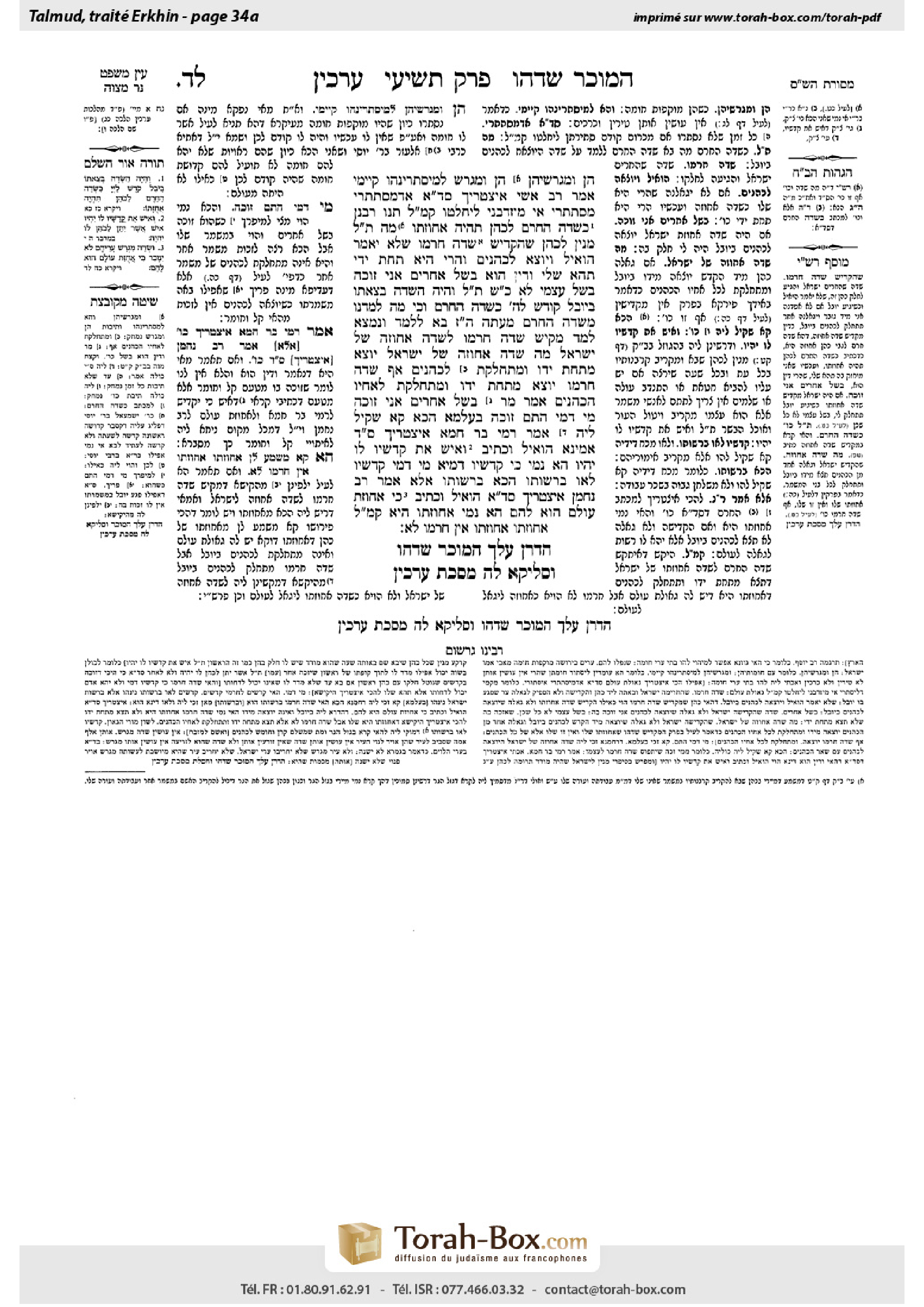
Arakhin 34a: Talmud study for Daf Yomi
Study the Talmud for Daf Yomi with scanned pages, Hebrew text, English translations from Sefaria and AI-generated French translations.
Passage selection and English or AI-generated French translation are available where the scan has annotations. Daf Study is independent of Torah-Box and Sefaria.
Browse Arakhin · ערכין · All tractatesArakhin 34a text and translations
This page of Arakhin includes the Aramaic text, an English translation and an AI-generated French translation, alongside the scan above.
ערכין ל״ד א · Aramaic and Hebrew text
הֵן וּמִגְרְשֵׁיהֶן, הֵן וּמִגְרְשֵׁיהֶן לְמִיסְתְּרִינְהוּ קָיְימִי. אָמַר רַב אָשֵׁי: אִיצְטְרִיךְ, סָלְקָא דַּעְתָּךְ אָמֵינָא: אַדְּמִסְתַּתְּרִי מִסְתַּתְּרִי, אִי מִיזְדַּבְּנִי לִיחַלְטוּ, קָא מַשְׁמַע לַן.
תָּנוּ רַבָּנַן: ״כִּשְׂדֵה הַחֵרֶם לַכֹּהֵן תִּהְיֶה אֲחֻזָּתוֹ״, מָה תַּלְמוּד לוֹמַר? מִנַּיִן לְכֹהֵן שֶׁהִקְדִּישׁ שְׂדֵה חֶרְמוֹ, שֶׁלֹּא יֹאמַר: הוֹאִיל וְיוֹצָא לַכֹּהֲנִים, וַהֲרֵי הִיא תַּחַת יָדִי — תְּהֵא שֶׁלִּי.
וְדִין הוּא: בְּשֶׁל אֲחֵרִים אֲנִי זוֹכֶה, בְּשֶׁל עַצְמִי לֹא כׇּל שֶׁכֵּן? תַּלְמוּד לוֹמַר: ״וְהָיָה הַשָּׂדֶה בְּצֵאתוֹ בַיֹּבֵל קוֹדֶשׁ לַה׳ כִּשְׂדֵה הַחֵרֶם״.
וְכִי מָה לָמַדְנוּ מִשְּׂדֵה הַחֵרֶם מֵעַתָּה? הֲרֵי זֶה בָּא לְלַמֵּד וְנִמְצָא לָמֵד, מַקִּישׁ שְׂדֵה חֶרְמוֹ לִשְׂדֵה אֲחוּזָּה שֶׁל יִשְׂרָאֵל: מָה שְׂדֵה אֲחוּזָּה שֶׁל יִשְׂרָאֵל יוֹצָא מִתַּחַת יָדוֹ וּמִתְחַלֶּקֶת לַכֹּהֲנִים, אַף שְׂדֵה חֶרְמוֹ יוֹצָא מִתַּחַת יָדוֹ וּמִתְחַלֶּקֶת לְאֶחָיו הַכֹּהֲנִים.
אָמַר מָר: בְּשֶׁל אֲחֵרִים אֲנִי זוֹכֶה. מִי דָּמֵי? הָתָם זוֹכֶה בְּעָלְמָא, הָכָא קָא שָׁקֵיל לֵיהּ.
אָמַר רָמֵי בַּר חָמָא: אִיצְטְרִיךְ, סָלְקָא דַּעְתָּךְ אָמֵינָא: הוֹאִיל וּכְתִיב ״וְאִישׁ אֶת קֳדָשָׁיו לוֹ יִהְיוּ״, הָא נָמֵי כִּי קֳדָשָׁיו דָּמְיָא.
מִי דָּמֵי? קֳדָשָׁיו לָאו בִּרְשׁוּתוֹ, הָכָא בִּרְשׁוּתוֹ.
אֶלָּא אָמַר רַב נַחְמָן: אִיצְטְרִיךְ, סָלְקָא דַּעְתָּךְ אָמֵינָא: הוֹאִיל וּכְתִיב ״כִּי אֲחוּזַּת עוֹלָם הוּא לָהֶם״, הָא נָמֵי אֲחוּזָּתוֹ הִיא, קָא מַשְׁמַע לַן ״אֲחוּזָּתוֹ״ — אֲחוּזָּתוֹ אִין, חֶרְמוֹ לָא.
הֲדַרַן עֲלָךְ הַמּוֹכֵר שָׂדֵהוּ, וּסְלִיקָא לָהּ מַסֶּכֶת עֲרָכִין.
Arakhin 34a · English translation
both they and their empty lots. The Gemara objects: But they and their lots stand to be dismantled, as a city of the Levites may not be surrounded by a wall. How, then, can such a city be considered surrounded by a wall? Rav Ashi said: Nevertheless, it was necessary for the baraita to teach that if a Levite sells a house in such a city he may always redeem it, as it might enter your mind to say: When the walls are dismantled, then they are dismantled, but as long as they remain standing, if houses in the city are sold and are not redeemed within one year, let them belong to the buyer in perpetuity, in accordance with the halakha of houses of walled cities. Therefore, the baraita teaches us that this is not the case.
§ The Sages taught: The verse states, with regard to one who consecrated his ancestral field but failed to redeem it before the Jubilee Year: “But the field, when it goes out in the Jubilee, shall be holy unto the Lord, as a field dedicated; his ancestral field shall be for the priest” (Leviticus 27:21). What is the meaning when the verse states: “As a field dedicated”? The baraita explains: From where is it derived with regard to a priest who consecrated his dedicated field, i.e., a field that was dedicated to the priests by an Israelite, and the Jubilee Year arrived, that he may not say: Since a field that was consecrated by its owners and was not redeemed leaves to the possession of the priests in the Jubilee Year, and this field that I consecrated is already in my possession, it is therefore mine.
The baraita continues: And this is the halakha despite the fact that the claim of the priest is based on logical inference: If I acquire the fields of others that were consecrated and not redeemed before the Jubilee Year, then with regard to my own property, should I not all the more so acquire it? Therefore, the verse states: “As a field dedicated, his ancestral field shall be for the priest,” which teaches that this is not the case.
The baraita elaborates: But what have we learned about a consecrated ancestral field from a dedicated field from now? The Torah does not explicitly state the halakha with regard to dedicated fields. Rather, this case of a dedicated field came to teach a halakha with regard to an ancestral field, and it turns out that in addition it derives a halakha from that case, i.e., the verse juxtaposes the dedicated field of a priest to the ancestral field of an Israelite: Just as the ancestral field of an Israelite that was redeemed by a priest from the Temple treasury leaves from his possession at the arrival of the Jubilee Year and is divided among all the priests (see 25a), so too, the dedicated field of a priest that he consecrated leaves from his possession and is divided among his brothers, the priests, at the beginning of the Jubilee Year.
The Gemara analyzes this baraita: The Master said: And this claim of the priest is based on logical inference: If I acquire the fields of others that were consecrated, then with regard to my own property, should I not acquire it all the more so? The Gemara asks: Are these cases comparable? There, with regard to an ancestral field that was consecrated and leaves to the possession of the priests, he merely acquires it as one of the priests, whereas here, with regard to a dedicated field that he consecrated, he seeks to take the entire field for himself. If so, there is no need for the verse to teach that the priest may not do so.
Rami bar Ḥama said: Nevertheless, the verse was necessary, as it might enter your mind to say that since it is written: “And every man’s hallowed things shall be his” (Numbers 5:10), from which it is derived that a priest who brings an offering may sacrifice it and take for himself those portions intended for the priests and he is not required to give them to the members of the current priestly watch, perhaps this too, i.e., his dedicated field that he consecrated, is considered like his hallowed things, and he may take it for himself. Therefore, the verse serves to indicate that this is not the case.
The Gemara asks: Are these cases comparable? His hallowed things, i.e., offerings brought by the priest, are not in his possession; rather, the priest receives the priestly portions from the table of the Most High, in exchange for performing the sacrificial rites. Here, the priest seeks to return the field to his possession.
Rather, Rav Naḥman said: The verse was necessary, as it might enter your mind to say that since it is written with regard to the fields of Levites and priests: “For that is their perpetual possession” (Leviticus 25:34), from which it is derived that if a priest consecrated his ancestral field he may always redeem it, so too this dedicated field received by the priest is also considered his ancestral field, and if he consecrated it he may always redeem it. The juxtaposition of the dedicated field of a priest to the ancestral field of an Israelite teaches us that this is not the halakha, as the verse states: “His ancestral field shall be for the priest” (Leviticus 27:31). The verse teaches that with regard to the ancestral field of a priest that he inherited from his father, yes, it remains in the possession of that priest in perpetuity, but with regard to his dedicated field, it does not remain in his possession in perpetuity; rather, it is divided among the members of the priestly watch serving at the beginning of the Jubilee Year.
We will return to you, “One who sold his field”...
Arakhin 34a · Traduction française (IA)
Les deux, ainsi que leurs terres vides. La Guemara s'oppose à cela : Mais ils et leurs terres sont susceptibles d'être démolis, car une ville des Lévites ne peut être entourée d'un mur. Comment alors peut-on considérer que cette ville est entourée d'un mur ? Rav Ashi dit : Néanmoins, il était nécessaire que la baraïta enseigne que si un Lévitique vend une maison dans une telle ville, il peut toujours l'acheter à nouveau, car il pourrait entrer en vous-même à l'idée que : Lorsque les murs sont démolis, alors ils sont démolis, mais tant qu'ils restent debout, si des maisons de la ville sont vendues et ne sont pas achetées dans l'espace d'un an, elles appartiennent à l'acheteur de manière permanente, conformément à la halakha des maisons des villes murées. Ainsi, la baraïta nous apprend que cela n'est pas le cas.
§ Les Sages enseignent : La Parashah dit, concernant celui qui a consacré son champ ancestral mais n'a pas réussi à l'acheter avant l'année sabbatique : « Mais le champ, lorsqu'il sortira en l'année sabbatique, sera saint au Seigneur, comme un champ consacré ; son champ ancestral sera pour le prêtre » (Lévitique 27:21). Quelle est la signification lorsque la Parashah dit : « Comme un champ consacré » ? La baraïta explique : D'où est-il tiré concernant un prêtre qui a consacré son champ consacré, c'est-à-dire un champ consacré aux prêtres par un Israélite, et l'année sabbatique est arrivée, qu'il ne peut pas dire : Puisque un champ consacré par ses propriétaires et non acheté reste à la possession des prêtres en l'année sabbatique, et ce champ que j'ai consacré est déjà en ma possession, il m'appartient donc.
La baraïta continue : Et c'est la halakha malgré le fait que la revendication du prêtre est basée sur une déduction logique : Si je achète les champs d'autrui qui ont été consacrés et non rachetés avant l'année sabbatique, alors concernant mes propres biens, ne devrais-je pas encore plus acheter ceux-ci ? Ainsi, la Parashah dit : « Comme un champ consacré, son champ ancestral sera pour le prêtre », ce qui enseigne que cela n'est pas le cas.
La baraïta développe : Mais qu'avons-nous appris concernant un champ ancestral consacré à partir d'un champ consacré ? La Torah ne précise pas explicitement la halakha concernant les champs consacrés. Cependant, ce cas de champ consacré est venu enseigner une halakha concernant un champ ancestral, et il se trouve qu'en outre, il dérive une halakha à partir de ce cas, c'est-à-dire que la Parashah juxtapose le champ consacré d'un prêtre au champ ancestral d'un Israélite : Tout comme le champ ancestral d'un Israélite qui a été racheté par un prêtre à partir du trésor du Temple quitte sa possession à l'arrivée de l'année sabbatique et est partagé entre tous les prêtres (voir 25a), de même, le champ consacré d'un prêtre qui a été consacré quitte sa possession et est partagé entre ses frères, les prêtres, au début de l'année sabbatique.
La Guemara analyse cette baraïta : Le Maître dit : Et cette revendication du prêtre est basée sur une déduction logique : Si je achète les champs d'autrui qui ont été consacrés, alors concernant mes propres biens, ne devrais-je pas encore plus acheter ceux-ci ? La Guemara demande : Ces cas sont-ils comparables ? Là, concernant un champ ancestral consacré qui quitte la possession des prêtres, il n'achète que comme l'un des prêtres, tandis que là, concernant un champ consacré qu'il a lui-même consacré, il cherche à s'approprier tout le champ. Si c'est le cas, il n'y a pas besoin que la Parashah enseigne que le prêtre ne peut pas le faire.
Rami bar Ḥama dit : Néanmoins, la versette était nécessaire, car il pourrait entrer en votre esprit à l'idée que puisque cela est écrit : « Et toutes les choses saintes de chaque homme seront à lui » (Nm 5:10), d'où il est tiré que le prêtre qui apporte un sacrifice peut le sacrifier et s'approprier les parties destinées aux prêtres et il n'est pas tenu de les donner aux membres de la garde prêtreuse actuelle, peut-être cela aussi, c'est-à-dire son champ consacré qu'il a lui-même consacré, est considéré comme ses choses saintes, et il peut s'en approprier.
La Guemara demande : Ces cas sont-ils comparables ? Ses choses saintes, c'est-à-dire les offrandes apportées par le prêtre, ne sont pas en son possession ; plutôt, le prêtre reçoit les portions prêtriales de la table du Très-Haut, en échange de l'accomplissement des rites sacrificiels. Ici, le prêtre cherche à rendre le champ à sa possession.
Plutôt, Rav Naḥman dit : La Parashah était nécessaire, car il pourrait entrer en vous à l'idée que puisque cela est écrit concernant les champs des Lévites et des prêtres : « Car c'est leur possession perpétuelle » (Lévitique 25:34), d'où il est tiré que si un prêtre a consacré son champ ancestral, il peut toujours le racheter, de même ce champ consacré reçu par le prêtre est également considéré comme son champ ancestral, et si il l'a consacré, il peut toujours le racheter. La juxtaposition du champ consacré d'un prêtre au champ ancestral d'un Israélite nous apprend que cela n'est pas la halakha, car la Parashah dit : « Son champ ancestral sera pour le prêtre » (Lévitique 27:31). La Parashah enseigne que concernant le champ ancestral d'un prêtre qu'il a hérité de son père, oui, il reste en possession de ce prêtre de manière perpétuelle, mais concernant son champ consacré, il ne reste pas en possession de manière perpétuelle ; plutôt, il est partagé entre les membres de la garde prêtreuse servant au début de l'année sabbatique.
Nous en reviendrons à vous, « Celui qui a vendu son champ »...
Traduction française générée par IA à partir de l’édition anglaise de Sefaria. Vérifie toujours un passage avec le texte source.
Text from Sefaria: William Davidson Edition - Vocalized Aramaic (CC BY NC); William Davidson Edition - English (CC BY NC).