Arakhin 4b: Talmud study for Daf Yomi
Study the Talmud for Daf Yomi with scanned pages, Hebrew text, English translations from Sefaria and AI-generated French translations.
Passage selection and English or AI-generated French translation are available where the scan has annotations. Daf Study is independent of Torah-Box and Sefaria.
Browse Arakhin · ערכין · All tractatesArakhin 4b text and translations
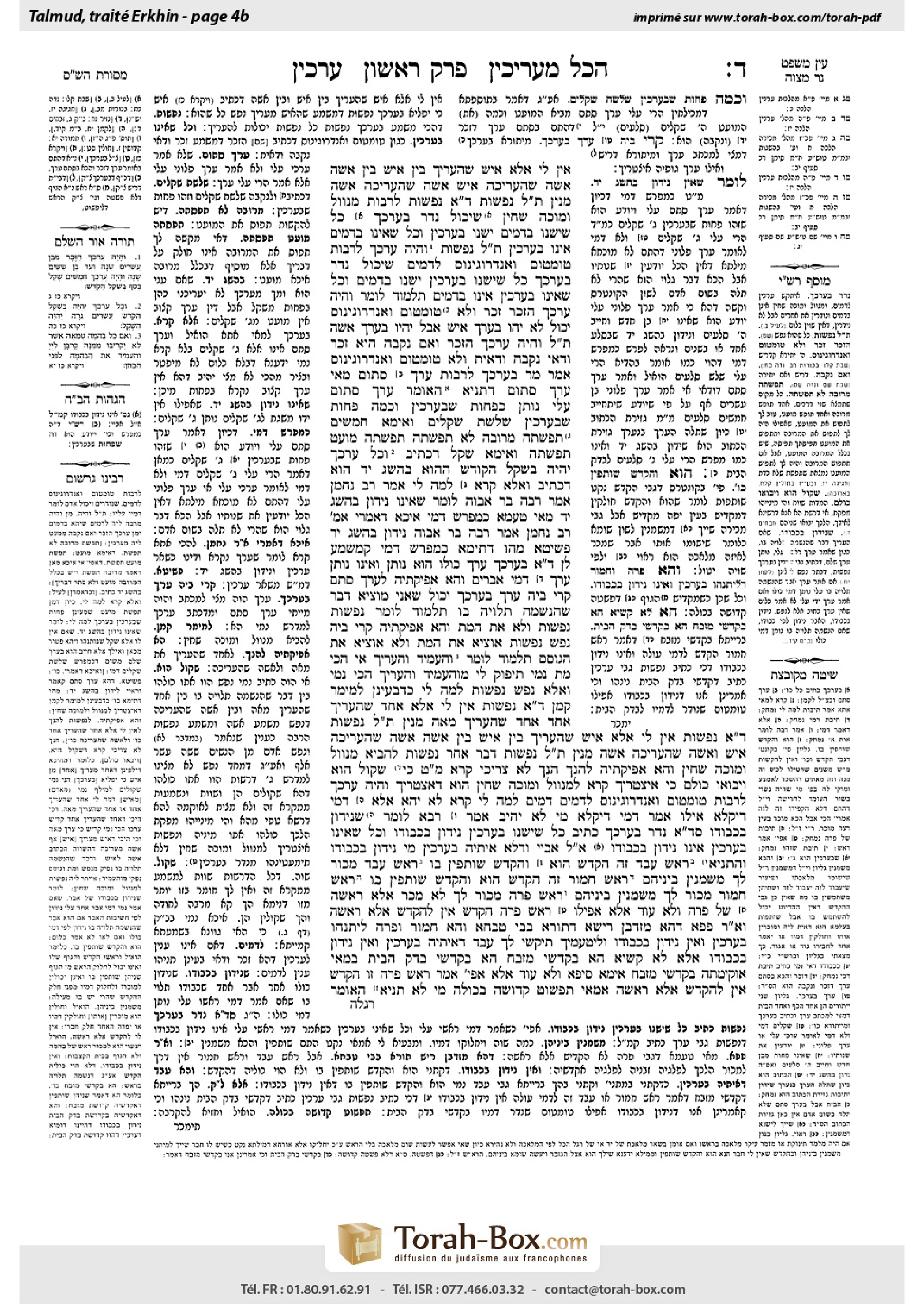
This page of Arakhin includes the Aramaic text, an English translation and an AI-generated French translation, alongside the scan above.
ערכין ד׳ ב · Aramaic and Hebrew text
אֵין לִי אֶלָּא אִישׁ שֶׁהֶעֱרִיךְ בֵּין אִישׁ בֵּין אִשָּׁה, אִשָּׁה שֶׁהֶעֱרִיכָה אִישׁ, אִשָּׁה שֶׁהֶעֱרִיכָה אִשָּׁה מִנַּיִן? תַּלְמוּד לוֹמַר ״נְפָשֹׁת״.
דָּבָר אַחֵר: ״נְפָשֹׁת״ — לְרַבּוֹת מְנוָּּול וּמוּכֵּה שְׁחִין.
שֶׁיָּכוֹל ״נֶדֶר בְּעֶרְכְּךָ״: כֹּל שֶׁיֶּשְׁנוֹ בְּדָמִים — יֶשְׁנוֹ בַּעֲרָכִין, וְכֹל שֶׁאֵינוֹ בְּדָמִים — אֵינוֹ בַּעֲרָכִין, תַּלְמוּד לוֹמַר ״נְפָשֹׁת״.
״וְהָיָה עֶרְכְּךָ״ — לְרַבּוֹת טוּמְטוּם וְאַנְדְּרוֹגִינוֹס לְדָמִים, שֶׁיָּכוֹל: נֶדֶר ״בְּעֶרְכְּךָ״ — כֹּל שֶׁיֶּשְׁנוֹ בַּעֲרָכִין יֶשְׁנוֹ בְּדָמִים, וְכֹל שֶׁאֵינוֹ בַּעֲרָכִין אֵינוֹ בְּדָמִים, תַּלְמוּד לוֹמַר: ״וְהָיָה עֶרְכְּךָ״.
״הַזָּכָר״ — זָכָר, וְלֹא טוּמְטוּם וְאַנְדְּרוֹגִינוֹס. יָכוֹל לֹא יְהוּ בְּעֵרֶךְ אִישׁ, אֲבָל יִהְיוּ בְּעֵרֶךְ אִשָּׁה? תַּלְמוּד לוֹמַר: ״וְהָיָה עֶרְכְּךָ הַזָּכָר... וְאִם נְקֵבָה הִיא״ — זָכָר וַדַּאי, נְקֵבָה וַדָּאִית, וְלֹא טוּמְטוּם וְאַנְדְּרוֹגִינוֹס.
אָמַר מָר: ״בְּעֶרְכְּךָ״ — לְרַבּוֹת עֵרֶךְ סָתוּם. מַאי עֵרֶךְ סָתוּם?
דְּתַנְיָא: הָאוֹמֵר ״עֵרֶךְ סָתוּם עָלַי״ נוֹתֵן כַּפָּחוֹת שֶׁבָּעֲרָכִין, וְכַמָּה פָּחוֹת שֶׁבָּעֲרָכִין? שְׁלֹשֶׁת שְׁקָלִים.
וְאֵימָא חֲמִשִּׁים! תָּפַשְׂתָּה מְרוּבֶּה — לֹא תָּפַשְׂתָּה, תָּפַשְׂתָּה מוּעָט — תָּפַשְׂתָּה.
וְאֵימָא שֶׁקֶל, דִּכְתִיב: ״וְכׇל עֶרְכְּךָ יִהְיֶה בְּשֶׁקֶל הַקֹּדֶשׁ״! הָהוּא בְּהֶשֵּׂג יָד הוּא דִּכְתִיב.
וְאֶלָּא קָרָא לְמָה לִי? אָמַר רַב נַחְמָן אָמַר רַבָּה בַּר אֲבוּהּ: לוֹמַר שֶׁאֵינוֹ נִידּוֹן בְּהֶשֵּׂג יָד. מַאי טַעְמָא? כִּמְפָרֵשׁ דָּמֵי.
אִיכָּא דְּאָמְרִי, אָמַר רַב נַחְמָן אָמַר רַבָּה בַּר אֲבוּהּ: נִידּוֹן בְּהֶשֵּׂג יָד. פְּשִׁיטָא! מַהוּ דְּתֵימָא כִּמְפָרֵשׁ דָּמֵי, קָמַשְׁמַע לַן.
דָּבָר אַחֵר: ״בְּעֶרְכְּךָ״ — עֵרֶךְ כּוּלּוֹ הוּא נוֹתֵן, וְאֵינוֹ נוֹתֵן עֵרֶךְ דְּמֵי אֵבָרִים. וְהָא אַפֵּיקְתֵּיהּ לְעֵרֶךְ סְתָם? קְרִי בֵּיהּ ״עֵרֶךְ״ ״בְּעֶרְכְּךָ״.
יָכוֹל שֶׁאֲנִי מוֹצִיא דָּבָר שֶׁהַנְּשָׁמָה תְּלוּיָה בּוֹ, תַּלְמוּד לוֹמַר: ״נְפָשֹׁת״, ״נְפָשֹׁת״ — וְלֹא אֶת הַמֵּת.
וְהָא אַפֵּיקְתֵּיהּ! קְרִי בֵּיהּ ״נֶפֶשׁ״, ״נְפָשֹׁת״.
אוֹצִיא אֶת הַמֵּת, וְלֹא אוֹצִיא אֶת הַגּוֹסֵס? תַּלְמוּד לוֹמַר: ״וְהָעֲמִיד וְהֶעֱרִיךְ״.
אִי הָכִי, מֵת נָמֵי תִּיפּוֹק לִי מִ״וְּהֶעֱמִיד וְהֶעֱרִיךְ״? הָכִי נָמֵי! וְאֶלָּא, ״נֶפֶשׁ״ ״נְפָשֹׁת״ לְמָה לִי? כִּדְבָעֵינַן לְמֵימַר קַמַּן.
דָּבָר אַחֵר, ״נְפָשֹׁת״ — אֵין לִי אֶלָּא אֶחָד שֶׁהֶעֱרִיךְ אֶחָד, אֶחָד שֶׁהֶעֱרִיךְ מֵאָה מִנַּיִן? תַּלְמוּד לוֹמַר ״נְפָשֹׁת״.
דָּבָר אַחֵר, ״נְפָשֹׁת״ — אֵין לִי אֶלָּא אִישׁ שֶׁהֶעֱרִיךְ, בֵּין אִישׁ בֵּין אִשָּׁה, אִשָּׁה שֶׁהֶעֱרִיכָה אִישׁ, וְאִשָּׁה שֶׁהֶעֱרִיכָה אִשָּׁה מִנַּיִן? תַּלְמוּד לוֹמַר: ״נְפָשֹׁת״.
דָּבָר אַחֵר: ״נְפָשֹׁת״ — לְהָבִיא מְנוָּּול וּמוּכֵּה שְׁחִין. וְהָא אַפֵּיקְתֵּיהּ לְהָנָךְ!
הָנָךְ לָא צְרִיכִי קְרָא, מַאי טַעְמָא? כִּי שָׁקוּל הוּא, וְיָבוֹאוּ כּוּלָּם כִּי אִיצְטְרִיךְ קְרָא, לִמְנוָּּול וּמוּכֵּה שְׁחִין הוּא דְּאִצְטְרִיךְ.
וְהָיָה עֶרְכְּךָ — לְרַבּוֹת טוּמְטוּם וְאַנְדְּרוֹגִינוֹס לְדָמִים. דָּמִים לְמָה לִי קְרָא? לֹא יְהֵא אֶלָּא דְּמֵי דִיקְלָא, אִילּוּ אָמַר ״דְּמֵי דִיקְלָא״ מִי לָא יָהֵיב?
אָמַר רָבָא: לוֹמַר שֶׁנִּידּוֹן בִּכְבוֹדוֹ.
סָלְקָא דַּעְתָּךְ אָמֵינָא: ״נֶדֶר בְּעֶרְכְּךָ״ כְּתִיב, כֹּל שֶׁיֶּשְׁנוֹ בַּעֲרָכִין — נִידּוֹן בִּכְבוֹדוֹ, וְכֹל שֶׁאֵינוֹ בַּעֲרָכִין — אֵינוֹ נִידּוֹן בִּכְבוֹדוֹ.
אֲמַר לֵיהּ אַבָּיֵי: וּדְלָא אִיתֵיהּ בַּעֲרָכִין, מִי נִידּוֹן בִּכְבוֹדוֹ? וְהָתַנְיָא: ״רֹאשׁ עֶבֶד זֶה הֶקְדֵּשׁ״ הוּא וְהֶקְדֵּשׁ שׁוּתָּפִין בּוֹ, ״רֹאשׁ עֶבֶד מָכוּר לְךָ״ מְשַׁמְּנִין בֵּינֵיהֶם, ״רֹאשׁ חֲמוֹר זֶה הֶקְדֵּשׁ״ הוּא וְהֶקְדֵּשׁ שׁוּתָּפִין בּוֹ, ״רֹאשׁ חֲמוֹר מָכוּר לָךְ״ מְשַׁמְּנִין בֵּינֵיהֶם.
״רֹאשׁ פָּרָה מָכוּר לְךָ״ — לֹא מָכַר אֶלָּא רֹאשָׁהּ שֶׁל פָּרָה. וְלֹא עוֹד, אֶלָּא אֲפִילּוּ: ״רֹאשׁ פָּרָה הֶקְדֵּשׁ״ אֵין לַהֶקְדֵּשׁ אֶלָּא רֹאשָׁהּ. וְאָמַר רַב פָּפָּא: דְּהָא מִזְדַּבַּן רֵישָׁא דְתוֹרָא בְּבֵי טַבָּחָא.
וְהָא חֲמוֹר וּפָרָה לֵיתַנְהוּ בַּעֲרָכִין, וְאֵין נִידּוֹן בִּכְבוֹדוֹ! וְלִיטַעְמָיךְ, תִּיקְשֵׁי לָךְ עֶבֶד, דְּאִיתֵיהּ בַּעֲרָכִין, וְאֵין נִידּוֹן בִּכְבוֹדוֹ!
אֶלָּא לָא קַשְׁיָא: הָא בְּקׇדְשֵׁי מִזְבֵּחַ, הָא בְּקׇדְשֵׁי בֶּדֶק הַבַּיִת.
בְּמַאי אוֹקֵימְתַּהּ, בְּקׇדְשֵׁי מִזְבַּח? אֵימָא סֵיפָא: וְלֹא עוֹד, אֶלָּא אֲפִילּוּ אָמַר ״רֹאשׁ פָּרָה זוֹ הֶקְדֵּשׁ״ — אֵין לַהֶקְדֵּשׁ אֶלָּא רֹאשָׁהּ. אַמַּאי? תִּפְשׁוֹט קְדוּשָּׁה בְּכוּלַּהּ! מִי לָא תַּנְיָא: הָאוֹמֵר
Arakhin 4b · English translation
I have derived only that this halakha applies in a case of a man who valuated another, whether a man or a woman, as the section begins: “When a man shall clearly utter a vow” (Leviticus 27:2). From where is it derived that the halakha of valuations also applies to a woman who valuated a man, or a woman who valuated a woman? The Gemara answers: The same verse states: “Vow of persons to the Lord, according to your valuation,” to include women.
Alternatively, the word “persons” serves to add a repulsive man and one afflicted with boils. If one valuates such a person, he is obligated to give the set amount according to age and sex.
This derivation is necessary as one might have thought that since the verse states: “A vow of persons to the Lord, according to your valuation” (Leviticus 27:2), it is juxtaposing a person who is valuated and one who is the object of a vow. Therefore, anyone who is included in the category of assessments, i.e., one who is obligated to pay his assessment to the Temple if he takes such a vow, is also included in the category of valuations. If he vows to pay his valuation, he must pay. But anyone who is not included in the category of assessments is not included in the category of valuations. Having no market value, these people are not subject to assessment, and are consequently also not subject to valuation. The verse, therefore, states: “Persons [nefashot],” teaching that anyone who has any amount of life [nefesh] is subject to valuation.
A baraita teaches that the apparently superfluous phrase: “Then your valuation shall be” (Leviticus 27:3), serves to include a tumtum and a hermaphrodite in the halakha of assessments, despite the fact that they are not included in the halakha of valuations. If one assesses a tumtum or a hermaphrodite, he is obligated to give that assessment. The baraita explains that one might have thought that since the verse states: “A vow of persons to the Lord, according to your valuation,” anyone who is included in the category of valuations is also included in the category of assessments, but anyone who is not included in the category of valuations is also not included in the category of assessments. Therefore, the verse states: “Then your valuation shall be,” to include a tumtum and a hermaphrodite in the halakha of assessment.
The baraita continues: This halakha, that a tumtum and a hermaphrodite are not included in valuation, is derived from the term: “The male” (Leviticus 27:3). The definite article teaches that this halakha applies specifically to a male, and not to a tumtum or a hermaphrodite. One might have thought that a tumtum and a hermaphrodite should not be valuated by the valuation of a man, but they should be valuated by the valuation of a woman. Therefore, the verse states: “Then your valuation shall be for the male…and if it be a female” (Leviticus 27:3–4). This teaches that valuation applies only to a definite male or a definite female, but not to a tumtum or a hermaphrodite, who are categorized as neither male nor female.
§ The Master said above in the beginning of the baraita that the verse: “When a man shall clearly utter a vow of persons to the Lord, according to your valuation” (Leviticus 27:2), serves to include an unspecified valuation. The Gemara asks: What is an unspecified valuation?
The Gemara answers: As it is taught in a baraita: One who says: It is incumbent upon me to donate an unspecified valuation, without specifying any particular person, gives the amount of the smallest of the valuations. And how much is the smallest of the valuations? It is three shekels, which is the valuation of a female who is younger than five years old (Leviticus 27:6).
The baraita asks: And why not say that one who does not specify a person should give fifty shekels, which is the largest of the valuations, that of a male between the ages of twenty and sixty (Leviticus 27:3)? The baraita answers: This ruling is based on the principle that if you grasped a lot you did not grasp anything, but if you grasped a little, you grasped something. In other words, if one can derive two sums from the verses, one should choose the smaller number, as it is included within the larger number and is therefore considered certain.
The baraita asks: And why not say that smallest of the valuations is one shekel, as it is written: “And all your valuations shall be according to the shekel of the Sanctuary” (Leviticus 27:25)? The baraita answers: That verse is written with regard to affordability. If one vows to donate the valuation of a person to the Temple treasury but does not have sufficient funds to fulfill his vow, he must pay at least a shekel.
The Gemara asks: But since the payment of three shekels can be derived from the principle of grasping the lesser amount, why do I need the verse “according to your valuation”? Rav Naḥman says that Rabba bar Avuh says: The verse is required to teach that unlike other valuations, where a person who cannot afford the set amount can fulfill his obligation with one shekel, in the case of an unspecified valuation even a poor person’s obligation is not determined by affordability, and he must give at least three shekels. The Gemara asks: What is the reason for this? The Gemara answers: It is because it is considered as though he explicitly vowed that he is obligated to pay three shekels. The principle of affordability applies only to the valuations fixed by the Torah.
There are those who say that Rav Naḥman says that Rabba bar Avuh says the opposite: The term “according to your valuation” actually teaches that even an unspecified valuation is determined based on affordability, and a poor person fulfills his obligation by giving one shekel. The Gemara asks: Isn’t that obvious? Why would one think that this case differs from any other valuation? The Gemara answers that the verse is necessary lest you say that one who obligates himself in an unspecified valuation is considered as though he articulated that he is obligated to pay three shekels, and may not pay less. Therefore, this verse teaches us that an unspecified valuation is also subject to affordability, like other valuations.
§ It is further stated in the baraita cited above: Alternatively, the term “according to your valuation” teaches that one gives the valuation of his entire self and does not give the valuation of the value of limbs. If one vows that he will give the valuation of a limb, he is not obligated to give anything. The Gemara asks: But you have already derived from this term: “According to your valuation,” the halakha of an unspecified valuation. How can you then derive another halakha from the same source? The Gemara answers: Read into this term two sources, as it could have merely written: “Valuation,” and instead it wrote: “According to your valuation.”
The baraita adds: One might have thought that I should exclude even the valuation of an item upon which the soul is dependent, without which one will die, e.g., the head. Therefore, the verse states: “Persons [nefashot],” which teaches that if one valuated a limb upon which the soul [nefesh] is dependent, he is obligated to give the valuation of his entire self. In addition, we derive from “persons” that one is obligated to pay only the valuation of a live person, and not the valuation of the dead.
The Gemara asks: But you have already derived from this term: “Persons [nefashot],” that one who valuates a limb upon which the soul [nefesh] is dependent is obligated to give the valuation of his entire self. The Gemara answers: Read into the verse two derivations, as it could have merely written: Person, and instead it wrote: Persons.
The baraita continues: Perhaps I should exclude only the dead from valuation, as they no longer possess life [nefesh], but I should not exclude a moribund person, as he is still alive. Therefore, the verse states: “Then he shall be set before the priest, and the priest shall value him” (Leviticus 27:8). This teaches that anyone included in the category of setting, i.e., who can stand, is included in the halakha of valuation. But one who is on his deathbed is not included in the halakha of valuation.
The Gemara asks: If so, let me also derive that the dead are not subject to valuation from the same verse: “Then he shall be set before the priest, and the priest shall value him,” as the dead cannot stand. Why do I need to derive this halakha from the fact that the verse wrote: “Persons,” instead of person? The Gemara answers that so too, this is correct, i.e., the halakha with regard to the dead is derived from that same verse. But if that is the case, why do I need the derivation based on the difference between person and “persons”? The Gemara answers that this teaches a different halakha, as we are about to state below, i.e., to add a repulsive man and one afflicted with boils.
The Gemara continues its review of the baraita: Alternatively, as the verse states: “Persons,” in the plural, it is expounded as follows. Were the verse to have written only: A person, I would have derived only that this applies to one person who valuated one person. From where is it derived that even if one person valuated a hundred people, this is also an effective evaluation? Thefore, the verse states: “Persons,” in the plural.
The baraita continues: Alternatively, one can expound the plural form of “persons” as follows: Were the verse to have written only: A person, one might have said that I can derive only that this halakha applies to a man who valuates anyone, whether a man or a woman, as the section begins: “When a man clearly utters a vow” (Leviticus 27:2). From where is it derived that the halakha of valuations also applies to a woman who valuated a man, or a woman who valuated a woman? The same verse states: “Vow of persons to the Lord, according to your valuation” (Leviticus 27:2), to include women.
The baraita continues: Alternatively, the word “persons” serves to add a repulsive man and one afflicted with boils. The Gemara asks: But you have already derived the halakha of these cases, i.e., one who valuated a hundred men or a woman who valuated, from “persons.” How, then, can you derive the halakha of a repulsive man and one afflicted with boils from this same word?
The Gemara answers: These do not require another verse. What is the reason? Each of these halakhot is equivalent to the others, i.e., each derivation from the word: Person, is equally valid. It teaches that one may valuate a limb that is vital to a person, that both men and women may take a vow of valuation, and that one may vow to give the valuation of multiple people. There is no reason to prefer one of these derivations over the others. And therefore, all of them are derived from the word: Person. When the verse, i.e., the plural term “persons,” is required, it is required only to include a repulsive man and one afflicted with boils.
§ The baraita also teaches that the phrase: “Then your valuation shall be” (Leviticus 27:2), serves to include a tumtum and a hermaphrodite in the halakha of assessments, despite the fact that they are not included in the halakha of valuations. The Gemara asks: Why do I need a verse to include them in the halakha of assessments? Even let this be considered only like the assessment of a tree; were one to say: The assessment of that tree is incumbent upon me, is he not obligated to give its assessment?
Rava said: The verse serves to say that a tumtum and a hermaphrodite are assessed by the significance of the body part that one specified. If one vowed to give a vital part of his body, he is not merely obligated to pay the value of that organ but must give the value of his entire body.
As it might enter your mind to say that since it is written in the verse: “A vow of persons to the Lord, according to your valuation,” a person who is valuated is juxtaposed to one who is the object of a vow of assessments. Therefore, anyone who is included in the category of valuations is also included in the halakha of being assessed by the significance of the body part that he specifies. But anyone who is not included in the category of valuations, such as a tumtum and a hermaphrodite, is not included in the halakha of being assessed by the significance of the body part that he specifies. Therefore, the verse teaches that although a tumtum and a hermaphrodite are not included in valuations, they are nevertheless included in the halakha of being assessed by the significance of the body part in question.
Abaye said to Rava: And is it true that one who is not included in valuations is nevertheless assessed by the significance of the body part that he specifies? But isn’t it taught in a baraita that if one says: The head of this slave is consecrated property, he and the Temple treasury are partners in the entire slave. Similarly, if one says to another: The head of this slave is sold to you, they appraise the slave and split the value between them. Likewise, if one says: The head of this donkey is consecrated property, he and the Temple treasury are partners in the donkey. And if one says to another: The head of this donkey is sold to you, they appraise the donkey and split the value between them.
But if one says to another: The head of this cow is sold to you, he has sold him only the head of the cow. Moreover, even if he says: The head of this cow is consecrated property, the Temple treasury has ownership only of the cow’s head. And Rav Pappa said: This difference between these cases is due to the fact that the head of an ox is sold independently in the butcher shop.
Abaye explains the difficulty that arises from this baraita: But isn’t it the halakha that a donkey and a cow are not included in valuations, and therefore are not assessed by the significance of the body part that is mentioned? If one consecrated their heads, their entire body is not consecrated. Rava said to Abaye: And according to your reasoning, that the halakha of assessment by the significance of the specified body part is contingent on inclusion in valuations, the case of a slave should pose a difficulty for you: A slave is included in the halakha of valuations, as stated in the mishna, and yet the baraita teaches that he is not assessed by the significance of the body part that is specified.
Rather, this is not difficult. This baraita, which states that in the case of a slave or donkey the head alone is consecrated, is referring to items consecrated in order to purchase offerings for the altar. On the other hand, that baraita, which rules that in the case of a tumtum one must pay his entire value, is referring to items consecrated for Temple maintenance. In such a case, it is assessed by the significance of the body part that is specified. Here we follow the paradigm of valuation, whose payment is also used for Temple maintenance.
The Gemara raises a difficulty: In what manner did you interpret the baraita that discusses consecrating the head of a slave? You interpreted it as dealing with a case of items consecrated in order to purchase offerings for the altar. But if so, say the latter clause: Moreover, even if he says: The head of this cow is consecrated property, the Temple treasury has ownership only of the cow’s head. According to this interpretation, that it is referring to items consecrated for the altar, why is the head alone consecrated? Let its sanctity spread throughout the entire cow. Isn’t it taught in a baraita: In a case where one says:
Arakhin 4b · Traduction française (IA)
J'ai déduit que cette halakha s'applique dans le cas d'un homme qui évalue un autre, qu'il s'agisse d'un homme ou d'une femme, comme le commence la section : « Quand un homme prononcera clairement un vœu » (Lévitique 27,2). D'où cette déduction que la halakha des évaluations s'applique également à une femme qui évalue un homme, ou à une femme qui évalue une femme ? La Guemara répond : le même verset dit : « Vœu de personnes à l'Éternel, selon votre évaluation », pour inclure les femmes.
D'une autre manière, le mot « personnes » sert à ajouter un homme repoussant et un homme souffrant de cloques. Si l'on évalue une telle personne, il est tenu de donner la somme fixée selon l'âge et le sexe.
Cette déduction est nécessaire car on aurait pu penser que puisque le verset dit : « Vœu de personnes à l'Éternel, selon votre évaluation » (Lévitique 27,2), il oppose une personne évaluée et une personne qui fait un vœu. Ainsi, toute personne incluse dans la catégorie des évaluations, c'est-à-dire celle qui est tenue de payer son évaluation au Temple s'il prend un tel vœu, est également incluse dans la catégorie des évaluations. Si l'on fait un vœu pour payer son évaluation, il doit le payer. Toutefois, toute personne non incluse dans la catégorie des évaluations n'est pas non plus incluse dans la catégorie des évaluations. Ayant une valeur marchande nulle, ces personnes ne sont pas soumises à l'évaluation et sont donc également exemptes de l'évaluation. Le verset, par conséquent, dit : « Personnes [nefashot] », enseignant que toute personne ayant une certaine vie [nefesh] est soumise à l'évaluation.
Une baraïta enseigne que la phrase apparemment superflue : « Alors votre évaluation sera » (Lévitique 27,3) sert à inclure un tumtum et un hermaphrodite dans la halakha des évaluations, malgré le fait qu'ils ne sont pas inclus dans la halakha des valuations. Si l'on évalue un tumtum ou un hermaphrodite, il est tenu de donner cette évaluation. La baraïta explique que l'on aurait pu penser que puisque le verset dit : « Vœu de personnes à l'Éternel, selon votre évaluation », toute personne incluse dans la catégorie des valuations est également incluse dans la catégorie des évaluations, mais toute personne non incluse dans la catégorie des valuations n'est pas non plus incluse dans la catégorie des évaluations. Ainsi, le verset dit : « Alors votre évaluation sera », pour inclure un tumtum et un hermaphrodite dans la halakha de l'évaluation.
La baraïta continue : cette halakha, que le tumtum et l'hermaphrodite ne sont pas inclus dans la valuation, est déduite du terme : « Le mâle » (Lévitique 27,3). L'article défini enseigne que cette halakha s'applique spécifiquement à un mâle, et non à un tumtum ou un hermaphrodite. L'on aurait pu penser qu'un tumtum et un hermaphrodite ne devraient pas être évalués par l'évaluation d'un homme, mais devraient être évalués par l'évaluation d'une femme. Ainsi, le verset dit : « Alors votre évaluation sera pour le mâle… et si c'est une femme » (Lévitique 27,3–4). Cela enseigne que l'évaluation s'applique uniquement à un mâle défini ou à une femme définie, mais pas à un tumtum ou un hermaphrodite, qui sont catégorisés comme ni mâle ni femme.
§ Le Maître a dit au début de la baraïta que le verset : « Quand un homme prononcera clairement un vœu de personnes à l'Éternel, selon votre évaluation » (Lévitique 27,2) sert à inclure une évaluation indéterminée. La Guemara demande : Qu'est-ce qu'une évaluation indéterminée ?
La Guemara répond : comme il est enseigné dans une baraïta : celui qui dit : « Il m'est imposé de donner une évaluation indéterminée », sans spécifier une personne particulière, donne la somme de la plus petite des évaluations. Et combien est la plus petite des évaluations ? C'est trois sicles, qui est l'évaluation d'une femme âgée de moins de cinq ans (Lévitique 27,6).
La baraïta demande : Et pourquoi ne pas dire que celui qui ne spécifie pas une personne doit donner cinquante sicles, qui est la plus grande des évaluations, celle d'un homme âgé entre vingt et soixante ans (Lévitique 27,3) ? La baraïta répond : cette décision est basée sur le principe que si vous avez saisi beaucoup, vous n'avez saisi rien, mais si vous avez saisi peu, vous avez saisi quelque chose. En d'autres termes, si l'on peut déduire deux montants des versets, on doit choisir le plus petit, car il est inclus dans le plus grand et est donc considéré comme certain.
La baraïta demande : Et pourquoi ne pas dire que la plus petite des évaluations est un seul sicle, comme il est écrit : « Et toutes vos évaluations seront selon le sicle du Sanctuaire » (Lévitique 27,25) ? La baraïta répond : ce verset est écrit en référence à la capacité financière. Si l'on fait un vœu de donner l'évaluation d'une personne au trésor du Temple mais qu'on n'a pas suffisamment d'argent pour remplir son vœu, il doit payer au moins un sicle.
La Guemara demande : Mais puisque le paiement de trois sicles peut être déduit du principe de saisir la somme moindre, pourquoi ai-je besoin du verset « selon votre évaluation » ? Rav Naḥman dit que Rabba bar Avuh dit : le verset est nécessaire pour enseigner que contrairement aux autres évaluations, où une personne qui ne peut pas se permettre le montant fixé peut remplir son obligation avec un sicle, dans le cas d'une évaluation indéterminée, même un pauvre n'a pas son obligation déterminée par la capacité financière, et il doit donner au moins trois sicles. La Guemara demande : Quelle est la raison de cela ? La Guemara répond : C'est parce qu'on considère qu'il a explicitement fait un vœu qu'il est tenu de payer trois sicles. Le principe de capacité financière s'applique uniquement aux évaluations fixées par la Torah.
Certains disent que Rav Naḥman dit que Rabba bar Avuh dit l'opposé : le terme « selon votre évaluation » enseigne en réalité que même une évaluation indéterminée est déterminée en fonction de la capacité financière, et un pauvre remplit son obligation en donnant un sicle. La Guemara demande : N'est-ce pas évident ? Pourquoi penserait-on que ce cas diffère des autres évaluations ? La Guemara répond que le verset est nécessaire pour éviter de dire qu'une personne qui s'engage dans une évaluation indéterminée est considérée comme si elle avait explicitement déclaré qu'elle est tenu de payer trois sicles et ne peut pas payer moins. Ainsi, ce verset enseigne que l'évaluation indéterminée est également soumise à la capacité financière, comme les autres évaluations.
§ Il est également dit dans la baraïta citée ci-dessus : L'expression « selon votre estimation » enseigne que l'on donne l'estimation de son être entier et non l'estimation de la valeur des membres. Si l'on jure qu'il donnera l'estimation d'un membre, il n'est pas tenu de donner quoi que ce soit. La Guemara demande : Mais vous avez déjà déduit de cette expression : « selon votre estimation », la halakha de l'estimation indéterminée. Comment pouvez-vous alors déduire une autre halakha de la même source ? La Guemara répond : Lisez dans cette expression deux sources, car elle aurait pu simplement écrire : « estimation », et elle a au contraire écrit : « selon votre estimation ».
La baraïta ajoute : On aurait pu penser que je devais exclure même l'estimation d'un objet sur lequel l'âme dépend, sans lequel on meurt, par exemple la tête. Ainsi, la Sainte Écriture dit : « personnes [nefashot] », ce qui enseigne que si l'on a estimé un membre sur lequel l'âme [nefesh] dépend, il est tenu de donner l'estimation de son être entier. De plus, nous déduisons de « personnes » que l'on est tenu de payer uniquement l'estimation d'une personne vivante, et non celle d'un mort.
La Guemara demande : Mais vous avez déjà déduit de cette expression : « personnes [nefashot] », que celui qui estime un membre sur lequel l'âme [nefesh] dépend est tenu de donner l'estimation de son être entier. La Guemara répond : Lisez dans la Sainte Écriture deux déductions, car elle aurait pu simplement écrire : personne, et elle a au contraire écrit : personnes.
La baraïta continue : Peut-être devrais-je exclure seulement les morts de l'estimation, car ils n'ont plus la vie [nefesh], mais je ne devrais pas exclure une personne mourante, car elle est encore vivante. Ainsi, la Sainte Écriture dit : « Il sera mis devant le prêtre, et le prêtre évaluera lui » (Lévitique 27:8). Cela enseigne que toute personne incluse dans la catégorie de celui qui peut se tenir est incluse dans la halakha de l'estimation. Mais celui qui est sur son lit de mort n'est pas inclus dans la halakha de l'estimation.
La Guemara demande : Si c'est ainsi, permettez-moi aussi de déduire que les morts ne sont pas soumis à l'estimation de la même Sainte Écriture : « Il sera mis devant le prêtre, et le prêtre évaluera lui », car les morts ne peuvent pas se tenir. Pourquoi ai-je besoin de déduire cette halakha du fait que la Sainte Écriture a écrit : « personnes », au lieu de « personne » ? La Guemara répond que c'est également correct, c'est-à-dire que la halakha concernant les morts est déduite de cette même Sainte Écriture. Mais si c'est ainsi, pourquoi ai-je besoin de la déduction basée sur la différence entre « personne » et « personnes » ? La Guemara répond que cela enseigne une autre halakha, comme nous allons le dire ci-dessous, c'est-à-dire d'ajouter un homme repoussant et une personne souffrant de vésicules.
La Guemara continue son examen de la baraïta : Alternativement, comme la Sainte Écriture dit : « personnes », au pluriel, elle est interprétée ainsi. Si la Sainte Écriture avait simplement dit : une personne, je n'aurais déduit que cela s'applique à une personne qui a évalué une autre personne. D'où déduit-on que même si une personne évalue cent personnes, cela est également une évaluation efficace ? Ainsi, la Sainte Écriture dit : « personnes », au pluriel.
La baraïta continue : Alternativement, on peut interpréter le pluriel de « personnes » ainsi : Si la Sainte Écriture avait simplement dit : une personne, on aurait pu dire que je déduis seulement que cette halakha s'applique à un homme qui évalue quiconque, qu'il s'agisse d'un homme ou d'une femme, car la section commence par : « Quand un homme formule clairement un vœu » (Lévitique 27:2). D'où déduit-on que la halakha des évaluations s'applique également à une femme qui a évalué un homme, ou à une femme qui a évalué une femme ? La même Sainte Écriture dit : « Vœu de personnes à l'Éternel, selon votre estimation » (Lévitique 27:2), pour inclure les femmes.
La baraïta continue : Alternativement, le mot « personnes » sert à inclure un homme repoussant et une personne souffrant de vésicules. La Guemara demande : Mais vous avez déjà déduit la halakha de ces cas, c'est-à-dire celui qui a évalué cent hommes ou une femme qui a évalué, à partir de « personnes ». Comment, alors, pouvez-vous déduire la halakha d'un homme repoussant et d'une personne souffrant de vésicules à partir de ce même mot ?
La Guemara répond : Ces cas n'ont pas besoin d'un autre verset. Quelle est la raison ? Chacune de ces halakhot est équivalente aux autres, c'est-à-dire que chaque déduction à partir du mot : « personne », est également valable. Elle enseigne que l'on peut évaluer un membre vital pour une personne, que les hommes et les femmes peuvent prendre un vœu d'évaluation, et qu'on peut jurer de donner l'évaluation de plusieurs personnes. Il n'y a aucune raison de préférer l'une de ces déductions à l'autre. Et donc, toutes sont déduites du mot : « personne ». Lorsque le verset, c'est-à-dire le terme pluriel « personnes », est requis, il est requis uniquement pour inclure un homme repoussant et une personne souffrant de vésicules.
§ La baraïta enseigne également que la phrase : « Alors votre estimation sera » (Lévitique 27:2), sert à inclure un tumtum et un hermaphrodite dans la halakha des évaluations, malgré le fait qu'ils ne sont pas inclus dans la halakha des évaluations. La Guemara demande : Pourquoi ai-je besoin d'un verset pour les inclure dans la halakha des évaluations ? Même si cela est considéré comme l'évaluation d'un arbre, si l'on dit : L'évaluation de cet arbre m'est imposée, n'est-il pas tenu de donner son évaluation ?
Rava dit : Le verset sert à dire qu'un tumtum et un hermaphrodite sont évalués selon la signification du membre spécifié. Si l'on jure de donner un membre vital de son corps, il n'est pas seulement tenu de payer la valeur de cet organe, mais doit donner la valeur de son corps entier.
Comme il pourrait entrer dans votre esprit de dire que puisque cela est écrit dans la versette : « Un vœu de personnes à l'Éternel, selon votre estimation », une personne estimée est mise en parallèle avec celle qui est l'objet d'un vœu d'estimation. Ainsi, toute personne incluse dans la catégorie des estimations est également incluse dans la halakha de l'évaluation selon la signification de la partie du corps qu'elle spécifie. Toutefois, toute personne non incluse dans la catégorie des estimations, telle qu'un tumtum ou un hermaphrodite, n'est pas incluse dans la halakha de l'évaluation selon la signification de la partie du corps qu'elle spécifie. Ainsi, la versette enseigne que bien que les tumtum et les hermaphrodites ne soient pas inclus dans les estimations, ils sont néanmoins inclus dans la halakha de l'évaluation selon la signification de la partie du corps en question.
Abaye dit à Rava : Et est-ce vrai que celui qui n'est pas inclus dans les estimations est néanmoins évalué selon la signification de la partie du corps qu'il spécifie ? Mais n'est-il pas enseigné dans une baraïta que si l'on dit : « La tête de ce serviteur est sanctifiée », il et le trésor du Temple sont associés à l'ensemble du serviteur. De même, si l'on dit à un autre : « La tête de ce serviteur est vendue à vous », ils évaluent le serviteur et partagent la valeur entre eux. De même, si l'on dit : « La tête de ce bœuf est sanctifiée », il et le trésor du Temple sont associés au bœuf. Et si l'on dit à un autre : « La tête de ce bœuf est vendue à vous », ils évaluent le bœuf et partagent la valeur entre eux.
Mais si l'on dit à un autre : « La tête de ce taureau est vendue à vous », il a vendu seulement la tête du taureau. De plus, même s'il dit : « La tête de ce taureau est sanctifiée », le trésor du Temple possède seulement la tête du taureau. Et Rav Pappa dit : Cette différence entre ces cas est due au fait que la tête d'un bœuf est vendue indépendamment dans la boucherie.
Abaye explique la difficulté qui découle de cette baraïta : Mais n'est-ce pas la halakha que les ânes et les vaches ne sont pas inclus dans les estimations, et donc ne sont pas évalués selon la signification de la partie du corps mentionnée ? Si l'on sanctifie leur tête, leur corps entier n'est pas sanctifié. Rava dit à Abaye : Et selon votre raisonnement, que la halakha de l'évaluation selon la signification de la partie du corps spécifiée dépend de l'inclusion dans les estimations, le cas du serviteur devrait poser une difficulté pour vous : Le serviteur est inclus dans la halakha des estimations, comme dit dans la mishna, et pourtant la baraïta enseigne qu'il n'est pas évalué selon la signification de la partie du corps spécifiée.
Plutôt, cela n'est pas difficile. Cette baraïta, qui stipule que dans le cas d'un serviteur ou d'un âne la tête seule est sanctifiée, fait référence aux objets sanctifiés afin d'acheter des offrandes pour l'autel. D'un autre côté, cette baraïta, qui règle que dans le cas d'un tumtum on doit payer sa valeur totale, fait référence aux objets sanctifiés pour l'entretien du Temple. Dans ce cas, il est évalué selon la signification de la partie du corps spécifiée. Ici, nous suivons le paradigme de l'estimation, dont le paiement est également utilisé pour l'entretien du Temple.
La Guemara soulève une difficulté : De quelle manière avez-vous interprété la baraïta qui discute de la sanctification de la tête d'un serviteur ? Vous l'avez interprétée comme faisant référence à des objets sanctifiés afin d'acheter des offrandes pour l'autel. Mais si c'est ainsi, disent ceux-ci : Et alors, dites la clause suivante : De plus, même s'il dit : « La tête de ce taureau est sanctifiée », le trésor du Temple possède seulement la tête du taureau. Selon cette interprétation, qui fait référence à des objets sanctifiés pour l'autel, pourquoi la tête seule est-elle sanctifiée ? Que sa sanctité s'étende à l'ensemble du taureau. N'est-il pas enseigné dans une baraïta : Dans le cas où l'on dit :
Traduction française générée par IA à partir de l’édition anglaise de Sefaria. Vérifie toujours un passage avec le texte source.
Text from Sefaria: William Davidson Edition - Vocalized Aramaic (CC BY NC); William Davidson Edition - English (CC BY NC).