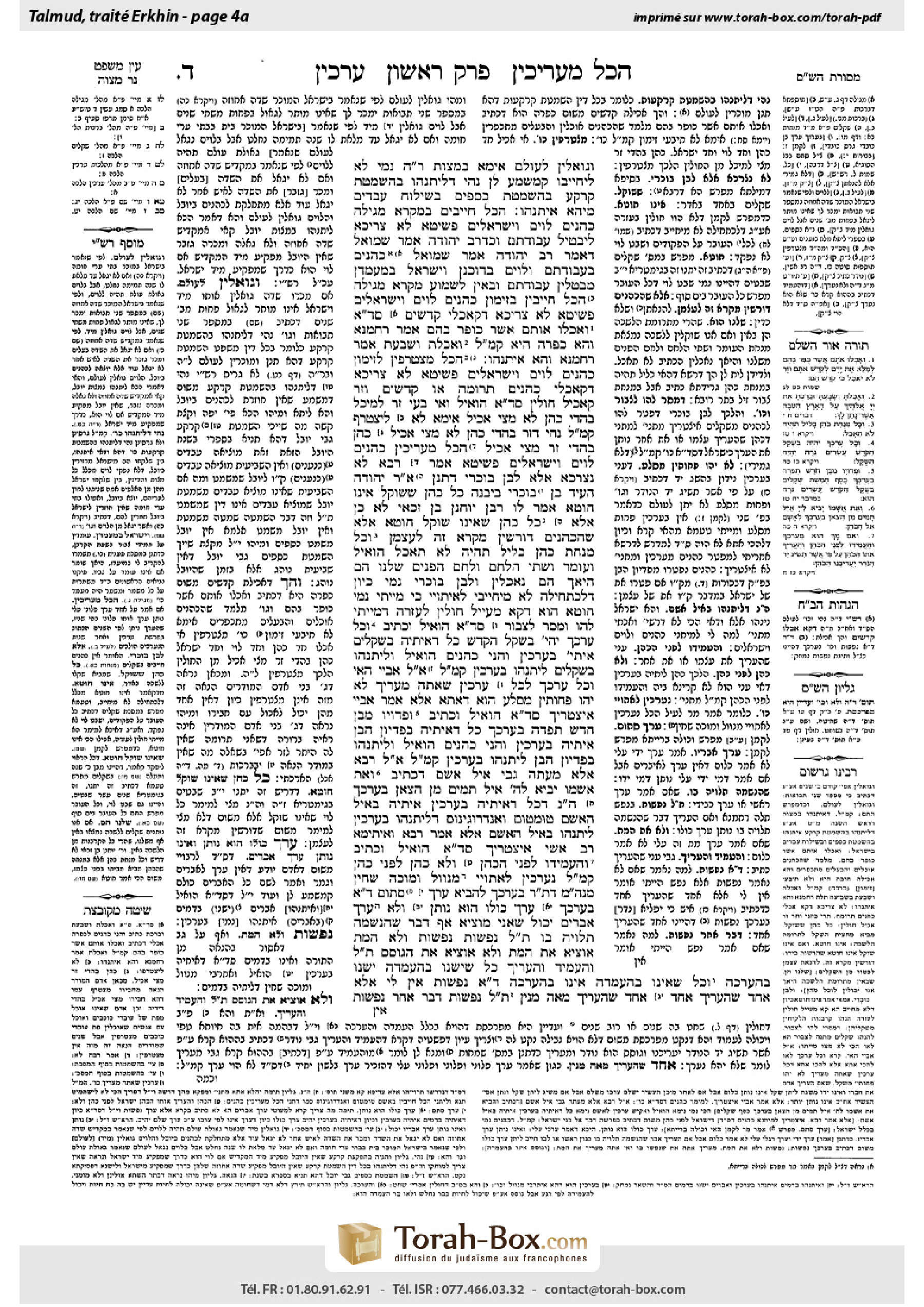
Arakhin 4a: Talmud study for Daf Yomi
Study the Talmud for Daf Yomi with scanned pages, Hebrew text, English translations from Sefaria and AI-generated French translations.
Passage selection and English or AI-generated French translation are available where the scan has annotations. Daf Study is independent of Torah-Box and Sefaria.
Browse Arakhin · ערכין · All tractatesArakhin 4a text and translations
This page of Arakhin includes the Aramaic text, an English translation and an AI-generated French translation, alongside the scan above.
ערכין ד׳ א · Aramaic and Hebrew text
וְגוֹאֲלִין לְעוֹלָם, אֵימָא בְּמִצְוַת רֹאשׁ הַשָּׁנָה נָמֵי לָא לִיחַיְּיבוּ, קָמַשְׁמַע לַן: נְהִי דְּלֵיתַנְהוּ בְּהַשְׁמָטַת קַרְקַע בְּהַשְׁמָטַת כְּסָפִים — בְּשִׁילּוּחַ עֲבָדִים מִיהָא אִיתַנְהוּ.
הַכֹּל חַיָּיבִים בְּמִקְרָא מְגִילָּה, כֹּהֲנִים לְוִיִּם וְיִשְׂרְאֵלִים. פְּשִׁיטָא! לָא צְרִיכָא לִיבַטֵּיל עֲבוֹדָתָם, וְכִדְרַב יְהוּדָה אָמַר שְׁמוּאֵל, דְּאָמַר רַב יְהוּדָה אָמַר שְׁמוּאֵל: כֹּהֲנִים בַּעֲבוֹדָתָם, וּלְוִיִּם בְּדוּכָנָן, וְיִשְׂרָאֵל בְּמַעֲמָדָן — מְבַטְּלִין עֲבוֹדָתָם וּבָאִין לִשְׁמוֹעַ מִקְרָא מְגִילָּה.
הַכֹּל חַיָּיבִין בְּזִימּוּן, כֹּהֲנִים לְוִיִּם וְיִשְׂרְאֵלִים. פְּשִׁיטָא! לָא צְרִיכָא, דְּקָאָכְלִי קׇדָשִׁים. סָלְקָא דַּעְתָּךְ אָמֵינָא: ״וְאָכְלוּ אוֹתָם אֲשֶׁר כֻּפַּר בָּהֶם״ אָמַר רַחֲמָנָא, וְהָא כַּפָּרָה הִיא.
קָא מַשְׁמַע לַן, ״וְאָכַלְתָּ וְשָׂבָעְתָּ״ אָמַר רַחֲמָנָא, וְהָא אִיתַנְהוּ.
הַכֹּל מִצְטָרְפִין לְזִימּוּן, כֹּהֲנִים לְוִיִּם וְיִשְׂרְאֵלִים. פְּשִׁיטָא! לָא צְרִיכָא, דְּקָאָכְלִי כֹּהֲנִים תְּרוּמָה אוֹ קׇדָשִׁים, וְזָר קָאָכֵיל חוּלִּין.
סָלְקָא דַּעְתָּךְ אָמֵינָא: הוֹאִיל וְאִי בָּעֵי זָר לְמֵיכַל בַּהֲדֵי כֹּהֵן לָא מָצֵי אָכֵיל, אֵימָא לָא לִיצְטָרֵף, קָא מַשְׁמַע לַן: נְהִי דְּזָר בַּהֲדֵי כֹּהֵן לָא מָצֵי אָכֵיל, כֹּהֵן בַּהֲדֵי זָר מָצֵי אָכֵיל.
הַכֹּל מַעֲרִיכִין, כֹּהֲנִים לְוִיִּם וְיִשְׂרְאֵלִים. פְּשִׁיטָא! אָמַר רָבָא: לֹא נִצְרְכָא אֶלָּא לְבֶן בּוּכְרִי, דִּתְנַן: אָמַר רַבִּי יְהוּדָה, הֵעִיד בֶּן בּוּכְרִי בְּיַבְנֶה: כׇּל כֹּהֵן שֶׁשּׁוֹקֵל אֵינוֹ חוֹטֵא.
אָמַר לוֹ רַבָּן יוֹחָנָן בֶּן זַכַּאי: לֹא כֵּן, אֶלָּא כׇּל כֹּהֵן שֶׁאֵינוֹ שׁוֹקֵל חוֹטֵא, אֶלָּא שֶׁהַכֹּהֲנִים דּוֹרְשִׁין מִקְרָא זֶה לְעַצְמָן: ״וְכׇל מִנְחַת כֹּהֵן כָּלִיל תִּהְיֶה לֹא תֵאָכֵל״.
הוֹאִיל וְעוֹמֶר וּשְׁתֵּי הַלֶּחֶם וְלֶחֶם הַפָּנִים שֶׁלָּנוּ הֵם, הֵיאַךְ הֵם נֶאֱכָלִין?
וּלְבֶן בּוּכְרִי נָמֵי, כֵּיוָן דִּלְכַתְּחִילָּה לָא מִיחַיְּיבִי לְאֵיתוֹיֵי, כִּי מַיְיתֵי נָמֵי — חוֹטֵא הוּא, דְּקָא מְעַיֵּיל חוּלִּין לָעֲזָרָה! דְּמַיְיתֵי לְהוּ וּמָסַר לַצִּבּוּר.
סָלְקָא דַּעְתָּךְ אָמֵינָא: הוֹאִיל וּכְתִיב ״וְכׇל עֶרְכְּךָ יִהְיֶה בְּשֶׁקֶל הַקֹּדֶשׁ״, כׇּל דְּאִיתֵיהּ בִּשְׁקָלִים — אִיתֵיהּ בַּעֲרָכִין, וְהָנֵי כֹּהֲנִים, הוֹאִיל וְלֵיתַנְהוּ בִּשְׁקָלִים — לֵיתַנְהוּ בַּעֲרָכִין, קָא מַשְׁמַע לַן.
אֲמַר לֵיהּ אַבָּיֵי: הַאי ״וְכׇל עֶרְכְּךָ״, לְכׇל עֲרָכִין שֶׁאַתָּה מַעֲרִיךְ לֹא יְהוּ פְּחוּתִין מִסֶּלַע הוּא דַּאֲתָא!
אֶלָּא אָמַר אַבָּיֵי: אִיצְטְרִיךְ, סָלְקָא דַּעְתָּךְ אָמֵינָא: הוֹאִיל וּכְתִיב ״וּפְדוּיָו מִבֶּן חֹדֶשׁ תִּפְדֶּה בְּעֶרְכְּךָ״, כׇּל דְּאִיתֵיהּ בְּפִדְיוֹן הַבֵּן — אִיתֵיהּ בַּעֲרָכִין, וְהָנֵי כֹּהֲנִים הוֹאִיל וְלֵיתַנְהוּ בְּפִדְיוֹן הַבֵּן — לֵיתַנְהוּ בַּעֲרָכִין, קָא מַשְׁמַע לַן.
אֲמַר לֵיהּ רָבָא: אֶלָּא מֵעַתָּה, גַּבֵּי אֵיל אָשָׁם, דִּכְתִיב: ״וְאֶת אֲשָׁמוֹ יָבִיא לַה׳ אַיִל תָּמִים מִן הַצֹּאן בְּעֶרְכְּךָ״, הָכִי נָמֵי דְּכׇל דְּאִיתֵיהּ בַּעֲרָכִין אִיתֵיהּ בְּאֵיל הָאָשָׁם, טוּמְטוּם וְאַנְדְּרוֹגִינוֹס דְּלֵיתַנְהוּ בַּעֲרָכִין לֵיתַנְהוּ בְּאֵיל הָאָשָׁם?
אֶלָּא אָמַר רָבָא, וְאִיתֵּימָא רַב אָשֵׁי: אִיצְטְרִיךְ, סָלְקָא דַּעְתָּךְ אָמֵינָא, הוֹאִיל וּכְתִיב ״וְהֶעֱמִידוֹ לִפְנֵי הַכֹּהֵן״, וְלֹא כֹּהֵן לִפְנֵי כֹּהֵן, קָא מַשְׁמַע לַן.
״נֶעֱרָכִין״ — לְאֵתוֹיֵי מְנוָּּול וּמוּכֵּה שְׁחִין. מְנָא הָנֵי מִילֵּי?
דְּתָנוּ רַבָּנַן: ״בְּעֶרְכְּךָ״ — לְהָבִיא עֵרֶךְ סָתוּם. דָּבָר אַחֵר: ״בְּעֶרְכְּךָ״ — עֵרֶךְ כּוּלּוֹ הוּא נוֹתֵן, וְלֹא עֵרֶךְ אֵבָרִים.
יָכוֹל שֶׁאֲנִי מוֹצִיא אַף דָּבָר שֶׁהַנְּשָׁמָה תְּלוּיָה בּוֹ? תַּלְמוּד לוֹמַר ״נְפָשׁוֹת״, נְפָשׁוֹת — וְלֹא הַמֵּת.
אוֹצִיא אֶת הַמֵּת, וְלֹא אוֹצִיא אֶת הַגּוֹסֵס? תַּלְמוּד לוֹמַר: ״וְהֶעֱמִיד... וְהֶעֱרִיךְ״ — כֹּל שֶׁיֶּשְׁנוֹ בְּהַעֲמָדָה, יֶשְׁנוֹ בְּהַעֲרָכָה, וְכֹל שֶׁאֵינוֹ בְּהַעֲמָדָה, אֵינוֹ בְּהַעֲרָכָה.
דָּבָר אַחֵר: ״נְפָשֹׁת״, אֵין לִי אֶלָּא אֶחָד שֶׁהֶעֱרִיךְ אֶחָד, אֶחָד שֶׁהֶעֱרִיךְ מֵאָה מִנַּיִן? תַּלְמוּד לוֹמַר ״נְפָשֹׁת״. דָּבָר אַחֵר: ״נְפָשֹׁת״,
Arakhin 4a · English translation
and they may also redeem lands that they sold at any time, i.e., even right after selling the field, and are not bound by the halakhot of the Jubilee Year, one might say that they should also not be obligated to fulfill the mitzva of blowing the shofar on Rosh HaShana. Therefore, the baraita teaches us that this is not the case. This is due to the fact that although priests are not included in the release of land, in any event they are included in the release of money and in the release of slaves in the Jubilee Year. Therefore, the priests are obligated in the sounding of the shofar on Rosh HaShana.
§ The Gemara cites another similar baraita: Everyone is obligated in the reading of the Megilla including priests, Levites, and Israelites. The Gemara asks as before: Isn’t that obvious? The Gemara answers: No, it is necessary to teach that they cancel their service in the Temple and come to hear the reading of the Megilla, and this is in accordance with that which Rav Yehuda says that Shmuel says. As Rav Yehuda says that Shmuel says: The priests at their Temple service, and the Levites on their platform in the Temple where they sang the daily psalm, and the Israelites at their non-priestly watches for the offerings of the community, all cancel their service and come to hear the reading of the Megilla.
The Gemara cites yet another similar baraita: Everyone is obligated to form a zimmun and recite Grace after Meals, including priests, Levites, and Israelites. The Gemara asks: Isn’t that obvious? The Gemara answers: No, it is necessary to teach this halakha in a case where the priests partake of sacrificial meat. It might enter your mind to say that since the Merciful One states in the Torah: “And they shall eat those things with which atonement was made” (Exodus 29:33), indicating that the owners of those offerings thereby achieve atonement, and therefore this consumption is an obligatory ritual act to bring about atonement, consequently, it is not considered a social meal requiring one to form a zimmun.
Therefore, the baraita teaches us that since the Merciful One states in the Torah: “And you shall eat, and be satisfied, and bless the Lord your God” (Deuteronomy 8:10), the obligation to recite Grace after Meals is contingent upon eating and being satisfied. Since there is eating and satisfaction in the case of priests partaking of the sacrificial meat, they are obligated to form a zimmun, despite the fact that the purpose of the meal is to bring about atonement.
The Gemara cites another baraita: Everyone joins a zimmun: Priests, Levites, and Israelites. The Gemara asks again: Isn’t that obvious? The Gemara answers: No, it is necessary to teach this halakha in a case where the priests are partaking of teruma, the portion of produce designated for priests, or sacrificial meat, and a non-priest is eating non-sacred food.
In such a case, it might enter your mind to say that since if the non-priest wants to eat together with the priest he cannot eat with him from the teruma, as it is forbidden to him, one could say that he cannot join with the priests for a zimmun. Therefore, the baraita teaches us that he can join them, as although a non-priest cannot eat together with a priest from his teruma, nevertheless, a priest can eat together with a non-priest from his food. Consequently, they can join together to form a zimmun.
§ The Gemara applies the same line of questioning to the mishna here: Everyone takes vows of valuation…priests, Levites, and Israelites. Isn’t that obvious? Rava said: This halakha is necessary only according to the opinion of ben Bukhri, who holds that priests are not obligated to contribute a yearly half-shekel to purchase the communal supplies. Therefore, one might have thought that they are not subject to the halakha of valuations, as the Gemara will explain. As we learned in a mishna (Shekalim 1:4) that Rabbi Yehuda said that ben Bukhri testified before the Sages in Yavne: Any priest who contributes the half-shekel for communal offerings is not considered a sinner, despite the fact that he is not obligated to contribute.
Rabbi Yehuda added that Rabban Yoḥanan ben Zakkai said to ben Bukhri: That is not the case; rather, any priest who does not contribute his half-shekel is considered a sinner, as they are obligated in this mitzva like all other Jews. But with regard to the priests who do not contribute the half-shekel, in order to excuse themselves from the mitzva they interpret this verse to their own advantage: “And every meal offering of the priest shall be wholly made to smoke; it shall not be eaten” (Leviticus 6:16).
Those priests claim as follows: Since the omer offering, the measure of barley brought as a communal offering on the sixteenth of Nisan, and the two loaves, i.e., the public offering of two loaves from the new wheat, brought on the festival of Shavuot, and the shewbread placed on the Table in the Sanctuary each Shabbat, which are all meal offerings, are ours, i.e., if we would contribute half-shekels we would have partial ownership of these communal offerings, as they are purchased with the half-shekels, how then can they be eaten? They would be regarded as priests’ meal offerings, which must be wholly burnt, in accordance with the aforementioned verse.
The Gemara clarifies: But according to the opinion of ben Bukhri, as well, why is a priest who contributes a half-shekel not considered a sinner? Since he is not obligated to bring the half-shekel ab initio, when he brings the half-shekel he is also a sinner, since he is causing the bringing of a non-sacred item into the Temple courtyard. The Gemara answers that the priest brings and transfers the half-shekel as a consecrated gift to the community, so it is considered part of the communal funds.
The Gemara explains the relevance of ben Bukhri’s opinion to the question of the priests’ status with respect to valuations. According to ben Bukhri, who exempts the priests from contributing the half-shekel, it might enter your mind to say that since it is written: “And all your valuations shall be according to the shekel of the Sanctuary” (Leviticus 27:25), perhaps this juxtaposition teaches that anyone who is included in the obligation to contribute half-shekels is included in the halakha of valuations. But with regard to these priests, since they are not included in the obligation to contribute half-shekels, they are also not included in the halakha of valuations. Therefore, the mishna teaches us that even according to the opinion of ben Bukhri, priests are included in the halakha of valuations.
Abaye said to Rava: One could not have thought that this phrase: “And all your valuations shall be according to the shekel of the Sanctuary” (Leviticus 27:25), might be coming to exempt the priests, as it comes to teach something else, namely that all valuations that you assess should not be less than the value of a sela coin. In other words, a poor person, who gives according to his means rather than the amount prescribed in the Torah, does not fulfill his obligation unless he gives at least a shekel, which is a sela coin.
Rather, Abaye said: It was necessary for the mishna to teach that priests are included in the halakha of valuation, as it might enter your mind to say: Since it is written with regard to a firstborn: “And their redemption money, from a month old you shall redeem them, shall be, according to your valuation, five shekels of silver” (Numbers 18:16), one might have said that anyone included in the mitzva of redemption of the firstborn son is included in the halakha of valuations; but with regard to these priests, since they are not included in the mitzva of redemption of the firstborn son, they are also not included in the halakha of valuations. Therefore, the mishna teaches us that priests are also included in the halakha of valuations.
Rava said to Abaye: If that is so, that one can expound the term “according to your valuation” in this manner, one could expound similarly with regard to the ram of the guilt offering brought by one who robs and then takes a false oath. As it is written with regard to that offering: “And he shall bring his guilt offering to the Lord, a ram without blemish out of the flock, according to your valuation” (Leviticus 5:25). One can argue that so too, anyone who is included in the halakha of valuations is included in the ram of the guilt offering. Therefore, a tumtum or a hermaphrodite, who are not included in the halakha of valuations, as stated in the mishna, should also not be included in the ram of the guilt offering. But that is not so, as there is no opinion that exempts them from this offering.
Rather, Rava said, and some say it was Rav Ashi: It was necessary to teach that priests are included in the halakha of valuation because it might enter your mind to say: Since it is written concerning valuations: “But if he is too poor for your valuation, then he shall be set before the priest” (Leviticus 27:8), this indicates that a poor man is placed before the priest for valuation, but a priest is not placed before another priest for valuation. Therefore, the mishna teaches us that priests are also included in the halakha of valuations.
§ The Gemara stated (2a) that the mishna’s statement: And everyone is valuated, serves to add that a repulsive man and one afflicted with boils are valuated in accordance with the Torah’s categories of age and sex despite their lack of market value. The Gemara asks: From where is this matter derived?
The Gemara answers that it is as the Sages taught in a baraita: The verse states: “When a man shall clearly utter a vow of persons to the Lord, according to your valuation” (Leviticus 27:2). The term serves to include an unspecified valuation, as explained below. Alternatively, the verse teaches that one gives the valuation of his entire self and not the valuation of his limbs. If someone vows that he will give the valuation of a limb, he is not obligated to give anything.
The baraita continues: One might have thought that I should exclude even the valuation of an item upon which the soul is dependent, without which one would die, e.g., the liver. Therefore, the verse states: “Persons [nefashot],” which teaches that if one valuated a limb upon which the soul [nefesh] is dependent, he is obligated to give the valuation of his entire self. The Gemara further derives from the term “persons” that one is obligated to pay the valuation only of a live person, and not the valuation of the dead. If one valuates a deceased person, his statement is of no effect.
Furthermore, one might have thought that I should exclude only the dead from valuation, but I should not exclude a moribund person, who is about to die but is still alive, and who is therefore included in the category of “persons.” Therefore, the verse states: “Then he shall be set before the priest, and the priest shall value him” (Leviticus 27:8). This teaches that anyone who is included in the category of setting, i.e., he can stand, is included in the halakha of valuation. And anyone not included in the category of setting, who cannot stand, e.g., one who is on his deathbed, is not included in the halakha of valuation. Therefore, one who valuates a moribund individual is not obligated to pay anything.
Alternatively, since the verse states: “Persons,” in the plural, it is expounded as follows: Were the verse to have written: A person, I would have derived only that this applies to one person who valuated one person. From where is it derived that even if one person valuated a hundred people, it is also an effective evaluation? The verse states: “Persons,” in the plural. This teaches that in such a case he must pay the valuation of each and every one of the hundred. Alternatively, one interprets the plural form of “persons” as follows: Were the verse to have written only: A person, one might have said that
Arakhin 4a · Traduction française (IA)
et ils peuvent également racheter des terres qu'ils ont vendues à tout moment, c'est-à-dire même juste après avoir vendu le champ, et ne sont pas soumis aux halakhot de l'année du Jubilé. On pourrait dire qu'ils ne sont pas non plus obligés de remplir la mitsva de sonner la trompette à Rosh HaShana. Ainsi, la baraïta nous apprend que ce n'est pas le cas. Cela est dû au fait que bien que les prêtres ne soient pas inclus dans la libération des terres, ils sont tout de même inclus dans la libération des deniers et dans la libération des esclaves lors de l'année du Jubilé. Ainsi, les prêtres sont obligés de sonner la trompette à Rosh HaShana.
§ Le Guemara cite une autre baraïta semblable : Tout le monde est tenu de lire la Megilla, y compris les prêtres, les Lévites et les Israélites. Le Guemara pose la question comme avant : N'est-ce pas évident ? Le Guemara répond : Non, il est nécessaire d'enseigner cela, car ils doivent abandonner leur service dans le Temple et venir écouter la lecture de la Megilla, et cela est conforme à ce que Rav Yehuda dit que Shmuel dit. Comme Rav Yehuda dit que Shmuel dit : Les prêtres lors de leur service dans le Temple, les Lévites sur leur plateforme dans le Temple où ils chantaient le psaume quotidien, et les Israélites lors de leurs veilles non sacrées pour les offrandes de la communauté, tous abandonnent leur service et viennent écouter la lecture de la Megilla.
Le Guemara cite une autre baraïta semblable : Tout le monde est tenu de former un zimmun et de réciter la Bérit après les repas, y compris les prêtres, les Lévites et les Israélites. Le Guemara pose la question : N'est-ce pas évident ? Le Guemara répond : Non, il est nécessaire d'enseigner cette halakha dans un cas où les prêtres consomment de la viande sacrée. Il pourrait entrer en votre esprit de dire que puisque l'Éternel dit dans la Torah : « Et ils mangeront ceux par lesquels l'atonement est accompli » (Exode 29:33), indiquant que les propriétaires de ces offrandes y trouvent l'atonement, et donc cette consommation est un acte rituel obligatoire pour obtenir l'atonement, par conséquent, cela ne serait pas considéré comme un repas social nécessitant de former un zimmun.
Ainsi, la baraïta nous apprend que puisque l'Éternel dit dans la Torah : « Et vous mangerez, et vous serez rassasiés, et vous bénirez l'Éternel votre Dieu » (Deutéronome 8:10), l'obligation de réciter la Bérit après les repas dépend de la consommation et de la satiété. Puisque dans le cas des prêtres consommant de la viande sacrée, il y a consommation et satiété, ils sont tenu de former un zimmun, malgré le fait que le but du repas est d'obtenir l'atonement.
Le Guemara cite une autre baraïta : Tout le monde participe à un zimmun : les prêtres, les Lévites et les Israélites. Le Guemara pose à nouveau la question : N'est-ce pas évident ? Le Guemara répond : Non, il est nécessaire d'enseigner cette halakha dans un cas où les prêtres consomment la terouma, la part de production réservée aux prêtres, ou la viande sacrée, et un non-prêtre mange de la nourriture non sacrée.
Dans ce cas, il pourrait entrer en votre esprit de dire que puisque si un non-prêtre veut manger avec un prêtre, il ne peut pas manger avec lui de la terouma, car cela lui est interdit, on pourrait dire qu'il ne peut pas participer avec les prêtres à un zimmun. Ainsi, la baraïta nous apprend que cela est possible, car bien qu'un non-prêtre ne puisse pas manger avec un prêtre de sa terouma, un prêtre peut manger avec un non-prêtre de son alimentation. Par conséquent, ils peuvent participer ensemble à un zimmun.
§ Le Guemara applique la même question à la mishna ici : Tout le monde prend des vœux de valeur… les prêtres, les Lévites et les Israélites. N'est-ce pas évident ? Rava dit : Cette halakha est nécessaire uniquement selon l'opinion de ben Bukhri, qui considère que les prêtres ne sont pas tenu de contribuer un demi-shekel annuel pour acheter les fournitures communautaires. Ainsi, on pourrait penser qu'ils ne sont pas soumis à la halakha des valeurs, comme le Guemara va l'expliquer. Comme nous avons appris dans une mishna (Shekalim 1:4) que Rabbi Yehuda dit que ben Bukhri a témoigné devant les Sages à Yavne : Tout prêtre qui contribue le demi-shekel pour les offrandes communautaires n'est pas considéré comme un pécheur, malgré le fait qu'il n'est pas tenu de contribuer.
Rabbi Yehuda ajouta que Rabban Yoḥanan ben Zakkai dit à ben Bukhri : Ce n'est pas le cas ; plutôt, tout prêtre qui ne contribue pas son demi-shekel est considéré comme un pécheur, car ils sont tenu de cette mitsva comme tous les Juifs. Mais concernant les prêtres qui ne contribuent pas le demi-shekel, afin d'excuser leur manquement à la mitsva, ils interprètent cette verset à leur avantage : « Et toute offrande de la table du prêtre sera entièrement brûlée ; elle ne sera pas mangée » (Lévitique 6:16).
Ces prêtres affirment comme suit : Puisque l'offrande de l'omer, la mesure de blé apportée comme offrande communautaire le seizième du Nisan, et les deux pains, c'est-à-dire l'offrande publique de deux pains de blé nouveau apportée à la fête de Shavuot, et le pain de présentation placé sur la Table dans le Sanctuaire chaque sabbat, qui sont toutes des offrandes de table, sont nôtres, c'est-à-dire si nous contribuions des demi-shekels, nous aurions une part de propriété sur ces offrandes communautaires, car elles sont achetées avec les demi-shekels, comment alors peuvent-elles être mangées ? Elles seraient considérées comme des offrandes de table des prêtres, qui doivent être entièrement brûlées, conformément à ce verset mentionné plus haut.
Le Guemara clarifie : Mais selon l'opinion de Ben Bukhri également, pourquoi un prêtre qui contribue un demi-shekel n'est-il pas considéré comme un pécheur ? Puisque celui-ci n'était pas tenu de contribuer le demi-shekel d'abord, lorsqu'il contribue le demi-shekel, il est également un pécheur, car il cause l'apport d'un objet non sacré dans le cour de l'Éternel. Le Guemara répond que le prêtre apporte et transfère le demi-shekel comme un don consacré à la communauté, donc il est considéré comme faisant partie des fonds communautaires.
La Guemara explique la pertinence de l'opinion de ben Bukhri par rapport à la question du statut des prêtres en matière de valuations. Selon ben Bukhri, qui exempt les prêtres de la contribution du demi-shekel, on pourrait penser que puisque cela est écrit : « Et toutes vos valuations seront selon le shekel du Sanctuaire » (Lévitique 27:25), peut-être cette juxtaposition enseigne que tout celui qui est inclus dans l'obligation de contribuer des demi-shekels est inclus dans la halakha des valuations. Mais concernant ces prêtres, puisqu'ils ne sont pas inclus dans l'obligation de contribuer des demi-shekels, ils ne sont pas non plus inclus dans la halakha des valuations. Ainsi, la mitsna nous apprend que même selon l'opinion de ben Bukhri, les prêtres sont inclus dans la halakha des valuations.
Abaye dit à Rava : On ne pourrait pas penser que cette phrase : « Et toutes vos valuations seront selon le shekel du Sanctuaire » (Lévitique 27:25) vienne exempter les prêtres, car elle vient enseigner quelque chose d'autre, à savoir que toutes les valuations que vous évaluez ne doivent pas être inférieures à la valeur d'un sela. En d'autres termes, un pauvre qui donne selon ses moyens plutôt que selon la quantité prescrite dans la Torah ne rempli son obligation qu'à condition qu'il donne au moins un shekel, c'est-à-dire un sela.
Plutôt, Abaye dit : Il était nécessaire que la mitsna enseigne que les prêtres sont inclus dans la halakha des appréciations, car on pourrait penser que puisque cela est écrit concernant un premier-né : « Et la valeur de leur rachat, à partir d'un mois, tu rachèteras, sera de cinq shekels d'argent » (Nb 18:16), on pourrait dire que tout celui inclus dans la mitsva du rachat du premier-né est inclus dans la halakha des appréciations ; mais concernant ces prêtres, puisqu'ils ne sont pas inclus dans la mitsva du rachat du premier-né, ils ne sont pas non plus inclus dans la halakha des appréciations. Ainsi, la mitsna nous apprend que les prêtres sont également inclus dans la halakha des appréciations.
Rava dit à Abaye : Si c'est ainsi, c'est-à-dire qu'on peut expliquer le terme « selon votre appréciation » ainsi, on pourrait expliquer de même concernant le bouc du sacrifice expiatoire apporté par celui qui vole et puis jure faux. Car il est écrit concernant ce sacrifice : « Et il apportera son sacrifice expiatoire à l'Éternel, un bouc sans tare du troupeau, selon votre appréciation » (Lévitique 5:25). On pourrait arguer que de même, tout celui inclus dans la halakha des appréciations est inclus dans le bouc du sacrifice expiatoire. Ainsi, un tumtum ou un hermaphrodite, qui ne sont pas inclus dans la halakha des appréciations, comme le dit la mitsna, ne devraient pas non plus être inclus dans le bouc du sacrifice expiatoire. Mais cela n'est pas vrai, car il n'y a pas d'opinion exemptant ces personnes de ce sacrifice.
Plutôt, Rava dit, et certains disent que c'était Rav Ashi : Il était nécessaire d'enseigner que les prêtres sont inclus dans la halakha des appréciations car on pourrait penser que puisque cela est écrit concernant les appréciations : « Mais s'il est trop pauvre pour votre appréciation, alors il sera mis devant le prêtre » (Lévitique 27:8), cela indique qu'un pauvre est mis devant le prêtre pour être apprécié, mais un prêtre n'est pas mis devant un autre prêtre pour être apprécié. Ainsi, la mitsna nous apprend que les prêtres sont également inclus dans la halakha des appréciations.
§ La Guemara a dit (2a) que l'affirmation de la mitsna : « Et tout le monde est apprécié » sert à ajouter que l'homme repoussant et celui souffrant de cloques sont appréciés selon les catégories de l'âge et du sexe prescrites par la Torah, malgré leur valeur marchande réduite. La Guemara pose la question : D'où cette matière est-elle dérivée ?
La Guemara répond que c'est comme les Sages ont enseigné dans une baraïta : Le verset dit : « Quand un homme aura clairement fait un vœu de personnes à l'Éternel, selon votre appréciation » (Lévitique 27:2). Le terme sert à inclure une appréciation non spécifiée, comme expliqué ci-dessous. Alternativement, le verset enseigne que l'on donne l'appréciation de son être entier et non l'appréciation de ses membres. Si quelqu'un fait un vœu selon lequel il donnera l'appréciation d'un membre, il n'est pas tenu de donner quoi que ce soit.
La baraïta continue : On pourrait penser qu'il faut exclure même l'appréciation d'un objet sur lequel l'âme dépend, sans lequel on meurt, par exemple le foie. Ainsi, le verset dit : « personnes [nefashot] », ce qui enseigne que si l'on appréciait un membre sur lequel l'âme [nefesh] dépend, il est tenu de donner l'appréciation de son être entier. La Guemara dérive également du terme « personnes » que l'on est tenu de payer l'appréciation seulement d'une personne vivante et non de la personne morte. Si l'on apprécie une personne décédée, sa déclaration est inefficace.
De plus, on pourrait penser qu'il faut exclure seulement les morts de l'appréciation, mais pas une personne mourante, qui est sur le point de mourir mais qui est encore vivante, et qui est donc incluse dans la catégorie de « personnes ». Ainsi, le verset dit : « Il sera mis devant le prêtre, et le prêtre appréciera lui » (Lévitique 27:8). Cela enseigne que toute personne incluse dans la catégorie de « celui qui peut se tenir », c'est-à-dire qui peut se lever, est incluse dans la halakha de l'appréciation. Et toute personne non incluse dans la catégorie de « celui qui peut se tenir », qui ne peut pas se lever, par exemple celui qui est sur son lit de mort, n'est pas incluse dans la halakha de l'appréciation. Ainsi, celui qui apprécie une personne mourante n'est pas tenu de payer quoi que ce soit.
Alternativement, puisque le verset dit : « personnes », au pluriel, il est expliqué comme suit : Si le verset avait dit : « une personne », je n'aurais dérivé que cela s'applique à une personne qui apprécie une personne. D'où est-il dérivé que même si une personne apprécie cent personnes, cela est également une appréciation efficace ? Le verset dit : « personnes », au pluriel. Cela enseigne que dans ce cas, il doit payer l'appréciation de chacune des cent personnes. Alternativement, on interprète la forme plurielle de « personnes » comme suit : Si le verset avait dit seulement : « une personne », on pourrait dire que
Traduction française générée par IA à partir de l’édition anglaise de Sefaria. Vérifie toujours un passage avec le texte source.
Text from Sefaria: William Davidson Edition - Vocalized Aramaic (CC BY NC); William Davidson Edition - English (CC BY NC).