Arakhin 5b: Talmud study for Daf Yomi
Study the Talmud for Daf Yomi with scanned pages, Hebrew text, English translations from Sefaria and AI-generated French translations.
Passage selection and English or AI-generated French translation are available where the scan has annotations. Daf Study is independent of Torah-Box and Sefaria.
Browse Arakhin · ערכין · All tractatesArakhin 5b text and translations
This page of Arakhin includes the Aramaic text, an English translation and an AI-generated French translation, alongside the scan above.
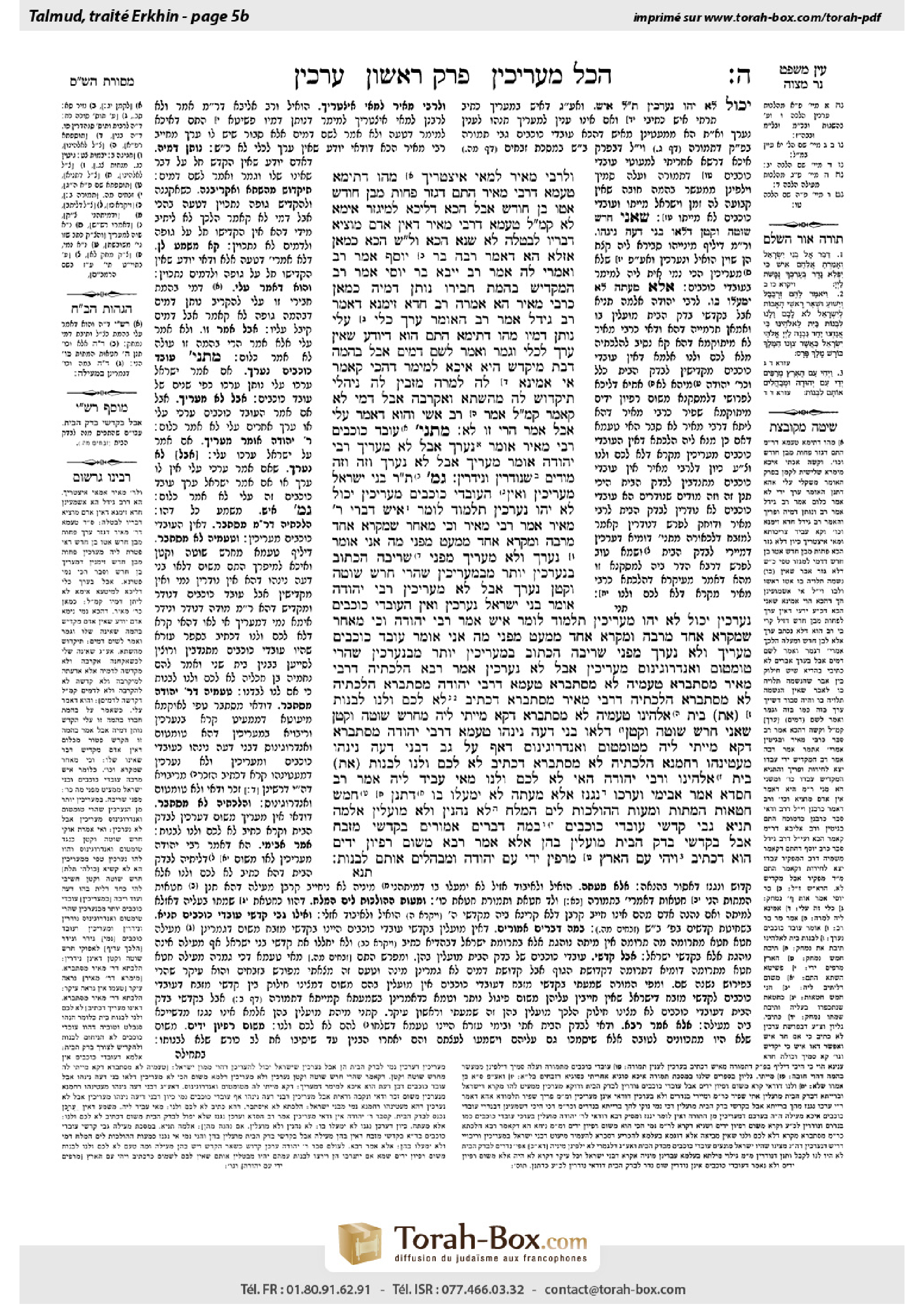
ערכין ה׳ ב · Aramaic and Hebrew text
וּלְרַבִּי מֵאִיר לְמַאי אִיצְטְרִיךְ?
מַהוּ דְּתֵימָא: טַעְמָא דְּרַבִּי מֵאִיר הָתָם, דְּגָזַר פָּחוֹת מִבֶּן חוֹדֶשׁ אַטּוּ בֶּן חוֹדֶשׁ, אֲבָל הָכָא דְּלֵיכָּא לְמִיגְזַר — אֵימָא לָא. קָא מַשְׁמַע לַן: טַעְמָא דְּרַבִּי מֵאִיר דְּאֵין אָדָם מוֹצִיא דְּבָרָיו לְבַטָּלָה, לָא שְׁנָא הָכָא וְלָא שְׁנָא הָכָא.
כְּמַאן אָזְלָא הָא דְּאָמַר רַבָּה בַּר יוֹסֵף אָמַר רַב, וְאָמְרִי לַהּ אָמַר רַב יֵיבָא בַּר יוֹסֵי אָמַר רַב: הַמַּקְדִּישׁ בֶּהֱמַת חֲבֵירוֹ נוֹתֵן דָּמֶיהָ? כְּמַאן — כְּרַבִּי מֵאִיר.
הָא אַמְרַהּ רַב חֲדָא זִימְנָא, דְּאָמַר רַב גִּידֵּל אָמַר רַב: הָאוֹמֵר ״עֵרֶךְ כְּלִי עָלַי״ נוֹתֵן דָּמָיו! מַהוּ דְּתֵימָא הָתָם הוּא דְּיוֹדֵעַ שֶׁאֵין עֵרֶךְ לִכְלִי, וְגָמַר וְאָמַר לְשֵׁם דָּמִים.
אֲבָל בְּהֵמָה, דְּבַת מִיקְדַּשׁ הִיא, אִיכָּא לְמֵימַר דְּהָכִי קָאָמַר: אִי אָמֵינָא לֵהּ לְמַרַּהּ מְזַבֵּין לַהּ נִיהֲלִי, תִּיקְדּוֹשׁ לַהּ מֵהַשְׁתָּא וְאַקְרְבַהּ, אֲבָל דְּמֵי לָא קָאָמַר, קָא מַשְׁמַע לַן.
אָמַר רַב אָשֵׁי: וְהוּא דְּאָמַר ״עָלַי״, אֲבָל אָמַר ״הֲרֵי זוֹ״ — לֹא.
מַתְנִי׳ נָכְרִי — רַבִּי מֵאִיר אוֹמֵר: נֶעֱרָךְ, אֲבָל לֹא מַעֲרִיךְ. רַבִּי יְהוּדָה אוֹמֵר: מַעֲרִיךְ, אֲבָל לֹא נֶעֱרָךְ. וְזֶה וָזֶה מוֹדִים שֶׁנּוֹדְרִין וְנִידָּרִין.
גְּמָ׳ תָּנוּ רַבָּנַן: בְּנֵי יִשְׂרָאֵל מַעֲרִיכִין וְאֵין הַגּוֹיִם מַעֲרִיכִין.
יָכוֹל לֹא יְהוּ נֶעֱרָכִין? תַּלְמוּד לוֹמַר: ״אִישׁ״, דִּבְרֵי רַבִּי מֵאִיר.
אָמַר רַבִּי מֵאִיר: וְכִי מֵאַחַר שֶׁמִּקְרָא אֶחָד מְרַבֶּה וּמִקְרָא אֶחָד מְמַעֵט, מִפְּנֵי מָה אֲנִי אוֹמֵר נֶעֱרָךְ וְלֹא מַעֲרִיךְ?
מִפְּנֵי שֶׁרִיבָּה הַכָּתוּב בַּנֶּעֱרָכִין יוֹתֵר מִבַּמַּעֲרִיכִין, שֶׁהֲרֵי חֵרֵשׁ שׁוֹטֶה וְקָטָן נֶעֱרָךְ, אֲבָל לֹא מַעֲרִיכִין.
רַבִּי יְהוּדָה אוֹמֵר: בְּנֵי יִשְׂרָאֵל נֶעֱרָכִין וְאֵין הַגּוֹיִם נֶעֱרָכִין; יָכוֹל לֹא יְהוּ מַעֲרִיכִין? תַּלְמוּד לוֹמַר ״אִישׁ״.
אָמַר רַבִּי יְהוּדָה: וְכִי מֵאַחַר שֶׁמִּקְרָא אֶחָד מְרַבֶּה וּמִקְרָא אֶחָד מְמַעֵט, מִפְּנֵי מָה אֲנִי אוֹמֵר נָכְרִי מַעֲרִיךְ וְלֹא נֶעֱרָךְ? מִפְּנֵי שֶׁרִיבָּה הַכָּתוּב בַּמַּעֲרִיכִין יוֹתֵר מִבַּנֶּעְרָכִין, שֶׁהֲרֵי טוּמְטוּם וְאַנְדְּרוֹגִינוֹס מַעֲרִיכִין אֲבָל לֹא נֶעֱרָכִין.
אָמַר רָבָא: הִלְכְתֵיהּ דְּרַבִּי מֵאִיר מִסְתַּבְּרָא, טַעְמֵיהּ לָא מִסְתַּבְּרָא, טַעְמָא דְּרַבִּי יְהוּדָה מִסְתַּבְּרָא, הִלְכְתֵיהּ לָא מִסְתַּבְּרָא.
הִלְכְתֵיהּ דְּרַבִּי מֵאִיר מִסְתַּבְּרָא, דִּכְתִיב: ״לֹא לָכֶם וָלָנוּ לִבְנוֹת אֶת בֵּית אֱלֹהֵינוּ״, טַעְמֵיהּ לָא מִסְתַּבְּרָא, דְּקָא מַיְיתֵי לֵיהּ מֵחֵרֵשׁ שׁוֹטֶה וְקָטָן, שָׁאנֵי חֵרֵשׁ שׁוֹטֶה וְקָטָן דְּלָאו בְּנֵי דֵעָה נִינְהוּ.
טַעְמָא דְּרַבִּי יְהוּדָה מִסְתַּבְּרָא, דְּקָא מַיְיתֵי לֵיהּ מִטּוּמְטוּם וְאַנְדְּרוֹגִינוֹס, דְּאַף עַל גַּב דִּבְנֵי דֵעָה נִינְהוּ מַעֲטִינְהוּ רַחֲמָנָא. הִלְכְתֵיהּ לָא מִסְתַּבְּרָא, דִּכְתִיב: ״לֹא לָכֶם וָלָנוּ לִבְנוֹת אֶת בֵּית אֱלֹהֵינוּ״.
וְרַבִּי יְהוּדָה, הַאי ״לָא לָכֶם וְלָנוּ״ מַאי עָבֵיד לֵיהּ? אָמַר רַב חִסְדָּא אָמַר אֲבִימִי: וְעֶרְכּוֹ נִגְנָז.
אֶלָּא מֵעַתָּה, לֹא יִמְעֲלוּ בּוֹ, דִּתְנַן: חָמֵשׁ חַטָּאוֹת הַמֵּתוֹת, וּמָעוֹת הַהוֹלְכוֹת לְיָם הַמֶּלַח — לֹא נֶהֱנִין וְלֹא מוֹעֲלִין!
אַלְּמָה תַּנְיָא גַּבֵּי קׇדְשֵׁי גוֹיִם: בַּמֶּה דְּבָרִים אֲמוּרִים — בְּקׇדְשֵׁי מִזְבֵּחַ, אֲבָל בְּקׇדְשֵׁי בֶּדֶק הַבַּיִת מוֹעֲלִין בָּהֶן?!
אֶלָּא אָמַר רָבָא: מִשּׁוּם רִפְיוֹן יָדַיִם הוּא, דִּכְתִיב: ״וַיְהִי עַם הָאָרֶץ מְרַפִּין יְדֵי עַם יְהוּדָה וּמְבַהֲלִים אוֹתָם לִבְנוֹת״.
Arakhin 5b · English translation
The Gemara asks: And as Rav stated his halakha in accordance with Rabbi Meir, who says that one who valuates a child less than a month old must pay his assessment, for what reason was it necessary for Rav to state his ruling? Isn’t this obvious?
The Gemara answers: It was necessary for him to state this halakha, lest you say that the reason that Rabbi Meir obligates him to pay the assessment there, in the case of the child, is that he decrees one must pay if the child is less than a month old, due to concern that otherwise people might mistakenly refrain from paying the valuation of a child who is a month old. But here, in the case of one who valuates a utensil, where there is no cause for such an error and therefore no need to decree, one might say that Rabbi Meir would not obligate him to pay. Therefore, Rav teaches us that since the reason of Rabbi Meir is that a person does not make his statement of consecration for naught, there is no difference between here, the case of a child, and there, with regard to a utensil. Rather, the halakha is the same in both cases.
The Gemara asks: In accordance with whose opinion is that which Rabba bar Yosef says that Rav says, and some say that Rav Yeiva bar Yosei says that Rav says: One who consecrates the animal of another must give its assessment. In accordance with whom? It is in accordance with the opinion of Rabbi Meir, that one does not issue a statement of consecration for naught. Since he knows that he cannot consecrate that which is not his, he meant to obligate himself in the animal’s assessment.
The Gemara asks: But didn’t Rav already say it once? As Rav Giddel says that Rav says: One who says: It is incumbent upon me to donate the valuation of a utensil, must give its assessment. The Gemara answers: Rav found it necessary to issue both statements, lest you say that this halakha applies only there, with regard to a utensil, as a person knows that a utensil has no valuation, i.e., that the term: Valuation, is not relevant to a utensil, and therefore it must be that he decided to donate money and says this expression as a reference to its monetary value, using the term: Valuation, imprecisely.
But in the case where one obligated himself in the valuation of another’s animal, which is subject to consecration, albeit not by him, there is room to say that this is what he is saying to himself: Were I to say to the owner that I want to buy it, he would sell it to me. Therefore, let it be consecrated from now, and I will sacrifice it once I purchase it from him. His intent is to consecrate the animal itself in order to sacrifice it. But since he did not say to himself that he would give its assessment, his statement is meaningless, as one cannot consecrate property that does not belong to him. Therefore, Rav teaches us that this is not the case. Rather, his statement should be interpreted in such a manner that he is obligated to give the assessment of the animal to the Temple treasury.
Rav Ashi says: And Rav’s ruling applies only in a case where one says: It is incumbent upon me to donate to the Temple treasury. But if he says: This animal is consecrated, he is not obligated to pay its assessment. This formulation clearly indicates that he intended to consecrate this animal, which he cannot do, as it does not yet belong to him.
MISHNA: With regard to a gentile, Rabbi Meir says: He is valuated in a case where a Jew says: It is incumbent upon me to donate the fixed value of this gentile. But a gentile does not take a vow of valuation to donate his fixed value or the value of others. Rabbi Yehuda says: He takes a vow of valuation, but is not valuated. And both this tanna, Rabbi Meir, and that tanna, Rabbi Yehuda, agree that gentiles vow to donate the assessment of another and are the object of vows, whereby one donates the assessment of a gentile.
GEMARA: The Sages taught the following in a baraita that deals with the reasoning for the rulings of Rabbi Meir and Rabbi Yehuda. It is written in the beginning of the passage in the Torah delineating valuations: “Speak to the children of Israel” (Leviticus 27:2). This teaches that “the children of Israel” can take a vow of valuation, but gentiles cannot take a vow of valuation.
One might have thought that this means that gentiles cannot be the object of a valuation either. Therefore, the verse states the inclusive expression: “When a man shall clearly utter a vow of persons to the Lord, according to your valuation” (Leviticus 27:2), to teach that in this regard, every “man,” even a gentile, is included in halakhot of valuations. This is the statement of Rabbi Meir.
Rabbi Meir says in explanation of his opinion: Since one verse, “a man,” includes gentiles, and another verse, “the children of Israel,” excludes gentiles, for what reason do I say that a gentile can be the object of a valuation but cannot take a vow of valuation, rather than the reverse?
It is due to the fact that the verse included more people in the category of those who are the object of a valuation than in the category of those who take a vow of valuation. As the mishna teaches (2a): A deaf-mute, an imbecile, and a minor are the object of a vow and are valuated, but they can neither vow to donate the assessment of a person nor take a vow of valuation.
Rabbi Yehuda says that the verses should be interpreted in the reverse manner: “The children of Israel,” can be the object of a valuation but gentiles cannot be the object of a valuation. One might have thought that gentiles cannot take a vow of valuation either. Therefore, the verse states the inclusive expression: “A man” (Leviticus 27:2), to teach that in this regard, every “man,” even a gentile, is included in the halakha of valuations.
Rabbi Yehuda says: Since one verse, “a man,” includes gentiles, and another verse, “the children of Israel,” excludes gentiles, for what reason do I say that a gentile can take a vow of a valuation but cannot be the object of a valuation? It is due to the fact that the verse included more people in the category of those who take a vow of valuation than in the category of those who are the object of a valuation. As the mishna teaches (2a): A tumtum and a hermaphrodite vow, are the object of a vow, and take vows of valuation, but they are not valuated.
Rava says: Rabbi Meir’s halakha is reasonable, but his explanation is not reasonable. Conversely, Rabbi Yehuda’s explanation is reasonable, but his halakha is not reasonable.
Rava elaborates: Rabbi Meir’s halakha that gentiles cannot take a valuation vow is reasonable, as it is written that the Jews who returned to Eretz Yisrael from Babylonia rejected the Samaritans’ request to assist them in the construction of the Second Temple, saying: “You have nothing to do with us to build a house to our God” (Ezra 4:3). This supports Rabbi Meir’s contention that gentiles may not take vows of valuation, which are used for Temple maintenance. But his explanation is not reasonable, as he adduces proof for his halakha from the fact that a deaf-mute, an imbecile, and a minor cannot take a vow of valuation. This proof is unconvincing, since a deaf-mute, an imbecile, and a minor are different, as unlike gentiles, they lack the presumed mental competence to make a commitment.
By contrast, Rabbi Yehuda’s explanation is reasonable, in that he adduces proof for his halakha from the case of a tumtum and a hermaphrodite, as even though they possess the presumed mental competence to make a commitment, nevertheless the Merciful One excludes them from being valuated. Since they are comparable to gentiles, they can serve as a precedent. But his halakha that gentiles can take a valuation vow is not reasonable, as it is written: “You have nothing to do with us to build a house to our God,” which indicates that they may not contribute anything to Temple maintenance.
The Gemara asks: And Rabbi Yehuda, who holds that gentiles can take valuation vows and that the funds go to Temple maintenance, what does he do with this verse: “You have nothing to do with us”? Rav Ḥisda said that Avimi said: He derives from it that if a gentile takes a vow of valuation and he brings the money to the Temple, his valuation money is not utilized but rather is interred.
The Gemara asks: If that is so, that the valuation is not utilized for the Temple, one who uses it should not be considered to have violated the prohibition of misuse. One who unwittingly derived benefit from the valuation should not be obligated to bring a guilt offering for misuse of consecrated property, as the Temple treasury does not derive benefit from it. As we learned in a baraita: With regard to the five sin offerings that may not be sacrificed and are left to die, and similarly, with regard to consecrated money that is taken and cast into the Dead Sea, as it is not fit for any purpose, one may not derive benefit from them ab initio. But after the fact, if one derived benefit from them he is not liable for misuse, as the Temple treasury has no use for them.
Why then is it taught in a baraita with regard to the consecrations of gentiles: In what case is this statement, that consecrations of gentiles are not subject to the halakhot of misuse, said? It is specifically with regard to consecrations for the altar. But with regard to consecrations for Temple maintenance, one who derives benefit from them is liable for misuse of consecrated property. Why is this the halakha, given the fact that the consecrations of a gentile are interred?
Rather, Rava said that actually Rabbi Yehuda maintains that the valuation of a gentile is given to Temple maintenance and is not interred. And as for that which the Jews said to the gentiles in the time of the Second Temple: “You have nothing to do with us,” that refusal was not for halakhic reasons. Rather, it was due to the gentiles’ attempt to foster weakening of the hands of those rebuilding the Temple. As it is written: “Then the people of the land weakened the hands of the people of Judah, and harried them while they were building” (Ezra 4:4).
Arakhin 5b · Traduction française (IA)
La Guemara pose la question : Et comme Rav a formulé sa halakha conformément à Rabbi Meir, qui affirme qu'une personne qui évalue un enfant âgé de moins d'un mois doit payer son évaluation, pourquoi était-il nécessaire que Rav énonce sa décision ? N'est-ce pas évident ?
La Guemara répond : Il était nécessaire qu'il énonce cette halakha, afin que l'on ne dise pas que la raison pour laquelle Rabbi Meir impose de payer l'évaluation dans le cas de l'enfant est que l'on craint que les gens ne se trompent en ne payant pas l'évaluation d'un enfant âgé d'un mois. Mais ici, dans le cas d'une personne qui évalue un ustensile, où il n'y a pas de cause d'erreur et donc pas besoin de décret, on pourrait dire que Rabbi Meir ne serait pas obligé de le faire. Ainsi, Rav nous enseigne que puisque la raison de Rabbi Meir est que la personne ne formule pas son dédicace à vide, il n'y a pas de différence entre ce cas, celui de l'enfant, et celui d'un ustensile. La halakha est la même dans les deux cas.
La Guemara pose la question : Selon l'opinion de qui est-ce que Rabba bar Yosef dit que Rav dit, et certains disent que Rav Yeiva bar Yosei dit que Rav dit : Celui qui dédie l'animal d'autrui doit donner son évaluation. Selon qui ? Selon l'opinion de Rabbi Meir, qui affirme qu'on ne formule pas de dédicace à vide. Sachant qu'il ne peut dédier ce qui n'est pas à lui, il voulait s'obliger à l'évaluation de l'animal.
La Guemara pose la question : Mais n'avait-il pas déjà dit cela une fois ? Comme Rav Giddel dit que Rav dit : Celui qui dit : Il m'est imposé de donner l'évaluation d'un ustensile doit donner son évaluation. La Guemara répond : Rav trouva nécessaire d'énoncer ces deux déclarations, afin que l'on ne dise pas que cette halakha s'applique uniquement là, au cas de l'ustensile, car une personne sait qu'un ustensile n'a pas d'évaluation, c'est-à-dire que le terme : évaluation, n'est pas pertinent pour un ustensile, et donc il faut dire qu'il a décidé de donner de l'argent et utilise ce terme imprecisément pour faire référence à sa valeur monétaire.
Mais dans le cas où l'on s'engage à l'évaluation d'un animal d'autrui, qui est soumis à la dédicace, bien que ce ne soit pas par lui, il y a lieu de dire que c'est ce qu'il dit à lui-même : Si je dis à l'propriétaire que je veux l'acheter, il me le vendra. Donc, qu'il soit dédié dès maintenant, et je le sacrifierai une fois que je l'aurai acheté de lui. Son intention est de dédier l'animal lui-même afin de le sacrifier. Mais puisqu'il n'a pas dit à lui-même qu'il donnerait son évaluation, son déclaration est vaine, car on ne peut dédier une propriété qui n'appartient pas à l'individu. Ainsi, Rav nous enseigne que ce n'est pas le cas. Son déclaration doit être interprétée de telle sorte qu'il soit obligé de donner l'évaluation de l'animal au trésor du Temple.
Rav Ashi dit : Et la décision de Rav s'applique uniquement dans le cas où l'on dit : Il m'est imposé de donner à la trésorerie du Temple. Mais si l'on dit : Cet animal est dédié, il n'est pas obligé de payer son évaluation. Cette formulation indique clairement qu'il voulait dédier cet animal, qu'il ne peut pas faire, car il n'appartient pas à lui encore.
MICHNA : En ce qui concerne un non-Juif, Rabbi Meir dit : Il est évalué dans le cas où un Juif dit : Il m'est imposé de donner la valeur fixe de ce non-Juif. Mais un non-Juif ne prend pas un serment d'évaluation pour donner sa valeur fixe ou celle des autres. Rabbi Yehuda dit : Il prend un serment d'évaluation, mais n'est pas évalué. Et les deux tannaïm, Rabbi Meir et Rabbi Yehuda, s'accordent sur le fait que les non-Juifs prennent des serments pour donner l'évaluation d'autrui et sont l'objet de serments.
GUEMARA : Les Sages ont enseigné ceci dans une baraïta qui traite de la raison des décisions de Rabbi Meir et Rabbi Yehuda. Il est écrit au début du passage dans la Torah qui définit les évaluations : « Parle aux enfants d'Israël » (Lévitique 27:2). Cela enseigne que « les enfants d'Israël » peuvent prendre un serment d'évaluation, mais les non-Juifs ne peuvent pas prendre un serment d'évaluation.
On pourrait penser que cela signifie que les non-Juifs ne sont pas non plus l'objet d'une évaluation. Ainsi, le verset dit l'expression inclusive : « Quand un homme aura clairement prononcé un serment de personnes à l'Éternel, selon votre évaluation » (Lévitique 27:2), pour enseigner que dans ce cas, chaque « homme », même un non-Juif, est inclus dans les halakhot des évaluations. C'est l'opinion de Rabbi Meir.
Rabbi Meir explique son opinion en disant : Puisque l'un des versets, « un homme », inclut les non-Juifs, et l'autre, « les enfants d'Israël », exclut les non-Juifs, pourquoi dis-je que les non-Juifs peuvent être l'objet d'une évaluation mais ne peuvent pas prendre un serment d'évaluation, plutôt que l'inverse ?
C'est à cause du fait que le verset a inclus plus de personnes dans la catégorie de ceux qui sont l'objet d'une évaluation que dans celle de ceux qui prennent un serment d'évaluation. Comme la mishna enseigne (2a) : Un sourd-muet, un imbécile et un mineur sont l'objet d'un serment et sont évalués, mais ils ne peuvent ni prendre un serment pour donner l'évaluation d'une personne ni prendre un serment d'évaluation.
Rabbi Yehuda dit que les versets doivent être interprétés dans l'ordre inverse : « Les enfants d'Israël », peuvent être l'objet d'une évaluation mais les non-Juifs ne peuvent pas être l'objet d'une évaluation. On pourrait penser que les non-Juifs ne peuvent pas non plus prendre un serment d'évaluation. Ainsi, le verset dit l'expression inclusive : « Un homme » (Lévitique 27:2), pour enseigner que dans ce cas, chaque « homme », même un non-Juif, est inclus dans la halakha des évaluations.
Rabbi Yéhuda dit : Puisqu'une seule versette, « un homme », inclut les gentils, et une autre versette, « les enfants d'Israël », exclut les gentils, pourquoi dis-je qu'un gentil peut prendre un serment de valeur mais ne peut être l'objet d'une valuation ? C'est à cause du fait que la versette inclut plus de personnes dans la catégorie de ceux qui prennent un serment de valeur que dans la catégorie de ceux qui sont l'objet d'une valuation. Comme le montre la mitsva (2a) : un tumtum et un hermaphrodite sont l'objet d'un serment et prennent des serments de valeur, mais ils ne sont pas valutés.
Rava dit : La halakha de Rabbi Meïr est raisonnable, mais son explication ne l'est pas. À l'inverse, l'explication de Rabbi Yéhuda est raisonnable, mais sa halakha ne l'est pas.
Rava développe : La halakha de Rabbi Meïr selon laquelle les gentils ne peuvent pas prendre un serment de valeur est raisonnable, car il est écrit que les Juifs qui sont revenus en Terre d'Israël d'Arabie du Nord ont rejeté la demande des Samaritains de les aider à construire le Temple Second, en disant : « Vous n'avez rien à faire avec nous pour construire une maison à notre Dieu » (Esdras 4:3). Cela soutient la contention de Rabbi Meïr selon laquelle les gentils ne peuvent pas prendre des serments de valeur, qui sont utilisés pour la maintenance du Temple. Mais son explication n'est pas raisonnable, car il tire une preuve pour sa halakha du fait qu'un sourd-muet, un imbécile et un mineur ne peuvent pas prendre un serment de valeur. Cette preuve est peu convaincante, car un sourd-muet, un imbécile et un mineur sont différents, car contrairement aux gentils, ils manquent de la compétence mentale supposée pour faire un engagement.
À l'inverse, l'explication de Rabbi Yéhuda est raisonnable, car il tire une preuve pour sa halakha du cas d'un tumtum et d'un hermaphrodite, car même s'ils possèdent la compétence mentale supposée pour faire un engagement, néanmoins l'Éternel les exclut de la catégorie des objets de valuation. Puisqu'ils sont comparables aux gentils, ils peuvent servir de précédent. Mais sa halakha selon laquelle les gentils peuvent prendre un serment de valeur n'est pas raisonnable, car il est écrit : « Vous n'avez rien à faire avec nous pour construire une maison à notre Dieu », ce qui indique qu'ils ne peuvent pas contribuer quoi que ce soit à la maintenance du Temple.
La Guemara demande : Et Rabbi Yéhuda, qui affirme que les gentils peuvent prendre des serments de valeur et que les fonds sont utilisés pour la maintenance du Temple, que fait-il avec cette versette : « Vous n'avez rien à faire avec nous » ? Rav Ḥisda a dit que Avimi a dit : Il en déduit que si un gentil prend un serment de valeur et qu'il apporte l'argent au Temple, son argent de valeur n'est pas utilisé mais plutôt enterré.
La Guemara demande : Si c'est ainsi, que la valuation n'est pas utilisée pour le Temple, celui qui l'utilise ne devrait pas être considéré comme ayant violé l'interdiction d'usurpation. Celui qui a involontairement tiré profit de la valuation ne devrait pas être tenu responsable d'offrir un sacrifice de culpabilité pour l'usurpation de biens consacrés, car le trésor du Temple n'en tire aucun bénéfice. Comme nous avons appris dans une baraïta : En ce qui concerne les cinq sacrifices de péché qui ne peuvent pas être sacrifiés et sont laissés mourir, et de même en ce qui concerne l'argent consacré qui est pris et jeté dans la Mer Morte, car il n'est pas adapté à tout usage, on ne peut pas tirer profit d'eux dès le début. Mais après coup, si l'on a tiré profit d'eux, on n'est pas tenu responsable d'usurpation, car le trésor du Temple n'en a pas besoin.
Pourquoi alors est-il enseigné dans une baraïta en ce qui concerne les consacrations des gentils : Dans quel cas cette déclaration, selon laquelle les consacrations des gentils ne sont pas soumises aux halakhot de l'usurpation, est-elle dite ? C'est spécifiquement en ce qui concerne les consacrations pour l'autel. Mais en ce qui concerne les consacrations pour la maintenance du Temple, celui qui tire profit d'elles est tenu responsable d'usurpation de biens consacrés. Pourquoi est-ce la halakha, sachant que les consacrations d'un gentil sont enterrées ?
Plutôt, Rava a dit que, en réalité, Rabbi Yéhuda maintient que la valuation d'un gentil est donnée à la maintenance du Temple et n'est pas enterrée. Et quant à ce que les Juifs ont dit aux gentils à l'époque du Second Temple : « Vous n'avez rien à faire avec nous », ce refus n'était pas pour des raisons halakhiques. Plutôt, c'était en raison de l'effort des gentils pour affaiblir les mains de ceux qui reconstruisaient le Temple. Comme il est écrit : « Alors les habitants de la terre affaiblirent les mains du peuple de Juda et les harcelèrent pendant qu'ils construisaient » (Esdras 4:4).
Traduction française générée par IA à partir de l’édition anglaise de Sefaria. Vérifie toujours un passage avec le texte source.
Text from Sefaria: William Davidson Edition - Vocalized Aramaic (CC BY NC); William Davidson Edition - English (CC BY NC).