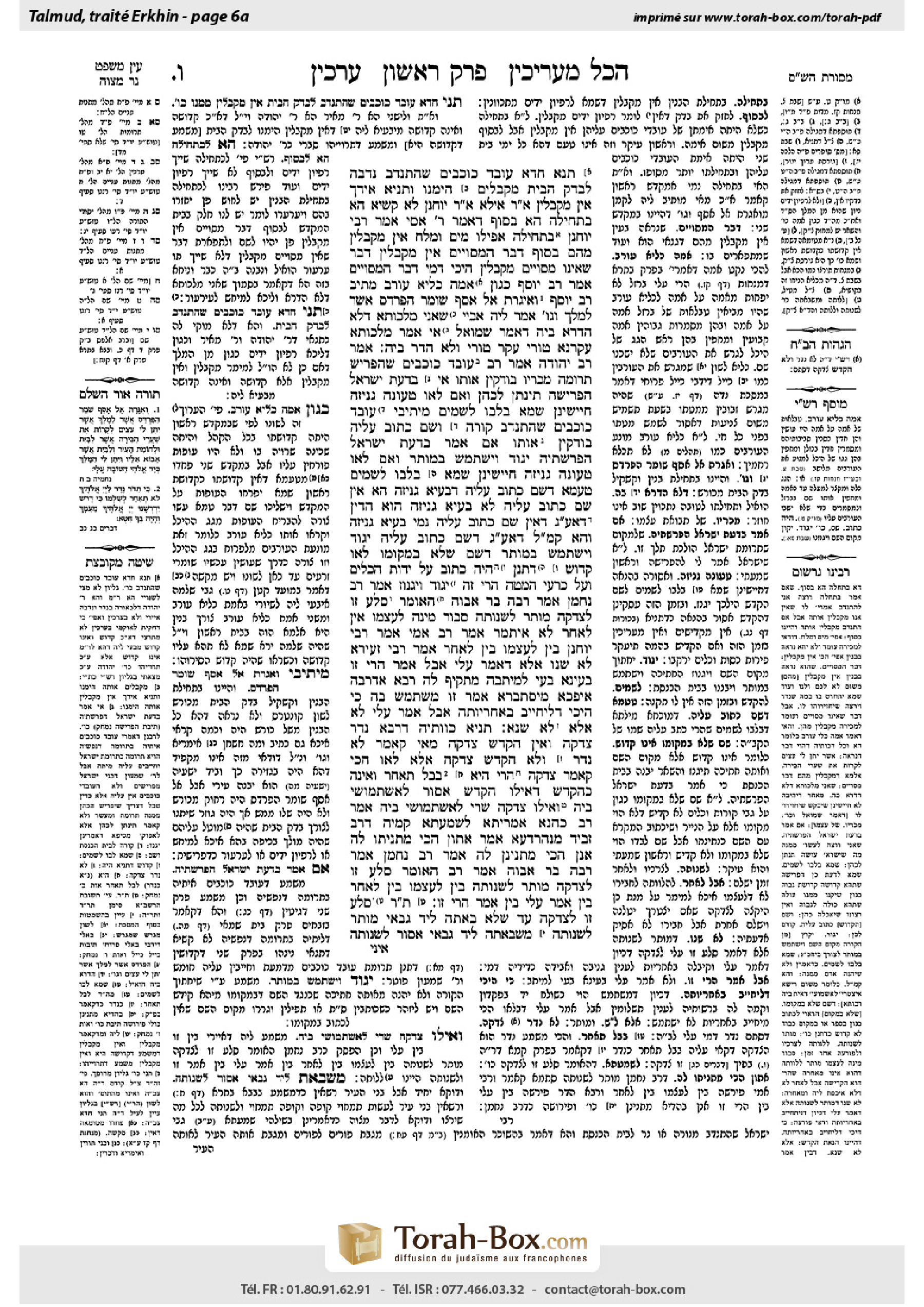
Arakhin 6a: Talmud study for Daf Yomi
Study the Talmud for Daf Yomi with scanned pages, Hebrew text, English translations from Sefaria and AI-generated French translations.
Passage selection and English or AI-generated French translation are available where the scan has annotations. Daf Study is independent of Torah-Box and Sefaria.
Browse Arakhin · ערכין · All tractatesArakhin 6a text and translations
This page of Arakhin includes the Aramaic text, an English translation and an AI-generated French translation, alongside the scan above.
ערכין ו׳ א · Aramaic and Hebrew text
תָּנָא חֲדָא: גּוֹי שֶׁהִתְנַדֵּב נְדָבָה לְבֶדֶק הַבַּיִת מְקַבְּלִים הֵימֶנּוּ, וְתַנְיָא אִידַּךְ: אֵין מְקַבְּלִין!
אָמַר רַבִּי אִילָא אָמַר רַבִּי יוֹחָנָן: לָא קַשְׁיָא, הָא — בַּתְּחִילָּה, הָא — בַּסּוֹף.
דְּאָמַר רַבִּי אַסִּי אָמַר רַבִּי יוֹחָנָן: בִּתְחִילָּה, אֲפִילּוּ מַיִם וּמֶלַח אֵין מְקַבְּלִין מֵהֶם. בַּסּוֹף, דָּבָר הַמְסוּיָּים אֵין מְקַבְּלִין, דָּבָר שֶׁאֵינוֹ מְסוּיָּים מְקַבְּלִין. הֵיכִי דָּמֵי דָּבָר הַמְסוּיָּים? אָמַר רַב יוֹסֵף: כְּגוֹן אַמָּה כָּלְיָא עוֹרֵב.
מֵתִיב רַב יוֹסֵף: ״וְאִיגֶּרֶת אֶל אָסָף שׁוֹמֵר הַפַּרְדֵּס אֲשֶׁר לַמֶּלֶךְ וְגוֹ׳״. אֲמַר לֵיהּ אַבַּיֵּי: שָׁאנֵי מַלְכוּתָא דְּלָא הָדְרָא בַּיהּ, דְּאָמַר שְׁמוּאֵל: אִי אָמַר מַלְכוּתָא ״עָקַרְנָא טוּרֵי״, עָקַר טוּרֵי וְלָא הָדַר בֵּיהּ.
אָמַר רַב יְהוּדָה אָמַר רַב: גּוֹי שֶׁהִפְרִישׁ תְּרוּמָה מִכִּרְיוֹ, בּוֹדְקִין אוֹתוֹ, אִי בְּדַעַת יִשְׂרָאֵל הִפְרִישָׁהּ — תִּינָּתֵן לַכֹּהֵן, וְאִם לָאו — טְעוּנָה גְּנִיזָה, חָיְישִׁינַן שֶׁמָּא בְּלִבּוֹ לַשָּׁמַיִם.
מֵיתִיבִי: גּוֹי שֶׁהִתְנַדֵּב קוֹרָה, וְשֵׁם כָּתוּב עָלֶיהָ — בּוֹדְקִין אוֹתוֹ, אִם אָמַר: ״בְּדַעַת יִשְׂרָאֵל הִפְרַשְׁתִּיהָ״ — יָגוֹד וְיִשְׁתַּמֵּשׁ בַּמּוֹתָר, וְאִם לָאו — טְעוּנָה גְּנִיזָה, חָיְישִׁינַן שֶׁמָּא בְּלִבּוֹ לַשָּׁמַיִם.
טַעְמָא דְּשֵׁם כָּתוּב עָלֶיהָ, דְּבָעֲיָא גְּנִיזָה; הָא אֵין שֵׁם כָּתוּב עָלֶיהָ — לָא בָּעֲיָא גְּנִיזָה!
הוּא הַדִּין דְּאַף עַל גַּב דְּאֵין שֵׁם כָּתוּב עָלֶיהָ נָמֵי בָּעֲיָא גְּנִיזָה, וְהָא קָא מַשְׁמַע לַן, דְּאַף עַל גַּב דְּשֵׁם כָּתוּב עָלֶיהָ, יָגוֹד וְיִשְׁתַּמֵּשׁ בַּמּוֹתָר, דְּשֵׁם שֶׁלֹּא בִּמְקוֹמוֹ לָאו קָדוֹשׁ.
דִּתְנַן: הָיָה כָּתוּב עַל יְדוֹת הַכֵּלִים וְעַל כַּרְעֵי הַמִּטָּה — הֲרֵי זֶה יָגוֹד וְיִגְנוֹז.
אָמַר רַב נַחְמָן אָמַר רַבָּה בַּר אֲבָהוּ: הָאוֹמֵר ״סֶלַע זוֹ לִצְדָקָה״ — מוּתָּר לְשַׁנּוֹתָהּ. סְבוּר מִינַּהּ: לְעַצְמוֹ — אִין, לְאַחֵר — לָא. אִיתְּמַר: אָמַר רַב אַמֵּי אָמַר רַבִּי יוֹחָנָן: בֵּין לְעַצְמוֹ בֵּין לְאַחֵר.
אָמַר רַבִּי זְעֵירָא: לֹא שָׁנוּ אֶלָּא דְּאָמַר ״עָלַי״, אֲבָל אָמַר ״הֲרֵי זוֹ״ — בְּעֵינַאּ בָּעֵי לְמִיתְּבַהּ.
מַתְקֵיף לַהּ רָבָא: אַדְּרַבָּה, אִיפְּכָא מִיסְתַּבְּרָא — אָמַר ״זוֹ״ מִשְׁתַּמֵּשׁ בָּהּ, כִּי הֵיכִי דְּלִיחַיַּיב בְּאַחְרָיוּתַהּ, אֲבָל אָמַר ״עָלַי״ — לָא! אֶלָּא, לָא שְׁנָא.
תַּנְיָא כְּוָותֵיהּ דְּרָבָא: נֶדֶר צְדָקָה, וְאֵין הֶקְדֵּשׁ צְדָקָה. מַאי קָאָמַר? לָא נֶדֶר וְלָא הֶקְדֵּשׁ צְדָקָה!
אֶלָּא לָאו הָכִי קָאָמַר: צְדָקָה הֲרֵי הִיא בְּבַל תְּאַחֵר, וְאֵינָהּ כְּהֶקְדֵּשׁ, דְּאִילּוּ הֶקְדֵּשׁ אֲסִיר לְאִשְׁתַּמּוֹשֵׁי בֵּיהּ, וְאִילּוּ צְדָקָה שְׁרֵי לְאִשְׁתַּמּוֹשֵׁי בֵּיהּ.
אָמַר רַב כָּהֲנָא: אַמְרִיתָא לִשְׁמַעְתָּא קַמֵּיהּ דְּרַב זְבִיד מִנְּהַרְדְּעָא, אָמַר: אַתּוּן הָכִי מַתְנִיתוּ לַהּ, אֲנַן הָכִי מַתְנֵינַן לַהּ — אָמַר רַב נַחְמָן אָמַר רַבָּה בַּר אֲבוּהּ אָמַר רַב: הָאוֹמֵר ״סֶלַע זוֹ לִצְדָקָה״ מוּתָּר לְשַׁנּוֹתָהּ, בֵּין לְעַצְמוֹ בֵּין לְאַחֵר, בֵּין אָמַר ״עָלַי״ בֵּין אָמַר ״הֲרֵי זוֹ״.
תָּנוּ רַבָּנַן: ״סֶלַע זוֹ לִצְדָקָה״ — עַד שֶׁלֹּא בָּאתָה לְיַד גַּבַּאי, מוּתָּר לְשַׁנּוֹתָהּ; מִשֶּׁבָּאתָה לְיַד גַּבַּאי, אָסוּר לְשַׁנּוֹתָהּ.
Arakhin 6a · English translation
§ The Gemara notes that there is an apparent contradiction with regard to the issue of whether or not a gentile may donate for the purpose of Temple maintenance. It was taught in one baraita: In the case of a gentile who pledged a gift for Temple maintenance, one accepts it from him. And it is taught in another baraita: One does not accept it from him.
Rabbi Ila says that Rabbi Yoḥanan says: It is not difficult. This baraita, which teaches that the donation is not accepted, is stated with regard to the beginning of the building of the Temple. The donation is refused in order that the Jews not rely upon on the donations of gentiles. That baraita, which states that the donation is accepted, is stated with regard to the end of the building of the Temple, i.e., after it is already built.
As Rabbi Asi says that Rabbi Yoḥanan says with regard to donations of gentiles for Temple maintenance: With regard to the beginning of the building of the Temple, one may not accept even water and salt from them. With regard to the end of the building of the Temple, one may not accept a defined item, i.e., if it will be clear that this was donated by a gentile. But one may accept their gift of an item that is not defined. The Gemara asks: What is considered to be a defined item? Rav Yosef says: For example, the cubit-wide spiked plates placed on the roof of the Sanctuary, which were designed to eliminate the ravens.
Rav Yosef raises an objection to the ruling of the baraita as interpreted by Rabbi Yoḥanan, that with regard to the beginning of the building of the Temple nothing is accepted from gentiles. Nehemiah requested from the king of Persia: “And a letter to Asaph the keeper of the king’s park, that he may give me timber to make beams for the gates of the castle that pertains to the house” (Nehemiah 2:8). Here Nehemiah clearly asked for material from gentiles. Abaye said to Rav Yosef: Actions taken by the government are different, as the government does not retract its decisions. As Shmuel says: If the government says: I will uproot mountains, it will uproot mountains and not retract what it said.
§ Rav Yehuda says that Rav says: With regard to a gentile who separated teruma from his pile of grain, one examines him to determine his intent. If he separated it with the intent that it be like the teruma of Jews, it should be given to a priest. If not, it requires interment, as we are concerned that perhaps his heart was directed toward Heaven, i.e., his intent was to consecrate it to the Temple and he did not want it to be given to a priest. Since there is uncertainty with regard to his intent, nothing can be done with that produce.
The Gemara raises an objection from a baraita: In the case of a gentile who donated a cross beam and brought it to a synagogue, and the name of God is written on it, one examines him to determine his intent. If he says: I separated it with the intent that it be like the donations of Jews, the name should be cut off [yagod] and interred, and one uses the remainder for a synagogue. And if not, the entire beam requires interment, as we are concerned that perhaps his heart was directed toward Heaven, i.e., his intent was to consecrate it to the Temple, and therefore it may not be used.
The Gemara analyzes this baraita: The reason that the beam requires interment is that the name of God is written on it, from which it may be inferred that if God’s name is not written on it, it does not require interment. Why, then, did Rav Yehuda say that if a gentile separated teruma it requires interment?
The Gemara answers: Even though the name of God is not written on the beam, the same halakha is true, and the beam requires interment, due to the concern that he might have intended to consecrate it. And as for why the baraita specifically discusses the case where God’s name was written on the beam, this teaches us that if his intention was for it to be used in a synagogue, then even though God’s name is written on it, nevertheless the rest of the beam is not prohibited. Rather, the name should be cut off and interred, and one may use the remainder for a synagogue. The reason is that if God’s name is written on an item, only the place where it is written is sanctified, but that part of the item that is not in its place is not sanctified.
As we learned in a baraita: If one of the names of God was written on the handles of vessels or on legs of a bed, one must cut off the name and inter it, and the remainder is permitted.
§ Rav Naḥman says that Rabba bar Abbahu says: One who says: I am contributing this sela to charity, is permitted to change its purpose, i.e., to use the money himself and later replace it. The Gemara comments: It was initially understood from this that if one wants to change its purpose for his own benefit, yes, this is permitted, as he originally had this stipulation in mind. But it is not permitted to lend it to another. Yet it was stated that Rav Ami says that Rabbi Yoḥanan says: It is permitted to change its purpose whether for himself or for another.
Rabbi Zeira says: They taught this halakha, that one may change the purpose of the coin, only in a case where he said: It is incumbent upon me to donate a sela to charity. But if he said: This sela is for charity, then he is required to give the sela to charity as is, and he may not use it and replace it.
Rava objects to this: On the contrary, the opposite is more reasonable. In a case where one said: This sela is for charity, it makes sense to allow him to use it, so that he should bear financial responsibility for its loss from that point onward. But if he said: It is incumbent upon me to donate a sela to charity, he should not be allowed to use the sela, as in any event he must donate a sela. Rather, as there is a reason in either situation to permit its use, there is no difference between the cases, and in both cases he may use the sela.
The Gemara notes that it is taught in a baraita in accordance with the opinion of Rava: A vow is charity, but consecrated property is not charity. The Gemara asks: What is the baraita saying? After all, neither a vow nor consecrated property is charity.
Rather, is it not correct that this is what the baraita is saying: Charity is like a vow to consecrate property, in that it is subject to the prohibition of: You shall not delay, which is derived from the verse: “When you shall vow a vow to the Lord your God, you shall not delay to pay it” (Deuteronomy 23:22). But nevertheless it is not like consecrated property, as in the case of consecrated property it is prohibited to use it, while in the case of charity it is permitted to use it. Since with regard to the option of using the money the baraita does not distinguish between a case where one says: It is incumbent upon me to donate a sela to charity, and a case where he says: This sela is for charity, it evidently supports the opinion of Rava.
Rav Kahana said: I said this halakha of Rav Naḥman’s, with regard to one who says: This sela is for charity, along with the accompanying discussion, before Rav Zevid from Neharde’a. He said to me: You teach this halakha in this manner, that Rav Naḥman merely stated that it is permitted to change the purpose of the sela, and the Sages clarified that it is permitted in all cases. But we teach this halakha in this manner, that it was all stated citing Rav Naḥman: Rav Naḥman says that Rabba bar Avuh says that Rav says: One who said: I am contributing this sela to charity, is permitted to change its purpose, whether for himself or for another, and whether he said: It is incumbent upon me, or whether he said: This sela is for charity.
§ The Sages taught a baraita which further deals with these matters. One who said: This sela is for charity, is permitted to change its purpose and replace it, as long as it has not yet come into the possession of the charity collectors. But once it has come into the possession of the charity collectors it is prohibited to change its purpose.
Arakhin 6a · Traduction française (IA)
§ La Guemara souligne qu'il existe une contradiction apparente concernant la question de savoir si un non-Juif peut faire un don pour la maintenance du Temple. Il a été enseigné dans une baraïta : Dans le cas d'un non-Juif qui a fait un don pour la maintenance du Temple, on l'accepte. Et il a été enseigné dans une autre baraïta : On ne l'accepte pas.
Rabbi Ila dit que Rabbi Yoḥanan dit : Ce n’est pas difficile. Cette baraïta, qui enseigne que le don n’est pas accepté, est formulée concernant le début de la construction du Temple. Le don est refusé afin que les Juifs ne s’appuient pas sur les dons des non-Juifs. Cette baraïta, qui affirme que le don est accepté, est formulée concernant la fin de la construction du Temple, c’est-à-dire après qu’il ait déjà été construit.
Comme Rabbi Asi dit que Rabbi Yoḥanan dit concernant les dons des non-Juifs pour la maintenance du Temple : Concernant le début de la construction du Temple, on ne peut pas accepter même de l’eau et du sel d’eux. Concernant la fin de la construction du Temple, on ne peut pas accepter un objet défini, c’est-à-dire si cela est clair que cela a été offert par un non-Juif. Mais on peut accepter leur don d’un objet non défini. La Guemara pose la question : Qu’est-ce qui constitue un objet défini ? Rav Yosef dit : Par exemple, les plaques à un cubit de large placées sur le toit du Sanctuaire, conçues pour éliminer les corbeaux.
Rav Yosef émet un objection contre la décision de la baraïta telle que l’interprète Rabbi Yoḥanan, à savoir que concernant le début de la construction du Temple, rien n’est accepté des non-Juifs. Néhémie demanda au roi de Perse : « Et une lettre à Asaph, le gardien du parc du roi, afin qu’il me donne du bois pour faire des poutres pour les portes du château qui appartient à la maison » (Néhémie 2:8). Ici Néhémie a clairement demandé des matériaux provenant de non-Juifs. Abaye dit à Rav Yosef : Les actions entreprises par la gouvernance sont différentes, car la gouvernance ne retire pas ses décisions. Comme Shmuel dit : Si la gouvernance dit : Je vais détruire les montagnes, elle détruirait les montagnes et ne retirerait pas ce qu’elle a dit.
§ Rav Yehuda dit que Rav dit : Concernant un non-Juif qui a séparé la terouma de son tas de céréales, on examine son intention. Si il a séparé cela avec l’intention qu’il soit comme la terouma des Juifs, il doit être donné à un prêtre. Si non, il faut l’enterrer, car nous craignons que son cœur soit tourné vers le Ciel, c’est-à-dire qu’il avait l’intention de sanctifier cela au Temple et qu’il ne voulait pas le donner à un prêtre. Puisque l’intention est incertaine, on ne peut rien faire avec ce produit.
La Guemara soulève une objection à partir d’une baraïta : Dans le cas d’un non-Juif qui a offert une poutre et l’a apportée à une synagogue, et où le nom de Dieu est écrit dessus, on examine son intention. Si il dit : J’ai séparé cela avec l’intention qu’il soit comme les dons des Juifs, le nom doit être effacé [yagod] et enterré, et on utilise le reste pour une synagogue. Et si non, la poutre entière doit être enterrée, car nous craignons que son cœur soit tourné vers le Ciel, c’est-à-dire qu’il avait l’intention de sanctifier cela au Temple, et donc cela ne peut être utilisé.
La Guemara analyse cette baraïta : La raison pour laquelle la poutre doit être enterrée est que le nom de Dieu est écrit dessus, d’où on peut en déduire que si le nom de Dieu n’est pas écrit dessus, cela ne nécessite pas d’être enterré. Pourquoi alors Rav Yehuda a-t-il dit que si un non-Juif séparait la terouma, cela nécessitait d’être enterré ?
La Guemara répond : Même si le nom de Dieu n’est pas écrit sur la poutre, la même halakha s’applique, et la poutre doit être enterrée, en raison de la crainte qu’il ait pu avoir l’intention de la sanctifier. Et concernant pourquoi la baraïta discute spécifiquement du cas où le nom de Dieu était écrit sur la poutre, cela nous enseigne que si son intention était d’utiliser cela dans une synagogue, alors même que le nom de Dieu est écrit dessus, la partie restante n’est pas interdite. Plutôt, le nom doit être effacé et enterré, et on peut utiliser le reste pour une synagogue. La raison est que si le nom de Dieu est écrit sur un objet, seulement la partie où il est écrit est sanctifiée, mais la partie de l’objet qui n’est pas à cet endroit n’est pas sanctifiée.
Comme nous avons appris dans une baraïta : Si l’un des noms de Dieu était écrit sur les manches des vases ou sur les jambes d’un lit, on doit effacer le nom et l’enterrer, et le reste est permis.
§ Rav Naḥman dit que Rabba bar Abbahu dit : Celui qui dit : Je contribue ce sela à la charité, est autorisé à changer son usage, c’est-à-dire à utiliser l’argent lui-même et à le remplacer plus tard. La Guemara commente : Cela a été initialement compris de cette manière que si l’on veut changer son usage à son propre bénéfice, oui, cela est autorisé, car il avait initialement cette stipulation en tête. Mais il n’est pas autorisé à prêter cela à un autre. Cependant, il a été dit que Rav Ami dit que Rabbi Yoḥanan dit : Il est autorisé à changer son usage, qu’il soit pour lui-même ou pour un autre.
Rabbi Zeira dit : Ils ont enseigné cette halakha, que l’on peut changer l’usage de la pièce, uniquement dans le cas où il a dit : Il m’est imposé de donner un sela à la charité. Mais si il a dit : Ce sela est pour la charité, il est tenu de donner le sela à la charité tel quel, et il ne peut pas l’utiliser et le remplacer.
Rava s’oppose à cela : Au contraire, l’inverse est plus rationnel. Dans le cas où l’on a dit : Ce sela est pour la charité, il est raisonnable d’autoriser l’utilisation, afin qu’il assume la responsabilité financière de sa perte à partir de ce moment. Mais si l’on a dit : Il m’est imposé de donner un sela à la charité, il ne devrait pas être autorisé à utiliser le sela, car en tout cas il doit donner un sela. Plutôt, comme il y a une raison dans les deux cas pour autoriser son utilisation, il n’y a pas de différence entre les cas, et dans les deux cas il peut utiliser le sela.
La Guemara note que cela est enseigné dans une baraïta selon l'opinion de Rava : une promesse est une charité, mais la propriété consacrée n'est pas une charité. La Guemara demande : de quoi la baraïta parle-t-elle ? Car ni une promesse ni une propriété consacrée ne sont des charités.
En réalité, n'est-ce pas correct que ce soit ce que la baraïta dit : la charité est comme une promesse de consacrer une propriété, car elle est soumise à l'interdiction : « Tu ne retarderas pas à le payer » qui est tirée du verset : « Quand tu feras un vœu au Seigneur ton Dieu, tu ne retarderas pas à le payer » (Deutéronome 23:22). Mais néanmoins, elle n'est pas comme la propriété consacrée, car dans le cas de la propriété consacrée, il est interdit d'en user, tandis que dans le cas de la charité, il est permis d'en user. Puisque, concernant l'option d'utiliser l'argent, la baraïta ne distingue pas entre le cas où l'on dit : « Il m'est imposé de donner un sela à la charité », et le cas où l'on dit : « Ce sela est pour la charité », il est évident que cela soutient l'opinion de Rava.
Rav Kahana a dit : J'ai dit cette halakha de Rav Naḥman, concernant celui qui dit : « Ce sela est pour la charité », avec l'entretien qui l'accompagne, devant Rav Zevid de Neharde’a. Il m'a dit : Tu enseignes cette halakha ainsi, que Rav Naḥman a simplement dit que l'on est autorisé à changer l'usage du sela, et les Sages ont clarifié que l'on est autorisé dans tous les cas. Mais nous enseignons cette halakha ainsi, que tout a été dit en citant Rav Naḥman : Rav Naḥman dit que Rabba bar Avuh dit que Rav dit : celui qui dit : « Je contribue ce sela à la charité », est autorisé à changer son usage, qu'il s'agisse de lui-même ou d'un autre, et qu'il ait dit : « Il m'est imposé », ou qu'il ait dit : « Ce sela est pour la charité ».
§ Les Sages ont enseigné une baraïta qui traite davantage de ces questions. Celui qui dit : « Ce sela est pour la charité », est autorisé à changer son usage et à le remplacer, tant qu'il n'a pas encore été mis en possession des collecteurs de charité. Mais une fois qu'il est en possession des collecteurs de charité, il est interdit de changer son usage.
Traduction française générée par IA à partir de l’édition anglaise de Sefaria. Vérifie toujours un passage avec le texte source.
Text from Sefaria: William Davidson Edition - Vocalized Aramaic (CC BY NC); William Davidson Edition - English (CC BY NC).