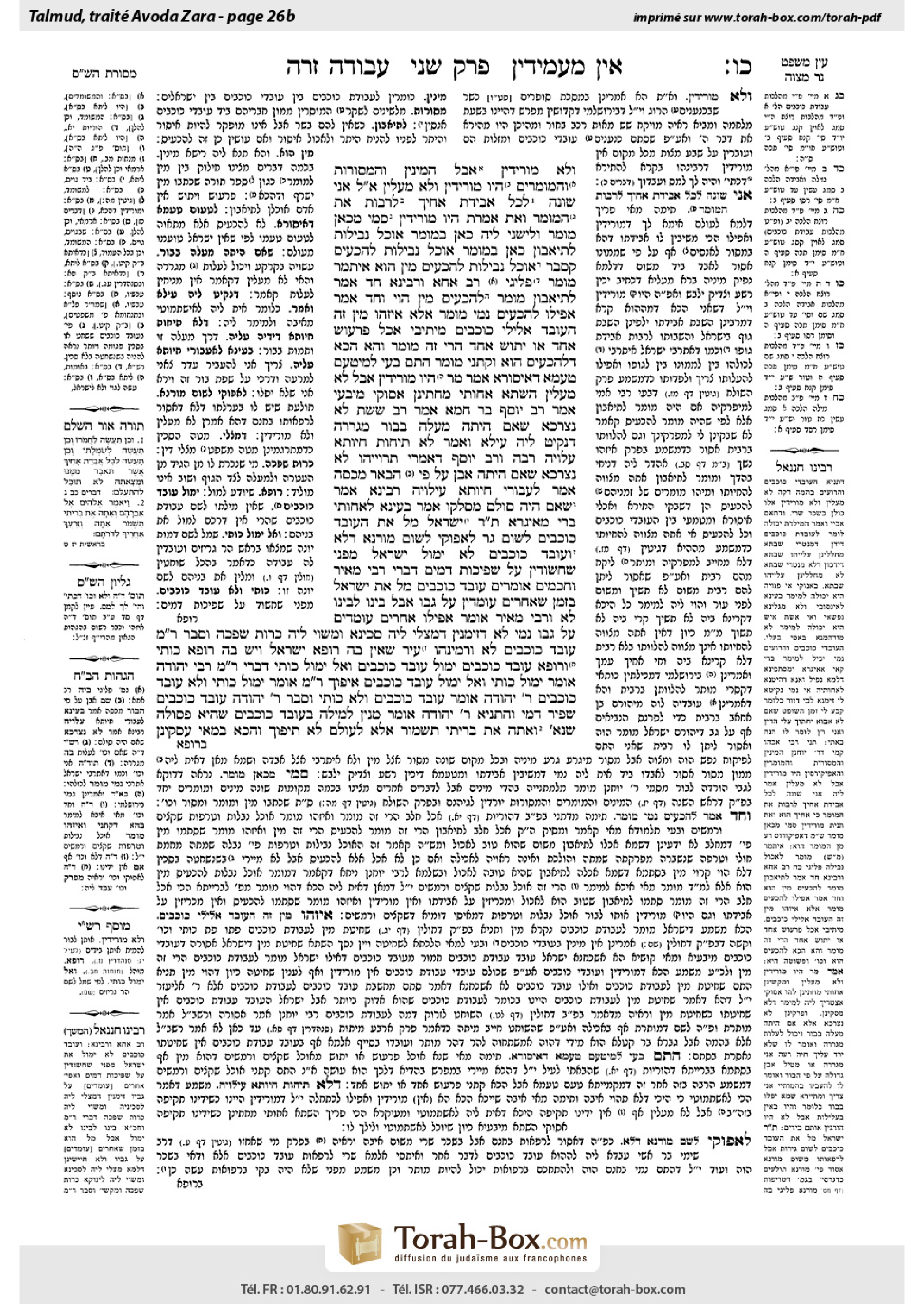
Avodah Zarah 26b: Talmud study for Daf Yomi
Study the Talmud for Daf Yomi with scanned pages, Hebrew text, English translations from Sefaria and AI-generated French translations.
Passage selection and English or AI-generated French translation are available where the scan has annotations. Daf Study is independent of Torah-Box and Sefaria.
Browse Avodah Zarah · עבודה זרה · All tractatesAvodah Zarah 26b text and translations
This page of Avodah Zarah includes the Aramaic text, an English translation and an AI-generated French translation, alongside the scan above.
עבודה זרה כ״ו ב · Aramaic and Hebrew text
וְלֹא מוֹרִידִין, אֲבָל הַמִּינִין וְהַמָּסוֹרוֹת וְהַמְשׁוּמָּדִים — מוֹרִידִין וְלֹא מַעֲלִין.
אֲמַר לֵיהּ: אֲנִי שׁוֹנֶה ״לְכׇל אֲבֵדַת אָחִיךָ״ לְרַבּוֹת אֶת הַמְשׁוּמָּד, וְאַתְּ אָמְרַתְּ מוֹרִידִין? סְמִי מִכָּאן מְשׁוּמָּד!
וְלִישַׁנֵּי לֵיהּ: כָּאן בִּמְשׁוּמָּד אוֹכֵל נְבֵילוֹת לְתֵיאָבוֹן, כָּאן בִּמְשׁוּמָּד אוֹכֵל נְבֵילוֹת לְהַכְעִיס! קָסָבַר: אוֹכֵל נְבֵילוֹת לְהַכְעִיס — מִין הוּא.
אִיתְּמַר מְשׁוּמָּד, פְּלִיגִי רַב אַחָא וְרָבִינָא: חַד אָמַר: לְתֵיאָבוֹן — מְשׁוּמָּד, לְהַכְעִיס — מִין הָוֵי, וְחַד אָמַר: אֲפִילּוּ לְהַכְעִיס נָמֵי מְשׁוּמָּד. אֶלָּא אֵיזֶהוּ מִין? זֶה הָעוֹבֵד עֲבוֹדָה זָרָה.
מֵיתִיבִי: אָכַל פַּרְעוֹשׁ אֶחָד אוֹ יַתּוּשׁ אֶחָד — הֲרֵי זֶה מְשׁוּמָּד; וְהָא הָכָא דִּלְהַכְעִיס הוּא, וְקָתָנֵי מְשׁוּמָּד! הָתָם בָּעֵי לְמִיטְעַם טַעְמָא דְּאִיסּוּרָא.
אָמַר מָר: מוֹרִידִין אֲבָל לֹא מַעֲלִין. הַשְׁתָּא אַחוֹתֵי מַחֲתִינַן, אַסּוֹקֵי מִיבְּעֵי? אָמַר רַב יוֹסֵף בַּר חָמָא אָמַר רַב שֵׁשֶׁת: לֹא נִצְרְכָה, שֶׁאִם הָיְתָה מַעֲלָה בַּבּוֹר — מְגָרְרָהּ, דְּנָקֵיט לֵיהּ עִילָּא וְאָמַר: לָא תֵּיחוֹת חֵיוְתָא עִלָּוֵיהּ.
רַבָּה וְרַב יוֹסֵף דְּאָמְרִי תַּרְוַיְיהוּ: לֹא נִצְרְכָה, שֶׁאִם הָיְתָה אֶבֶן עַל פִּי הַבְּאֵר, מְכַסָּהּ, אָמַר: לְעַבּוֹרֵי חַיּוּתָא עִילָּוַיהּ. רָבִינָא אָמַר: שֶׁאִם הָיָה סוּלָּם, מְסַלְּקוֹ, אָמַר: בָּעֵינָא לְאַחוֹתֵי בְּרִי מֵאִיגָּרָא.
תָּנוּ רַבָּנַן: יִשְׂרָאֵל מָל אֶת הַגּוֹי לְשׁוּם גֵּר, לְאַפּוֹקֵי לְשׁוּם מוּרְנָא דְּלָא, וְגוֹי לֹא יָמוּל יִשְׂרָאֵל, מִפְּנֵי שֶׁחֲשׁוּדִין עַל שְׁפִיכוּת דָּמִים, דִּבְרֵי רַבִּי מֵאִיר.
וַחֲכָמִים אוֹמְרִים: גּוֹי מָל אֶת יִשְׂרָאֵל בִּזְמַן שֶׁאֲחֵרִים עוֹמְדִין עַל גַּבּוֹ, אֲבָל בֵּינוֹ לְבֵינוֹ — לָא. וְרַבִּי מֵאִיר אוֹמֵר: אֲפִילּוּ אֲחֵרִים עוֹמְדִים עַל גַּבּוֹ נָמֵי לָא, דְּזִימְנִין דְּמַצְלֵי לֵיהּ סַכִּינָא וּמְשַׁוֵּי לֵיהּ כְּרוּת שׇׁפְכָה.
וְסָבַר רַבִּי מֵאִיר גּוֹי לָא? וּרְמִינְהוּ: עִיר שֶׁאֵין בָּהּ רוֹפֵא יִשְׂרָאֵל וְיֵשׁ בָּהּ רוֹפֵא כּוּתִי וְרוֹפֵא אַרְמַאי — יָמוּל אַרְמַאי וְאַל יָמוּל כּוּתִי, דִּבְרֵי רַבִּי מֵאִיר. רַבִּי יְהוּדָה אוֹמֵר: יָמוּל כּוּתִי וְאַל יָמוּל אַרְמַאי!
אֵיפוֹךְ, רַבִּי מֵאִיר אוֹמֵר: יָמוּל כּוּתִי וְלֹא אַרְמַאי, רַבִּי יְהוּדָה אוֹמֵר: אַרְמַאי וְלֹא כּוּתִי.
וְסָבַר רַבִּי יְהוּדָה אַרְמַאי שַׁפִּיר דָּמֵי? וְהָתַנְיָא: רַבִּי יְהוּדָה אוֹמֵר: מִנַּיִן לְמִילָה בְּגוֹי שֶׁהִיא פְּסוּלָה? שֶׁנֶּאֱמַר: ״וְאַתָּה אֶת בְּרִיתִי תִשְׁמֹר״.
אֶלָּא, לְעוֹלָם לָא תֵּיפוֹךְ, וְהָכָא בְּמַאי עָסְקִינַן?
Avodah Zarah 26b · English translation
and one may not lower them into a pit. But the heretics, and the informers, and the apostates [vehameshummadim] are lowered into a pit, but not raised out of it.
Rabbi Yoḥanan said to Rabbi Abbahu: I teach that the verse: “And so you shall do with every lost item of your brother” (Deuteronomy 22:3), serves to include the apostate in one’s obligation to return a lost item to another Jew; and you say that one may lower him into a pit? Remove the term apostate from here.
The Gemara asks: And let Rabbi Abbahu answer Rabbi Yoḥanan as follows: Here, with regard to a lost item, the verse includes an apostate because it is referring to an apostate who eats non-kosher meat due to his appetite, i.e., he succumbs to the temptation. Conversely, there, with regard to raising an apostate from a pit, I am referring to an apostate who eats non-kosher meat to express insolence. The Gemara answers: Rabbi Abbahu holds that one who eats non-kosher meat to express insolence is a heretic, rather than an apostate.
§ It was stated with regard to the definition of an apostate that Rav Aḥa and Ravina disagree. One says that someone who transgresses a prohibition due to his appetite is an apostate, while one who transgresses a prohibition in order to express insolence is a heretic. And one says that even one who sins to express insolence is considered an apostate. Rather, who is considered a heretic? This is an idol worshipper.
The Gemara raises an objection from a baraita against the opinion that one who sins to express insolence is considered a heretic. The baraita teaches: If one ate a single flea or a single mosquito, he is considered an apostate. The Gemara clarifies the objection: But here it must be assumed that the insect was eaten to express insolence, as it is unappetizing, and yet this baraita teaches that one who eats a flea or a mosquito is an apostate. The Gemara answers: There, he desires to experience the taste of forbidden food, and therefore he is considered to be eating only due to temptation.
§ The Gemara returns to the subject of lowering someone into a pit. The Master said: Heretics, informers, and apostates are lowered into a pit but not raised out of it. The Gemara analyzes this statement: Now that it is known that one actively lowers them into a pit, is it necessary to teach that one does not raise them from it? Rav Yosef bar Ḥama said that Rav Sheshet said: No, it is necessary to teach this halakha because it can be inferred from here that if there was a ledge in the pit, a Jew scrapes it off so that the one in the pit cannot ascend from it, as the Jew employs a pretext and says that he is removing the ledge so that animals do not descend upon the one in the pit while he is trapped in the pit.
Rabba and Rav Yosef both say a different answer: No, it is necessary to teach this, as it can be inferred from here that if there was a stone at the mouth of the well that one had fallen into, a Jew covers it and says that he is covering the opening in order to pass his animals over it. Ravina said: One can learn from here that if there was a ladder in the pit, a Jew removes it and says: I require the ladder to lower my son from the roof.
§ The Gemara discusses the subject of assisting or receiving aid from a gentile in the context of circumcision. The Sages taught: A Jew may circumcise a gentile for the sake of making him a convert. This is to the exclusion of circumcising a gentile for the sake of removing a worm [murna], which is not permitted, as it is forbidden to heal a gentile. But one may not allow a gentile to circumcise a Jew in any situation, because gentiles are suspected of bloodshed. This is the statement of Rabbi Meir.
And the Rabbis say: One may allow a gentile to circumcise a Jew while others are standing over him and observing his actions, but not when they are alone together. And Rabbi Meir says: Even where others are standing over him it is also not permitted, as there are times when a gentile might tilt the knife and render the Jew one whose penis has been severed, and he will be unable to father children.
The Gemara asks: But does Rabbi Meir hold that one may not allow a gentile to circumcise a Jew? And the Gemara raises a contradiction against this claim from the following baraita: In a city in which there is no Jewish physician, and in which there is a Samaritan physician and an Aramean, i.e., a gentile, physician, it is preferable that the Aramean circumcise the Jewish boys of the city and the Samaritan not circumcise them. This is the statement of Rabbi Meir. Rabbi Yehuda says: It is preferable that the Samaritan circumcise the boys and the Aramean not circumcise them. Rabbi Meir holds that it is preferable for an Aramean gentile to perform circumcision despite the fact that Samaritans are considered Jewish to a certain extent.
The Gemara answers: Reverse their opinions, so that Rabbi Meir says: It is preferable that the Samaritan circumcise the boys and not the Aramean, and Rabbi Yehuda says: It is preferable that the Aramean circumcise them and not the Samaritan.
The Gemara asks: And does Rabbi Yehuda hold that it is permitted for circumcision to be performed by an Aramean? But isn’t it taught in a baraita that Rabbi Yehuda says: From where is it derived with regard to circumcision performed by a gentile that it is not valid? It is derived from a verse, as it is stated: “And God said to Abraham: And as for you, you shall keep My covenant, you, and your seed after you throughout their generations” (Genesis 17:9). “My covenant [beriti]” here is a reference to circumcision [berit mila], and therefore the verse is teaching that only Abraham and his descendants, i.e., Jews, are qualified to perform circumcision.
Rather, the Gemara suggests, actually do not reverse it. As for the apparent contradiction between the two statements of Rabbi Meir, the Gemara explains: And what are we dealing with here?
Avodah Zarah 26b · Traduction française (IA)
et on ne peut pas les descendre dans un puits. Mais les hérétiques, les informateurs et les apostats [vehameshummadim] sont descendus dans un puits, mais on ne les soulève pas de là.
Rabbi Yoḥanan a dit à Rabbi Abbahu : Je prétends que la parole : « Et ainsi tu feras avec tout objet perdu de ton frère » (Deutéronome 22:3), sert à inclure l'apostat dans ton obligation de rendre un objet perdu à un autre Juif ; et tu dis que l'on peut descendre cet homme dans un puits ? Retire le terme d'apostat ici.
La Guemara pose la question : Et laissez Rabbi Abbahu répondre à Rabbi Yoḥanan comme suit : Ici, concernant un objet perdu, la parole inclut un apostat car il s'agit d'un apostat qui mange de la viande non kasher en raison de son appétit, c'est-à-dire qu'il cède à la tentation. À l'inverse, là, concernant l'extinction d'un apostat d'un puits, je fais référence à un apostat qui mange de la viande non kasher pour exprimer son insolence. La Guemara répond : Rabbi Abbahu considère que celui qui mange de la viande non kasher pour exprimer son insolence est un hérétique, et non un apostat.
§ La Guemara aborde la définition d'un apostat et mentionne que Rav Aḥa et Ravina sont en désaccord. L'un dit que celui qui transgresse une interdiction en raison de son appétit est un apostat, tandis que celui qui transgresse une interdiction pour exprimer son insolence est un hérétique. L'autre dit que même celui qui commet un péché pour exprimer son insolence est considéré comme un apostat. Et qui est considéré comme un hérétique ? C'est un idolâtre.
La Guemara soulève une objection contre l'opinion selon laquelle celui qui commet un péché pour exprimer son insolence est considéré comme un hérétique. La baraïta enseigne : Si l'on a mangé un seul moustique ou une seule blatte, on est considéré comme un apostat. La Guemara clarifie cette objection : Mais ici, il faut supposer que l'insecte a été mangé pour exprimer son insolence, car il n'est pas appétissant, et pourtant cette baraïta enseigne que celui qui mange un moustique ou une blatte est un apostat. La Guemara répond : Là, il désire goûter le goût de la nourriture interdite, et donc il est considéré comme mangeant uniquement en raison de la tentation.
§ La Guemara retourne à la question de descendre quelqu'un dans un puits. Le Maître a dit : Les hérétiques, les informateurs et les apostats sont descendus dans un puits mais on ne les soulève pas de là. La Guemara analyse cette déclaration : Maintenant que l'on sait que l'on descend activement dans un puits, est-il nécessaire d'enseigner que l'on ne soulève pas de là ? Rav Yosef bar Ḥama a dit que Rav Sheshet a dit : Non, il est nécessaire d'enseigner cette halakha car on peut en déduire ici que si il y avait une plateforme dans le puits, un Juif la retire afin que celui dans le puits ne puisse pas monter, car le Juif utilise une excuse et dit qu'il retire la plateforme afin que les animaux ne descendent pas sur celui dans le puits pendant qu'il est coincé dans le puits.
Rabba et Rav Yosef donnent une réponse différente : Non, il est nécessaire d'enseigner cela, car on peut en déduire ici que si une pierre était à l'entrée du puits dans lequel l'on était tombé, un Juif la recouvre et dit qu'il recouvre l'ouverture afin de faire passer ses animaux dessus. Ravina a dit : On peut en déduire ici que si une échelle était dans le puits, un Juif la retire et dit : J'ai besoin de l'échelle pour descendre mon fils du toit.
§ La Guemara discute du sujet d'aider ou de recevoir de l'aide d'un non-Juif dans le contexte de la circoncision. Les Sages ont enseigné : Un Juif peut circoncire un non-Juif à la condition de le convertir. Cela exclut la circoncision d'un non-Juif pour l'effet de retirer un ver [murna], ce qui n'est pas permis, car il est interdit de guérir un non-Juif. Mais on ne peut pas permettre à un non-Juif de circoncire un Juif dans tout cas, car les non-Juifs sont soupçonnés de meurtre. C'est la déclaration de Rabbi Meir.
Et les Rabbins disent : On peut permettre à un non-Juif de circoncire un Juif tant que d'autres sont présents et observent ses actions, mais pas quand ils sont seuls. Et Rabbi Meir dit : Même quand d'autres sont présents, cela n'est pas permis, car il y a des moments où un non-Juif pourrait pencher le couteau et rendre le Juif incapable de procréer.
La Guemara pose la question : Mais Rabbi Meir considère-t-il que l'on ne doit pas permettre à un non-Juif de circoncire un Juif ? Et la Guemara soulève une contradiction contre cette affirmation à partir de la suivante baraïta : Dans une ville où il n'y a pas de médecin juif, et où il y a un médecin samaritain et un médecin araméen, c'est-à-dire un médecin non-Juif, il est préférable que l'araméen circoncisse les garçons juifs de la ville et que le samaritain ne les circoncisse pas. C'est la déclaration de Rabbi Meir. Rabbi Yehuda dit : Il est préférable que le samaritain circoncisse les garçons et que l'araméen ne les circoncisse pas. Rabbi Meir considère que c'est préférable qu'un médecin araméen non-Juif effectue la circoncision, malgré le fait que les samaritains sont considérés comme juifs à un certain point.
La Guemara répond : Inversez leurs opinions, de sorte que Rabbi Meir dise : Il est préférable que le samaritain circoncisse les garçons et non l'araméen, et Rabbi Yehuda dise : Il est préférable que l'araméen circoncisse les garçons et non le samaritain.
La Guemara pose la question : Et Rabbi Yehuda considère-t-il que la circoncision par un non-Juif est permise ? Mais n'est-il pas enseigné dans une baraïta que Rabbi Yehuda dit : D'où est-il déduit concernant la circoncision par un non-Juif qu'elle n'est pas valide ? C'est déduit d'une parole, car il est dit : « Et Dieu dit à Abraham : Et toi, tu observeras mon alliance, toi et ta descendance après toi, à travers leurs générations » (Genèse 17:9). « Mon alliance [beriti] » ici fait référence à la circoncision [berit mila], et donc la parole enseigne que seul Abraham et ses descendants, c'est-à-dire les Juifs, sont qualifiés de faire la circoncision.
Plutôt, la Guemara suggère qu'en réalité, il ne faut pas inverser cela. Concernant la contradiction apparente entre les deux déclarations de Rabbi Meir, la Guemara explique : De quoi sommes-nous en train de parler ici ?
Traduction française générée par IA à partir de l’édition anglaise de Sefaria. Vérifie toujours un passage avec le texte source.
Text from Sefaria: William Davidson Edition - Vocalized Aramaic (CC BY NC); William Davidson Edition - English (CC BY NC).