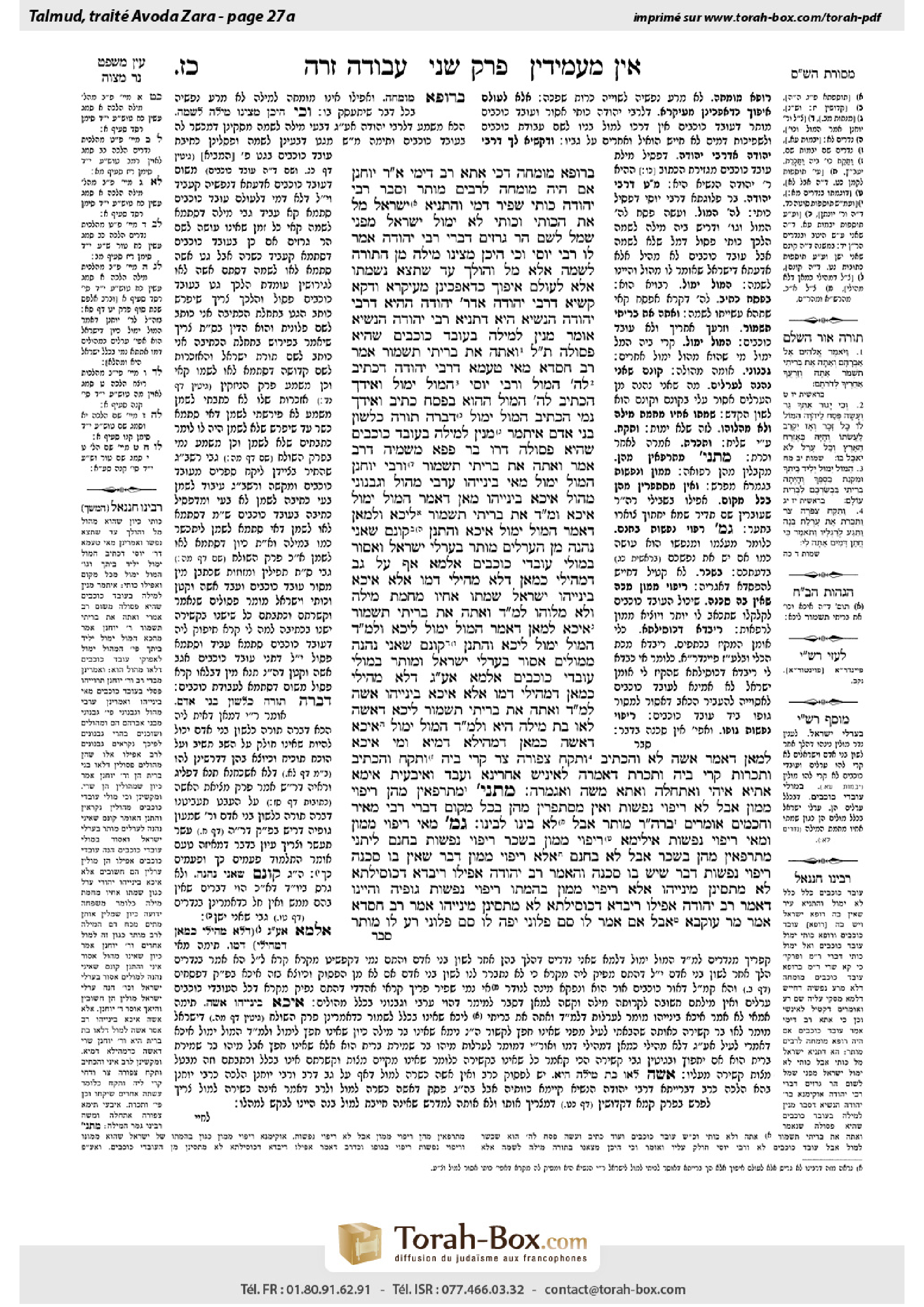
Avodah Zarah 27a: Talmud study for Daf Yomi
Study the Talmud for Daf Yomi with scanned pages, Hebrew text, English translations from Sefaria and AI-generated French translations.
Passage selection and English or AI-generated French translation are available where the scan has annotations. Daf Study is independent of Torah-Box and Sefaria.
Browse Avodah Zarah · עבודה זרה · All tractatesAvodah Zarah 27a text and translations
This page of Avodah Zarah includes the Aramaic text, an English translation and an AI-generated French translation, alongside the scan above.
עבודה זרה כ״ז א · Aramaic and Hebrew text
בְּרוֹפֵא מוּמְחֶה, דְּכִי אֲתָא רַב דִּימִי אָמַר רַבִּי יוֹחָנָן: אִם הָיָה מוּמְחֶה לְרַבִּים — מוּתָּר.
וְסָבַר רַבִּי יְהוּדָה כּוּתִי שַׁפִּיר דָּמֵי? וְהָתַנְיָא: יִשְׂרָאֵל מָל אֶת הַכּוּתִי, וְכוּתִי לֹא יָמוּל יִשְׂרָאֵל, מִפְּנֵי שֶׁמָּל לְשֵׁם הַר גְּרִזִים, דִּבְרֵי רַבִּי יְהוּדָה.
אָמַר לוֹ רַבִּי יוֹסֵי: וְכִי הֵיכָן מָצִינוּ מִילָה מִן הַתּוֹרָה לִשְׁמָהּ? אֶלָּא מָל וְהוֹלֵךְ עַד שֶׁתֵּצֵא נִשְׁמָתוֹ!
אֶלָּא, לְעוֹלָם אֵיפוֹךְ כִּדְאָפְכִינַן מֵעִיקָּרָא, וּדְקָא קַשְׁיָא דְּרַבִּי יְהוּדָה אַדְּרַבִּי יְהוּדָה — הָהִיא דְּרַבִּי יְהוּדָה הַנָּשִׂיא הִיא.
דְּתַנְיָא, רַבִּי יְהוּדָה הַנָּשִׂיא אוֹמֵר: מִנַּיִן לְמִילָה בְּגוֹי שֶׁהִיא פְּסוּלָה? תַּלְמוּד לוֹמַר: ״וְאַתָּה אֶת בְּרִיתִי תִשְׁמוֹר״.
אָמַר רַב חִסְדָּא: מַאי טַעְמָא דְּרַבִּי יְהוּדָה? דִּכְתִיב: ״לַה׳ הִמּוֹל״, וְרַבִּי יוֹסֵי — ״הִמּוֹל יִמּוֹל״.
וְאִידָּךְ, הָכְתִיב: ״לַה׳ הִמּוֹל״! הָהוּא בְּפֶסַח כְּתִיב. וְאִידַּךְ נָמֵי הָכְתִיב: ״הִמּוֹל יִמּוֹל״! דִּבְּרָה תוֹרָה כִלְשׁוֹן בְּנֵי אָדָם.
אִיתְּמַר: מִנַּיִן לְמִילָה בְּגוֹי שֶׁהִיא פְּסוּלָה? דָּרוּ בַּר פָּפָּא מִשְּׁמֵיהּ דְּרַב אָמַר: ״וְאַתָּה אֶת בְּרִיתִי תִשְׁמֹר״, וְרַבִּי יוֹחָנָן: ״הִמּוֹל יִמּוֹל״.
מַאי בֵּינַיְיהוּ? עַרְבִי מָהוּל וְגַבְנוּנִי מָהוּל אִיכָּא בֵּינַיְיהוּ. מַאן דְּאָמַר ״הִמּוֹל יִמּוֹל״ — אִיכָּא, וּמַאן דְּאָמַר ״אֶת בְּרִיתִי תִּשְׁמֹר״ — לֵיכָּא.
וּלְמַאן דְּאָמַר ״הִמּוֹל יִמּוֹל״ אִיכָּא? וְהָתְנַן: קוּנָּם שֶׁאֲנִי נֶהֱנֶה מִן הָעֲרֵלִים — מוּתָּר בְּעַרְלֵי יִשְׂרָאֵל, וְאָסוּר בְּמוּלֵי אוּמּוֹת הָעוֹלָם; אַלְמָא, אַף עַל גַּב דִּמְהִילִי, כְּמַאן דְּלָא מְהִילִי דָּמוּ!
אֶלָּא אִיכָּא בֵּינַיְיהוּ יִשְׂרָאֵל שֶׁמֵּתוּ אֶחָיו מֵחֲמַת מִילָה, וְלֹא מָלוּהוּ. לְמַאן דְּאָמַר ״וְאַתָּה אֶת בְּרִיתִי תִשְׁמֹר״ — אִיכָּא, לְמַאן דְּאָמַר ״הִמּוֹל יִמּוֹל״ — לֵיכָּא.
וּלְמַאן דְּאָמַר ״הִמּוֹל יִמּוֹל״ לֵיכָּא? וְהָתְנַן: ״קוּנָּם שֶׁאֲנִי נֶהֱנֶה מִמּוּלִים״ — אָסוּר בְּעַרְלֵי יִשְׂרָאֵל וּמוּתָּר בְּמוּלֵי אוּמּוֹת הָעוֹלָם, אַלְמָא אַף עַל גַּב דְּלָא מְהִילִי כְּמַאן דִּמְהִילִי דָּמוּ!
אֶלָּא, אִיכָּא בֵּינַיְיהוּ אִשָּׁה, לְמַאן דְּאָמַר ״וְאַתָּה אֶת בְּרִיתִי תִשְׁמוֹר״ — לֵיכָּא, דְּאִשָּׁה לָאו בַּת מִילָה הִיא, וּלְמַאן דְּאָמַר ״הִמּוֹל יִמּוֹל״ — אִיכָּא, דְּאִשָּׁה כְּמַאן דִּמְהִילָא דָּמְיָא.
וּמִי אִיכָּא לְמַאן דְּאָמַר אִשָּׁה לָא? וְהָכְתִיב: ״וַתִּקַּח צִפֹּרָה צֹר״! קְרִי בֵּיהּ ״וַתַּקַּח״. וְהָכְתִיב ״וַתִּכְרֹת״! קְרִי בֵּיהּ ״וַתַּכְרֵת״, דְּאָמְרָה לְאִינִישׁ אַחֲרִינָא וַעֲבַד. וְאִיבָּעֵית אֵימָא: (אתיא) [אֲתַיאי] אִיהִי וְאַתְחִלָה, וַאֲתָא מֹשֶׁה וְאַגְמְרַהּ.
מַתְנִי׳ מִתְרַפְּאִין מֵהֶן רִיפּוּי מָמוֹן, אֲבָל לֹא רִיפּוּי נְפָשׁוֹת. וְאֵין מִסְתַּפְּרִין מֵהֶן בְּכׇל מָקוֹם, דִּבְרֵי רַבִּי מֵאִיר. וַחֲכָמִים אוֹמְרִים: בִּרְשׁוּת הָרַבִּים מוּתָּר, אֲבָל לֹא בֵּינוֹ לְבֵינוֹ.
גְּמָ׳ מַאי ״רִיפּוּי מָמוֹן״, וּמַאי ״רִיפּוּי נְפָשׁוֹת״? אִילֵּימָא ״רִיפּוּי מָמוֹן״ בְּשָׂכָר, ״רִיפּוּי נְפָשׁוֹת״ בְּחִנָּם — לִיתְנֵי: מִתְרַפְּאִין מֵהֶן בְּשָׂכָר אֲבָל לֹא בְּחִנָּם!
אֶלָּא, ״רִיפּוּי מָמוֹן״ — דָּבָר שֶׁאֵין בּוֹ סַכָּנָה, ״רִיפּוּי נְפָשׁוֹת״ — דָּבָר שֶׁיֵּשׁ בּוֹ סַכָּנָה. וְהָאָמַר רַב יְהוּדָה: אֲפִילּוּ רִיבְדָּא דְּכוּסִילְתָּא לָא מִתַּסֵּינַן מִינַּיְיהוּ!
אֶלָּא, ״רִיפּוּי מָמוֹן״ — בְּהֶמְתּוֹ, ״רִיפּוּי נְפָשׁוֹת״ — גּוּפֵיהּ, וְהַיְינוּ דְּאָמַר רַב יְהוּדָה: אֲפִילּוּ רִיבְדָּא דְּכוּסִילְתָּא לָא מִתַּסֵּינַן מִינַּיְיהוּ.
אָמַר רַב חִסְדָּא אָמַר מָר עוּקְבָא: אֲבָל אִם אָמַר לוֹ סַם פְּלוֹנִי יָפֶה לוֹ, סַם פְּלוֹנִי רַע לוֹ — מוּתָּר.
Avodah Zarah 27a · English translation
We are dealing with an expert physician, who will not risk his reputation by harming a child. This is similar to that which Rabbi Yoḥanan said, as when Rav Dimi came from Eretz Yisrael to Babylonia, he said that Rabbi Yoḥanan says: If the physician was considered a recognized expert, it is permitted for one to be healed by him. When Rabbi Meir said that an Aramean may circumcise a Jewish boy, he was referring specifically to a doctor who is known for his expertise.
The latter clause of the baraita states that Rabbi Yehuda maintains that a Samaritan may circumcise a Jewish infant. The Gemara asks: And does Rabbi Yehuda actually hold that it is permitted for a Samaritan to perform circumcision? But isn’t it taught in a baraita: A Jew may circumcise a Samaritan but a Samaritan may not be allowed to circumcise a Jew, because he circumcises him for the sake of Mount Gerizim; this is the statement of Rabbi Yehuda.
Rabbi Yosei said to him: And where do we find that the mitzva of circumcision from the Torah must be performed for the sake of fulfilling God’s will? Rather, a Samaritan may continue to circumcise Jews until his soul leaves his body, i.e., until the Samaritan dies, and there is no room for concern. But Rabbi Yehuda explicitly states above that circumcision may not be performed by a Samaritan.
Rather, actually you should reverse the opinions in the baraita as we reversed them initially. And as for the difficulty raised with regard to one statement of Rabbi Yehuda against the other statement of Rabbi Yehuda, that opinion, that a gentile may not perform circumcision, is actually the opinion of Rabbi Yehuda HaNasi. Conversely, the first baraita, which is reversed and therefore cites Rabbi Yehuda as maintaining that an Aramean may perform circumcision, is referring to Rabbi Yehuda bar Ilai. Accordingly, the different opinions reflect a dispute between tanna’im rather than a contradiction.
The Gemara cites a proof that according to the opinion of Rabbi Yehuda HaNasi a gentile is not qualified to perform circumcision. As it is taught in a baraita that Rabbi Yehuda HaNasi says: From where is it derived with regard to circumcision performed by a gentile that it is not valid? The verse states: “And God said to Abraham: And as for you, you shall keep My covenant, you, and your seed after you throughout their generations” (Genesis 17:9).
§ It was stated that according to the opinion of Rabbi Yehuda circumcision must be performed for the sake of fulfilling a mitzva, whereas Rabbi Yosei holds that no particular intention is necessary. The Gemara analyzes these opinions. Rav Ḥisda said: What is the reasoning of Rabbi Yehuda? As it is written: “And when a stranger shall sojourn with thee, and will keep the Passover to the Lord let all his males be circumcised” (Exodus 12:48). It can be inferred from the verse that the males must be circumcised “to the Lord,” i.e., for the sake of fulfilling God’s will. The Gemara asks: And what is the reasoning of Rabbi Yosei? It is written: “He must be circumcised [himmol yimmol]” (Genesis 17:13). The usage of the doubled verb teaches that circumcision may be performed by anyone.
The Gemara asks: And according to the other Sage, i.e., Rabbi Yosei, isn’t it written: “To the Lord let all his males be circumcised,” which indicates that circumcision must be performed for the sake of fulfilling God’s will? The Gemara answers: That is written with regard to Passover. According to Rabbi Yosei, the phrase “to the Lord” is referring to the previous mention of the Paschal offering, rather than to circumcision. Accordingly, the verse should be read: “Will keep Passover to the Lord.” The Gemara asks: And according to the other Sage, Rabbi Yehuda, isn’t it also written: “He must be circumcised [himmol yimmol],” indicating that circumcision may be performed by anyone? The Gemara answers: The Torah spoke in the language of people, i.e., the doubled verb is the usual style of the Torah, which does not serve to teach a novel halakha.
§ The Gemara continues discussing the issue of circumcisions performed by gentiles. It was stated: From where is it derived with regard to circumcision performed by a gentile that it is not valid? Daru bar Pappa says in the name of Rav: This is derived from a verse, as it is stated: And God said to Abraham: “And as for you, you shall keep My covenant, you, and your seed after you throughout their generations.” And Rabbi Yoḥanan says that it is derived from the verse: “He must be circumcised [himmol yimmol].” According to Rabbi Yoḥanan, this verse teaches that a Jew must be circumcised by one who is already circumcised.
The Gemara asks: What is the practical difference between these two opinions? There is a practical difference between them with regard to a circumcised Arab or a circumcised hill person [gavnuni]. According to the one who says that the halakha that a Jewish infant may be circumcised only by one who has been circumcised himself is derived from the verse: “He must be circumcised [himmol yimmol],” there is reason to permit an Arab or gavnuni to perform the circumcision, as they are circumcised. And according to the one who says that circumcision may not be performed by a gentile is derived from the phrase: “You shall keep my covenant,” there is no reason to permit an Arab or Gibeonite to perform circumcision.
The Gemara raises an objection: And is it so, according to the one who says it is derived from the verse: “He must be circumcised [himmol yimmol],” that a Jew may not be circumcised by a gentile, that there is reason to permit a circumcised gentile to perform circumcision? But didn’t we learn in a mishna (Nedarim 31b): With regard to one who vows: Deriving benefit from those who are uncircumcised is konam for me, he is permitted to derive benefit from uncircumcised Jews because they are not regarded as uncircumcised, but he is prohibited from deriving benefit from the uncircumcised of the nations of the world? Apparently, even though some gentiles are circumcised, they are nevertheless considered as those who are uncircumcised.
Rather, there is a difference between them with regard to a Jew whose brothers died due to circumcision, and as a result, they did not circumcise him. According to the one who says that the halakha is derived from the verse: “And as for you, you shall keep My covenant,” there is reason to permit such a person to perform circumcision, as he is a Jew. According to the one who says that the halakha is derived from the phrase: “He must be circumcised [himmol yimmol],” there is no reason to permit this Jew to perform circumcision, as he is not circumcised himself.
The Gemara rejects this suggestion as well: And is it so that according to the one who says that the halakha is derived from the verse: “He must be circumcised [himmol yimmol],” there is no reason to permit an uncircumcised Jew to perform circumcision? But didn’t we learn in a mishna (Nedarim 31b): With regard to one who vows: Deriving benefit from those who are circumcised is konam for me, he is prohibited from deriving benefit even from uncircumcised Jews and he is permitted to derive benefit from the circumcised of the nations of the world. Apparently, even though some Jews are not circumcised, they are nevertheless considered as those who are circumcised.
Rather, there is a difference between these two opinions with regard to a woman. According to the one who says that the halakha is derived from the verse: “And as for you, you shall keep My covenant,” there is no reason to permit a woman to perform circumcision, as a woman is not subject to the mitzva of circumcision, and therefore she is not included in those who must keep God’s covenant. And according to the one who says that the halakha is derived from the verse: “He must be circumcised [himmol yimmol],” there is reason to permit a woman to perform circumcision, as a woman is considered as one who is naturally circumcised.
The Gemara raises a difficulty against this explanation: And is there anyone who says that a woman may not perform circumcision? But isn’t it written: “Then Zipporah took [vattikkaḥ] a flint and cut off the foreskin of her son” (Exodus 4:25). This verse explicitly states that a circumcision was performed by a woman. The Gemara answers that one should read into the verse: And she caused to be taken [vattakkaḥ], i.e., she did not take a flint herself. But isn’t it written: And she cut off [vattikhrot]? Read into the verse: And she caused to be cut off [vattakhret], as she told another person to take a flint and cut off her son’s foreskin, and he did so. The Gemara provides an alternative explanation: And if you wish, say instead: She came and began the act, and Moses came and completed the circumcision.
MISHNA: The mishna discusses the issue of accepting certain professional services from a gentile. One may be treated by gentiles, provided that it is monetary treatment, but not personal treatment. And one may not have his hair cut by them anywhere, due to the danger that the gentile will kill him with the razor; this is the statement of Rabbi Meir. And the Rabbis say: In the public thoroughfare, it is permitted to have one’s hair cut by a gentile, but not when the Jew and gentile are alone together.
GEMARA: What is monetary treatment, and what is personal treatment? If we say that monetary treatment is medical attention provided in exchange for payment, whereas personal treatment is medical attention provided for free, then let the mishna teach: One may be treated by gentiles in exchange for payment, but not for free.
The Gemara suggests another explanation: Rather, monetary treatment is referring to medical treatment for a matter that poses no life-threatening danger, whereas personal treatment is referring to treatment for a matter that does pose life-threatening danger. The Gemara rejects this suggestion as well. But doesn’t Rav Yehuda say: Even with regard to the wound of a bloodletting incision [rivda dekhusilta] we are not permitted to be treated by gentiles. The wound left after bloodletting certainly does not pose life-threatening danger, and yet a Jew is prohibited from having it treated by a gentile.
Rather, monetary treatment is referring to medical treatment provided for one’s animal, whereas personal treatment is referring to treatment provided for his own body, and this is in accordance with that which Rav Yehuda says: Even with regard to the wound of a bloodletting incision, we are not permitted to be treated by them.
Rav Ḥisda says that Mar Ukva says: But if a gentile said to him: Such and such a potion is beneficial for this ailment, or such and such a potion is harmful for this ailment, it is permitted to adhere to the gentile’s advice.
Avodah Zarah 27a · Traduction française (IA)
Nous discutons d'un médecin expert, qui ne risquerait pas sa réputation en blessant un enfant. Cela ressemble à ce que Rabbi Yoḥanan a dit, lorsque Rav Dimi est venu de la Terre d'Israël vers Babylone, il a dit que Rabbi Yoḥanan affirme : Si le médecin est considéré comme un expert reconnu, il est permis de le soigner. Lorsque Rabbi Meir a dit qu'un Araméen peut circoncire un petit Juif, il faisait référence spécifiquement à un médecin dont la compétence est connue.
La seconde partie de la baraïta indique que Rabbi Yehuda maintient que les Samaritains peuvent circoncire un bébé juif. La Guemara pose la question : Et Rabbi Yehuda maintient-t-il vraiment que cela est permis ? N'est-ce pas enseigné dans une baraïta : Un Juif peut circoncire un Samaritain, mais un Samaritain ne peut pas circoncire un Juif, car il le fait pour le compte de la montagne de Gerizim ; c'est l'opinion de Rabbi Yehuda.
Rabbi Yosei a dit à lui : Et où trouvons-nous que la mitsva de la circoncision, selon la Torah, doit être accomplie pour la volonté divine ? En réalité, un Samaritain peut continuer à circoncire des Juifs jusqu'à ce que son âme quitte son corps, c'est-à-dire jusqu'à sa mort, et il n'y a pas de raison de s'inquiéter. Mais Rabbi Yehuda affirme explicitement ci-dessus que la circoncision ne peut pas être accomplie par un Samaritain.
En réalité, vous devriez inverser les opinions dans la baraïta comme nous l'avons fait initialement. Et concernant la difficulté soulevée par l'une des déclarations de Rabbi Yehuda contre l'autre, cette opinion, selon laquelle un non-Juif ne peut pas accomplir la circoncision, est en réalité celle de Rabbi Yehuda HaNasi. À l'inverse, la première baraïta, qui a été inversée et cite donc Rabbi Yehuda comme affirmant qu'un Araméen peut accomplir la circoncision, fait référence à Rabbi Yehuda bar Ilai. Ainsi, les différences d'opinions reflètent un débat entre des tannaïm plutôt qu'une contradiction.
La Guemara cite une preuve selon l'opinion de Rabbi Yehuda HaNasi, un non-Juif n'est pas qualifié pour accomplir la circoncision. Comme il est enseigné dans une baraïta que Rabbi Yehuda HaNasi dit : D'où est tiré le fait que la circoncision accomplie par un non-Juif n'est pas valide ? De la parole : « Et Dieu dit à Abraham : Et toi, tu observeras mon alliance, toi et ta descendance après toi, à travers leurs générations » (Genèse 17:9).
§ Il a été dit que selon l'opinion de Rabbi Yehuda, la circoncision doit être accomplie pour l'accomplissement d'une mitsva, tandis que Rabbi Yosei maintient qu'il n'est pas nécessaire d'avoir une intention particulière. La Guemara analyse ces opinions. Rav Ḥisda a dit : Quel est le raisonnement de Rabbi Yehuda ? Comme il est écrit : « Et quand un étranger séjournera avec toi, et voudra observer la Pessah à l'Éternel, tous ses mâles doivent être circoncis » (Exode 12:48). On peut en déduire de cette parole que les mâles doivent être circoncis « à l'Éternel », c'est-à-dire pour l'accomplissement de la volonté divine. La Guemara pose la question : Et quel est le raisonnement de Rabbi Yosei ? Il est écrit : « Il doit être circoncis [himmol yimmol] » (Genèse 17:13). L'usage du verbe double enseigne que la circoncision peut être accomplie par n'importe qui.
La Guemara pose la question : Et selon l'autre Sage, c'est-à-dire Rabbi Yosei, n'est-il pas écrit : « À l'Éternel, tous ses mâles doivent être circoncis », ce qui indique que la circoncision doit être accomplie pour le compte d'accomplir la volonté divine ? La Guemara répond : Cela est écrit concernant la Pessah. Selon Rabbi Yosei, la phrase « à l'Éternel » fait référence à la mention précédente de l'offrande pascal, et non à la circoncision. Ainsi, la parole devrait être lue : « Il observera la Pessah à l'Éternel ». La Guemara pose la question : Et selon l'autre Sage, Rabbi Yehuda, n'est-il pas également écrit : « Il doit être circoncis [himmol yimmol] », indiquant que la circoncision peut être accomplie par n'importe qui ? La Guemara répond : La Torah parle dans la langue des gens, c'est-à-dire que le verbe double est le style habituel de la Torah, qui ne sert pas à enseigner une halakha nouvelle.
§ La Guemara continue la discussion sur la question des circoncisions accomplies par des non-Juifs. Il a été dit : D'où est tiré le fait que la circoncision accomplie par un non-Juif n'est pas valide ? Daru bar Pappa dit en nom de Rav : Cela est tiré d'une parole, comme il est dit : « Et Dieu dit à Abraham : Et toi, tu observeras mon alliance, toi et ta descendance après toi, à travers leurs générations ». Et Rabbi Yoḥanan dit que cela est tiré de la parole : « Il doit être circoncis [himmol yimmol] ». Selon Rabbi Yoḥanan, cette parole enseigne qu'un Juif doit être circoncis par celui qui est déjà circoncis.
La Guemara pose la question : Quelle est la différence pratique entre ces deux opinions ? Il y a une différence pratique entre eux concernant un Arabe circoncis ou un Gavnuni circoncis. Selon celui qui dit que la halakha selon laquelle un bébé juif peut être circoncis uniquement par celui qui est déjà circoncis est tirée de la parole : « Il doit être circoncis [himmol yimmol] », il y a une raison de permettre à un Arabe ou un Gavnuni de faire la circoncision, car ils sont circoncis. Et selon celui qui dit que la circoncision ne peut pas être accomplie par un non-Juif est tirée de la phrase : « Tu observeras mon alliance », il n'y a pas de raison de permettre à un Arabe ou un Gibeonite de faire la circoncision.
La Guemara soulève un objection : Et est-ce ainsi, selon celui qui dit que cela est tiré de la parole : « Il doit être circoncis [himmol yimmol] », que un Juif ne peut pas être circoncis par un non-Juif, que cela donne une raison de permettre à un non-Juif circoncis de faire la circoncision ? Mais n'avons-nous pas appris dans une mishna (Nedarim 31b) : Concernant celui qui fait un vœu : « Il est konam pour moi de tirer un bénéfice de ceux qui sont incirconcis », il est permis de tirer un bénéfice des Juifs incirconcis, car ils ne sont pas considérés comme incirconcis, mais il est interdit de tirer un bénéfice des incirconcis des nations du monde ? Apparemment, même si certains non-Juifs sont circoncis, ils sont tout de même considérés comme incirconcis.
En réalité, il y a une différence entre eux concernant un Juif dont les frères sont morts à cause de la circoncision, et en conséquence, on n'a pas circoncis celui-ci. Selon celui qui affirme que la halakha provient de la parole : « Et toi, garde mon alliance », il y a une raison de permettre à cette personne de se faire circoncire, car il est Juif. Selon celui qui affirme que la halakha provient de la phrase : « Il doit être circoncis [himmol yimmol] », il n'y a pas de raison de permettre à ce Juif non circoncis de se faire circoncire, car il n'est pas lui-même circoncis.
La Guemara rejette cette suggestion également : Et est-ce que, selon celui qui affirme que la halakha provient de la parole : « Il doit être circoncis [himmol yimmol] », il n'y a pas de raison de permettre à un Juif non circoncis de se faire circoncire ? Mais n'avons-nous pas appris dans une mitsna (Nedarim 31b) : Concernant celui qui fait un vœu : « Il est interdit de tirer profit de ceux qui sont circoncis », il est interdit de tirer profit même des Juifs non circoncis et il est permis de tirer profit des circoncis des nations du monde. Apparemment, même si certains Juifs ne sont pas circoncis, ils sont tout de même considérés comme ceux qui sont circoncis.
En réalité, il y a une différence entre ces deux opinions concernant une femme. Selon celui qui affirme que la halakha provient de la parole : « Et toi, garde mon alliance », il n'y a pas de raison de permettre à une femme de se faire circoncire, car la femme n'est pas soumise à la mitsva de la circoncision, et par conséquent elle n'est pas incluse dans ceux qui doivent garder l'alliance de Dieu. Et selon celui qui affirme que la halakha provient de la parole : « Il doit être circoncis [himmol yimmol] », il y a une raison de permettre à une femme de se faire circoncire, car la femme est considérée comme celle qui est naturellement circoncise.
La Guemara soulève une difficulté contre cette explication : Et est-ce que quelqu'un affirme qu'une femme ne peut pas effectuer une circoncision ? Mais n'est-il pas écrit : « Et Zipporah prit [vattikkaḥ] un caillou et coupa le prépuce de son fils » (Exode 4:25). Cette parole indique explicitement qu'une circoncision a été effectuée par une femme. La Guemara répond que l'on doit interpréter la parole : « Et elle fit prendre [vattakkaḥ] », c'est-à-dire qu'elle ne prit pas elle-même un caillou. Mais n'est-il pas écrit : « Et elle coupa [vattikhrot] » ? Lisez la parole ainsi : « Et elle fit couper [vattakhret] », car elle demanda à une autre personne de prendre un caillou et de couper le prépuce de son fils, et il le fit. La Guemara propose une autre explication : Et si vous le souhaitez, dites plutôt : Elle vint et commença l'acte, et Moïse vint et acheva la circoncision.
MICHNA : La mitsva discute de la question d'accepter certains services professionnels d'un non-Juif. On peut être traité par des non-Juifs, à condition que ce soit un traitement monétaire, mais pas un traitement personnel. Et on ne doit pas permettre à un non-Juif de couper ses cheveux, en raison du danger qu'il puisse le tuer avec la tondeuse ; c'est la déclaration de Rabbi Meir. Et les Sages disent : Dans la rue publique, il est permis de laisser un non-Juif couper ses cheveux, mais pas lorsque le Juif et le non-Juif sont seuls ensemble.
GUEMARA : Quel est le traitement monétaire et quel est le traitement personnel ? Si nous disons que le traitement monétaire est l'attention médicale fournie en échange d'une rémunération, tandis que le traitement personnel est l'attention médicale fournie gratuitement, alors la mitsva devrait enseigner : On peut être traité par des non-Juifs en échange d'une rémunération, mais pas gratuitement.
La Guemara suggère une autre explication : En réalité, le traitement monétaire fait référence à un traitement médical pour une affaire ne présentant pas de danger mortel, tandis que le traitement personnel fait référence à un traitement pour une affaire présentant un danger mortel. La Guemara rejette cette suggestion également. Mais n'est-ce pas dit par Rav Yehuda : Même concernant la plaie d'une incision de saignement [rivda dekhusilta], nous ne sommes pas autorisés à être traités par des non-Juifs. La plaie laissée après une saignée ne présente certainement pas de danger mortel, et pourtant un Juif est interdit de la laisser traiter par un non-Juif.
En réalité, le traitement monétaire fait référence à un traitement médical pour un animal, tandis que le traitement personnel fait référence à un traitement pour son propre corps, et cela correspond à ce que Rav Yehuda dit : Même concernant la plaie d'une incision de saignement, nous ne sommes pas autorisés à être traités par eux.
Rav Ḥisda dit que Mar Ukva dit : Mais si un non-Juif dit à lui : Une telle potion est bénéfique pour cette maladie, ou une telle potion est nuisible pour cette maladie, il est permis d'adopter les conseils du non-Juif.
Traduction française générée par IA à partir de l’édition anglaise de Sefaria. Vérifie toujours un passage avec le texte source.
Text from Sefaria: William Davidson Edition - Vocalized Aramaic (CC BY NC); William Davidson Edition - English (CC BY NC).