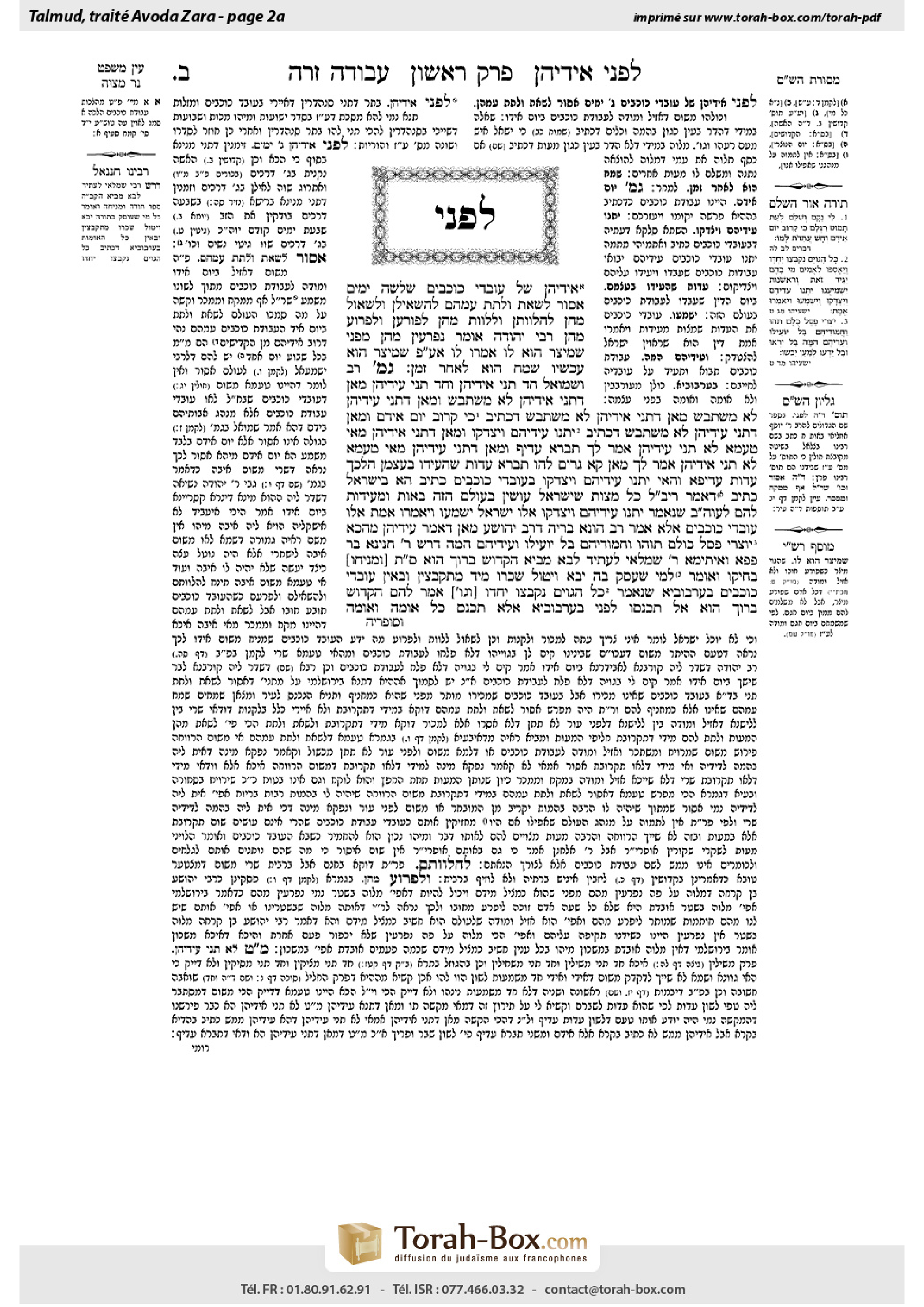
Avodah Zarah 2a: Talmud study for Daf Yomi
Study the Talmud for Daf Yomi with scanned pages, Hebrew text, English translations from Sefaria and AI-generated French translations.
Passage selection and English or AI-generated French translation are available where the scan has annotations. Daf Study is independent of Torah-Box and Sefaria.
Browse Avodah Zarah · עבודה זרה · All tractatesAvodah Zarah 2a text and translations
This page of Avodah Zarah includes the Aramaic text, an English translation and an AI-generated French translation, alongside the scan above.
עבודה זרה ב׳ א · Aramaic and Hebrew text
מַתְנִי׳ לִפְנַי אֵידֵיהֶן שֶׁל גּוֹיִם שְׁלֹשָׁה יָמִים — אָסוּר לָשֵׂאת וְלָתֵת עִמָּהֶם, לְהַשְׁאִילָן וְלִשְׁאוֹל מֵהֶן, לְהַלְווֹתָן וְלִלְווֹת מֵהֶן, לְפוֹרְעָן וְלִפְרוֹעַ מֵהֶן. רַבִּי יְהוּדָה אוֹמֵר: נִפְרָעִין מֵהֶן, מִפְּנֵי שֶׁמֵּיצֵר הוּא לוֹ. אָמְרוּ לוֹ: אַף עַל פִּי שֶׁמֵּיצֵר הוּא עַכְשָׁיו, שָׂמֵחַ הוּא לְאַחַר זְמַן.
גְּמָ׳ רַב וּשְׁמוּאֵל, חַד תָּנֵי ״אֵידֵיהֶן״, וְחַד תָּנֵי ״עֵידֵיהֶן״. מַאן דְּתָנֵי ״אֵידֵיהֶן״ לָא מִשְׁתַּבַּשׁ, וּמַאן דְּתָנֵי ״עֵידֵיהֶן״ לָא מִשְׁתַּבַּשׁ.
מַאן דְּתָנֵי ״אֵידֵיהֶן״ לָא מִשְׁתַּבַּשׁ, דִּכְתִיב: ״כִּי קָרוֹב יוֹם אֵידָם״, וּמַאן דְּתָנֵי ״עֵידֵיהֶן״ לָא מִשְׁתַּבַּשׁ, דִּכְתִיב: ״יִתְּנוּ עֵדֵיהֶם וְיִצְדָּקוּ״.
וּמַאן דְּתָנֵי ״אֵידֵיהֶן״, מַאי טַעְמָא לָא תָּנֵי ״עֵידֵיהֶן״? אָמַר לָךְ: תְּבָרָא עֲדִיף. וּמַאן דְּתָנֵי ״עֵידֵיהֶן״, מַאי טַעְמָא לָא תָּנֵי ״אֵידֵיהֶן״? אָמַר לָךְ: מַאן קָא גָרֵים לְהוּ תְּבָרָא? עֵדוּת שֶׁהֵעִידוּ בְּעַצְמָן, הִלְכָּךְ עֵדוּת עֲדִיפָא.
וְהַאי ״יִתְּנוּ עֵדֵיהֶם וְיִצְדָּקוּ״ בְּאוּמּוֹת הָעוֹלָם כְּתִיב? הָא בְּיִשְׂרָאֵל כְּתִיב, דְּאָמַר רַבִּי יְהוֹשֻׁעַ בֶּן לֵוִי: כׇּל מִצְוֹת שֶׁיִּשְׂרָאֵל עוֹשִׂין בָּעוֹלָם הַזֶּה בָּאוֹת וּמְעִידוֹת לָהֶם לָעוֹלָם הַבָּא, שֶׁנֶּאֱמַר: ״יִתְּנוּ עֵדֵיהֶם וְיִצְדָּקוּ״ — אֵלּוּ יִשְׂרָאֵל, ״יִשְׁמְעוּ וְיֹאמְרוּ אֱמֶת״ — אֵלּוּ אוּמּוֹת הָעוֹלָם.
אֶלָּא אָמַר רַב הוּנָא בְּרֵיהּ דְּרַב יְהוֹשֻׁעַ: מַאן דְּאָמַר ״עֵידֵיהֶן״ — מֵהָכָא: ״יֹצְרֵי פֶסֶל כֻּלָּם תֹּהוּ וַחֲמוּדֵיהֶם בַּל יוֹעִילוּ וְעֵדֵיהֶם הֵמָּה״.
דָּרֵשׁ רַבִּי חֲנִינָא בַּר פָּפָּא, וְאִיתֵּימָא רַבִּי שִׂמְלַאי: לְעָתִיד לָבֹא מֵבִיא הַקָּדוֹשׁ בָּרוּךְ הוּא סֵפֶר תּוֹרָה וּמַנִּיחוֹ בְּחֵיקוֹ, וְאוֹמֵר: לְמִי שֶׁעָסַק בָּהּ יָבֹא וְיִטּוֹל שְׂכָרוֹ.
מִיָּד מִתְקַבְּצִין וּבָאִין אוּמּוֹת הָעוֹלָם בְּעִרְבּוּבְיָא, שֶׁנֶּאֱמַר: ״כׇּל הַגּוֹיִם נִקְבְּצוּ יַחְדָּו וְגוֹ׳״, אֹמֵר לָהֶם הַקָּדוֹשׁ בָּרוּךְ הוּא: אַל תִּכָּנְסוּ לְפָנַי בְּעִרְבּוּבְיָא, אֶלָּא תִּכָּנֵס כׇּל אוּמָּה וְאוּמָּהּ
Avodah Zarah 2a · English translation
MISHNA: On the three days before the festivals of gentiles the following actions are prohibited, as they would bring joy to the gentile, who would subsequently give thanks to his object of idol worship on his festival: It is prohibited to engage in business with them; to lend items to them or to borrow items from them; to lend money to them or to borrow money from them; and to repay debts owed to them or to collect repayment of debts from them. Rabbi Yehuda says: One may collect repayment of debts from them because this causes the gentile distress. The Rabbis said to Rabbi Yehuda: Even though he is distressed now, when he repays the money, he is happy afterward that he is relieved of the debt, and therefore there is concern that he will give thanks to his object of idol worship on his festival.
GEMARA: Rav and Shmuel disagree with regard to the correct version of the text of the mishna. One teaches the term meaning: Their festivals, as eideihen, spelled with an alef as the first letter, and one teaches eideihen with an ayin as the first letter. The Gemara comments: The one who teaches eideihen with an alef is not mistaken, and the one who teaches eideihen with an ayin is not mistaken, as there is support for each version of the term.
The Gemara elaborates: The one who teaches eideihen with an alef is not mistaken, as it is written: “For the day of their calamity [eidam] is at hand” (Deuteronomy 32:35), and the future downfall mentioned in the verse is partly due to the festivals of idol worshippers. The term there is spelled with an alef. And likewise, the one who teaches eideihen with an ayin is not mistaken, as it is written: “Let them bring their witnesses [eideihem], that they may be justified” (Isaiah 43:9), i.e., the festivals will serve as witnesses against gentile sinners, proving that they engaged in idol worship. The term there is spelled with an ayin.
The Gemara asks: And according to the one who teaches eideihen with an alef, what is the reason that he did not teach eideihen with an ayin? The Gemara answers: He could have said to you that a term that refers to a calamity is preferable. The Gemara asks: And the one who teaches eideihen with an ayin, what is the reason that he did not teach eideihen with an alef? The Gemara answers: He could have said to you: What causes this calamity to happen to them? It is the testimony that they testified against themselves. Therefore, a term that references testimony is preferable.
The Gemara asks: But is this verse: “Let them bring their witnesses that they may be justified,” written with regard to the nations of the world? Isn’t it written with regard to the Jewish people? As Rabbi Yehoshua ben Levi says: All the mitzvot that the Jews perform in this world will come and bear witness for them in the World-to-Come, as it is stated: “Let them bring their witnesses that they may be justified.” These are the Jews, as their good deeds bear witness for them and demonstrate their righteousness. When the verse states: “And let them hear, and say: It is truth” (Isaiah 43:9), these are the nations of the world, who will admit to the righteousness of the Jews.
Rather, Rav Huna, son of Rav Yehoshua, said: The one who says that the correct word is eideihen with an ayin derived this use of the term from here: “They that fashion a graven image are all of them vanity, and their delectable things shall not profit; and their own witnesses [eideihem] see not, nor know” (Isaiah 44:9). This demonstrates that the objects of idol worship will serve as witnesses against their worshippers.
§ The Gemara cites homiletic interpretations of the verse that was discussed earlier: “All the nations are gathered together, and let the peoples be assembled; who among them can declare this, and announce to us former matters? Let them bring their witnesses, that they may be justified; and let them hear, and say: It is truth” (Isaiah 43:9). Rabbi Ḥanina bar Pappa taught, and some say that it was Rabbi Simlai who taught: In the future, the Holy One, Blessed be He, will bring a Torah scroll and place it in His lap and say: Anyone who engaged in its study should come and take his reward.
Immediately, the nations of the world will gather together and come intermingled with each other, as it is stated: “All the nations are gathered together and let the peoples be assembled.” The Holy One, Blessed be He, will say to them: Do not enter before Me intermingled; rather, let each and every nation enter
Avodah Zarah 2a · Traduction française (IA)
MICHNA: Sur les trois jours précédant les fêtes des gentils, les actions suivantes sont interdites, car elles procurent du plaisir au gentil, qui donnera ensuite grâce à son objet d'idolâtrie lors de ses fêtes : il est interdit d'entreprendre des affaires avec eux ; de prêter des objets à eux ou de les emprunter ; de prêter de l'argent à eux ou de le leur emprunter ; et de rembourser des dettes envers eux ou de recouvrer des dettes auprès d'eux. Rabbi Yéhuda dit : On peut recouvrer des dettes auprès d'eux, car cela cause à l'gentil de la détresse. Les Sages dirent à Rabbi Yéhuda : Même s'il est en détresse maintenant, lorsqu'il remet l'argent, il sera heureux après avoir été débarrassé de la dette, et par conséquent, il y a un risque qu'il donne grâce à son objet d'idolâtrie lors de ses fêtes.
GUEMARA : Rav et Shmuel s'entendent à propos de la version correcte du texte de la mitsna. L'un enseigne le terme signifiant : leurs fêtes, comme eideihen, orthographié avec un alef comme première lettre, et l'autre enseigne eideihen avec une ayin comme première lettre. La Guemara commente : Celui qui enseigne eideihen avec un alef n'a pas tort, et celui qui enseigne eideihen avec une ayin n'a pas tort non plus, car il y a un soutien pour chaque version du terme.
La Guemara développe : Celui qui enseigne eideihen avec un alef n'a pas tort, car il est écrit : « Car le jour de leur calamité [eidam] est proche » (Deutéronome 32:35), et la chute future mentionnée dans la versette est en partie due aux fêtes des idolâtres. Le terme y est orthographié avec un alef. De même, celui qui enseigne eideihen avec une ayin n'a pas tort, car il est écrit : « Faites-leur apporter leurs témoins [eideihem], afin qu'ils soient justifiés » (Isaïe 43:9), c'est-à-dire les fêtes serviront de témoins contre les pécheurs gentils, prouvant qu'ils ont pratiqué l'idolâtrie. Le terme y est orthographié avec une ayin.
La Guemara pose la question : Et selon celui qui enseigne eideihen avec un alef, quelle est la raison qu'il n'a pas enseigné eideihen avec une ayin ? La Guemara répond : Il aurait pu dire à vous que le terme désignant une calamité est préférable. La Guemara pose la question : Et celui qui enseigne eideihen avec une ayin, quelle est la raison qu'il n'a pas enseigné eideihen avec un alef ? La Guemara répond : Il aurait pu dire à vous : Qu'est-ce qui cause cette calamité à leur égard ? C'est le témoignage qu'ils ont témoigné contre eux-mêmes. Par conséquent, un terme faisant référence au témoignage est préférable.
La Guemara pose la question : Mais cette versette : « Faites-leur apporter leurs témoins afin qu'ils soient justifiés », est-elle écrite à propos des nations du monde ? N'est-elle pas écrite à propos du peuple juif ? Comme dit Rabbi Yéhoshua ben Levi : Toutes les mitsvot que les Juifs accomplissent dans ce monde viendront et témoigneront pour eux dans le Monde à Venir, comme il est dit : « Faites-leur apporter leurs témoins afin qu'ils soient justifiés ». Ce sont les Juifs, car leurs bonnes œuvres témoignent pour eux et démontrent leur piété. Lorsque la versette dit : « Et qu'ils écoutent et disent : C'est la vérité » (Isaïe 43:9), ce sont les nations du monde qui reconnaîtront la piété des Juifs.
Plutôt, Rav Huna, fils de Rav Yéhoshua, dit : Celui qui dit que le terme correct est eideihen avec une ayin a tiré cette utilisation du terme de là : « Ceux qui façonnent une image graver sont tous vanité, et leurs choses agréables ne leur profiteront pas ; et leurs propres témoins [eideihem] ne voient pas, ni ne savent » (Isaïe 44:9). Cela démontre que les objets d'idolâtrie serviront de témoins contre leurs adorateurs.
§ La Guemara cite des interprétations homilétiques de la versette discutée plus tôt : « Toutes les nations sont réunies, et que les peuples soient assemblés ; qui parmi eux peut déclarer cela, et annoncer à nous les choses passées ? Faites-leur apporter leurs témoins, afin qu'ils soient justifiés ; et qu'ils écoutent, et disent : C'est la vérité » (Isaïe 43:9). Rabbi Ḥanina bar Pappa enseigna, et certains disent que c'était Rabbi Simlai qui enseigna : À l'avenir, le Saint, le Bienheureux, ramènera un rouleau de Torah et le placera sur ses genoux et dira : Tout celui qui a étudié sa Torah devrait venir et prendre sa récompense.
Immédiatement, les nations du monde se réuniront et viendront se mêler les unes aux autres, comme il est dit : « Toutes les nations sont réunies et que les peuples soient assemblés ». Le Saint, le Bienheureux, dira à eux : Ne pénétrez pas devant Moi en mélange ; plutôt, que chaque nation entre.
Traduction française générée par IA à partir de l’édition anglaise de Sefaria. Vérifie toujours un passage avec le texte source.
Text from Sefaria: William Davidson Edition - Vocalized Aramaic (CC BY NC); William Davidson Edition - English (CC BY NC).