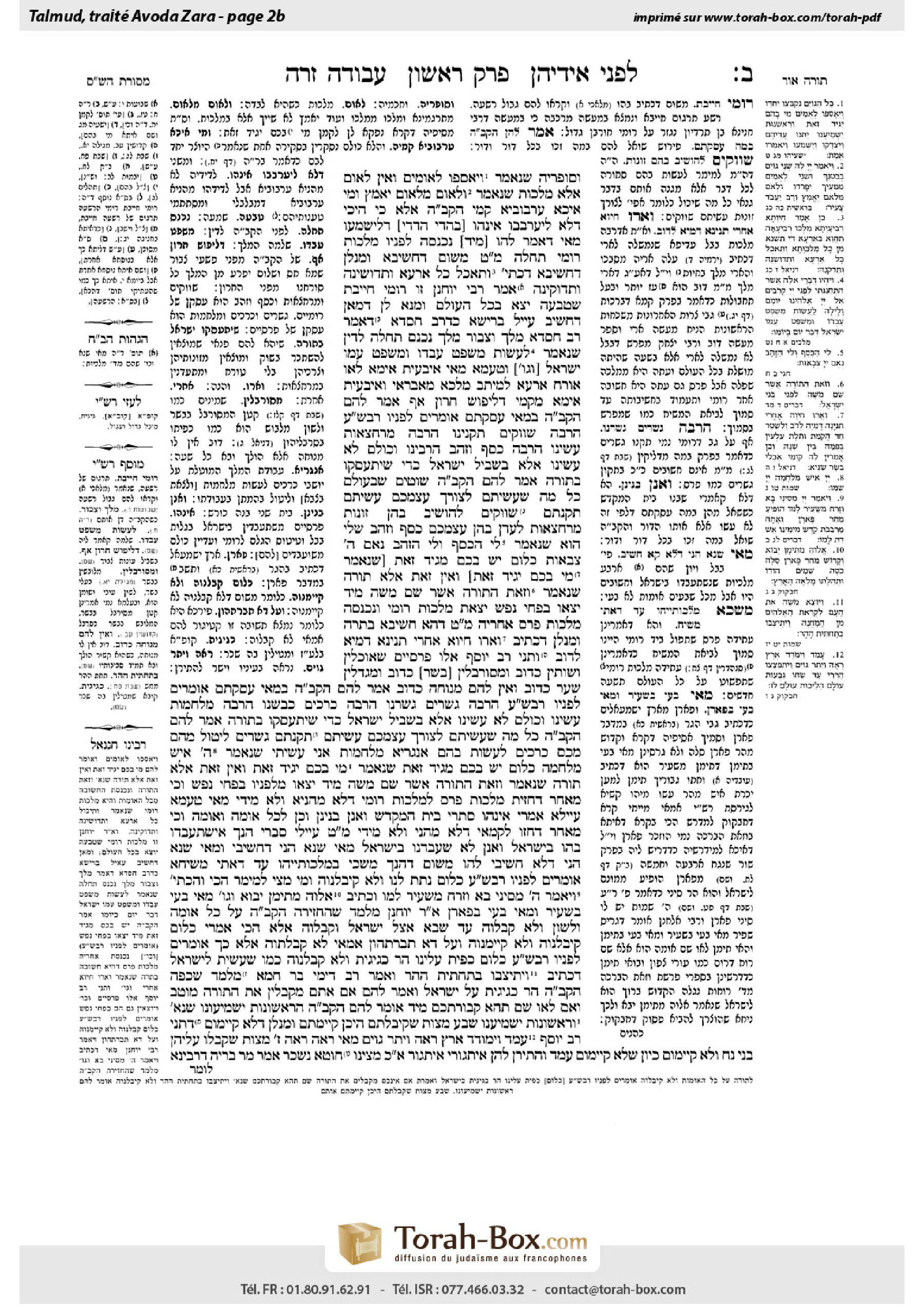
Avodah Zarah 2b: Talmud study for Daf Yomi
Study the Talmud for Daf Yomi with scanned pages, Hebrew text, English translations from Sefaria and AI-generated French translations.
Passage selection and English or AI-generated French translation are available where the scan has annotations. Daf Study is independent of Torah-Box and Sefaria.
Browse Avodah Zarah · עבודה זרה · All tractatesAvodah Zarah 2b text and translations
This page of Avodah Zarah includes the Aramaic text, an English translation and an AI-generated French translation, alongside the scan above.
עבודה זרה ב׳ ב · Aramaic and Hebrew text
וְסוֹפְרֶיהָ, שֶׁנֶּאֱמַר: ״וְיֵאָסְפוּ לְאֻמִּים״, וְאֵין ״לְאוֹם״ אֶלָּא מַלְכוּת, שֶׁנֶּאֱמַר: ״וּלְאֹם מִלְּאֹם יֶאֱמָץ״. וּמִי אִיכָּא עִרְבּוּבְיָא קַמֵּי הַקָּדוֹשׁ בָּרוּךְ הוּא? אֶלָּא כִּי הֵיכִי דְּלָא לִיעַרְבְּבוּ אִינְהוּ [בַּהֲדֵי הֲדָדֵי], דְּלִישְׁמְעוּ מַאי דְּאָמַר לְהוּ.
[מִיָּד] נִכְנְסָה לְפָנָיו מַלְכוּת רוֹמִי תְּחִלָּה. מַאי טַעְמָא? מִשּׁוּם דַּחֲשִׁיבָא. וּמְנָלַן דַּחֲשִׁיבָא? דִּכְתִיב: ״וְתֵאכֻל כׇּל אַרְעָא וּתְדוּשִׁנַּהּ וְתַדְּקִינַּהּ״. אָמַר רַבִּי יוֹחָנָן: זוֹ רוֹמִי חַיֶּיבֶת שֶׁטִּבְעָהּ יָצָא בְּכׇל הָעוֹלָם.
וּמְנָא לַן דְּמַאן דַּחֲשִׁיב עָיֵיל בְּרֵישָׁא? כִּדְרַב חִסְדָּא, דְּאָמַר רַב חִסְדָּא: מֶלֶךְ וְצִבּוּר — מֶלֶךְ נִכְנָס תְּחִלָּה לְדִין, שֶׁנֶּאֱמַר: ״לַעֲשׂוֹת מִשְׁפַּט עַבְדּוֹ וּמִשְׁפַּט עַמּוֹ יִשְׂרָאֵל וְגוֹ׳״. וְטַעְמָא מַאי? אִיבָּעֵית אֵימָא: לָאו אוֹרַח אַרְעָא לְמֵיתַב מַלְכָּא מֵאַבָּרַאי, וְאִיבָּעֵית אֵימָא: מִקַּמֵּי דְּלִיפּוֹשׁ חֲרוֹן אַף.
אָמַר לָהֶם הַקָּדוֹשׁ בָּרוּךְ הוּא: בְּמַאי עֲסַקְתֶּם? אוֹמְרִים לְפָנָיו: רִבּוֹנוֹ שֶׁל עוֹלָם, הַרְבֵּה שְׁוָוקִים תִּקַנְּינוּ, הַרְבֵּה מֶרְחֲצָאוֹת עָשִׂינוּ, הַרְבֵּה כֶּסֶף וְזָהָב הִרְבֵּינוּ, וְכוּלָּם לֹא עָשִׂינוּ אֶלָּא בִּשְׁבִיל יִשְׂרָאֵל כְּדֵי שֶׁיִּתְעַסְּקוּ בְּתוֹרָה.
אָמַר לָהֶם הַקָּדוֹשׁ בָּרוּךְ הוּא: שׁוֹטִים שֶׁבָּעוֹלָם, כׇּל מַה שֶּׁעֲשִׂיתֶם לְצוֹרֶךְ עַצְמְכֶם עֲשִׂיתֶם, תִּקַּנְתֶּם שְׁוָוקִים לְהוֹשִׁיב בָּהֶן זוֹנוֹת, מֶרְחֲצָאוֹת לְעַדֵּן בָּהֶן עַצְמְכֶם, כֶּסֶף וְזָהָב שֶׁלִּי הוּא, שֶׁנֶּאֱמַר: ״לִי הַכֶּסֶף וְלִי הַזָּהָב נְאֻם ה׳ צְבָאוֹת״.
כְּלוּם יֵשׁ בָּכֶם מַגִּיד זֹאת? שֶׁנֶּאֱמַר: ״מִי בָכֶם יַגִּיד זֹאת״, וְאֵין ״זֹאת״ אֶלָּא תּוֹרָה, שֶׁנֶּאֱמַר: ״וְזֹאת הַתּוֹרָה אֲשֶׁר שָׂם מֹשֶׁה״. מִיָּד יָצְאוּ בְּפַחֵי נֶפֶשׁ.
יָצָאת מַלְכוּת רוֹמִי, וְנִכְנְסָה מַלְכוּת פָּרַס אַחֲרֶיהָ. מַאי טַעְמָא? דְּהָא חֲשִׁיבָא בָּתְרַהּ. וּמְנָלַן? דִּכְתִיב: ״וַאֲרוּ חֵיוָא אָחֳרִי תִּנְיָנָא דָּמְיָא לְדֹב״, וְתָנֵי רַב יוֹסֵף: אֵלּוּ פַּרְסִיִּים, שֶׁאוֹכְלִין וְשׁוֹתִין כְּדוֹב, וּמְסוּרְבָּלִין [בָּשָׂר] כְּדוֹב, וּמְגַדְּלִין שֵׂעָר כְּדוֹב, וְאֵין לָהֶם מְנוּחָה כְּדוֹב.
אֹמֵר לָהֶם הַקָּדוֹשׁ בָּרוּךְ הוּא: בְּמַאי עֲסַקְתֶּם? אוֹמְרִים לְפָנָיו: רִבּוֹנוֹ שֶׁל עוֹלָם, הַרְבֵּה גְּשָׁרִים גָּשַׁרְנוּ, הַרְבֵּה כְּרַכִּים כָּבַשְׁנוּ, הַרְבֵּה מִלְחָמוֹת עָשִׂינוּ, וְכוּלָּם לֹא עָשִׂינוּ אֶלָּא בִּשְׁבִיל יִשְׂרָאֵל כְּדֵי שֶׁיִּתְעַסְּקוּ בַּתּוֹרָה.
אָמַר לָהֶם הַקָּדוֹשׁ בָּרוּךְ הוּא: כׇּל מַה שֶּׁעֲשִׂיתֶם לְצוֹרֶךְ עַצְמְכֶם עֲשִׂיתֶם, תִּקַּנְתֶּם גְּשָׁרִים לִיטּוֹל מֵהֶם מֶכֶס, כְּרַכִּים לַעֲשׂוֹת בָּהֶם אַנְגַּרְיָא, מִלְחָמוֹת אֲנִי עָשִׂיתִי, שֶׁנֶּאֱמַר: ״ה׳ אִישׁ מִלְחָמָה״, כְּלוּם יֵשׁ בָּכֶם מַגִּיד זֹאת? שֶׁנֶּאֱמַר: ״מִי בָכֶם יַגִּיד זֹאת״, וְאֵין ״זֹאת״ אֶלָּא תּוֹרָה, שֶׁנֶּאֱמַר: ״וְזֹאת הַתּוֹרָה אֲשֶׁר שָׂם מֹשֶׁה״, מִיָּד יָצְאוּ מִלְּפָנָיו בְּפַחֵי נֶפֶשׁ.
וְכִי מֵאַחַר דַּחֲזָית מַלְכוּת פָּרַס לְמַלְכוּת רוֹמִי דְּלָא מַהְנְיָא וְלָא מִידֵּי, מַאי טַעְמָא עָיְילָא? אָמְרִי: אִינְהוּ סָתְרִי בֵּית הַמִּקְדָּשׁ וַאֲנַן בָּנִינַן, וְכֵן לְכׇל אוּמָּה וְאוּמַהּ.
וְכִי מֵאַחַר דַּחֲזוֹ לְקַמָּאֵי דְּלָא מַהֲנֵי וְלָא מִידֵּי, מַאי טַעְמָא עָיְילִי? סָבְרִי: הָנָךְ אִישְׁתַּעְבַּדוּ בְּהוּ בְּיִשְׂרָאֵל, וַאֲנַן לָא שַׁעְבַּדְנוּ בְּיִשְׂרָאֵל. מַאי שְׁנָא הָנֵי דַּחֲשִׁיבִי, וּמַאי שְׁנָא הָנֵי דְּלָא חֲשִׁיבִי לְהוּ? מִשּׁוּם דְּהָנָךְ מָשְׁכִי בְּמַלְכוּתַיְיהוּ עַד דְּאָתֵי מְשִׁיחָא.
אוֹמְרִים לְפָנָיו: רִבּוֹנוֹ שֶׁל עוֹלָם, כְּלוּם נָתַתָּ לָנוּ וְלֹא קִיבַּלְנוּהָ? וּמִי מָצֵי לְמֵימַר הָכִי? וְהָכְתִיב: ״וַיֹּאמַר ה׳ מִסִּינַי בָּא וְזָרַח מִשֵּׂעִיר לָמוֹ״, וּכְתִיב: ״אֱלוֹהַּ מִתֵּימָן יָבוֹא וְגוֹ׳״. מַאי בָּעֵי בְּשֵׂעִיר, וּמַאי בָּעֵי בְּפָארָן?
אָמַר רַבִּי יוֹחָנָן: מְלַמֵּד שֶׁהֶחְזִירָהּ הַקָּדוֹשׁ בָּרוּךְ הוּא עַל כׇּל אוּמָּה וְלָשׁוֹן, וְלֹא קִבְּלוּהָ, עַד שֶׁבָּא אֵצֶל יִשְׂרָאֵל וְקִבְּלוּהָ!
אֶלָּא הָכִי אָמְרִי: כְּלוּם קִיבַּלְנוּהָ וְלֹא קִיַּימְנוּהָ? וְעַל דָּא תְּבָרְתְּהוֹן, אַמַּאי לָא קַבֵּלְתּוּהָ? אֶלָּא כָּךְ אוֹמְרִים לְפָנָיו: רִבּוֹנוֹ שֶׁל עוֹלָם, כְּלוּם כָּפִיתָ עָלֵינוּ הַר כְּגִיגִית וְלֹא קִבַּלְנוּהָ, כְּמוֹ שֶׁעָשִׂיתָ לְיִשְׂרָאֵל?
דִּכְתִיב: ״וַיִּתְיַצְּבוּ בְּתַחְתִּית הָהָר״, וְאָמַר רַב דִּימִי בַּר חָמָא: מְלַמֵּד שֶׁכָּפָה הַקָּדוֹשׁ בָּרוּךְ הוּא הַר כְּגִיגִית עַל יִשְׂרָאֵל, וְאָמַר לָהֶם: אִם אַתֶּם מְקַבְּלִין אֶת הַתּוֹרָה — מוּטָב, וְאִם לָאו — שָׁם תְּהֵא קְבוּרַתְכֶם!
מִיָּד אוֹמֵר לָהֶם הַקָּדוֹשׁ בָּרוּךְ הוּא: הָרִאשׁוֹנוֹת יַשְׁמִיעוּנוּ, שֶׁנֶּאֱמַר: ״וְרִאשׁוֹנוֹת יַשְׁמִיעֻנוּ״, שֶׁבַע מִצְוֹת שֶׁקִּיבַּלְתֶּם הֵיכָן קִיַּימְתֶּם?
וּמְנָלַן דְּלֹא קִיְּימוּם? דְּתָנֵי רַב יוֹסֵף: ״עָמַד וַיְמֹדֶד אֶרֶץ רָאָה וַיַּתֵּר גּוֹיִם״, מַאי רָאָה? רָאָה שֶׁבַע מִצְוֹת שֶׁקִּבְּלוּ עֲלֵיהֶן בְּנֵי נֹחַ וְלֹא קִיְּימוּם, כֵּיוָן שֶׁלֹּא קִיְּימוּם עָמַד וְהִתִּירָן לָהֶן. אִיתְּגוֹרֵי אִיתְּגוּר? אִם כֵּן מָצִינוּ חוֹטֵא נִשְׂכָּר!
אָמַר מָר בְּרֵיהּ דְּרָבִינָא:
Avodah Zarah 2b · English translation
with their scholars, as it is stated: “And let the peoples [le’umim] be assembled” (Isaiah 43:9); and the term le’om means nothing other than kingdom, as it is stated: “And the one kingdom [ule’om] shall be stronger than the other kingdom [mile’om]” (Genesis 25:23). The Gemara asks: But is it possible for there to be intermingling before the Holy One, Blessed be He, that it should be necessary for each nation to stand and be addressed separately? Rather, the nations are instructed to stand separately so that they will not become intermingled with each other in order that they will each hear what He says to them.
Immediately, the Roman Empire enters first before Him. The Gemara asks: What is the reason that the Roman Empire enters first? It is because the Roman Empire is the most important of all of the nations. And from where do we derive that it is the most important? As it is written in the book of Daniel with regard to the fourth empire that will rule over the world: “And it shall devour the whole earth, and shall tread it down, and break it in pieces” (Daniel 7:23), and Rabbi Yoḥanan says: This empire that will devour the earth is the wicked Roman Empire, whose name spread throughout the world.
The Gemara asks: And from where do we derive that whoever is more important enters first? This is in accordance with a statement of Rav Ḥisda, as Rav Ḥisda says: When a king and a community are brought before God for judgment, the king enters for judgment first, as it is stated: “That He make the judgment of His servant and the judgment of His people Israel, as every day shall require” (I Kings 8:59). And what is the reason that it is important for the king to enter first? If you wish, say that it is not proper conduct for the king to stand outside and wait for the trial of his subjects to end. And if you wish, say instead that the king is brought in first so that he may be judged before God’s anger intensifies due to the sins of the community.
The Gemara returns to its narration of the future judgment. First, the members of the Roman Empire enter. The Holy One, Blessed be He, says to them: With what did you occupy yourselves? They say before Him in response: Master of the Universe, we have established many marketplaces, we have built many bathhouses, and we have increased much silver and gold. And we did all of this only for the sake of the Jewish people, so that they would be free to engage in Torah study.
The Holy One, Blessed be He, says to them: Fools of the world! Are you attempting to deceive Me? Everything that you did, you did for your own needs. You established marketplaces to place prostitutes in them; you built bathhouses for your own enjoyment; and as for the silver and gold that you claim to have increased, it is Mine, as it is stated: “Mine is the silver, and Mine the gold, said the Lord of hosts” (Haggai 2:8).
Is there no one among you who can declare that they have studied this Torah? This is the meaning of the continuation of the verse from Isaiah, as it is stated: “Who among them can declare this?” (Isaiah 43:9). And “this” is referring to nothing other than the Torah, as it is stated: “And this is the Torah that Moses set before the children of Israel” (Deuteronomy 4:44), and whoever did not engage in its study does not receive reward. Immediately, the members of the Roman Empire leave disappointed.
The Roman Empire leaves, and the Persian Empire enters after it. What is the reason that the Persian Empire enters second? The reason is that after the Roman Empire it is the next most important. And from where do we derive this? As it is written in Daniel’s vision: “And behold another beast, a second, like a bear” (Daniel 7:5). And Rav Yosef teaches: These are the Persians, who are compared to a bear, as they eat and drink copious amounts as does a bear, and they are fleshy like a bear, and they grow their hair long as does a bear, and they never rest, like a bear, which is constantly on the move from one place to another.
The Holy One, Blessed be He, says to them: With what did you occupy yourselves? They say before Him in response: Master of the Universe, we have built many bridges, we have conquered many cities, and we have fought many wars. And we did all of this only for the sake of the Jewish people, so that they would engage in Torah study.
The Holy One, Blessed be He, says to them: Everything that you did, you did for your own needs. You established bridges to collect taxes from all who pass over them. You conquered cities to use their residents for forced labor [angareya]; and with regard to fighting the wars, I wage wars, and your success is from Me, as it is stated: “The Lord is a man of war” (Exodus 15:3). Is there no one among you who can declare that they have studied this Torah? As it is stated: “Who among them can declare this” (Isaiah 43:9), and “this” is referring to nothing other than the Torah, as it is stated: “And this is the Torah that Moses set” (Deuteronomy 4:44). Immediately, the members of the Persian Empire leave from before Him disappointed.
The Gemara asks: But once the Persian Empire sees that everything said by the Roman Empire is completely ineffective, what is the reason that they come forward? The Gemara answers: They believe that their claims will be more effective, as they say: The Romans destroyed the Second Temple, and we had built it, as the Second Temple was constructed under the auspices and with the encouragement of Cyrus, the king of Persia. The Gemara adds: And likewise, a similar exchange occurred with each and every nation.
The Gemara asks: But once the other nations see that everything said by the first ones, Rome and Persia, is completely ineffective, what is the reason that they come forward? The Gemara answers that they think: Those Empires subjugated the Jewish people, but we did not subjugate the Jewish people. The Gemara further asks: What is different about these, Rome and Persia, which were singled out explicitly, and what is different about those other empires that come afterward, which were not singled out and mentioned by name? It is because with regard to these, Rome and Persia, their kingship extends until the coming of the Messiah.
The nations will say before God: Master of the Universe, did You give us the Torah and we did not accept it? Since we never received the Torah, why are we being judged for not fulfilling its mitzvot? The Gemara asks: And can one say that they were never offered the Torah? But isn’t it written in the description of the giving of the Torah: “And he said: The Lord came from Sinai, and rose from Seir unto them” (Deuteronomy 33:2), and it is written: “God comes from Teman, and the Holy One from mount Paran” (Habakkuk 3:3). And the Sages asked: What did God require in Seir and what did He require in Paran? The Torah was not given in those locations.
And Rabbi Yoḥanan says: This teaches that the Holy One, Blessed be He, took the Torah around to every nation and those who speak every language, such as the Edomites in Seir and the Ishmaelites in Paran, but they did not accept it, until He came to the Jewish people and they accepted it. If the other nations all rejected the Torah, how can they excuse themselves by claiming that it was never offered to them?
Rather, this is what they say: Did we accept the Torah and then not fulfill its mitzvot? The Gemara asks: But this itself serves as the refutation of their own claim, as one can respond: Why didn’t you accept it? Rather, this is what the nations of the world say before Him: Master of the Universe, did You overturn the mountain above us like a basin, and we still did not accept the Torah, as You did for the Jewish people?
The Gemara provides the background for this claim: As it is written: “And they stood at the nether part of the mount” (Exodus 19:17), and Rav Dimi bar Ḥama says: The verse teaches that the Holy One, Blessed be He, overturned the mountain, i.e., Mount Sinai, above the Jews like a basin, and He said to them: If you accept the Torah, excellent, and if not, there, under the mountain, will be your burial. The nations of the world will claim that they too could have been coerced to accept the Torah.
Immediately, the Holy One, Blessed be He, says to them: The first mitzvot will let us hear the truth, as it is stated in the continuation of the same verse under discussion: “And announce to us the first things” (Isaiah 43:9). With regard to the seven Noahide mitzvot that preceded the giving of the Torah that even you accepted, where is the proof that you fulfilled them?
The Gemara asks: And from where do we derive that they did not fulfill them? As Rav Yosef teaches in explanation of the verse: “He stands, and shakes the earth, He sees, and makes the nations tremble [vayater]” (Habakkuk 3:6): What did God see? He saw the seven mitzvot that the descendants of Noah accepted upon themselves, and He saw that they did not fulfill them. Since they did not fulfill them, He arose and nullified for them [vehitiran] the command to heed these mitzvot. The Gemara asks: Do they gain from not obeying, as they are now released from the obligation to fulfill these mitzvot? If so, we find that a sinner profits from his transgression.
Mar, son of Ravina, said:
Avodah Zarah 2b · Traduction française (IA)
avec leurs savants, comme il est dit : « Et les peuples [le’umim] seront rassemblés » (Isaïe 43:9) ; et le terme le’om ne signifie rien d'autre que royaume, comme il est dit : « Et un seul royaume [ule’om] sera plus fort que l'autre royaume [mile’om] » (Genèse 25:23). La Guemara demande : Mais est-il possible qu'il y ait un mélange devant le Saint, le Bienheureux, de sorte qu'il faille que chaque nation se lève et soit adressée séparément ? Plutôt, les nations sont instruites à se lever séparément afin qu'elles ne s'entremêlent pas les unes aux autres, de sorte qu'elles entendent chacune ce que Lui dit à elles.
Immédiatement, l'Empire romain entre en premier devant Lui. La Guemara demande : Quelle est la raison pour laquelle l'Empire romain entre en premier ? C'est parce que l'Empire romain est le plus important de tous les peuples. Et d'où dérivons-nous que c'est le plus important ? Comme il est écrit dans le livre de Daniel concernant l'empire quatrième qui régnera sur la terre : « Et il dévorerait toute la terre, et il la marcherait sur, et il la briserait en morceaux » (Daniel 7:23), et le Rabbi Yoḥanan dit : Cet empire qui dévorerait la terre est l'Empire romain malveillant, dont le nom s'est répandu dans le monde entier.
La Guemara demande : Et d'où dérivons-nous que celui qui est plus important entre en premier ? C'est selon la déclaration du Rav Ḥisda, comme le Rav Ḥisda dit : Lorsqu'un roi et une communauté sont présentés devant Dieu pour être jugés, le roi entre en premier pour être jugé, comme il est dit : « Que Il fasse le jugement de Son serviteur et le jugement de Son peuple Israël, comme chaque jour exige » (I Rois 8:59). Et quelle est la raison pour laquelle il est important que le roi entre en premier ? Si tu veux, dis que ce n'est pas convenable que le roi reste en dehors et attende la fin du jugement de ses sujets. Et si tu veux, dis plutôt que le roi est introduit en premier afin qu'il soit jugé avant que l'indignation de Dieu ne s'intensifie à cause des péchés de la communauté.
La Guemara retourne à son récit du jugement futur. En premier, les membres de l'Empire romain entrent. Le Saint, le Bienheureux, dit à eux : Avec quoi avez-vous occupé votre temps ? Ils répondent devant Lui : Maître du Monde, nous avons établi beaucoup de marchés, nous avons construit beaucoup de bains, et nous avons augmenté beaucoup d'argent et d'or. Et nous avons fait tout cela uniquement pour le compte du peuple juif, afin qu'ils puissent s'engager dans l'étude de la Torah.
Le Saint, le Bienheureux, dit à eux : Fous du monde ! Voulez-vous m'escamoter ? Tout ce que vous avez fait, vous l'avez fait pour vos propres besoins. Vous avez établi des marchés pour y placer des prostituées ; vous avez construit des bains pour votre propre plaisir ; et quant à l'argent et l'or que vous affirmez avoir augmentés, c'est à moi, comme il est dit : « Mien est l'argent, et Mien l'or, dit l'Éternel des armées » (Haggaï 2:8).
Y a-t-il parmi vous quelqu'un qui puisse déclarer qu'il a étudié cette Torah ? C'est la signification de la continuation du verset d'Isaïe, comme il est dit : « Qui parmi eux peut déclarer cela ? » (Isaïe 43:9). Et « cela » désigne rien d'autre que la Torah, comme il est dit : « Et c'est la Torah que Moïse a mis devant les enfants d'Israël » (Deutéronome 4:44), et celui qui n'a pas participé à son étude ne reçoit pas de récompense. Immédiatement, les membres de l'Empire romain partent déçus.
L'Empire romain part, et l'Empire perse entre après lui. Quelle est la raison pour laquelle l'Empire perse entre en second ? La raison est que, après l'Empire romain, c'est le suivant en importance. Et d'où dérivons-nous cela ? Comme il est écrit dans la vision de Daniel : « Et voici un autre animal, un second, semblable à un ours » (Daniel 7:5). Et Rav Yosef enseigne : Ce sont les Perses, comparés à un ours, comme ils mangent et boivent en abondance comme un ours, et ils sont gras comme un ours, et ils laissent leurs cheveux pousser comme un ours, et ils ne reposent jamais, comme un ours, qui est constamment en mouvement d'un lieu à un autre.
Le Saint, le Bienheureux, dit à eux : Avec quoi avez-vous occupé votre temps ? Ils répondent devant Lui : Maître du Monde, nous avons construit beaucoup de ponts, nous avons conquis beaucoup de villes, et nous avons mené beaucoup de guerres. Et nous avons fait tout cela uniquement pour le compte du peuple juif, afin qu'ils s'engagent dans l'étude de la Torah.
Le Saint, le Bienheureux, dit à eux : Tout ce que vous avez fait, vous l'avez fait pour vos propres besoins. Vous avez construit des ponts pour collecter des impôts de tous ceux qui les traversent. Vous avez conquis des villes pour utiliser leurs habitants comme main-d'œuvre forcée [angareya] ; et concernant la guerre, c'est Moi qui mène la guerre, et votre succès vient de Moi, comme il est dit : « L'Éternel est un homme de guerre » (Exode 15:3). Y a-t-il parmi vous quelqu'un qui puisse déclarer qu'il a étudié cette Torah ? Comme il est dit : « Qui parmi eux peut déclarer cela ? » (Isaïe 43:9), et « cela » désigne rien d'autre que la Torah, comme il est dit : « Et c'est la Torah que Moïse a instituée » (Deutéronome 4:44). Immédiatement, les membres de l'Empire perse partent devant Lui déçus.
La Guemara demande : Mais une fois que l'Empire perse voit que tout ce que l'Empire romain a dit est totalement inefficace, quelle est la raison pour laquelle ils viennent en avant ? La Guemara répond : Ils croient que leurs déclarations seront plus efficaces, comme ils disent : Les Romains ont détruit le Temple Second, et nous avons construit ce temple, comme le Temple Second a été construit sous la tutelle et avec l'encouragement de César, roi des Perses. La Guemara ajoute : Et de même, un échange similaire s'est produit avec chaque nation.
La Guemara pose la question : Mais une fois que les autres nations voient que tout ce que disaient les premiers, Rome et Perse, est totalement inefficace, quelle est la raison pour laquelle ils s'approchent ? La Guemara répond qu'ils pensent : Ces Empires ont soumis le peuple juif, mais nous n'avons pas soumis le peuple juif. La Guemara pose ensuite une autre question : Qu'est-ce qui diffère chez ces derniers, Rome et Perse, qui ont été explicitement désignés, et qu'est-ce qui diffère chez les autres Empires qui sont venus après eux, qui n'ont pas été nommés ? C'est parce que, concernant ces derniers, Rome et Perse, leur souveraineté s'étend jusqu'à l'arrivée du Messie.
Les nations diront devant Dieu : Seigneur de l'Univers, avez-vous donné la Torah à nous et nous n'avons pas accepté ? Puisque nous n'avons jamais reçu la Torah, pourquoi sommes-nous jugés pour ne pas avoir accompli ses mitsvot ? La Guemara pose la question : Et peut-on dire qu'ils n'ont jamais été offerts la Torah ? Mais n'est-il pas écrit dans la description de la donnée de la Torah : « Et il dit : L'Éternel est descendu de Sinaï, et s'est levé de Séir pour eux » (Deutéronome 33 : 2), et il est écrit : « Dieu vient de Teman, et le Saint d'entre les saints de la montagne Paran » (Habacuc 3 : 3). Et les Sages ont demandé : Qu'est-ce que l'Éternel exigeait à Séir et qu'est-ce qu'Il exigeait à Paran ? La Torah n'a pas été donnée dans ces lieux.
Et Rabbi Yochanan dit : Cela enseigne que l'Éternel, béni soit-Il, a fait tourner la Torah autour de chaque nation et de ceux qui parlent toutes les langues, comme les Edomites à Séir et les Ishmaélites à Paran, mais ils n'ont pas accepté, jusqu'à ce qu'Il vienne au peuple juif et qu'ils l'acceptent. Si toutes les autres nations ont rejeté la Torah, comment peuvent-ils s'excuser en disant qu'elle n'a jamais été offerte à eux ?
Plutôt, c'est ce qu'ils disent : Avons-nous accepté la Torah et n'avons-nous pas accompli ses mitsvot ? La Guemara pose la question : Mais cela même sert de réfutation de leur propre allégation, car on peut répondre : Pourquoi n'avez-vous pas accepté ? Plutôt, c'est ce que les nations du monde disent devant Lui : Seigneur de l'Univers, avez-vous fait descendre la montagne sur nous comme un bol, et nous n'avons pas accepté la Torah, comme vous l'avez fait pour le peuple juif ?
La Guemara donne le contexte de cette allégation : Comme il est écrit : « Et ils se tenaient à la partie inférie de la montagne » (Exode 19 : 17), et Rav Dimi bar Ḥama dit : La versette enseigne que l'Éternel, béni soit-Il, a fait descendre la montagne, c'est-à-dire la montagne de Sinaï, sur les Juifs comme un bol, et Il a dit à eux : Si vous acceptez la Torah, c'est excellent, et si non, là, sous la montagne, sera votre sépulture. Les nations du monde affirmeront qu'elles aussi auraient pu être contraintes d'accepter la Torah.
Immédiatement, l'Éternel, béni soit-Il, dit à eux : Les premières mitsvot nous permettront d'entendre la vérité, comme il est dit dans la continuation de la même versette : « Et annoncez-nous les premières choses » (Isaïe 43 : 9). Concernant les sept mitsvot de Noé qui précédaient la donnée de la Torah que même vous avez acceptés, où est la preuve que vous les avez accomplis ?
La Guemara pose la question : Et d'où tirons-nous que ces commandements n'ont pas été accomplis ? Comme Rav Yosef explique à partir de la versette : « Il se lève, et secoue la terre, Il voit, et fait trembler les nations [vayater] » (Habacuc 3 : 6) : Qu'Éternel a-t-Il vu ? Il a vu les sept mitsvot que les descendants de Noé s'étaient imposés, et Il a vu qu'ils ne les avaient pas accomplis. Puisqu'ils ne les avaient pas accomplis, Il s'est levé et a annulé pour eux [vehitiran] l'obligation de respecter ces mitsvot. La Guemara pose la question : Profitent-ils de leur transgression, puisqu'ils sont maintenant libérés de l'obligation de les accomplir ? Si c'est le cas, nous trouvons que le pêcheur profite de son péché.
Mar, fils de Ravina, a dit :
Traduction française générée par IA à partir de l’édition anglaise de Sefaria. Vérifie toujours un passage avec le texte source.
Text from Sefaria: William Davidson Edition - Vocalized Aramaic (CC BY NC); William Davidson Edition - English (CC BY NC).