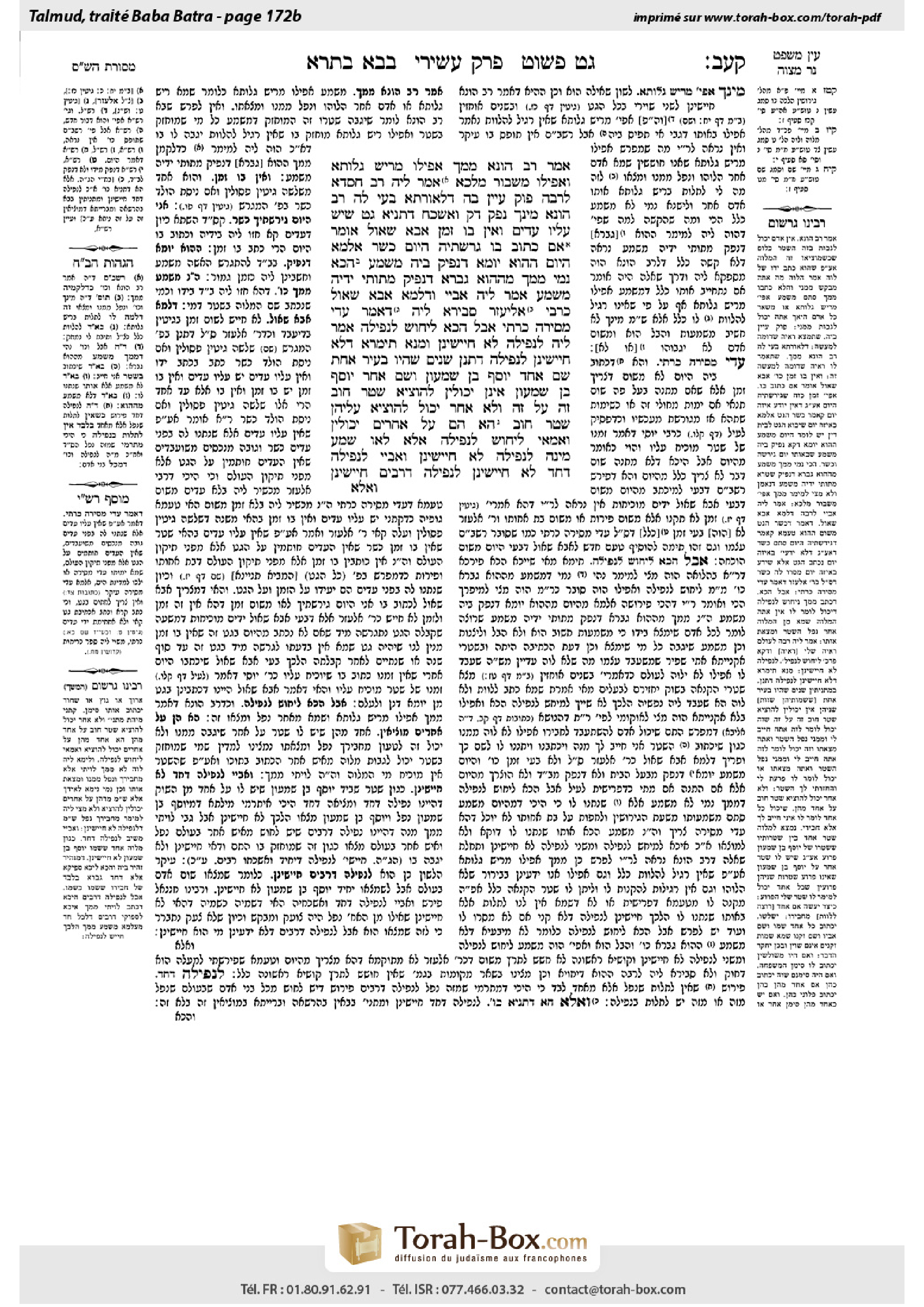
Bava Batra 172b: Talmud study for Daf Yomi
Study the Talmud for Daf Yomi with scanned pages, Hebrew text, English translations from Sefaria and AI-generated French translations.
Passage selection and English or AI-generated French translation are available where the scan has annotations. Daf Study is independent of Torah-Box and Sefaria.
Browse Bava Batra · בבא בתרא · All tractatesBava Batra 172b text and translations
This page of Bava Batra includes the Aramaic text, an English translation and an AI-generated French translation, alongside the scan above.
בבא בתרא קע״ב ב · Aramaic and Hebrew text
אָמַר רַב הוּנָא: ״מִמְּךָ״ – אֲפִילּוּ מֵרֵישׁ גָּלוּתָא, וַאֲפִילּוּ מִשַּׁבּוּר מַלְכָּא.
אֲמַר לֵיהּ רַב חִסְדָּא לְרַבָּה: פּוֹק עַיֵּין בָּהּ, דִּלְאוּרְתָּא בָּעֵי לַהּ רַב הוּנָא מִינָּךְ.
נְפַק דָּק וְאַשְׁכַּח – דְּתַנְיָא: גֵּט שֶׁיֵּשׁ עָלָיו עֵדִים וְאֵין בּוֹ זְמַן, אַבָּא שָׁאוּל אוֹמֵר: אִם כָּתוּב בּוֹ ״גֵּרַשְׁתִּיהָ הַיּוֹם״ – כָּשֵׁר.
אַלְמָא ״הַיּוֹם״ – הַהוּא יוֹמָא דְּנָפֵיק בֵּיהּ מַשְׁמַע; הָכָא נָמֵי, מִמְּךָ – מֵהָהוּא גַּבְרָא דְּנָפֵיק מִתּוּתֵי יְדֵיהּ מַשְׁמַע.
אֲמַר לֵיהּ אַבָּיֵי: וְדִלְמָא אַבָּא שָׁאוּל כְּרַבִּי אֱלִיעֶזֶר סְבִירָא לֵיהּ, דְּאָמַר: עֵדֵי מְסִירָה כָּרְתִי; אֲבָל הָכָא לֵיחוּשׁ לִנְפִילָה!
אֲמַר לֵיהּ: לִנְפִילָה לָא חָיְישִׁינַן. וּמְנָא תֵּימְרָא דְּלָא חָיְישִׁינַן לִנְפִילָה?
דִּתְנַן: שְׁנַיִם שֶׁהָיוּ בְּעִיר אַחַת, שֵׁם אֶחָד יוֹסֵף בֶּן שִׁמְעוֹן וְשֵׁם אַחֵר יוֹסֵף בֶּן שִׁמְעוֹן – אֵינָן יְכוֹלִין לְהוֹצִיא שְׁטַר חוֹב זֶה עַל זֶה, וְלֹא אַחֵר יָכוֹל לְהוֹצִיא עֲלֵיהֶן שְׁטַר חוֹב. הָא הֵם עַל אֲחֵרִים – יְכוֹלִין; וְאַמַּאי? לֵיחוּשׁ לִנְפִילָה! אֶלָּא לָאו שְׁמַע מִינַּהּ לִנְפִילָה לָא חָיְישִׁינַן?
וְאַבָּיֵי – לִנְפִילָה דְחַד לָא חָיְישִׁינַן, לִנְפִילָה דְרַבִּים חָיְישִׁינַן.
Bava Batra 172b · English translation
Rav Huna said: The term: From you, in the document does not identify anyone in particular, and can mean even: From the Exilarch, or even: From King Shapur.
Rav Ḥisda said to Rabba: Go out and investigate this matter, as tonight Rav Huna will ask this question of you.
Rabba went out, examined the matter, and discovered a relevant source. As it is taught in a baraita: Concerning a bill of divorce in which there are the signatures of witnesses on the document but there is no date written on it, Abba Shaul says that if it is written in it: I divorced her today, it is valid.
Rabba concludes: Apparently, the term: Today, indicates that day on which the bill of divorce emerges in the presence of the court. Here too, the term: From you, in a promissory note indicates that man from whose possession it emerges.
Abaye said to him: But this is not a valid proof, as perhaps Abba Shaul holds in accordance with the opinion of Rabbi Eliezer, who says that witnesses of the transmission of the bill of divorce effect the divorce. But here, let there be a concern for the possibility of the promissory note falling from its rightful owner and being found by the present holder of the document.
Rabba said to Abaye: We are not concerned for the possibility of a promissory note falling from its rightful owner and being found by another. And from where do you say, i.e., from where can it be proven, that we are not concerned for the possibility of a promissory note falling and being found by another?
As we learned in the mishna: If there are two people who were living in one city, one named Yosef ben Shimon and the other also named Yosef ben Shimon, one cannot present a promissory note against the other, as the purported debtor can claim: On the contrary, it is you who owed me money; you repaid me and I returned this note to you upon payment. Nor can another, third person, present a promissory note against either of them. This indicates that one of them can present a promissory note against others. But why can they do so? Let there be a concern for the possibility of the promissory note falling from one Yosef ben Shimon and being found by the other. Rather, must one not conclude from this mishna that we are not concerned for the possibility of the promissory note falling from one Yosef ben Shimon and being found by the other?
The Gemara asks: And why did Abaye, who is concerned for this possibility, not see a proof to the contrary from the mishna? He would counter: We are not concerned for the possibility of a promissory note falling from one particular person and being found by the other person with the same name, which is the case in the mishna, as that is extremely unlikely. We are concerned for the possibility of a promissory note falling from one of the general public and being found by someone else.
Bava Batra 172b · Traduction française (IA)
Rav Huna a dit : Le terme : De vous, dans le document ne désigne personne en particulier et peut signifier même : De l'Exilarch, ou même : De l'empereur Shapur.
Rav Ḥisda a dit à Rabba : Sortez et examinez cette question, car ce soir Rav Huna vous posera cette question.
Rabba est sorti, a examiné la question et a découvert une source pertinente. Comme il est enseigné dans une baraïta : Concernant un acte de divorce dans lequel figurent les signatures des témoins sur le document mais sans date inscrite, Abba Shaul dit que si on y écrit : Je l'ai divorcée aujourd'hui, cela est valide.
Rabba conclut : Il semble que le terme : Aujourd'hui, indique la journée où l'acte de divorce est rendu en présence du tribunal. Ici aussi, le terme : De vous, dans une note de promesse indique l'homme dont la possession est la source de ce document.
Abaye a dit à lui : Mais cela n'est pas une preuve valide, car peut-être Abba Shaul suit l'opinion de Rabbi Eliezer, qui affirme que les témoins de la transmission de l'acte de divorce accomplissent le divorce. Mais ici, il y a un risque que la note de promesse tombe des mains de son propriétaire légitime et soit trouvée par le détenteur actuel du document.
Rabba a dit à Abaye : Nous ne craignons pas que la note de promesse tombe des mains de son propriétaire légitime et soit trouvée par un autre. Et d'où dis-tu cela, c'est-à-dire d'où peut-on prouver que nous ne craignons pas que la note de promesse tombe et soit trouvée par un autre ?
Comme nous l'avons appris dans la Michna : Si deux personnes vivaient dans une même ville, l'une nommée Yosef ben Shimon et l'autre aussi nommée Yosef ben Shimon, l'une ne peut présenter une note de promesse contre l'autre, car le débiteur prétendu peut dire : Au contraire, c'est toi qui m'as doit de l'argent ; tu m'as remboursé et je t'ai rendu cette note après le paiement. Ni un tiers ne peut présenter une note de promesse contre l'un ou l'autre d'eux. Cela indique que l'un d'eux peut présenter une note de promesse contre les autres. Mais pourquoi peuvent-ils le faire ? Il y a un risque que la note de promesse tombe des mains d'un Yosef ben Shimon et soit trouvée par l'autre. Plutôt, ne devons-nous pas conclure de cette Michna que nous ne craignons pas que la note de promesse tombe des mains d'un Yosef ben Shimon et soit trouvée par l'autre ?
La Guemara demande : Et pourquoi Abaye, qui craint cette possibilité, n'a-t-il pas vu une preuve contraire dans la Michna ? Il répondrait : Nous ne craignons pas que la note de promesse tombe des mains d'une personne particulière et soit trouvée par une autre personne portant le même nom, ce qui est le cas dans la Michna, car cela est extrêmement improbable. Nous craignons plutôt que la note de promesse tombe des mains du grand public et soit trouvée par quelqu'un d'autre.
Traduction française générée par IA à partir de l’édition anglaise de Sefaria. Vérifie toujours un passage avec le texte source.
Text from Sefaria: William Davidson Edition - Vocalized Aramaic (CC BY NC); William Davidson Edition - English (CC BY NC).