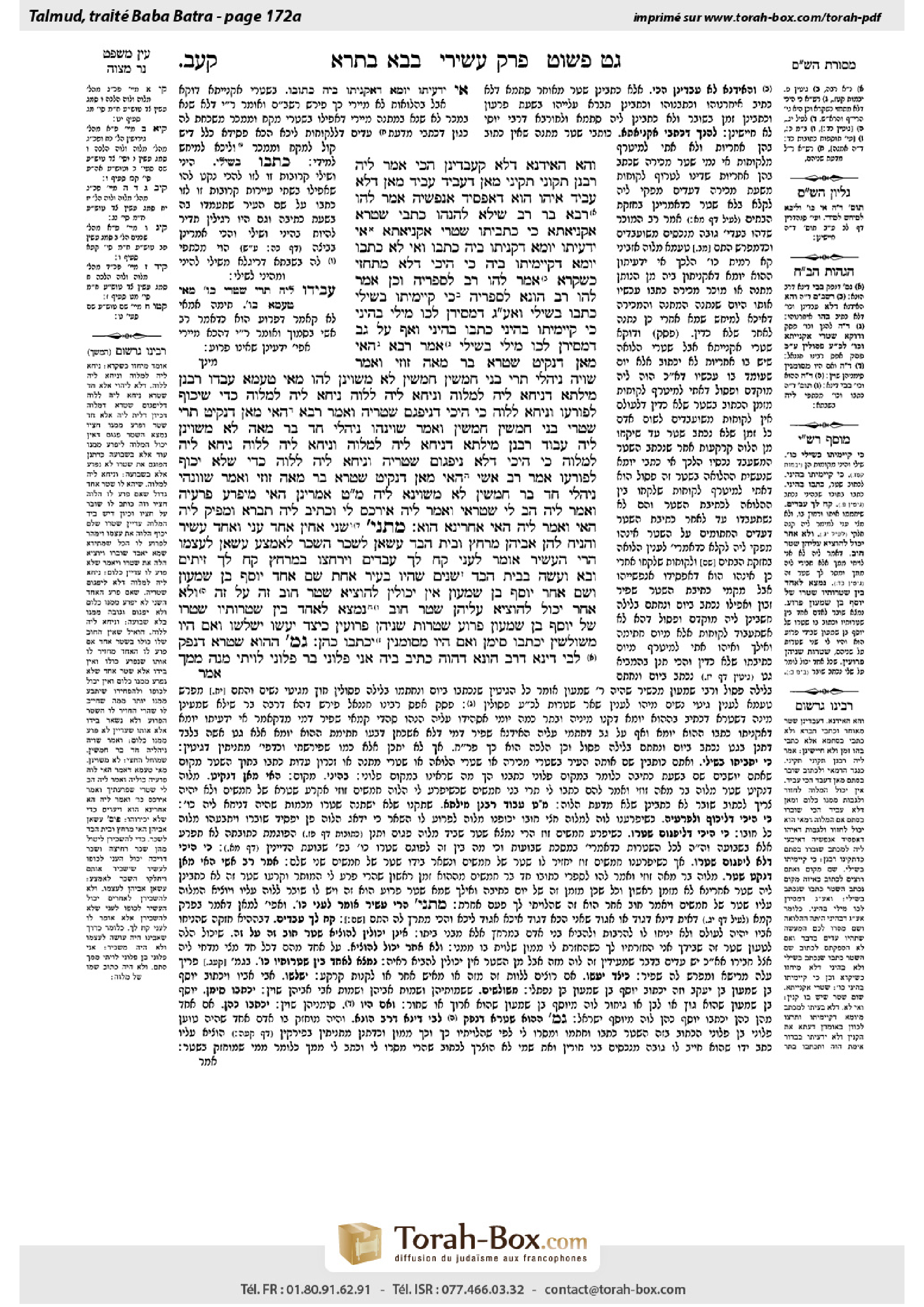
Bava Batra 172a: Talmud study for Daf Yomi
Study the Talmud for Daf Yomi with scanned pages, Hebrew text, English translations from Sefaria and AI-generated French translations.
Passage selection and English or AI-generated French translation are available where the scan has annotations. Daf Study is independent of Torah-Box and Sefaria.
Browse Bava Batra · בבא בתרא · All tractatesBava Batra 172a text and translations
This page of Bava Batra includes the Aramaic text, an English translation and an AI-generated French translation, alongside the scan above.
בבא בתרא קע״ב א · Aramaic and Hebrew text
וְהָא הָאִידָּנָא – דְּלָא קָעָבְדִינַן הָכִי! אֲמַר לֵיהּ: רַבָּנַן תַּקּוֹנֵי תַּקִּינוּ; מַאן דְּעָבֵיד – עָבֵיד, מַאן דְּלָא עָבֵיד – אִיהוּ הוּא דְּאַפְסֵיד אַנַּפְשֵׁיהּ.
אֲמַר לְהוּ רָבָא בַּר רַב שֵׁילָא לְהָנְהוּ כָּתְבֵי שְׁטָרֵי אַקְנְיָאתָא: כִּי כָּתְבִיתוּ שְׁטָרֵי אַקְנְיָאתָא; אִי יָדְעִיתוּ יוֹמָא דִּקְנֵיתוּ בֵּיהּ – כְּתֻבוּ, וְאִי לָא – כְּתֻבוּ יוֹמָא דְּקָיְימִיתוּ בֵּיהּ, כִּי הֵיכִי דְּלָא מִתְחֲזֵי כְּשִׁקְרָא.
אֲמַר לְהוּ רַב לְסָפְרֵיהּ, וְכֵן אֲמַר לְהוּ רַב הוּנָא לְסָפְרֵיהּ: כִּי קָיְימִיתוּ בְּשִׁילֵי – כְּתֻבוּ בְּשִׁילֵי, וְאַף עַל גַּב דִּמְסִירָן לְכוּ מִילֵּי בְּהִינֵי; כִּי קָיְימִיתוּ בְּהִינֵי – כְּתֻבוּ בְּהִינֵי, וְאַף עַל גַּב דִּמְסִירָן לְכוּ מִילֵּי בְּשִׁילֵי.
אָמַר רָבָא: הַאי מַאן דִּנְקִיט שְׁטָרָא בַּר מְאָה זוּזֵי, וְאָמַר: שַׁוְּיֻהּ נִיהֲלִי תְּרֵי בְּנֵי חַמְשִׁין חַמְשִׁין, לָא מְשַׁוֵּינַן לְהוּ.
מַאי טַעְמָא? עֲבַדוּ רַבָּנַן מִילְּתָא דְּנִיחָא לֵיהּ לְמַלְוֶה, וְנִיחָא לֵיהּ לְלֹוֶה; נִיחָא לֵיהּ לְמַלְוֶה – כְּדֵי שֶׁיָּכוֹף לְפוֹרְעוֹ, וְנִיחָא לְלֹוֶה – כִּי הֵיכִי דְּנִיפְגֹּם שְׁטָרֵיהּ.
וְאָמַר רָבָא: הַאי מַאן דִּנְקִיט תְּרֵי שְׁטָרֵי בְּנֵי חַמְשִׁין חַמְשִׁין, וְאָמַר: שַׁוִּינְהוּ נִיהֲלִי חַד בַּר מְאָה – לָא מְשַׁוֵּינַן לֵיהּ.
עֲבוּד רַבָּנַן מִילְּתָא דְּנִיחָא לֵיהּ לְמַלְוֶה, וְנִיחָא לֵיהּ לְלֹוֶה; נִיחָא לֵיהּ לְמַלְוֶה – כִּי הֵיכִי דְּלָא נִיפְגּוֹם שְׁטָרֵיהּ, וְנִיחָא לֵיהּ לְלֹוֶה – כְּדֵי שֶׁלֹּא יָכוֹף לְפוֹרְעוֹ.
אָמַר רַב אָשֵׁי: הַאי מַאן דִּנְקִיט שְׁטָרָא בַּר מְאָה זוּזֵי, וְאָמַר: שַׁוּוֹנְהִי נִיהֲלִי חַד בַּר חַמְשִׁין – לָא מְשַׁוֵּינָא לֵיהּ.
מַאי טַעְמָא? אָמְרִינַן: הַאי מִיפְרָע פַּרְעֵיהּ, וַאֲמַר לֵיהּ: הַב לִי שְׁטָרַאי, וַאֲמַר לֵיהּ: אִירְכַס לִי, וּכְתַיב לֵיהּ תְּבָרָא; וּמַפֵּיק לֵיהּ הַאי, וְאָמַר לֵיהּ: הַאי אַחֲרִינָא הוּא.
מַתְנִי׳ שְׁנֵי אַחִין – אֶחָד עָנִי וְאֶחָד עָשִׁיר, וְהִנִּיחַ לָהֶן אֲבִיהֶן מֶרְחָץ וּבֵית הַבַּד; עֲשָׂאָן לְשָׂכָר – הַשָּׂכָר לָאֶמְצַע. עֲשָׂאָן לְעַצְמוֹ – הֲרֵי הֶעָשִׁיר אוֹמֵר לֶעָנִי: ״קַח לְךָ עֲבָדִים וְיִרְחֲצוּ בַּמֶּרְחָץ, קַח לְךָ זֵיתִים וּבֹא וַעֲשֵׂה בְּבֵית הַבַּד״.
שְׁנַיִם שֶׁהָיוּ בְּעִיר אַחַת, שֵׁם אֶחָד ״יוֹסֵף בֶּן שִׁמְעוֹן״ וְשֵׁם אַחֵר ״יוֹסֵף בֶּן שִׁמְעוֹן״ – אֵין יְכוֹלִין לְהוֹצִיא שְׁטַר חוֹב זֶה עַל זֶה, וְלֹא אַחֵר יָכוֹל לְהוֹצִיא עֲלֵיהֶן שְׁטַר חוֹב.
נִמְצָא לְאֶחָד בֵּין שְׁטָרוֹתָיו ״שְׁטָרוֹ שֶׁל יוֹסֵף בֶּן שִׁמְעוֹן פָּרוּעַ״ – שְׁטָרוֹת שְׁנֵיהֶן פְּרוּעִין.
כֵּיצַד יַעֲשׂוּ? יְשַׁלְּשׁוּ, וְאִם הָיוּ מְשׁוּלָּשִׁין – יִכְתְּבוּ סִימָן, וְאִם הָיוּ מְסוּמָּנִין – יִכְתְּבוּ כֹּהֵן.
גְּמָ׳ הָהוּא שְׁטָרָא דִּנְפַק לְבֵי דִינָא דְּרַב הוּנָא, דַּהֲוָה כְּתִיב בֵּיהּ: ״אֲנִי פְּלוֹנִי בַּר פְּלוֹנִי לָוִיתִי מָנֶה מִמְּךָ״.
Bava Batra 172a · English translation
But today, when we do not do this either when writing receipts, how can we avoid double collection of a loan? Rav Kahana said to him: The Sages instituted taking this precaution. One who does what the Sages instituted does it and protects himself from loss; and as for one who does not do so, he has brought the loss upon himself, and will suffer the consequences if the promissory note is found and presented in the future.
Rava bar Rav Sheila said to those who wrote deeds of acquisition, i.e., deeds of sale or deeds of gifts for property they acquired: When you write deeds of acquisition after the acquisition was performed, if you know the day on which you effected the acquisition, write that date on the document. But if you do not know the day on which you effected the acquisition, write the date on which you are currently writing the document. You should follow this procedure, and not write an approximate or estimated date, so that the document shall not appear as a falsehood.
Rav said to his scribe, and Rav Huna said similarly to his scribe: When you are writing a document and you are situated in Shili, write that the document was written in Shili, and you should do so even if the matters were given over to you, i.e., the transaction attested to in the document took place, in Hini. When you are situated in Hini, write that the document was written in Hini, even if the matters were given over to you in Shili.
§ Rava said: With regard to this one who is holding a promissory note of one hundred dinars, and he says to the court: Prepare this note for me, i.e., exchange it, for two notes of fifty dinars each, so that if the debtor pays half the debt I will be able to give him one document and keep the other, we do not prepare the new notes for him.
What is the reason? The Sages have performed a matter here that is beneficial to the creditor and is beneficial to the debtor as well. It is beneficial to the creditor to keep the promissory note with the larger sum so that he can coerce the debtor to repay him, as there is a greater incentive to pay off a larger promissory note than a smaller one. And it is beneficial to the debtor, so that when he pays half the debt his promissory note becomes vitiated, and the remainder of the sum written in the vitiated promissory note can be collected only if the creditor takes an oath that he has not received the entire sum.
And Rava said further: With regard to this one who is holding two promissory notes, each of fifty dinars, owed by the same person, and he says to the court: Prepare this note for me into a single note of one hundred dinars, we do not prepare the new note for him.
What is the reason? The Sages have performed a matter here that is beneficial to the creditor and is beneficial to the debtor as well. It is beneficial to the creditor to keep the smaller notes, so that if the debtor pays fifty dinars, his promissory note will not become vitiated, which would require the creditor to take an oath before collecting the remainder. And it is beneficial to the debtor, so that the creditor will not be able to coerce him to repay the debt quickly, as there is a greater incentive to repay a larger sum than a smaller one.
Rav Ashi says: With regard to this one who is holding a promissory note of one hundred dinars, and he said to the court: Prepare this note for me into one note of fifty dinars, as the debtor has paid me half, we do not prepare the new note for him.
What is the reason? We say, i.e., we are concerned, that the following may have happened: This debtor actually repaid all one hundred dinars, and when he did so he said to the creditor: Give me back my promissory note. And the creditor said to him: I lost it. And the creditor wrote a receipt for him in lieu of handing over the promissory note. And now, if we write a new promissory note of fifty dinars for the creditor, he will present this note and say to the debtor, who presents his receipt for a hundred dinars: That receipt is for a different loan that you repaid.
MISHNA: In a case where there are two brothers, one poor and one rich, and their father left them a bathhouse or an olive press as an inheritance, if the father had built these facilities for profit, i.e., to charge others for using them, the profit that accrues after the father’s death is shared equally by the two brothers. If the father had built them for himself and for the members of his household to use, the poor brother, who has little use for these amenities, cannot force the rich brother to convert the facilities to commercial use; rather, the rich brother can say to the poor brother: Go take servants for yourself, and they will bathe in the bathhouse. Or he can say: Go take olives for yourself, and come and make them into oil in the olive press.
If there are two people who were living in one city, one named Yosef ben Shimon and the other also named Yosef ben Shimon, one cannot present a promissory note against the other, as the purported debtor can claim: On the contrary, it is you who owed me money; you repaid me and I returned this note to you upon payment. Nor can another, third person, present a promissory note against either of them, as each one can claim: It is not I but the other Yosef ben Shimon who owes you money.
If a document is found among one’s documents stating: The promissory note against Yosef ben Shimon is repaid, and both men named Yosef ben Shimon owed this man money, the promissory notes of both of them are considered repaid, as it cannot be determined which debt was repaid and which is outstanding.
What should two people with the same name in a single city do in order to conduct their business? They should triple their names by writing three generations: Yosef ben Shimon ben so-and-so. And if they have identical triple names, i.e., not only their fathers but their grandfathers had identical names, they should write an indication as to which one is referred to, such as: The short Yosef ben Shimon or the dark Yosef ben Shimon. And if they have identical indications, they should write: Yosef ben Shimon the priest, if one of them is a priest.
GEMARA: There was a certain promissory note that was presented at the court of Rav Huna, in which it was written: I, so-and-so son of so-and-so, borrowed one hundred dinars from you. No name was given as the creditor, but the one presenting the document claimed that the money was owed to him.
Bava Batra 172a · Traduction française (IA)
Mais aujourd'hui, lorsque nous ne faisons pas cela même lors de l'écriture de reçus, comment pouvons-nous éviter la collecte double d'un prêt ? Rav Kahana dit à lui : Les Sages ont institué cette précaution. Celui qui fait ce que les Sages ont institué le fait et se protège contre la perte ; et celui qui ne le fait pas a mis la perte sur lui, et subira les conséquences si le billet de change est trouvé et présenté à l'avenir.
Rava bar Rav Sheila dit à ceux qui écrivaient des actes d'acquisition, c'est-à-dire des actes de vente ou des dons concernant les biens qu'ils avaient acquis : Lorsque vous écrivez des actes d'acquisition après que l'acquisition ait été effectuée, si vous savez la date à laquelle vous avez effectué l'acquisition, écrivez cette date sur le document. Mais si vous ne savez pas la date à laquelle vous avez effectué l'acquisition, écrivez la date à laquelle vous écrivez actuellement le document. Vous devez suivre cette procédure, et ne pas écrire une date approximative ou estimée, afin que le document ne semble pas être un faux.
Rav dit à son scribe, et Rav Huna dit de même à son scribe : Lorsque vous écrivez un document et que vous êtes à Shili, écrivez que le document a été rédigé à Shili, et vous devez le faire même si les affaires ont été confiées à vous, c'est-à-dire que la transaction attestée dans le document s'est déroulée à Hini. Lorsque vous êtes à Hini, écrivez que le document a été rédigé à Hini, même si les affaires ont été confiées à vous à Shili.
§ Rava dit : En ce qui concerne celui qui tient un billet de change d'une centaine de drachmes, et qui dit au tribunal : Préparez-moi ce billet, c'est-à-dire échangez-le, pour deux billets de cinquante drachmes chacun, afin que si le débiteur paie la moitié de la dette, je puisse lui donner un document et conserver l'autre, nous ne préparons pas les nouveaux billets pour lui.
Quelle est la raison ? Les Sages ont accompli une affaire ici qui est bénéfique pour le créancier et bénéfique pour le débiteur également. C'est bénéfique pour le créancier de conserver le billet de change avec la somme plus grande afin qu'il puisse contraindre le débiteur à le rembourser, car il y a un plus grand motif de paiement pour un billet de change plus important qu'un plus petit. Et c'est bénéfique pour le débiteur, afin que lorsqu'il paie la moitié de la dette, son billet de change devienne inefficace, et la somme restante écrite dans le billet de change inefficace ne puisse être récupérée que si le créancier jure qu'il n'a pas reçu l'intégralité de la somme.
Et Rava dit de plus : En ce qui concerne celui qui tient deux billets de change, chacun de cinquante drachmes, dus par la même personne, et qui dit au tribunal : Préparez-moi ce billet pour un seul billet d'une centaine de drachmes, nous ne préparons pas le nouveau billet pour lui.
Quelle est la raison ? Les Sages ont accompli une affaire ici qui est bénéfique pour le créancier et bénéfique pour le débiteur également. C'est bénéfique pour le créancier de conserver les petits billets, afin que si le débiteur paie cinquante drachmes, son billet de change ne devienne pas inefficace, ce qui exigerait que le créancier jure avant de récupérer le reste. Et c'est bénéfique pour le débiteur, afin que le créancier ne puisse pas le contraindre à rembourser la dette rapidement, car il y a un plus grand motif de paiement pour une somme plus grande qu'une plus petite.
Rav Ashi dit : En ce qui concerne celui qui tient un billet de change d'une centaine de drachmes, et qui dit au tribunal : Préparez-moi ce billet pour un billet de cinquante drachmes, car le débiteur m'a payé la moitié, nous ne préparons pas le nouveau billet pour lui.
Quelle est la raison ? Nous disons, c'est-à-dire nous sommes préoccupés, que cela peut être arrivé : ce débiteur a effectivement remboursé les cent drachmes, et lorsqu'il l'a fait, il a dit au créancier : Donnez-moi mon billet de change. Et le créancier a dit à lui : Je l'ai perdu. Et le créancier a écrit un reçu à sa place au lieu de lui rendre le billet de change. Et maintenant, si nous rédigeons un nouveau billet de change de cinquante drachmes pour le créancier, il présentera ce billet et dira au débiteur, qui présente son reçu pour cent drachmes : Ce reçu est pour un prêt différent que vous avez remboursé.
MICHNA : Dans un cas où il y a deux frères, l'un pauvre et l'autre riche, et que leur père leur a laissé en héritage une salle de bain ou une presse à huile, si le père avait construit ces installations à des fins commerciales, c'est-à-dire pour facturer les autres pour leur utilisation, le bénéfice qui s'accumule après la mort du père est partagé également entre les deux frères. Si le père avait construit ces installations pour lui-même et pour les membres de sa famille à utiliser, le frère pauvre, qui n'a peu d'utilité pour ces commodités, ne peut pas obliger le frère riche à convertir les installations en usage commercial ; plutôt, le frère riche peut dire au frère pauvre : Va-t'en chercher des serviteurs pour toi-même, et ils baigneront dans la salle de bain. Ou il peut dire : Va-t'en chercher des olives pour toi-même, et viens les transformer en huile dans la presse à huile.
Si deux personnes vivaient dans une même ville, l'un nommé Yosef ben Shimon et l'autre également nommé Yosef ben Shimon, l'un ne peut présenter un billet de change contre l'autre, car le débiteur prétendu peut affirmer : Au contraire, c'est toi qui m'as dû de l'argent ; tu m'as remboursé et j'ai rendu ce billet à toi après le paiement. De même, un tiers ne peut présenter un billet de change contre l'un ou l'autre d'eux, car chacun peut affirmer : Ce n'est pas moi mais l'autre Yosef ben Shimon qui t'a dû de l'argent.
Si un document est trouvé parmi ses documents indiquant : Le billet de change contre Yosef ben Shimon est remboursé, et les deux hommes nommés Yosef ben Shimon devaient cette somme à cette personne, les billets de change des deux hommes sont considérés comme remboursés, car il n'est pas possible de déterminer quelle dette a été remboursée et laquelle reste encaissable.
Quand deux personnes portent le même nom dans une même ville, comment doivent-elles traiter leurs affaires ? Elles doivent tripler leurs noms en indiquant trois générations : Yosef fils de Shimon fils de tel et tel. Et si leurs noms triples sont identiques, c'est-à-dire que non seulement leurs pères mais aussi leurs grands-pères portaient le même nom, ils doivent indiquer par quel moyen l'un est désigné, par exemple : Yosef fils de Shimon le petit ou Yosef fils de Shimon le sombre. Et si les indications sont également identiques, ils doivent écrire : Yosef fils de Shimon le prêtre, si l'un d'eux est prêtre.
GUEMARA : Il y avait un billet de change qui fut présenté devant la cour de Rav Huna, dans lequel il était écrit : Je, tel et tel fils de tel et tel, ai emprunté cent dinars à vous. Aucun nom n'était indiqué comme créancier, mais celui qui présentait le document affirmait que l'argent lui était dû.
Traduction française générée par IA à partir de l’édition anglaise de Sefaria. Vérifie toujours un passage avec le texte source.
Text from Sefaria: William Davidson Edition - Vocalized Aramaic (CC BY NC); William Davidson Edition - English (CC BY NC).