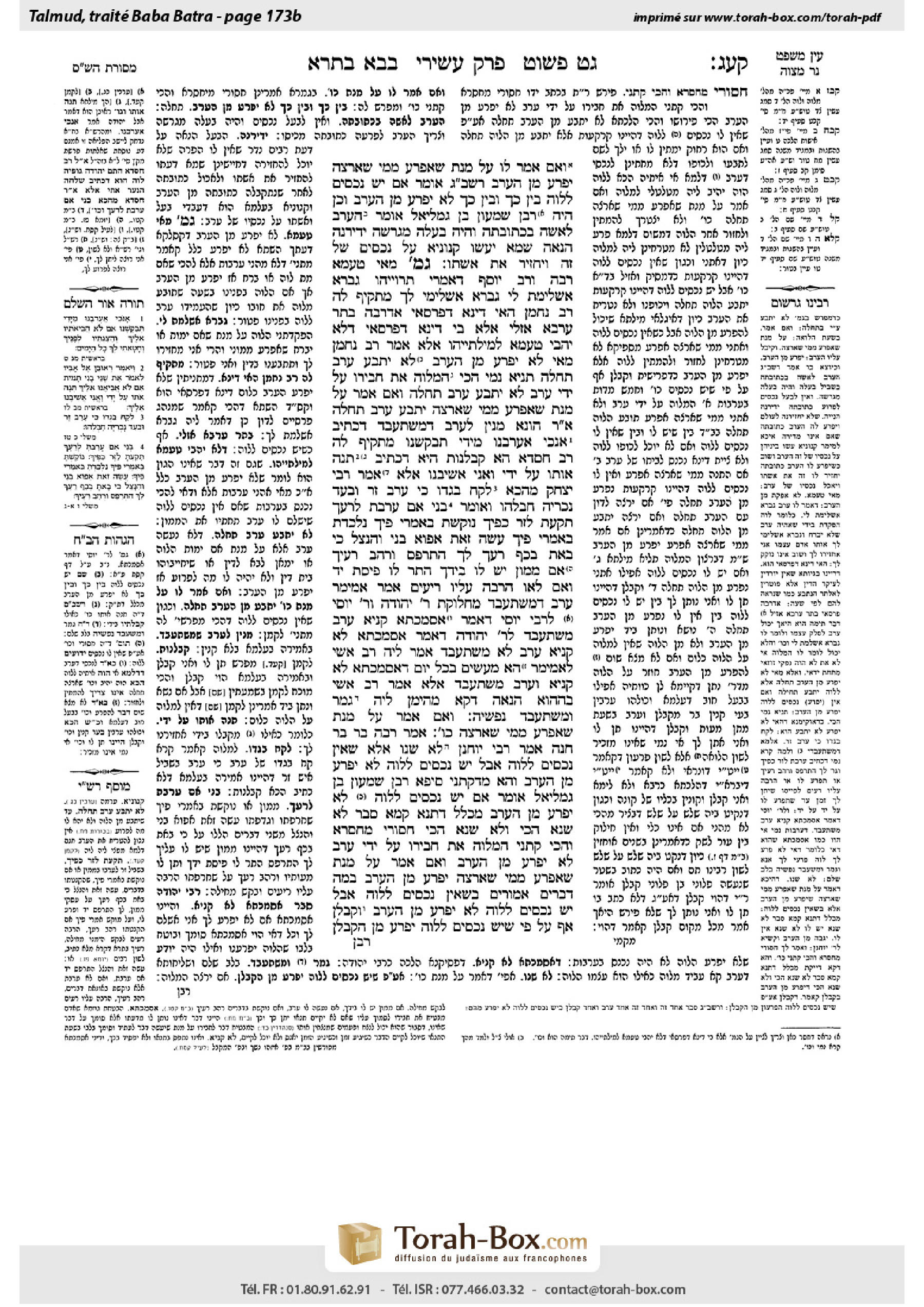
Bava Batra 173b: Talmud study for Daf Yomi
Study the Talmud for Daf Yomi with scanned pages, Hebrew text, English translations from Sefaria and AI-generated French translations.
Passage selection and English or AI-generated French translation are available where the scan has annotations. Daf Study is independent of Torah-Box and Sefaria.
Browse Bava Batra · בבא בתרא · All tractatesBava Batra 173b text and translations
This page of Bava Batra includes the Aramaic text, an English translation and an AI-generated French translation, alongside the scan above.
בבא בתרא קע״ג ב · Aramaic and Hebrew text
וְאִם אָמַר לוֹ: ״עַל מְנָת שֶׁאֶפָּרַע מִמִּי שֶׁאֶרְצֶה״ – יִפָּרַע מִן הֶעָרֵב. רַבָּן שִׁמְעוֹן בֶּן גַּמְלִיאֵל אוֹמֵר: אִם יֵשׁ נְכָסִים לַלֹּוֶה – בֵּין כָּךְ וּבֵין כָּךְ לֹא יִפָּרַע מִן הֶעָרֵב.
וְכֵן הָיָה רַבָּן שִׁמְעוֹן בֶּן גַּמְלִיאֵל אוֹמֵר: הֶעָרֵב לְאִשָּׁה בִּכְתוּבָּתָהּ, וְהָיָה בַּעְלָהּ מְגָרְשָׁהּ – יַדִּירֶנָּה הֲנָאָה; שֶׁמָּא יַעֲשׂוּ קְנוּנְיָא עַל נְכָסִים שֶׁל זֶה, וְיַחְזִיר אֶת אִשְׁתּוֹ.
גְּמָ׳ מַאי טַעְמָא? רַבָּה וְרַב יוֹסֵף דְּאָמְרִי תַּרְוַיְיהוּ: גַּבְרָא אַשְׁלֵימְתְּ לִי, גַּבְרָא אַשְׁלֵימִי לָךְ.
מַתְקֵיף לַהּ רַב נַחְמָן: הַאי – דִּינָא דְפָרְסָאֵי!
אַדְּרַבָּה, בָּתַר עָרְבָא אָזְלִי!
אֶלָּא בֵּי דִינָא דְפָרְסָאֵי – דְּלָא יָהֲבִי טַעְמָא לְמִילְּתַיְיהוּ.
אֶלָּא אָמַר רַב נַחְמָן: מַאי ״לֹא יִפָּרַע מִן הֶעָרֵב״ – לֹא יִתְבַּע עָרֵב תְּחִלָּה.
תַּנְיָא נָמֵי הָכִי: הַמַּלְוֶה אֶת חֲבֵירוֹ עַל יְדֵי עָרֵב – לֹא יִתְבַּע עָרֵב תְּחִלָּה. וְאִם אָמַר: ״עַל מְנָת שֶׁאֶפָּרַע מִמִּי שֶׁאֶרְצֶה״ – יִתְבַּע עָרֵב תְּחִלָּה.
אָמַר רַב הוּנָא: מִנַּיִן לְעָרֵב דְּמִשְׁתַּעְבֵּד? דִּכְתִיב: ״אָנֹכִי אֶעֶרְבֶנּוּ, מִיָּדִי תְּבַקְשֶׁנּוּ״.
מַתְקֵיף לַהּ רַב חִסְדָּא: הָא קַבְּלָנוּת הִיא – דִּכְתִיב: ״תְּנָה אֹתוֹ עַל יָדִי, וַאֲנִי אֲשִׁיבֶנּוּ״!
אֶלָּא אָמַר רַבִּי יִצְחָק, מֵהָכָא: ״לְקַח בִּגְדוֹ כִּי עָרַב זָר, וּבְעַד נׇכְרִיָּה חַבְלֵהוּ״.
וְאוֹמֵר: ״בְּנִי, אִם עָרַבְתָּ לְרֵעֶךָ תָּקַעְתָּ לַזָּר כַּפֶּיךָ, נוֹקַשְׁתָּ בְאִמְרֵי פִיךָ נִלְכַּדְתָּ בְּאִמְרֵי פִיךָ, עֲשֵׂה זֹאת אֵפוֹא בְּנִי וְהִנָּצֵל כִּי בָאתָ בְכַף רֵעֶךָ, לֵךְ הִתְרַפֵּס וּרְהַב רֵעֶיךָ״ – אִם מָמוֹן יֵשׁ לוֹ בְּיָדֶךָ, הַתֵּר לוֹ פִּיסַּת יָד; וְאִם לָאו, הַרְבֵּה עָלָיו רֵיעִים.
אָמַר אַמֵּימָר: עָרֵב דְּמִשְׁתַּעְבַּד, מַחְלוֹקֶת רַבִּי יְהוּדָה וְרַבִּי יוֹסֵי; לְרַבִּי יוֹסֵי דְּאָמַר: אַסְמַכְתָּא קָנְיָא – עָרֵב מִשְׁתַּעְבַּד. לְרַבִּי יְהוּדָה דְּאָמַר: אַסְמַכְתָּא לָא קָנְיָא – עָרֵב לָא מִשְׁתַּעְבַּד.
אֲמַר לֵיהּ רַב אָשֵׁי לְאַמֵּימָר: הָא מַעֲשִׂים בְּכׇל יוֹם, דְּאַסְמַכְתָּא לָא קָנְיָא וְעָרֵב מִשְׁתַּעְבַּד!
אֶלָּא אָמַר רַב אָשֵׁי: בְּהָהוּא הֲנָאָה דְּקָא מְהֵימַן לֵיהּ – גָּמַר וּמִשְׁתַּעְבַּד נַפְשֵׁיהּ.
וְאִם אָמַר ״עַל מְנָת שֶׁאֶפָּרַע מִמִּי שֶׁאֶרְצֶה״ כּוּ׳. אָמַר רַבָּה בַּר בַּר חָנָה אָמַר רַבִּי יוֹחָנָן: לֹא שָׁנוּ אֶלָּא שֶׁאֵין נְכָסִים לַלֹּוֶה, אֲבָל יֵשׁ נְכָסִים לַלֹּוֶה – לֹא יִפָּרַע מִן הֶעָרֵב.
וְהָא מִדְּקָתָנֵי סֵיפָא, רַבָּן שִׁמְעוֹן בֶּן גַּמְלִיאֵל אוֹמֵר: אִם יֵשׁ נְכָסִים לַלֹּוֶה – לֹא יִפָּרַע מִן הֶעָרֵב, מִכְּלָל דְּתַנָּא קַמָּא סָבַר: לָא שְׁנָא הָכִי וְלָא שְׁנָא הָכִי!
חַסּוֹרֵי מְחַסְּרָא, וְהָכִי קָתָנֵי: הַמַּלְוֶה אֶת חֲבֵירוֹ עַל יְדֵי עָרֵב – לֹא יִפָּרַע מִן הֶעָרֵב. וְאִם אָמַר ״עַל מְנָת שֶׁאֶפָּרַע מִמִּי שֶׁאֶרְצֶה״ – יִפָּרַע מִן הֶעָרֵב. בַּמֶּה דְּבָרִים אֲמוּרִים – בְּשֶׁאֵין נְכָסִים לַלֹּוֶה; אֲבָל יֵשׁ נְכָסִים לַלֹּוֶה – לֹא יִפָּרַע מִן הֶעָרֵב. וְקַבְּלָן, אַף עַל פִּי שֶׁיֵּשׁ נְכָסִים לַלֹּוֶה – יִפָּרַע מִן הַקַּבְּלָן.
Bava Batra 173b · English translation
But if the creditor said to the debtor: I am lending the money on the condition that I will collect the debt from whomever I wish, i.e., either the debtor or the guarantor, he can collect the debt from the guarantor. Rabban Shimon ben Gamliel says: If the debtor has property of his own, then whether in this case, where the creditor stipulated this condition, or that case, where he did not, he cannot collect the debt from the guarantor.
And so Rabban Shimon ben Gamliel would say: If there is a guarantor for a woman for her marriage contract, from whom the woman can collect payment of her marriage contract instead of collecting it from the husband, and her husband was divorcing her, the husband must take a vow prohibiting himself from deriving any benefit from her, so that he can never remarry her. This precaution is taken lest the couple collude [kenunya] to divorce in order to collect payment of the marriage contract from this guarantor’s property, and then the husband will remarry his wife.
GEMARA: The mishna teaches: One who lends money to another with a guarantor cannot collect the debt from the guarantor. The Gemara at first understands that the mishna is ruling that a guarantor’s commitment is limited to when the debtor dies or flees. What is the reason the guarantor’s commitment is limited? Rabba and Rav Yosef both say that the guarantor can tell the creditor: You gave a man over to me, to take responsibility for him if he dies or flees; I have given a man back to you. The debtor is here before you; take your money from him, and if he has nothing, suffer the loss yourself.
Rav Naḥman objects to this: This is Persian law.
The Gemara interjects: On the contrary, the Persian courts go after the guarantor directly, without even attempting to collect the debt from the debtor himself. Why, then, did Rav Naḥman say that excusing the guarantor from payment is Persian law?
The Gemara clarifies Rav Naḥman’s intent: Rather, Rav Naḥman meant to say that this kind of ruling would be appropriate for the members of a Persian court, who do not give a reason for their statements, but issue rulings by whim. Rav Naḥman was saying that it is not fair or logical to excuse the guarantor and cause a loss to the creditor who was depending on him.
Rather, Rav Naḥman said: What does the mishna mean when it says that the creditor cannot collect the debt from the guarantor? It means that he cannot claim payment from the guarantor at the outset, until after it is established that the debtor has no means to repay the debt. After the borrower defaults, the creditor can collect the debt from the guarantor.
This halakha is also taught in a baraita: One who lends money to another with the assurance of a guarantor cannot claim payment of the debt from the guarantor at the outset, rather, he must first attempt to collect the debt from the debtor. But if the creditor said to the debtor: I am lending the money on the condition that I will collect the debt from whomever I wish, he can claim payment of the debt from the guarantor at the outset, bypassing the debtor.
§ Rav Huna said: From where is it derived that a guarantor becomes obligated to repay a loan he has guaranteed? As it is written that Judah reassured his father concerning the young Benjamin: “I will be his guarantor; of my hand shall you request him” (Genesis 43:9). This teaches that it is possible for one to act as a guarantor that an item will be returned to the giver.
Rav Ḥisda objects to this: This incident involving Benjamin is not a case of a standard guarantor, but a case of an unconditional guarantee, as it is written, also in the context of Benjamin, that Reuben said: “Deliver him into my hand, and I will bring him back to you” (Genesis 42:37). One who undertakes unconditional responsibility for a loan has a different status than a standard guarantor, as will soon be elaborated. Therefore, a biblical source has yet to be adduced to teach that one can become a standard guarantor.
Rather, Rabbi Yitzḥak said that the source is from here: “Take his garment that is surety for a stranger; and hold him in pledge that is surety for an alien woman” (Proverbs 20:16). The verse advises a creditor to take the garment of the debtor’s guarantor as payment for the loan.
And it is stated: “My son, if you have become surety for your neighbor, if you have shaken your hands for a stranger, you have become ensnared by the words of your mouth, you have been caught by the words of your mouth. Do this now, my son, and save yourself, seeing that you have come into the hand of your neighbor: Go, humble yourself [hitrappes], and assemble your neighbors” (Proverbs 6:1–3). This last part of the passage means: If your neighbor’s money is in your possession, as you owe it as a guarantor, open up [hatter] the palm [pissat] of your hand and repay him. And if it is not money that you owe him, but rather “you have become ensnared by the words of your mouth” and owe him an apology for a personal slight, gather together many neighbors through which to seek his forgiveness.
§ Ameimar said: The issue of whether or not a guarantor in fact becomes obligated to repay the loan he has guaranteed is a dispute between Rabbi Yehuda and Rabbi Yosei. According to Rabbi Yosei, who says that a transaction with inconclusive consent [asmakhta] effects acquisition, a guarantor becomes obligated to repay the loan, whereas according to Rabbi Yehuda, who says that an asmakhta does not effect acquisition, a guarantor does not become obligated to repay the loan. Any obligation one undertakes that is dependent on the fulfillment of certain conditions that he does not expect will be fulfilled, in this case the debtor’s default on the loan, is considered an asmakhta.
Rav Ashi said to Ameimar that he was conflating these two issues: But it is a daily occurrence, i.e., it is taken for granted, that an asmakhta does not effect acquisition, and it is also taken for granted that a guarantor becomes obligated to repay the loan he has guaranteed.
Rather, Rav Ashi said: Through that satisfaction that the guarantor feels when the creditor trusts him and loans the money based on his guarantee, the guarantor resolves to obligate himself to repay the loan. Guaranteeing a loan is unlike a usual case of an obligation undertaken that is dependent on the fulfillment of certain conditions that he does not expect will be fulfilled, in which the commitment is not considered a real one. Here, the one obligating himself experiences a sense of satisfaction when the money is loaned to the debtor, and due to that, fully commits to fulfill his obligation.
§ The mishna teaches: But if the creditor said to the debtor: I am lending the money on the condition that I will collect the debt from whomever I wish, he can collect the debt from the guarantor. Rabba bar bar Ḥana says that Rabbi Yoḥanan says: They taught this only when the debtor has no property of his own from which to repay the loan, but if the debtor has property the creditor cannot collect the debt from the guarantor.
The Gemara questions this assertion: But from the fact that the latter clause of the mishna teaches that Rabban Shimon ben Gamliel says: If the debtor has property of his own, then whether in this case, where the creditor stipulated this condition, or that case, where he did not, he cannot collect the debt from the guarantor, by inference one can understand that the first tanna maintains that there is no difference if it is like this and there is no difference if it is like that. Whether or not the debtor has property from which to repay the loan, the creditor can collect the debt from the guarantor.
The Gemara clarifies: The mishna is incomplete and this is what it is teaching: One who lends money to another with the assurance of a guarantor cannot collect the debt from the guarantor before first claiming the debt from the debtor. But if the creditor said to the debtor: I am lending the money on the condition that I will collect the debt from whomever I wish, he can collect the debt from the guarantor. In what case is this statement said? When the debtor has no property of his own from which to repay the debt; but if the debtor has property, the creditor cannot collect the debt from the guarantor. This is the halakha with regard to a standard guarantor, but in the case of an unconditional guarantor, even if the debtor has property of his own, the creditor can collect the debt from the unconditional guarantor.
Bava Batra 173b · Traduction française (IA)
Mais si le créancier a dit au débiteur : Je prête cet argent sous condition que je puisse récupérer la dette auprès de qui je veux, c'est-à-dire soit le débiteur soit le garant, il peut récupérer la dette auprès du garant. Rabban Shimon ben Gamliel dit : Si le débiteur possède des biens personnels, alors qu'importe que la condition ait été stipulée ou non, il ne peut pas récupérer la dette auprès du garant.
Et ainsi Rabban Shimon ben Gamliel dit : Si un garant est engagé pour le mariage d'une femme, auprès duquel la femme peut récupérer le paiement de son mariage à la place du mari, et que ce dernier divorce d'elle, le mari doit prendre un serment interdisant à lui-même d'obtenir quelque bénéfice d'elle, afin qu'il ne puisse jamais la remettre en mariage. Cette précaution est prise afin d'éviter que le couple ne collabore [kenunya] pour divorcer afin de récupérer le paiement du mariage auprès des biens de ce garant, et ensuite le mari remarie sa femme.
GUEMARA : La mitsva enseigne : Celui qui prête de l'argent à un autre avec un garant ne peut pas récupérer la dette auprès du garant. La Guemara commence par comprendre que la mitsva établit que la responsabilité du garant est limitée à l'événement où le débiteur meurt ou s'enfuit. Pourquoi la responsabilité du garant est-elle limitée ? Rabba et Rav Yosef disent tous les deux que le garant peut dire au créancier : Tu m'as donné un homme à garder, pour qu'il assume la responsabilité s'il meurt ou s'enfuit ; je t'ai rendu un homme. Le débiteur est ici devant toi ; prends ton argent de lui, et s'il n'a rien, souffre la perte toi-même.
Rav Naḥman s'oppose à cela : C'est la loi perse.
La Guemara intercale : Au contraire, les tribunaux perses poursuivent directement le garant sans même tenter de récupérer la dette auprès du débiteur lui-même. Pourquoi alors Rav Naḥman a-t-il dit que l'excuse du garant est la loi perse ?
La Guemara clarifie l'intention de Rav Naḥman : Plutôt, Rav Naḥman voulait dire que ce genre de décision serait approprié pour les membres d'un tribunal perse, qui ne donnent pas de raisons pour leurs déclarations, mais émettent des décisions par caprice. Rav Naḥman disait que ce n'était pas juste ou logique d'excuser le garant et de causer une perte au créancier qui comptait sur lui.
Plutôt, Rav Naḥman dit : Que signifie la Michna lorsqu'elle dit que le créancier ne peut pas récupérer la dette auprès du garant ? Elle signifie qu'il ne peut réclamer le paiement auprès du garant dès le début, jusqu'à ce qu'il soit établi que le débiteur n'a pas les moyens de rembourser la dette. Après que le débiteur ait default, le créancier peut récupérer la dette auprès du garant.
Cette halakha est également enseignée dans une baraïta : Celui qui prête de l'argent à un autre avec l'assurance d'un garant ne peut pas réclamer le paiement de la dette auprès du garant dès le début, mais doit d'abord tenter de récupérer la dette auprès du débiteur. Mais si le créancier a dit au débiteur : Je prête cet argent sous condition que je puisse récupérer la dette auprès de qui je veux, il peut réclamer le paiement de la dette auprès du garant dès le début, en contournant le débiteur.
§ Rav Huna dit : D'où est tiré que le garant devient obligé de rembourser un prêt qu'il a garanti ? Comme il est écrit que Jéhuda a rassuré son père concernant le jeune Benjamin : « Je serai son garant ; de ma main tu demanderas à lui » (Genèse 43:9). Cela enseigne que l'on peut agir comme garant que l'objet sera rendu au donneur.
Rav Ḥisda s'oppose à cela : Cet incident concernant Benjamin n'est pas un cas de garant standard, mais un cas de garant inconditionnel, car il est écrit, également dans le contexte de Benjamin, que Réuben a dit : « Livre-le-moi en ma main, et je le ramènerai à toi » (Genèse 42:37). Celui qui assume une responsabilité inconditionnelle pour un prêt a un statut différent d'un garant standard, comme il sera bientôt développé. Par conséquent, une source biblique n'a pas encore été établie pour enseigner que l'on peut devenir un garant standard.
Plutôt, Rabbi Yitzḥak dit que la source est ici : « Prends sa robe qui est garantie pour un étranger ; et tiens-le en caution qui est garantie pour une femme étrangère » (Proverbes 20:16). La versette conseille au créancier de prendre la robe du garant du débiteur comme paiement pour le prêt.
Et il est dit : « Mon fils, si tu es devenu garant pour ton voisin, si tu as secoué ta main pour un étranger, tu es devenu ensnarré par les paroles de ta bouche, tu as été capturé par les paroles de ta bouche. Fais cela maintenant, mon fils, et sauve-toi, sachant que tu es entré dans la main de ton voisin : Allez, humilie-toi [hitrappes], et assemble tes voisins » (Proverbes 6:1–3). Cette dernière partie du passage signifie : Si les biens de ton voisin sont en ton possession, comme tu dois lui rembourser en tant que garant, ouvre [hatter] la main [pissat] et rembourse-le. Et si ce n'est pas de l'argent que tu dois lui, mais plutôt « tu es devenu ensnarré par les paroles de ta bouche » et tu dois lui une excuse pour une offense personnelle, rassemble beaucoup de voisins pour chercher son pardon.
§ Ameimar dit : La question de savoir si un garant devient effectivement obligé de rembourser le prêt qu'il a garanti est un débat entre Rabbi Yéhuda et Rabbi Yosei. Selon Rabbi Yosei, qui dit qu'une transaction avec un consentement indéterminé [asmakhta] constitue une acquisition, le garant devient obligé de rembourser le prêt, tandis que selon Rabbi Yéhuda, qui dit qu'une asmakhta ne constitue pas une acquisition, le garant ne devient pas obligé de rembourser le prêt. Toute obligation que l'on entreprend, dépendant de la réalisation de certaines conditions que l'on ne s'attend pas à ce qu'elles soient remplies, dans ce cas la faillite du débiteur sur le prêt, est considérée comme une asmakhta.
Rav Ashi a dit à Ameimar qu'il confondait ces deux questions : Mais c'est une chose quotidienne, c'est-à-dire qu'on le prend pour acquis, qu'une asmakhta ne produit pas l'acquisition, et qu'un garant devient obligé de rembourser le prêt qu'il a garanti.
En réalité, Rav Ashi a dit : Par ce sentiment de satisfaction que ressent le garant lorsqu'il est confié par le créancier et qu'il prête l'argent sur sa garantie, le garant s'engage pleinement à rembourser le prêt. Garantir un prêt est différent d'un cas ordinaire d'engagement conditionnel, où l'engagement dépend de la réalisation de certaines conditions qu'on ne s'attend pas à ce qu'elles soient remplies, et où l'engagement n'est pas considéré comme réel. Ici, celui qui s'engage ressent un sentiment de satisfaction lorsqu'on prête l'argent au débiteur, et à cause de cela, s'engage pleinement à remplir son obligation.
§ La mitsna enseigne : Mais si le créancier a dit au débiteur : Je prête l'argent à la condition que je puisse récupérer la dette auprès de qui je veux, il peut récupérer la dette auprès du garant. Rabba bar bar Ḥana dit que Rabbi Yoḥanan dit : Ils ont enseigné cela uniquement lorsque le débiteur n'a pas de propriété personnelle pour rembourser le prêt, mais si le débiteur a de la propriété, le créancier ne peut pas récupérer la dette auprès du garant.
La Guemara questionne cette affirmation : Mais à partir du fait que la dernière partie de la Michna enseigne que Rabban Shimon ben Gamliel dit : Si le débiteur a des biens personnels, alors que dans ce cas, où le créancier a stipulé cette condition, ou que dans ce cas, où il n'a pas stipulé cette condition, il ne peut pas récupérer la dette auprès du garant, on peut en déduire que le premier tanna maintient qu'il n'y a pas de différence entre ces deux cas. Quel que soit le fait que le débiteur ait ou non des biens pour rembourser la dette, le créancier peut récupérer la dette auprès du garant.
La Guemara clarifie : La Michna est incomplète et c'est ce qu'elle enseigne : Celui qui prête de l'argent à un autre avec l'assurance d'un garant ne peut récupérer la dette auprès du garant avant d'avoir d'abord réclamé la dette auprès du débiteur. Mais si le créancier a dit au débiteur : Je prête l'argent à la condition que je puisse récupérer la dette auprès de qui je veux, il peut récupérer la dette auprès du garant. Dans quel cas cette déclaration est-elle faite ? Lorsque le débiteur n'a pas de propriété personnelle pour rembourser la dette ; mais si le débiteur a des biens, le créancier ne peut pas récupérer la dette auprès du garant. C'est la halakha concernant un garant ordinaire, mais dans le cas d'un garant inconditionnel, même si le débiteur a des biens personnels, le créancier peut récupérer la dette auprès du garant inconditionnel.
Traduction française générée par IA à partir de l’édition anglaise de Sefaria. Vérifie toujours un passage avec le texte source.
Text from Sefaria: William Davidson Edition - Vocalized Aramaic (CC BY NC); William Davidson Edition - English (CC BY NC).