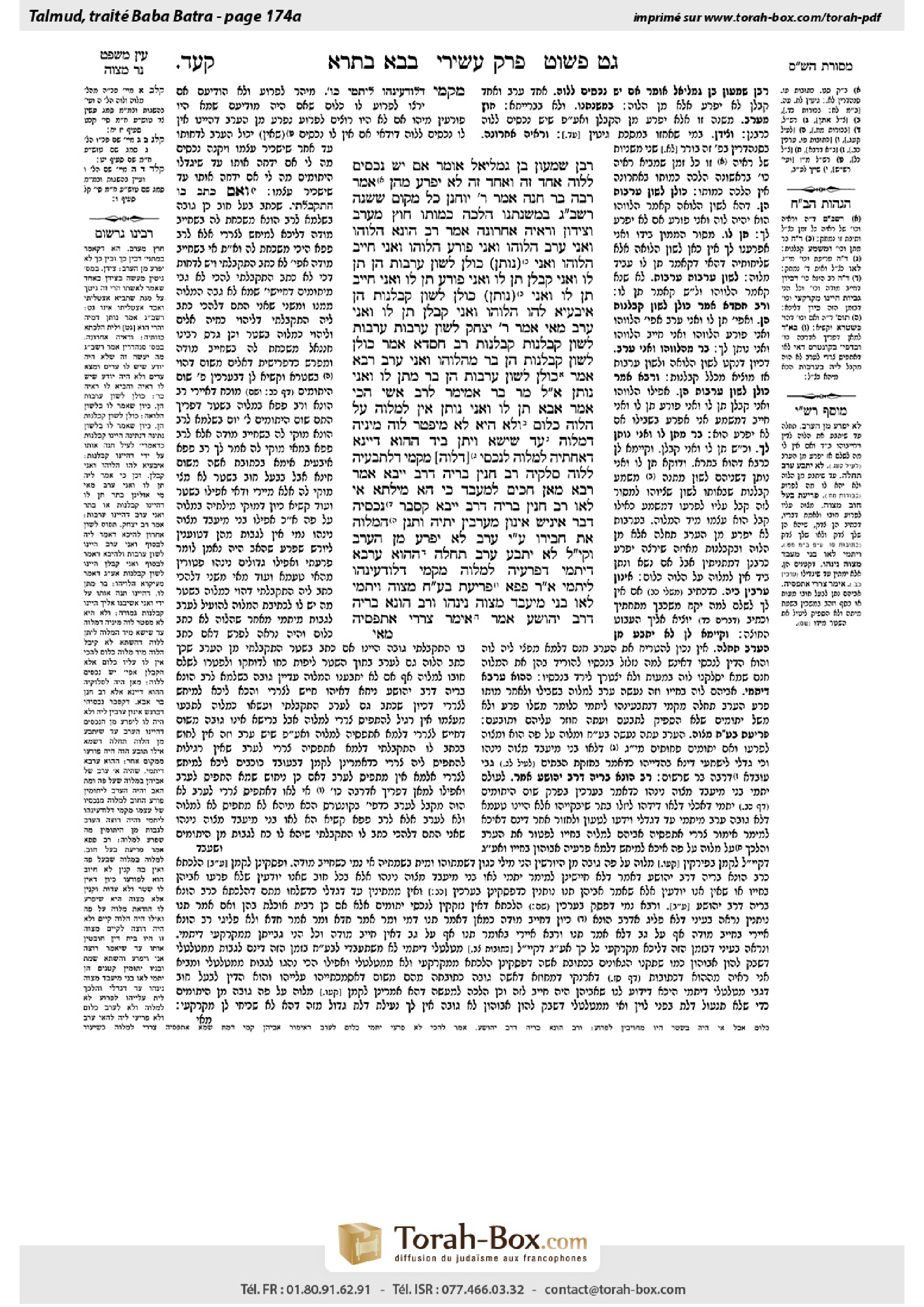
Bava Batra 174a: Talmud study for Daf Yomi
Study the Talmud for Daf Yomi with scanned pages, Hebrew text, English translations from Sefaria and AI-generated French translations.
Passage selection and English or AI-generated French translation are available where the scan has annotations. Daf Study is independent of Torah-Box and Sefaria.
Browse Bava Batra · בבא בתרא · All tractatesBava Batra 174a text and translations
This page of Bava Batra includes the Aramaic text, an English translation and an AI-generated French translation, alongside the scan above.
בבא בתרא קע״ד א · Aramaic and Hebrew text
רַבָּן שִׁמְעוֹן בֶּן גַּמְלִיאֵל אוֹמֵר: אִם יֵשׁ נְכָסִים לַלֹּוֶה – אֶחָד זֶה וְאֶחָד זֶה לֹא יִפָּרַע מֵהֶן.
אָמַר רַבָּה בַּר חָנָה אָמַר רַבִּי יוֹחָנָן: כׇּל מָקוֹם שֶׁשָּׁנָה רַבָּן שִׁמְעוֹן בֶּן גַּמְלִיאֵל בְּמִשְׁנָתֵנוּ – הֲלָכָה כְּמוֹתוֹ; חוּץ מֵעָרֵב, וְצַיְדָן, וּרְאָיָה אַחֲרוֹנָה.
אָמַר רַב הוּנָא: ״הַלְוֵהוּ וַאֲנִי עָרֵב״; ״הַלְוֵהוּ וַאֲנִי פּוֹרֵעַ״; ״הַלְוֵהוּ וַאֲנִי חַיָּיב״; ״הַלְוֵהוּ וַאֲנִי נוֹתֵן״ – כּוּלָּן לְשׁוֹן עַרְבוּת הֵן.
״תֵּן לוֹ וַאֲנִי קַבְּלָן״; ״תֵּן לוֹ וַאֲנִי פּוֹרֵעַ״; ״תֵּן לוֹ וַאֲנִי חַיָּיב״; ״תֵּן לוֹ וַאֲנִי נוֹתֵן״ – כּוּלָּן לְשׁוֹן קַבְּלָנוּת הֵן.
אִיבַּעְיָא לְהוּ: ״הַלְוֵהוּ וַאֲנִי קַבְּלָן״; ״תֵּן לוֹ וַאֲנִי עָרֵב״ – מַאי?
אָמַר רַבִּי יִצְחָק: לְשׁוֹן עַרְבוּת – עַרְבוּת, לְשׁוֹן קַבְּלָנוּת – קַבְּלָנוּת.
רַב חִסְדָּא אָמַר: כּוּלָּן לְשׁוֹן קַבְּלָנוּת הֵן, בַּר מֵ״הַלְוֵהוּ וַאֲנִי עָרֵב״.
רָבָא אָמַר: כּוּלָּן לְשׁוֹן עַרְבוּת הֵן, בַּר מִ״תֵּן לוֹ וַאֲנִי נוֹתֵן״.
אֲמַר לֵיהּ מָר בַּר אַמֵּימָר לְרַב אָשֵׁי, הָכִי אָמַר אַבָּא: ״תֵּן לוֹ וַאֲנִי נוֹתֵן״ – אֵין לַמַּלְוֶה עַל הַלֹּוֶה כְּלוּם.
וְלָא הִיא; לָא מִיפְּטַר לֹוֶה מִינֵּיהּ דְּמַלְוֶה, עַד שֶׁיִּשָּׂא וְיִתֵּן בַּיָּד.
הָהוּא דַּיָּינָא דְּאַחֲתֵיהּ לְמַלְוֶה לְנִכְסֵי [דְלֹוֶה] מִקַּמֵּי דְּלִתְבְּעֵיהּ לְלֹוֶה, סַלְּקֵיהּ רַב חָנִין בְּרֵיהּ דְּרַב יֵיבָא.
אָמַר רָבָא: מַאן חַכִּים לְמֶעְבַּד כִּי הָא מִילְּתָא, אִי לָאו רַב חָנִין בְּרֵיהּ דְּרַב יֵיבָא! קָסָבַר: נִכְסֵיהּ דְּבַר אִינִישׁ – אִינּוּן מְעָרְבִין יָתֵיהּ; וּתְנַן: הַמַּלְוֶה אֶת חֲבֵירוֹ עַל יְדֵי עָרֵב – לֹא יִפָּרַע מִן הֶעָרֵב, וְקַיְימָא לַן: לֹא יִתְבַּע עָרֵב תְּחִלָּה.
הָהוּא עָרְבָא דְּיַתְמֵי, דְּפַרְעֵיהּ לְמַלְוֶה מִקַּמֵּי דְּלוֹדְעִינְהוּ לְיַתְמֵי;
אָמַר רַב פָּפָּא: פְּרִיעַת בַּעַל חוֹב מִצְוָה, וְיַתְמֵי לָאו בְּנֵי מֶיעְבַּד מִצְוָה נִינְהוּ.
וְרַב הוּנָא בְּרֵיהּ דְּרַב יְהוֹשֻׁעַ אָמַר: אֵימַר צְרָרֵי אַתְפְּסֵיהּ.
Bava Batra 174a · English translation
Rabban Shimon ben Gamliel says: If the debtor has property, in both this case and in that case, i.e., whether the guarantor is a standard guarantor or an unconditional guarantor, the creditor cannot collect the debt from either type of guarantor.
Rabba bar Ḥana says that Rabbi Yoḥanan says: Wherever Rabban Shimon ben Gamliel taught a halakha in the corpus of our Mishna, the halakha is in accordance with his opinion, except for the following three cases: The responsibility of the guarantor, and the incident that occurred in the city of Tzaidan (see Gittin 74a), and the dispute with regard to evidence in the final disagreement (see Sanhedrin 31a).
§ The Gemara discusses which expressions confer upon a person the status of a standard guarantor, and which confer the status of an unconditional guarantor. Rav Huna says that if one says to a potential creditor: Lend money to him and I am a guarantor, or: Lend money to him and I will repay the debt, or: Lend money to him and I am obligated to repay the debt, or: Lend money to him and I will give the money back to you, all these are expressions that confer the status of a standard guarantee.
If one says: Give money to him and I am an unconditional guarantor, or: Give money to him and I will repay the debt, or: Give money to him and I am obligated to repay the debt, or: Give money to him and I will give the money back to you, all these are expressions that confer the status of an unconditional guarantee. The usage of the word give, as opposed to lend, confers the status of an unconditional guarantor.
A dilemma was raised before the Sages: What is the halakha if one says: Lend money to him and I am an unconditional guarantor? On the one hand, the word lend is used, as opposed to give, but on the other hand, he explicitly states that he will be an unconditional guarantor. What is the halakha if one says: Give money to him and I am a guarantor? On the one hand, the word give is used, as opposed to lend, but on the other hand, he states that he will be a guarantor.
Rabbi Yitzḥak says in resolving this dilemma: When one employs the language of a standard guarantee, it is a standard guarantee, even if he also used the word give. And when one employs the language of an unconditional guarantee, it is an unconditional guarantee, even if he also used the word lend.
Rav Ḥisda says: All of the expressions mentioned in this discussion are expressions of an unconditional guarantee, except for: Lend money to him and I am a guarantor.
Rava says: All of the expressions mentioned in this discussion are expressions of a standard guarantee, except for: Give money to him and I will give the money back to you.
Mar bar Ameimar said to Rav Ashi: My father said the following: If one says: Give money to him and I will give the money back to you, this expression binds the guarantor to such an extent that the lender has no claim against the debtor at all; his only option is to collect the debt from the guarantor.
The Gemara rejects this last statement: But that is not so. Rather, the debtor is not exempted from dealing with the creditor unless the guarantor takes the money from the creditor and gives it to the debtor with his own hand.
§ The Gemara relates: There was once a certain judge who permitted a creditor to enter the debtor’s property and collect it for his debt before lodging a claim against the debtor himself. Rav Ḥanin, son of Rav Yeiva, overruled that judge and expelled the creditor from the seized property.
When Rava heard about this he said: Who is wise enough to perform such a matter, i.e., to issue this ruling, if not Rav Ḥanin, son of Rav Yeiva? He holds that a person’s property is a guarantee for him, i.e., it acts as a guarantor for the loan if the debtor does not repay it; and we learned in the mishna: One who lends money to another with the assurance of a guarantor cannot collect the debt from the guarantor. And we established that the mishna means that he cannot collect the debt from the guarantor at the outset, before seeking payment from the debtor himself. So too, he cannot collect the debt by taking the debtor’s property without first seeking payment from the debtor himself.
§ The Gemara relates: There was once a certain guarantor for orphans whose father borrowed money and died, and the orphans were minors, and this guarantor repaid the debt to the creditor before informing the orphans that he was repaying the debt for them. The guarantor now sought reimbursement from the orphans.
Rav Pappa said: Repaying a creditor is a mitzva, and orphans who are minors are not obligated in performing a mitzva. They therefore do not have to repay any debts owed by their deceased father until they reach the age of majority.
And Rav Huna, son of Rav Yehoshua, also said that the orphans do not have to repay the guarantor until reaching majority, but for a different reason: Say that perhaps the deceased gave bundles of money to his creditor before his death, and therefore some or all of the debt has been paid. As long as they are minors, the heirs would not be aware of this payment, but upon reaching majority there is a chance that they may examine their father’s papers and discover that their father had done this. Therefore, payment is deferred until they reach majority.
Bava Batra 174a · Traduction française (IA)
Rabban Shimon ben Gamliel dit : Si le débiteur possède des biens, dans ce cas comme dans celui-là, c'est-à-dire que le cautionneur soit un cautionneur ordinaire ou un cautionneur inconditionnel, le créancier ne peut pas récupérer la dette auprès de l'un ou l'autre type de cautionneur.
Rabba bar Ḥana dit que Rabbi Yoḥanan dit : Partout où Rabban Shimon ben Gamliel a enseigné une halakha dans le corpus de notre Michna, la halakha suit son avis, sauf dans les trois cas suivants : La responsabilité du cautionneur, et l'incident survenu dans la ville de Tzaidan (voir Gittin 74a), et le débat concernant les témoins dans le dernier désaccord (voir Sanhedrin 31a).
§ Le Guemara discute des expressions qui confèrent à une personne le statut de cautionneur ordinaire et celles qui confèrent le statut de cautionneur inconditionnel. Rav Huna dit que si l'on dit à un créancier potentiel : Prête-lui de l'argent et je suis un cautionneur, ou : Prête-lui de l'argent et je paierai la dette, ou : Prête-lui de l'argent et je suis tenu de payer la dette, ou : Prête-lui de l'argent et je te rendrai l'argent, toutes ces expressions confèrent le statut de cautionneur ordinaire.
Si l'on dit : Donne-lui de l'argent et je suis un cautionneur inconditionnel, ou : Donne-lui de l'argent et je paierai la dette, ou : Donne-lui de l'argent et je suis tenu de payer la dette, ou : Donne-lui de l'argent et je te rendrai l'argent, toutes ces expressions confèrent le statut de cautionneur inconditionnel. L'emploi du mot donne, par opposition à prête, confère le statut de cautionneur inconditionnel.
Un dilemme a été soulevé devant les Sages : Quelle est la halakha si l'on dit : Prête-lui de l'argent et je suis un cautionneur inconditionnel ? D'une part, le mot prête est utilisé, par opposition à donne, mais d'autre part, il déclare explicitement qu'il sera un cautionneur inconditionnel. Quelle est la halakha si l'on dit : Donne-lui de l'argent et je suis un cautionneur ? D'une part, le mot donne est utilisé, par opposition à prête, mais d'autre part, il déclare qu'il sera un cautionneur.
Rabbi Yitzḥak dit pour résoudre ce dilemme : Lorsqu'on utilise le langage d'une caution ordinaire, c'est une caution ordinaire, même s'il utilise aussi le mot prête. Et lorsqu'on utilise le langage d'une caution inconditionnelle, c'est une caution inconditionnelle, même s'il utilise aussi le mot donne.
Rav Ḥisda dit : Toutes les expressions mentionnées dans cette discussion sont des expressions de caution inconditionnelle, sauf : Prête-lui de l'argent et je suis un garant.
Rava dit : Toutes les expressions mentionnées dans cette discussion sont des expressions de caution ordinaire, sauf : Donne-lui de l'argent et je te rendrai l'argent.
Mar bar Ameimar dit à Rav Ashi : Mon père a dit ceci : Si l'on dit : Donne-lui de l'argent et je te rendrai l'argent, cette expression engage le garant à tel point que le prêteur n'a aucun droit contre le débiteur ; son seul recours est de récupérer la dette auprès du garant.
Le Guemara rejette cette dernière déclaration : Mais ce n'est pas ainsi. Plutôt, le débiteur n'est pas exempté de traiter avec le créancier à moins que le cautionneur ne prenne l'argent du créancier et ne le donne au débiteur avec sa propre main.
§ Le Guemara rapporte : Il y avait un juge qui autorisait un créancier à entrer dans la propriété du débiteur et à la récupérer pour sa dette avant de porter une action contre le débiteur lui-même. Rav Ḥanin, fils de Rav Yeiva, a annulé ce juge et a expulsé le créancier de la propriété saisie.
Quand Rava a entendu cela, il a dit : Qui est sage assez pour accomplir une telle affaire, c'est-à-dire pour émettre ce jugement, si ce n'est Rav Ḥanin, fils de Rav Yeiva ? Il considère que la propriété d'une personne est une garantie pour lui, c'est-à-dire qu'elle agit comme caution pour le prêt si le débiteur ne le rembourse pas ; et nous avons appris dans la mishna : Celui qui prête de l'argent à un autre avec la garantie d'un cautionneur ne peut pas récupérer la dette auprès du cautionneur. Et nous avons établi que la mishna signifie qu'il ne peut pas récupérer la dette auprès du cautionneur dès le début, avant d'avoir cherché à récupérer la dette auprès du débiteur lui-même. De même, il ne peut pas récupérer la dette en prenant la propriété du débiteur sans avoir d'abord cherché à récupérer la dette auprès du débiteur lui-même.
§ Le Guemara rapporte : Il y avait un cautionneur pour des orphelins dont le père avait emprunté de l'argent et était mort, et les orphelins étaient des mineurs, et ce cautionneur a remboursé la dette au créancier avant d'informer les orphelins qu'il la remboursait pour eux. Le cautionneur cherche maintenant à être rétribué par les orphelins.
Rav Pappa dit : Rembourser un créancier est une mitsva, et les orphelins, mineurs, ne sont pas tenus de faire une mitsva. Ils n'ont donc pas à rembourser les dettes de leur père décédé jusqu'à leur majorité.
Et Rav Huna, fils de Rav Yehoshua, a aussi dit que les orphelins n'ont pas à rembourser le cautionneur jusqu'à leur majorité, mais pour une autre raison : Disons que peut-être le défunt avait donné des ballots d'argent à son créancier avant sa mort, et donc une partie ou toute la dette avait été payée. Tant qu'ils sont mineurs, les héritiers ne seraient pas conscients de ce paiement, mais à leur majorité, il y a une chance qu'ils examinent les papiers de leur père et découvrent qu'il avait fait cela. Par conséquent, le paiement est reporté jusqu'à leur majorité.
Traduction française générée par IA à partir de l’édition anglaise de Sefaria. Vérifie toujours un passage avec le texte source.
Text from Sefaria: William Davidson Edition - Vocalized Aramaic (CC BY NC); William Davidson Edition - English (CC BY NC).