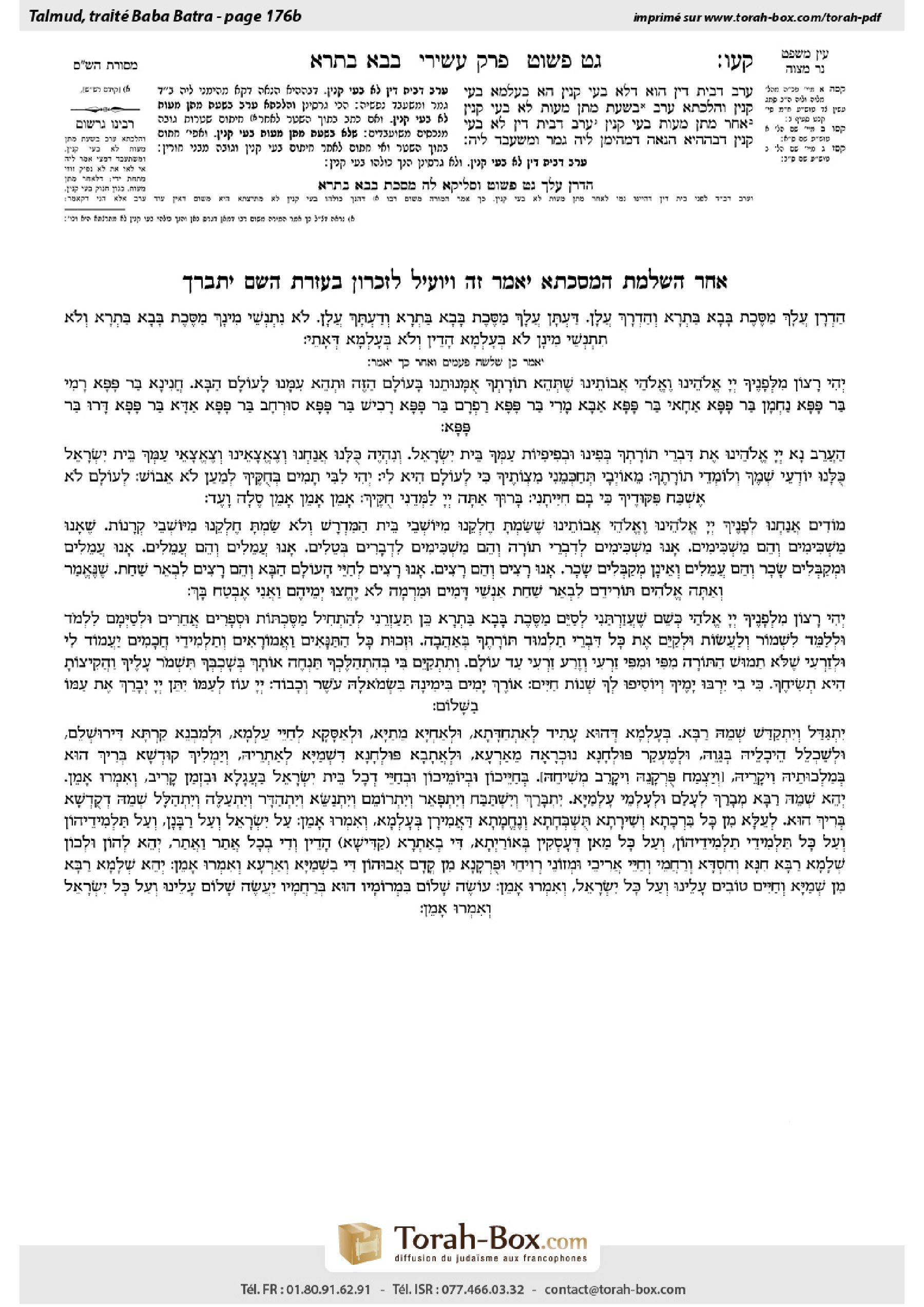
Bava Batra 176b: Talmud study for Daf Yomi
Study the Talmud for Daf Yomi with scanned pages, Hebrew text, English translations from Sefaria and AI-generated French translations.
Passage selection and English or AI-generated French translation are available where the scan has annotations. Daf Study is independent of Torah-Box and Sefaria.
Browse Bava Batra · בבא בתרא · All tractatesBava Batra 176b text and translations
This page of Bava Batra includes the Aramaic text, an English translation and an AI-generated French translation, alongside the scan above.
בבא בתרא קע״ו ב · Aramaic and Hebrew text
עָרֵב דְּבֵית דִּין הוּא דְּלָא בָּעֵי קִנְיָן, הָא בְּעָלְמָא בָּעֵי קִנְיָן.
וְהִלְכְתָא: עָרֵב בִּשְׁעַת מַתַּן מָעוֹת – לֹא בָּעֵי קִנְיָן, אַחַר מַתַּן מָעוֹת – בָּעֵי קִנְיָן. עָרֵב דְּבֵית דִּין – לָא בָּעֵי קִנְיָן; דִּבְהָהִיא הֲנָאָה דִּמְהֵימַן לֵיהּ – גָּמַר וּמְשַׁעְבֵּד לֵיהּ.
הֲדַרַן עֲלָךְ גֵּט פָּשׁוּט, וּסְלִיקָא לַהּ מַסֶּכֶת בָּבָא בָּתְרָא
Bava Batra 176b · English translation
It is only a guarantor who undertakes a loan guarantee in the presence of a court who does not require an act of acquisition; this indicates that generally, a guarantor requires an act of acquisition in order to be obligated to pay.
The Gemara concludes: And the halakha is that a guarantor who accepts responsibility for the loan at the time of the giving of the money does not require an act of acquisition; but if he accepts responsibility after the giving of the money, he requires an act of acquisition. Moreover, a guarantor who undertakes a loan guarantee in the presence of a court does not require an act of acquisition, as in return for that gratification that he experiences in that the court trusts him, he resolves to obligate himself.
Bava Batra 176b · Traduction française (IA)
C'est seulement un cautionneur qui entre en garantie d'un prêt devant un tribunal qui n'exige pas d'acte d'acquisition ; cela indique que généralement, un cautionneur a besoin d'un acte d'acquisition afin d'être tenu responsable de la dette.
La Guemara conclut : Et la halakha est que le cautionneur qui accepte la responsabilité du prêt au moment de la remise de l'argent n'a pas besoin d'un acte d'acquisition ; mais si il accepte la responsabilité après la remise de l'argent, il a besoin d'un acte d'acquisition. De plus, le cautionneur qui entre en garantie d'un prêt devant un tribunal n'a pas besoin d'un acte d'acquisition, car en retour de cette satisfaction qu'il ressent en ce que le tribunal a confiance en lui, il se résout à s'engager.
Traduction française générée par IA à partir de l’édition anglaise de Sefaria. Vérifie toujours un passage avec le texte source.
Text from Sefaria: William Davidson Edition - Vocalized Aramaic (CC BY NC); William Davidson Edition - English (CC BY NC).