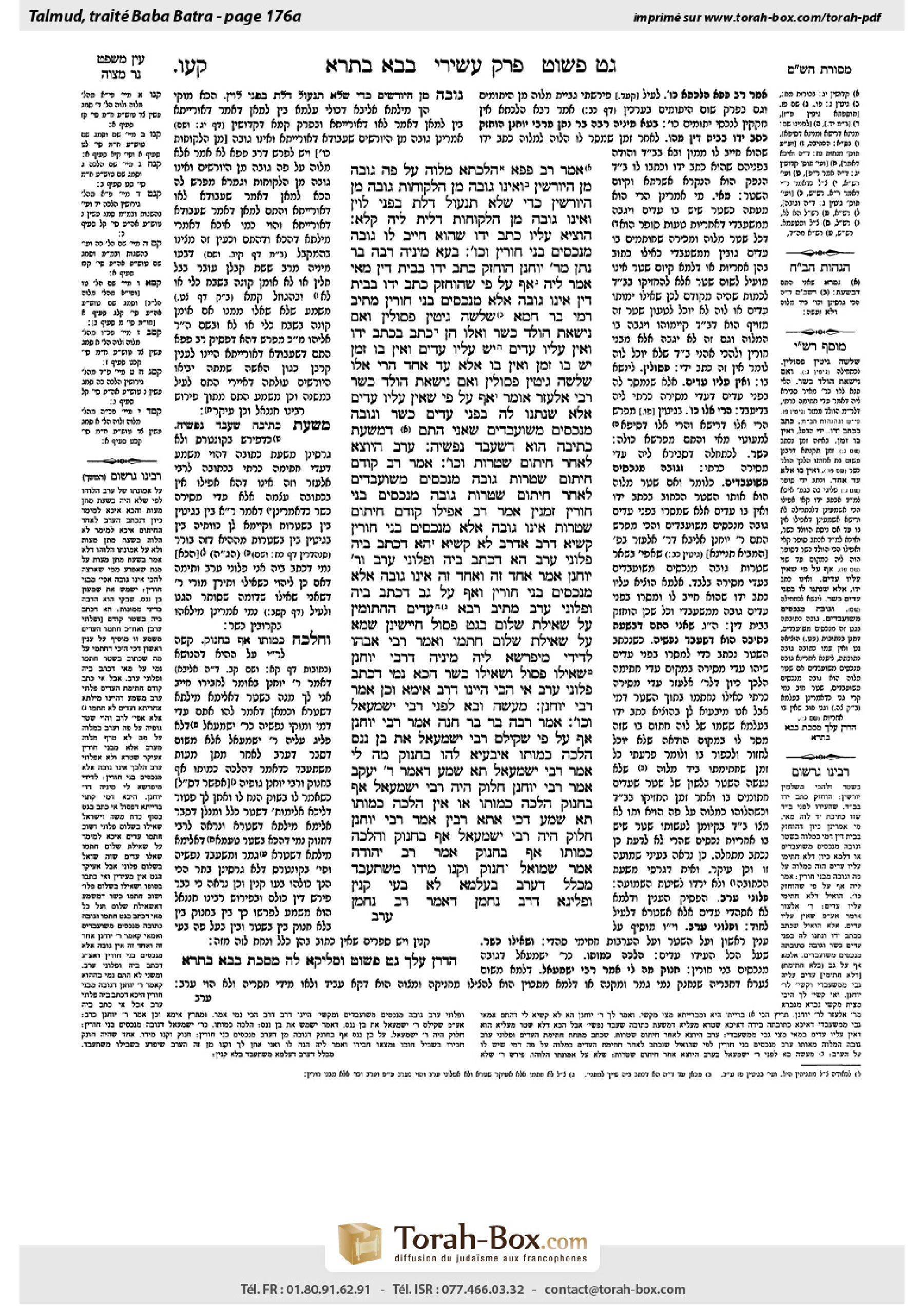
Bava Batra 176a: Talmud study for Daf Yomi
Study the Talmud for Daf Yomi with scanned pages, Hebrew text, English translations from Sefaria and AI-generated French translations.
Passage selection and English or AI-generated French translation are available where the scan has annotations. Daf Study is independent of Torah-Box and Sefaria.
Browse Bava Batra · בבא בתרא · All tractatesBava Batra 176a text and translations
This page of Bava Batra includes the Aramaic text, an English translation and an AI-generated French translation, alongside the scan above.
בבא בתרא קע״ו א · Aramaic and Hebrew text
אָמַר רַב פָּפָּא, הִלְכְתָא: מִלְוֶה עַל פֶּה – גּוֹבֶה מִן הַיּוֹרְשִׁין, וְאֵינוֹ גּוֹבֶה מִן הַלָּקוֹחוֹת. גּוֹבֶה מִן הַיּוֹרְשִׁין – כְּדֵי שֶׁלֹּא תִּנְעוֹל דֶּלֶת בִּפְנֵי לֹוִין, וְאֵינוֹ גּוֹבֶה מִן הַלָּקוֹחוֹת – דְּלֵית לֵיהּ קָלָא.
הוֹצִיא עָלָיו כְּתַב יָדוֹ שֶׁהוּא חַיָּיב לוֹ – גּוֹבֶה מִנְּכָסִים בְּנֵי חוֹרִין וְכוּ׳. בְּעָא מִינֵּיהּ רַבָּהּ בַּר נָתָן מֵרַבִּי יוֹחָנָן: הוּחְזַק כְּתַב יָדוֹ בְּבֵית דִּין, מַאי? אֲמַר לֵיהּ: אַף עַל פִּי שֶׁהוּחְזַק כְּתַב יָדוֹ בְּבֵית דִּין – אֵינוֹ גּוֹבֶה אֶלָּא מִנְּכָסִים בְּנֵי חוֹרִין.
מֵתִיב רָמֵי בַּר חָמָא: שְׁלֹשָׁה גִּיטִּין פְּסוּלִין, וְאִם נִישֵּׂאת – הַוָּלָד כָּשֵׁר. וְאֵלּוּ הֵן: כָּתַב בִּכְתַב יָדוֹ – וְאֵין עָלָיו עֵדִים; יֵשׁ עָלָיו עֵדִים – וְאֵין בּוֹ זְמַן; יֵשׁ בּוֹ זְמַן – וְאֵין בּוֹ אֶלָּא עֵד אֶחָד; הֲרֵי אֵלּוּ שְׁלֹשָׁה גִּיטִּין פְּסוּלִין, וְאִם נִישֵּׂאת – הַוָּלָד כָּשֵׁר.
רַבִּי אֶלְעָזָר אוֹמֵר: אַף עַל פִּי שֶׁאֵין עָלָיו עֵדִים, אֶלָּא שֶׁנְּתָנוֹ לָהּ בִּפְנֵי עֵדִים – כָּשֵׁר, וְגוֹבֶה מִנְּכָסִים מְשׁוּעְבָּדִים.
שָׁאנֵי הָתָם, דְּמִשְּׁעַת כְּתִיבָה הוּא דְּשַׁעְבַּד נַפְשֵׁיהּ.
עָרֵב הַיּוֹצֵא לְאַחַר חִיתּוּם שְׁטָרוֹת וְכוּ׳. אָמַר רַב: קוֹדֶם חִיתּוּם שְׁטָרוֹת – גּוֹבֶה מִנְּכָסִים מְשׁוּעְבָּדִים. לְאַחַר חִיתּוּם שְׁטָרוֹת – גּוֹבֶה מִנְּכָסִים בְּנֵי חוֹרִין.
זִמְנִין אָמַר רַב: אֲפִילּוּ קוֹדֶם חִיתּוּם שְׁטָרוֹת – אֵינוֹ גּוֹבֶה אֶלָּא מִנְּכָסִים בְּנֵי חוֹרִין.
קַשְׁיָא דְּרַב אַדְּרַב! לָא קַשְׁיָא; הָא דִּכְתִב בֵּיהּ ״פְּלוֹנִי עָרֵב״. הָא דִּכְתִב בֵּיהּ ״וּפְלוֹנִי עָרֵב״.
וְרַבִּי יוֹחָנָן אָמַר: אֶחָד זֶה וְאֶחָד זֶה – אֵינוֹ גּוֹבֶה אֶלָּא מִנְּכָסִים בְּנֵי חוֹרִין, וְאַף עַל גַּב דִּכְתִב בֵּיהּ ״וּפְלוֹנִי עָרֵב״.
מֵתִיב רָבָא: עֵדִים הַחֲתוּמִין עַל שְׁאֵילַת שָׁלוֹם בְּגֵט – פָּסוּל; חָיְישִׁינַן שֶׁמָּא עַל שְׁאֵילַת שָׁלוֹם חָתְמוּ.
וְאָמַר רַבִּי אֲבָהוּ, לְדִידִי מִיפָּרְשָׁא לֵיהּ מִינֵּיהּ דְּרַבִּי יוֹחָנָן: ״שְׁאִילוּ״ – פָּסוּל. ״וּשְׁאִילוּ״ – כָּשֵׁר!
הָכָא נָמֵי, דִּכְתִב ״פְּלוֹנִי עָרֵב״.
אִי הָכִי, הַיְינוּ דְּרַב! אֵימָא: וְכֵן אָמַר רַבִּי יוֹחָנָן.
מַעֲשֶׂה וּבָא לִפְנֵי רַבִּי יִשְׁמָעֵאל וְכוּ׳. אָמַר רַבָּה בַּר בַּר חָנָה אָמַר רַבִּי יוֹחָנָן: אַף עַל פִּי שֶׁקִּילֵּס רַבִּי יִשְׁמָעֵאל אֶת בֶּן נַנָּס, הֲלָכָה כְּמוֹתוֹ.
אִיבַּעְיָא לְהוּ: בְּחָנוּק – מָה לִי אָמַר רַבִּי יִשְׁמָעֵאל? תָּא שְׁמַע, דְּאָמַר רַבִּי יַעֲקֹב אָמַר רַבִּי יוֹחָנָן: חָלוּק הָיָה רַבִּי יִשְׁמָעֵאל אַף בְּחָנוּק.
הֲלָכָה כְּמוֹתוֹ, אוֹ אֵין הֲלָכָה כְּמוֹתוֹ? תָּא שְׁמַע, דְּכִי אֲתָא רָבִין אָמַר רַבִּי יוֹחָנָן: חָלוּק הָיָה רַבִּי יִשְׁמָעֵאל אַף בְּחָנוּק, וַהֲלָכָה כְּמוֹתוֹ אַף בְּחָנוּק.
אָמַר רַב יְהוּדָה אָמַר שְׁמוּאֵל: חָנוּק, וְקָנוּ מִיָּדוֹ – מִשְׁתַּעְבֵּד. מִכְּלַל דְּעָרֵב בְּעָלְמָא – לָא בָּעֵי קִנְיָן. וּפְלִיגָא דְּרַב נַחְמָן, דְּאָמַר רַב נַחְמָן:
Bava Batra 176a · English translation
Rav Pappa said: The halakha is that when a creditor gives a loan by oral contract, he can collect the debt from the heirs of the debtor after his death, but he cannot collect the debt from the purchasers of the debtor’s property. He can collect the debt from the heirs so as not to lock the door in the face of potential borrowers. But he cannot collect the debt from the purchasers, as a loan by oral contract has no publicity associated with it.
§ The mishna teaches: If one presents to a debtor a document in the handwriting of the debtor stating that he owes money to him, but without witnesses signed on the document, the creditor can collect only from unsold property. Rabba bar Natan asked Rabbi Yoḥanan: If the document in the handwriting of the debtor was ratified in court at a later time, what is the halakha? Would it then be possible to collect the debt from liened property that has been sold? Rabbi Yoḥanan said to him in reply: Even if the document in the handwriting of the debtor was ratified in court, the creditor can collect the debt only from unsold property.
Rami bar Ḥama raises an objection from a mishna (Gittin 86a), which states: There are three types of bills of divorce that are not valid ab initio, but if the woman marries another man on the basis of one of these bills of divorce the lineage of the offspring from this marriage is unflawed. In other words, she is not considered to be a married woman who engaged in sexual intercourse with another man, which would impair the lineage of their child. And they are these: A bill of divorce that the husband wrote in his handwriting but there are no signatures of witnesses in the document at all; a bill of divorce where there are the signatures of witnesses in the document but there is no date written in it; and a bill of divorce where there is a date written in it, but it contains only one witness. These are the three bills of divorce that are not valid with regard to which the Sages said: And if she marries, the lineage of the offspring is unflawed.
Rabbi Elazar says: Even though there are no signatures of witnesses in the document, but he handed it to her in the presence of two witnesses, it is a valid bill of divorce. And on the basis of this bill of divorce the woman can collect the amount written to her in her marriage contract even from liened property that has been sold. This indicates that even when no witnesses signed the document, the debt listed therein can be collected from liened property that has been sold, as long as witnesses saw the document being transferred to the creditor. All the more so a debt listed in a document in the handwriting of the debtor that has been ratified by a court should be eligible for collection from liened property that has been sold.
The Gemara answers: There it is different, as the husband obligated himself and his property immediately from the time of the writing of the document, as he knew at that time that the document would be transferred in the presence of witnesses. By contrast, in the case of the mishna here, the document in the handwriting of the debtor was written without the intent of ratifying it. It was only at a later date, as an afterthought, that it was ratified, and the terms of the obligation of the debt cannot be changed at that time.
§ The mishna teaches: In the case of a guarantor whose commitment emerged, i.e., was written, after the signing of the promissory note, the creditor can collect the debt only from unsold property of the guarantor. Rav says: If the guarantor’s commitment is written before the signing of the document, the creditor can collect the debt from the guarantor from liened property that has been sold; if it is written after the signing of the document, the creditor can collect the debt only from unsold property.
At other times, Rav said: Even if the guarantee is written before the signing of the document, the creditor can collect the debt only from unsold property.
The Gemara asks: There is a difficulty resulting from the contradiction between one statement of Rav to the other statement of Rav, as they seem to contradict one another with regard to a guarantee that is written before the signing of the document. The Gemara answers: This is not difficult. This case, where Rav says the creditor can collect the debt only from unsold property, is where it was written in the document as follows: So-and-so is a guarantor, as this formulation is an independent statement, and the witnesses signing the document do not necessarily relate to that statement. And that case, where Rav says the creditor can collect the debt from liened property that has been sold, is where it was written in the document as follows: And so-and-so is a guarantor. The usage of the conjunctive: And, causes this clause to be an integral part of the document, so that the signatures of the witnesses relate to it as well.
And Rabbi Yoḥanan says: In both this case and that case, the creditor can collect the debt only from unsold property. The Gemara comments: And according to the opinion of Rabbi Yoḥanan, this is the halakha even if it is written in the document: And so-and-so is a guarantor.
Rava raises an objection from a baraita (Tosefta, Gittin 9:9): In a case where witnesses are signed on a greeting written in a bill of divorce, the bill of divorce is not valid, as we are concerned that perhaps the witnesses signed on the greeting alone, i.e., they did not intend to testify to the divorce, but only to verify that the greeting was written.
And Rabbi Abbahu said concerning this baraita: It was explained to me personally by Rabbi Yoḥanan himself that it is only when the wording of the greeting begins: Send a greeting to so-and-so, that the bill of divorce is not valid, as this is an independent statement and it is possible that the signatures relate to it alone. But if the wording is: And send a greeting to so-and-so, the usage of the conjunctive: And, causes this clause to be an integral part of the document, and the bill of divorce is valid. This indicates that Rabbi Yoḥanan himself maintains that when the conjunction is used the signatures relate to the entire document.
The Gemara answers: Here too, when did Rabbi Yoḥanan say that the creditor can collect the debt only from the guarantor’s unsold property? Where it was written: So-and-so is a guarantor. If the conjunction is used, he can collect the debt even from liened property that has been sold.
The Gemara objects: But if so, this is identical to the opinion of Rav, whereas Rabbi Yoḥanan was presented as disagreeing with Rav. The Gemara answers: That presentation was inaccurate. Say instead: And so Rabbi Yoḥanan says as Rav did.
§ The mishna relates: An incident occurred where such a case came before Rabbi Yishmael, and he said: The creditor can collect the debt from unsold property of the guarantor, but not from liened property that the guarantor has sold to others. Ben Nannas said to Rabbi Yishmael: The creditor cannot collect the debt from the guarantor at all, not from liened property that has been sold, nor from unsold property. Rabba bar bar Ḥana says that Rabbi Yoḥanan says: Although Rabbi Yishmael praised Ben Nannas after hearing his dissenting opinion (see 175b), the halakha is actually in accordance with Rabbi Yishmael’s opinion as he stated it initially, i.e., that in the case of a guarantee that is written after the signatures, the creditor can collect the debt only from unsold property of the guarantor, but not from liened property that has been sold.
A dilemma was raised before the Sages: What would Rabbi Yishmael say to me about the case of the debtor who was being strangled, as depicted by ben Nannas? Perhaps he would agree in that case, since the guarantee was given under duress, that it is not valid. The Gemara suggests: Come and hear, as Rabbi Yaakov says that Rabbi Yoḥanan says: Rabbi Yishmael disagreed with ben Nannas also in the case of the debtor being strangled.
The Gemara asks: And is the halakha in accordance with Rabbi Yishmael’s opinion even in the case of the debtor being strangled, or is the halakha not in accordance with his opinion in that case? Come and hear, as when Ravin came he said that Rabbi Yoḥanan says: Rabbi Yishmael disagreed with ben Nannas also in the case of the debtor being strangled, and the halakha is in accordance with Rabbi Yishmael’s opinion also in the case of the debtor being strangled.
Rav Yehuda says that Shmuel says: If the debtor was being strangled, and in addition an act of acquisition was performed with the guarantor, the guarantor becomes obligated to repay the debt. The Gemara deduces: By inference it emerges that a guarantor generally does not require an act of acquisition to become obligated to pay. And this disagrees with a statement of Rav Naḥman, as Rav Naḥman says:
Bava Batra 176a · Traduction française (IA)
Rav Pappa a dit : La halakha est que lorsqu'un créancier prête de l'argent par un contrat oral, il peut récupérer la dette auprès des héritiers du débiteur après sa mort, mais il ne peut pas la récupérer auprès des acheteurs des biens du débiteur. Il peut récupérer la dette auprès des héritiers afin de ne pas bloquer la porte aux emprunteurs potentiels. Mais il ne peut pas récupérer la dette auprès des acheteurs, car un prêt par contrat oral n'a pas de publicité associée.
§ La mitsva enseigne : Si l'on présente à un débiteur un document rédigé à la main du débiteur indiquant qu'il doit de l'argent à l'individu, mais sans témoins signant ce document, le créancier peut récupérer la dette uniquement des biens non vendus. Rabba bar Natan a demandé à Rabbi Yoḥanan : Si le document rédigé à la main du débiteur a été validé en cour plus tard, quelle est la halakha ? Est-il alors possible de récupérer la dette auprès des biens hypothéqués non vendus ? Rabbi Yoḥanan a répondu à ce propos : Même si le document rédigé à la main du débiteur a été validé en cour, le créancier peut récupérer la dette uniquement des biens non vendus.
Rami bar Ḥama émet un objection à partir d'une mitsva (Gittin 86a), qui stipule : Il existe trois types de lettres de divorce qui ne sont pas valides dès leur émission, mais si la femme épouse un autre homme sur la base d'une de ces lettres de divorce, la lignée des enfants de ce mariage est intacte. En d'autres termes, elle n'est pas considérée comme une femme mariée ayant eu des relations sexuelles avec un autre homme, ce qui altérerait la lignée de leurs enfants. Et ces trois lettres de divorce sont : une lettre de divorce rédigée à la main du mari sans aucune signature de témoins dans le document ; une lettre de divorce où les signatures des témoins sont présentes dans le document mais sans date écrite ; et une lettre de divorce où une date est écrite, mais qui contient uniquement un témoin. Ces trois lettres de divorce ne sont pas valides, et les Sages ont dit : Et si elle se marie, la lignée des enfants est intacte.
Rabbi Elazar dit : Même s'il n'y a pas de signatures de témoins dans le document, mais qu'il l'a remis à elle en présence de deux témoins, c'est une lettre de divorce valide. Et sur la base de cette lettre de divorce, la femme peut récupérer la somme écrite dans son contrat de mariage même auprès des biens hypothéqués vendus. Cela indique que même lorsqu'aucun témoin n'a signé le document, la dette mentionnée dans ce document peut être récupérée auprès des biens hypothéqués vendus, à condition que des témoins aient vu le document être transmis au créancier. De même, une dette mentionnée dans un document rédigé à la main du débiteur et validé par un tribunal devrait être éligible à la récupération auprès des biens hypothéqués vendus.
La Guemara répond : C'est différent là-bas, car le mari s'est engagé lui-même et ses biens immédiatement à partir du moment où le document a été rédigé, car il savait à ce moment-là que le document serait transmis en présence de témoins. À l'inverse, dans le cas de la mitsva ici, le document rédigé à la main du débiteur a été rédigé sans l'intention de le valider. Il a été validé plus tard, comme une pensée secondaire, et les termes de l'obligation de la dette ne peuvent pas être modifiés à ce moment-là.
§ La mitsva enseigne : Dans le cas d'un garant dont l'engagement s'est produit, c'est-à-dire a été rédigé, après la signature du document, le créancier peut récupérer la dette uniquement des biens non vendus du garant. Rav dit : Si l'engagement du garant est rédigé avant la signature du document, le créancier peut récupérer la dette auprès du garant des biens hypothéqués non vendus ; si l'engagement est rédigé après la signature du document, le créancier peut récupérer la dette uniquement des biens non vendus.
D'autres fois, Rav a dit : Même si l'engagement est rédigé avant la signature du document, le créancier peut récupérer la dette uniquement des biens non vendus.
La Guemara pose une question : Il y a une difficulté résultant de la contradiction entre l'une des déclarations de Rav et l'autre déclaration de Rav, car elles semblent s'opposer l'une à l'autre concernant un engagement rédigé avant la signature du document. La Guemara répond : Ce n'est pas difficile. Ce cas, où Rav dit que le créancier peut récupérer la dette uniquement des biens non vendus, est celui où le document indique : tel est un garant, car cette formulation est une déclaration indépendante, et les témoins signant le document n'ont pas nécessairement à faire avec cette déclaration. Et ce cas, où Rav dit que le créancier peut récupérer la dette auprès des biens hypothéqués vendus, est celui où le document indique : et tel est un garant. L'usage du conjonctif « et » rend cette clause partie intégrante du document, de sorte que les signatures des témoins s'appliquent également à cette clause.
Et Rabbi Yoḥanan dit : Dans les deux cas, le créancier peut récupérer la dette uniquement des biens non vendus. La Guemara commente : Et selon l'opinion de Rabbi Yoḥanan, c'est la halakha même si le document indique : et tel est un garant.
Rava émet une objection à partir d'une baraïta (Tosefta, Gittin 9:9) : Dans le cas où des témoins ont signé un salut rédigé dans une lettre de divorce, la lettre de divorce n'est pas valide, car nous craignons que les témoins aient signé uniquement le salut, c'est-à-dire qu'ils n'ont pas l'intention de témoigner sur le divorce, mais seulement de vérifier que le salut avait été rédigé.
Et Rabbi Abbahu a dit concernant cette baraïta : On me l'a expliqué personnellement par Rabbi Yoḥanan lui-même, disant qu'il n'est valide que lorsque le début du salut commence par : Envoie un salut à tel et tel, que le document de divorce n'est pas valide, car c'est une déclaration indépendante et il est possible que les signatures concernent uniquement cela. Mais si le texte est : Et envoie un salut à tel et tel, l'usage de la conjonction : Et, rend cette clause partie intégrante du document, et le document de divorce est valide. Cela montre que Rabbi Yoḥanan lui-même maintient que lorsqu'on utilise la conjonction, les signatures concernent l'ensemble du document.
La Guemara répond : C'est pareil ici, quand Rabbi Yoḥanan a-t-il dit que le créancier ne peut récupérer la dette que du bien non vendu du garant ? Lorsqu'il est écrit : Tel et tel est un garant. Si la conjonction est utilisée, il peut récupérer la dette même du bien hypothéqué qui a été vendu.
La Guemara s'oppose : Mais si c'est ainsi, cela est identique à l'opinion de Rav, alors que Rabbi Yoḥanan était présenté comme le désaccordant avec Rav. La Guemara répond : Cette présentation était inexacte. Dis plutôt : Et ainsi Rabbi Yoḥanan dit comme Rav l'a fait.
§ La Michna relate : Un cas s'est produit où un tel cas est venu devant Rabbi Yishmael, et il a dit : Le créancier peut récupérer la dette du bien non vendu du garant, mais pas du bien hypothéqué que le garant a vendu à d'autres. Ben Nannas a dit à Rabbi Yishmael : Le créancier ne peut récupérer la dette du garant du tout, ni du bien hypothéqué qui a été vendu, ni du bien non vendu. Rabba bar bar Ḥana dit que Rabbi Yoḥanan dit : Bien que Rabbi Yishmael ait loué Ben Nannas après avoir entendu son opinion divergente (voir 175b), la halakha est en réalité selon l'opinion de Rabbi Yishmael telle qu'il l'a exprimée initialement, c'est-à-dire que dans le cas d'une garantie écrite après les signatures, le créancier peut récupérer la dette uniquement du bien non vendu du garant, mais pas du bien hypothéqué qui a été vendu.
Un dilemme a été soulevé devant les Sages : Que dirait Rabbi Yishmael à mon sujet concernant le cas du débiteur qui était étouffé, comme décrit par Ben Nannas ? Peut-être qu'il serait d'accord dans ce cas-là, puisque la garantie a été donnée sous la contrainte, qu'elle n'est pas valide. La Guemara suggère : Viens écouter, car Rabbi Yaakov dit que Rabbi Yoḥanan dit : Rabbi Yishmael a désaccordé Ben Nannas également dans le cas du débiteur étouffé.
La Guemara demande : Et la halakha est-elle selon l'opinion de Rabbi Yishmael même dans le cas du débiteur étouffé, ou la halakha n'est-elle pas selon son opinion dans ce cas-là ? Viens écouter, car lorsque Rabin est venu, il a dit que Rabbi Yoḥanan dit : Rabbi Yishmael a désaccordé Ben Nannas également dans le cas du débiteur étouffé, et la halakha est selon l'opinion de Rabbi Yishmael également dans le cas du débiteur étouffé.
Rav Yehuda dit que Shmuel dit : Si le débiteur était étouffé, et en plus un acte d'acquisition a été effectué avec le garant, le garant devient obligé de rembourser la dette. La Guemara déduit : Par l'inférence, il ressort que le garant ne nécessite généralement pas d'acte d'acquisition pour devenir obligé de payer. Et cela contredit une déclaration de Rav Naḥman, car Rav Naḥman dit :
Traduction française générée par IA à partir de l’édition anglaise de Sefaria. Vérifie toujours un passage avec le texte source.
Text from Sefaria: William Davidson Edition - Vocalized Aramaic (CC BY NC); William Davidson Edition - English (CC BY NC).