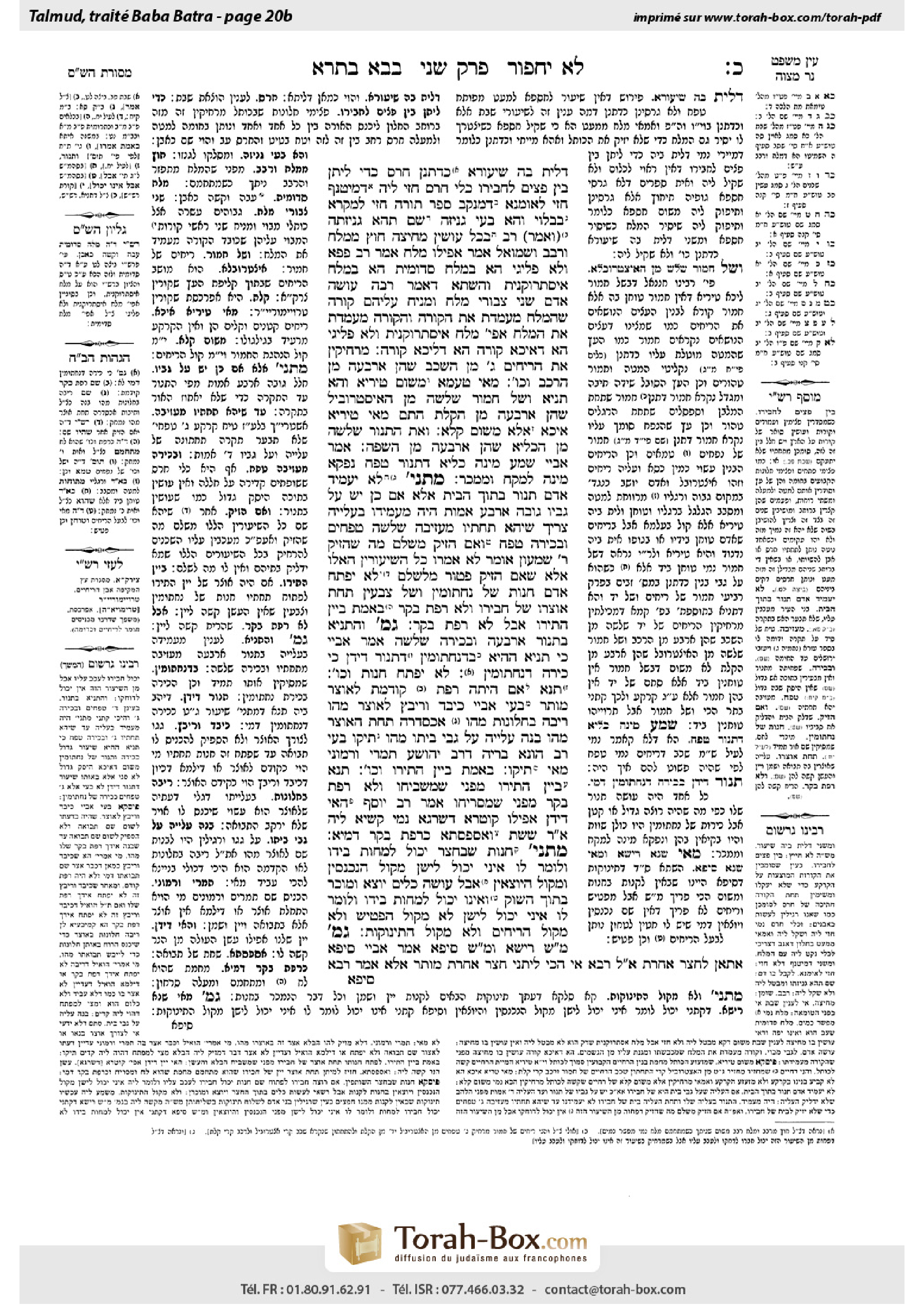
Bava Batra 20b: Talmud study for Daf Yomi
Study the Talmud for Daf Yomi with scanned pages, Hebrew text, English translations from Sefaria and AI-generated French translations.
Passage selection and English or AI-generated French translation are available where the scan has annotations. Daf Study is independent of Torah-Box and Sefaria.
Browse Bava Batra · בבא בתרא · All tractatesBava Batra 20b text and translations
This page of Bava Batra includes the Aramaic text, an English translation and an AI-generated French translation, alongside the scan above.
בבא בתרא כ׳ ב · Aramaic and Hebrew text
דְּלֵית בַּהּ שִׁיעוּרָא; כְּדִתְנַן: חֶרֶס – כְּדֵי לִיתֵּן בֵּין פַּצִּים לַחֲבֵירוֹ.
כְּלִי חֶרֶס – חֲזֵי לֵיהּ! דְּמִיטַּנַּף. חֲזֵי לְאוּמָּנָא! דִּמְנַקַּב.
סֵפֶר תּוֹרָה – חֲזֵי לְמִקְרָא! בְּבָלוּי. וְהָא בָּעֵי גְּנִיזָה! שָׁם תְּהֵא גְּנִיזָתָהּ.
וְאָמַר רַב: בַּכֹּל עוֹשִׂין מְחִיצָה, חוּץ מִמֶּלַח וּרְבָב. וּשְׁמוּאֵל אָמַר: אֲפִילּוּ מֶלַח. אָמַר רַב פָּפָּא: וְלָא פְּלִיגִי – הָא בְּמֶלַח סְדוֹמִית, הָא בְּמֶלַח אִיסְתְּרוֹקָנִית.
וְהַשְׁתָּא דְּאָמַר רַבָּה: עוֹשֶׂה אָדָם שְׁנֵי צִבּוּרֵי מֶלַח וּמַנִּיחַ עֲלֵיהֶם קוֹרָה, שֶׁהַמֶּלַח מַעֲמֶדֶת אֶת הַקּוֹרָה וְהַקּוֹרָה מַעֲמֶדֶת אֶת הַמֶּלַח; אֲפִילּוּ מֶלַח אִיסְתְּרוֹקָנִית – וְלָא פְּלִיגִי: הָא דְּאִיכָּא קוֹרָה, הָא דְּלֵיכָּא קוֹרָה.
מַרְחִיקִין אֶת הָרֵיחַיִם שְׁלֹשָׁה מִן הַשֶּׁכֶב, שֶׁהֵן אַרְבָּעָה מִן הָרֶכֶב וְכוּ׳. מַאי טַעְמָא? מִשּׁוּם טִירְיָא. וְהָא תַּנְיָא: וְשֶׁל חֲמוֹר – שְׁלֹשָׁה מִן הָאִיסְטְרוֹבֵיל שֶׁהֵן אַרְבָּעָה מִן הַקֶּלֶת; הָתָם מַאי טִירְיָא אִיכָּא? אֶלָּא מִשּׁוּם קָלָא.
וְאֶת הַתַּנּוּר – שְׁלֹשָׁה מִן הַכִּלְיָא, שֶׁהֵן אַרְבָּעָה מִן הַשָּׂפָה. אָמַר אַבָּיֵי: שְׁמַע מִינַּהּ, כִּלְיָא דְּתַנּוּר טֶפַח; נָפְקָא מִינַּהּ לְמִקָּח וּמִמְכָּר.
מַתְנִי׳ לֹא יַעֲמִיד אָדָם תַּנּוּר בְּתוֹךְ הַבַּיִת, אֶלָּא אִם כֵּן יֵשׁ עַל גַּבָּיו גּוֹבַהּ אַרְבַּע אַמּוֹת. הָיָה מַעֲמִידוֹ בַּעֲלִיָּיה – צָרִיךְ שֶׁיְּהֵא תַּחְתָּיו מַעֲזִיבָה שְׁלֹשָׁה טְפָחִים. וּבַכִּירָה – טֶפַח.
וְאִם הִזִּיק – מְשַׁלֵּם מַה שֶּׁהִזִּיק. רַבִּי שִׁמְעוֹן אוֹמֵר: לֹא אָמְרוּ כׇּל הַשִּׁיעוּרִין הָאֵלּוּ, אֶלָּא שֶׁאִם הִזִּיק – פָּטוּר מִלְּשַׁלֵּם.
לֹא יִפְתַּח אָדָם חֲנוּת שֶׁל נַחְתּוֹמִין וְשֶׁל צַבָּעִין תַּחַת אוֹצָרוֹ שֶׁל חֲבֵירוֹ, וְלֹא רֶפֶת בָּקָר. בֶּאֱמֶת בַּיַּיִן הִתִּירוּ, אֲבָל לֹא רֶפֶת בָּקָר.
גְּמָ׳ וְהָתַנְיָא: בַּתַּנּוּר אַרְבָּעָה, וּבַכִּירָה שְׁלֹשָׁה! אֲמַר אַבָּיֵי: כִּי תַּנְיָא הָהִיא – בִּדְנַחְתּוֹמִין, דְּתַנּוּר דִּידַן כִּי כִּירָה דְנַחְתּוֹמִין.
לֹא יִפְתַּח חֲנוּת וְכוּ׳. תָּנָא: אִם הָיְתָה רֶפֶת קוֹדֶמֶת לָאוֹצָר – מוּתָּר. בָּעֵי אַבָּיֵי: כִּיבֵּד וְרִיבֵּץ לְאוֹצָר, מַהוּ?
רִיבָּה בַּחַלּוֹנוֹת, מַהוּ? אַכְסַדְרָה תַּחַת הָאוֹצָר, מַהוּ? בָּנָה עֲלִיָּיה עַל גַּבֵּי בֵּיתוֹ, מַהוּ? תֵּיקוּ. בָּעֵי רַב הוּנָא בְּרֵיהּ דְּרַב יְהוֹשֻׁעַ: תַּמְרֵי וְרִמּוֹנֵי, מַאי? תֵּיקוּ.
בֶּאֱמֶת בְּיַיִן הִתִּירוּ וְכוּ׳. תָּנָא: בְּיַיִן הִתִּירוּ – מִפְּנֵי שֶׁמַּשְׁבִּיחוֹ, וְלֹא רֶפֶת בָּקָר – מִפְּנֵי שֶׁמַּסְרִיחוֹ. אָמַר רַב יוֹסֵף: הַאי דִּידַן, אֲפִילּוּ קוּטְרָא דִּשְׁרָגָא נָמֵי קַשְׁיָא לֵיהּ. אָמַר רַב שֵׁשֶׁת: וְאַסְפַּסְתָּא כְּרֶפֶת בָּקָר דָּמְיָא.
מַתְנִי׳ חֲנוּת שֶׁבְּחָצֵר – יָכוֹל לִמְחוֹת בְּיָדוֹ וְלוֹמַר לוֹ: אֵינִי יָכוֹל לִישַׁן מִקּוֹל הַנִּכְנָסִין וּמִקּוֹל הַיּוֹצְאִין. אֲבָל עוֹשֶׂה כֵּלִים – יוֹצֵא וּמוֹכֵר בְּתוֹךְ הַשּׁוּק, וְאֵינוֹ יָכוֹל לִמְחוֹת בְּיָדוֹ וְלוֹמַר לוֹ: אֵינִי יָכוֹל לִישַׁן – לֹא מִקּוֹל הַפַּטִּישׁ, וְלֹא מִקּוֹל הָרֵיחַיִם, וְלֹא מִקּוֹל הַתִּינוֹקוֹת.
גְּמָ׳ מַאי שְׁנָא רֵישָׁא, וּמַאי שְׁנָא סֵיפָא? אָמַר אַבָּיֵי: סֵיפָא אֲתָאן לְחָצֵר אַחֶרֶת. אֲמַר לֵיהּ רָבָא: אִי הָכִי, לִיתְנֵי: חָצֵר אַחֶרֶת – מוּתָּר! אֶלָּא אָמַר רָבָא:
Bava Batra 20b · English translation
The Gemara answers: This is referring to a case where the shard does not have the sufficient measure for ritual impurity, and is therefore considered insignificant. As we learned in a mishna (Shabbat 82a): One who carries a shard of earthenware on Shabbat is liable only if it is equivalent in size to that which is used to place between one pillar and another when they are piled on the ground, to strengthen the pillars.
The baraita teaches: An earthenware vessel reduces the dimensions of a window. The Gemara challenges: But it is fit for one to use; therefore, it is likely to be removed from the window. The Gemara answers: This is referring to a case where the earthenware is dirty. The Gemara challenges: Even so, it is fit for a bloodletter to collect the blood. It would not matter to him if the earthenware were dirty. The Gemara answers: It is referring to a case where it is perforated and therefore unfit for that use.
The baraita teaches: A Torah scroll reduces the dimensions of a window. The Gemara challenges: But it is fit for reading; therefore, it might be removed. The Gemara answers: This is referring to a Torah scroll that is worn out and unfit for reading. The Gemara challenges: But one is required to place the Torah scroll in a repository for unusable sacred books; therefore, he will certainly remove it to be stored away. The Gemara answers: This is referring to one who determines that its repository will be there. In other words, it was placed in the window with the intent of storing it there in its worn-out state.
§ With regard to the halakha of the baraita referring to salt, the Gemara cites that which Rav says: One can construct a barrier to delineate a private domain on Shabbat or to block the spreading of ritual impurity with anything except for salt and fat, as salt crumbles and fat melts in the heat. And Shmuel says: Even salt can be used as a barrier. Rav Pappa said: And they do not disagree, as this ruling of Shmuel is referring to Sodomite salt, which is like stone and can be used as a barrier, and that ruling of Rav is referring to isterokanit salt, which is taken from the sea and is composed of grains.
The Gemara adds: And now that Rabba said: If a person makes two piles of salt at the opening to an alleyway and places a cross beam on top of them, so that the salt supports the cross beam and the cross beam supports the salt by weighing it down and compressing it, he can use this beam to render it permitted to carry in the alleyway on Shabbat, one can say that even isterokanit salt can be used as a barrier. And even so, Rav and Shmuel do not disagree: This ruling of Shmuel is referring to a case where there is a cross beam to weigh the salt down, and that ruling of Rava is referring to a case where there is no cross beam.
§ The mishna teaches that one must distance a mill from a neighbor’s wall by a distance of three handbreadths from the lower stone of the mill, which is four handbreadths from the upper stone of the mill. The Gemara asks: What is the reason that one must distance a mill from the property of his neighbor? It is due to the vibrations it causes. The Gemara asks: But isn’t it taught in a baraita: And the measure for distancing a mill on a base is three handbreadths from the lower millstone [ha’isterobil], which is four handbreadths from the mouth [hakelet], where the wheat is fed in? But there, what vibrations are there? Rather, the reason for the distancing is due to the noise generated by the mill.
The mishna teaches: And there must be a distance of three handbreadths from the protruding base of an oven until the wall, which is four handbreadths from the narrow upper rim of the oven. Abaye said: Learn from the mishna that the base of an oven is a handbreadth wider than its rim. The practical difference of this observation is with respect to buying and selling, i.e., a buyer should know that this is the proper ratio for the dimensions of an oven.
MISHNA: A person may not set up an oven inside a house unless there is a space four cubits high above it, i.e., between the top of the oven and the ceiling, to avoid burning the ceiling, which serves as the floor of the residence above. If one was setting up an oven in the upper story, there must be a plaster floor beneath it, which serves as the ceiling of the lower story, at least three handbreadths thick, so that the ceiling below does not burn. And in the case of a stove the plaster floor must be at least one handbreadth thick.
And if he causes damage in any case, he pays compensation for that which he damaged. Rabbi Shimon says: They said all of these measurements to teach only that if he causes damage he is exempt from paying, as he took all reasonable precautions.
The mishna continues: A person may not open a bakery or a dye shop beneath the storeroom of another, and he may not establish a cattle barn there, as these produce heat, smoke, and odors, which rise and damage the items in the storeroom. The mishna comments: In truth, the halakha is that in the case of a storeroom of wine the Sages rendered it permitted to set up a bakery and a dye shop beneath, as the heat that rises does not damage the wine. But they did not render it permitted to establish a cattle barn, because its odor damages the wine.
GEMARA: The Gemara asks: But isn’t it taught in a baraita that in the case of an oven the plaster floor must be four handbreadths thick, and with regard to a stove it must be three? By contrast, the mishna says that the plaster floor beneath and oven and a stove must be three handbreadths and one handbreadth thick, respectively. Abaye said: When that baraita is taught it is with regard to ovens and stoves of bakers. Since they bake all day long, their implements get very hot. The oven discussed in our mishna is similar to a baker’s stove, which is why in both cases a distance of three handbreadths is required.
The mishna teaches that one may not open a bakery or a dye shop beneath the storeroom of another, and he may not establish a cattle barn there. A Sage taught: If the cattle barn preceded the storeroom it is permitted, i.e., the barn owner is not required to move it. With regard to this point, Abaye raises a dilemma: If he cleaned and sprinkled the area, i.e., he prepared it for use as a storeroom but he has not yet filled it, what is the halakha? Is it considered a storeroom already, and therefore others may no longer put a cattle barn beneath it, or perhaps the halakha is that as long as it is empty he cannot prevent others from establishing a cattle barn?
Similarly, if he added windows for ventilation, which demonstrates his intention to use it as a storeroom, what is the halakha? Likewise, if he establishes an enclosed veranda beneath the storeroom, what is the halakha? If he built an upper room on top of his house for storage, what is the halakha? None of these questions are answered, and the Gemara declares that they shall stand unresolved. The Gemara cites a similar question: Rav Huna, son of Rav Yehoshua, raises a dilemma: If he placed dates and pomegranates there, what is the halakha? Is this considered the start of its use as a storeroom or not? No answer was found to this question either, and the Gemara declares: The dilemma shall stand [teiku] unresolved.
§ The mishna teaches that in truth, it is permitted in the case of wine but not in the case of a cattle barn. The Gemara states that a Sage taught: They permitted it in the case of wine because the heat and the smoke improve the wine. But they did not permit one to establish a cattle barn, because a barn creates a bad odor. Rav Yosef said: This wine of ours spoils quickly, and therefore even the smoke of a candle also damages it. Rav Sheshet said: And alfalfa [ve’aspasta] is considered like a cattle barn in this regard, because it rots over time and creates a foul odor.
MISHNA: If a resident wants to open a store in his courtyard, his neighbor can protest to prevent him from doing so and say to him: I am unable to sleep due to the sound of people entering the store and the sound of people exiting. But one may fashion utensils in his house and go out and sell them in the market, despite the fact that he is not allowed to set up a store in the courtyard, and the neighbor cannot protest against him doing so and say to him: I am unable to sleep due to the sound of the hammer you use to fashion utensils, nor can he say: I cannot sleep due to the sound of the mill that you use to grind, nor can he say: I cannot sleep due to the sound of the children. It is permitted for one to make reasonable use of his own home.
GEMARA: The Gemara asks: What is different in the first clause of the mishna, which states that one can prevent his neighbor from opening a store in the courtyard because the noise keeps him awake, and what is different in the latter clause, which states that one cannot protest when his neighbor performs labor that is noisy? Abaye said: In the latter clause we arrive at the case of one who operates in another courtyard, i.e., one cannot prevent activity in a separate courtyard that is connected to the alleyway in which he lives. Rava said to him: If so, let it teach that in a different courtyard it is permitted. Why does the mishna not specify that it is referring to a different courtyard? Rather, Rava said:
Bava Batra 20b · Traduction française (IA)
La Guemara répond : Il s'agit d'un cas où la pièce ne possède pas la mesure suffisante pour l'impureté rituelle et est donc considérée comme insignifiante. Comme nous l'avons appris dans une mitsva (Shabbat 82a) : Celui qui transporte une pièce de terre sur le Shabbat est puni uniquement si elle est équivalente en taille à celle utilisée pour placer entre un pilier et un autre lorsqu'ils sont empilés au sol, afin de renforcer les piliers.
La baraïta enseigne : Un récipient en terre réduit les dimensions d'une fenêtre. La Guemara conteste : Mais il est utilisable ; donc, il est probable qu'on le retire de la fenêtre. La Guemara répond : Il s'agit d'un cas où la terre est sale. La Guemara conteste : Même ainsi, il est utilisable par un ciseleur pour recueillir le sang. Il n'aurait pas de problème s'il était sale. La Guemara répond : Il s'agit d'un cas où il est percé et donc inutilisable à cette fin.
La baraïta enseigne : Un rouleau de Torah réduit les dimensions d'une fenêtre. La Guemara conteste : Mais il est utilisable pour la lecture ; donc, il pourrait être retiré. La Guemara répond : Il s'agit d'un rouleau de Torah usé et inutilisable. La Guemara conteste : Mais on est tenu de placer le rouleau de Torah dans un réduit pour livres sacrés inutilisables ; donc, on le retirera certainement pour le stocker. La Guemara répond : Il s'agit d'une personne qui décide que son réduit sera là. En d'autres termes, il a été placé dans la fenêtre avec l'intention de le stocker là dans son état usé.
§ En ce qui concerne la halakha de la baraïta concernant le sel, la Guemara cite ce que dit Rav : On peut construire un obstacle pour délimiter un domaine privé le Shabbat ou pour bloquer la propagation de l'impureté rituelle avec n'importe quoi sauf le sel et la graisse, car le sel s'effrite et la graisse fond dans la chaleur. Et Shmuel dit : Même le sel peut être utilisé comme obstacle. Rav Pappa dit : Et ils ne s'entendent pas, car cette décision de Shmuel concerne le sel de Sodome, qui est comme la pierre et peut être utilisé comme obstacle, et celle de Rav concerne le sel d'istérokane, qui provient de la mer et est composé de grains.
La Guemara ajoute : Et maintenant que Rabba a dit : Si une personne fait deux tas de sel à l'entrée d'un passage et place une poutre au-dessus d'eux, de sorte que le sel soutienne la poutre et la poutre soutienne le sel en le pesant et en le comprimant, il peut utiliser cette poutre pour rendre permis de porter dans le passage le Shabbat, on peut dire que même le sel d'istérokane peut être utilisé comme obstacle. Et même ainsi, Rav et Shmuel ne s'entendent pas : Cette décision de Shmuel concerne un cas où il y a une poutre pour peser le sel, et celle de Rava concerne un cas où il n'y a pas de poutre.
§ La mitsva enseigne que l'on doit distancer une meule d'un mur de voisin par une distance de trois tefachim du bas de la meule, qui est quatre tefachim du haut de la meule. La Guemara demande : Quelle est la raison d'avoir à distancer une meule du domaine du voisin ? C'est à cause des vibrations qu'elle génère. La Guemara demande : Mais n'est-il pas enseigné dans une baraïta : Et la mesure pour distancer une meule sur une base est de trois tefachim du bas de la meule [ha'isterobil], qui est quatre tefachim de la bouche [hakelet], où on alimente le blé ? Mais là, quels sont les vibrations ? Plutôt, la raison de la distance est due au bruit généré par la meule.
La mitsva enseigne : Il faut une distance de trois tefachim du bas de l'âtre jusqu'au mur, qui est quatre tefachim du bord étroit du haut de l'âtre. Abaye dit : Apprends de la mitsva que la base de l'âtre est plus large d'un tefach que son bord. La différence pratique de cette observation concerne l'achat et la vente, c'est-à-dire qu'un acheteur devrait savoir que c'est le rapport correct des dimensions d'un âtre.
MITSVA : On ne peut pas installer un âtre à l'intérieur d'une maison à moins qu'il y ait un espace de quatre coudées au-dessus de lui, c'est-à-dire entre le haut de l'âtre et le plafond, pour éviter de brûler le plafond, qui sert de sol à la résidence au-dessus. Si l'on installait un âtre au premier étage, il fallait un plancher en plâtre sous lui, qui sert de plafond au rez-de-chaussée, d'au moins trois tefachim d'épaisseur, afin que le plafond en dessous ne brûle pas. Et dans le cas d'une cuisinière, le plancher en plâtre devait être d'au moins un tefach d'épaisseur.
Et s'il cause un préjudice dans tout cas, il paie une compensation pour ce qu'il a endommagé. Rabbi Shimon dit : Ils ont dit toutes ces mesures pour enseigner seulement que s'il cause un préjudice, il est exempt de payer, car il a pris toutes les précautions raisonnables.
La mitsva continue : On ne peut pas ouvrir une boulangerie ou une teurie sous la cave d'un autre, et on ne peut pas établir un étable là, car ces activités produisent de la chaleur, de la fumée et des odeurs, qui montent et endommagent les objets de la cave. La mitsva commente : En vérité, la halakha est que dans le cas d'une cave à vin, les Sages ont rendu permis d'installer une boulangerie et une teurie dessous, car la chaleur qui monte ne nuit pas au vin. Mais ils n'ont pas rendu permis d'établir un étable, car son odeur nuit au vin.
GUEMARA : La Guemara demande : Mais n'est-il pas enseigné dans une baraïta que dans le cas d'un four, le plancher en plâtre doit être d'épaisseur de quatre tefachim, et concernant une cuisinière, de trois ? Par contraste, la mitsva dit que le plancher en plâtre sous un four et une cuisinière doit être d'épaisseur de trois tefachim et d'un tefach, respectivement. Abaye dit : Lorsque cette baraïta est enseignée, elle concerne les fours et cuisinières des boulangeries. Comme ils cuisent toute la journée, leurs ustensiles sont très chauds. L'âtre discuté dans notre mitsva est similaire à une cuisinière de boulanger, ce qui est pourquoi, dans les deux cas, une distance de trois tefachim est requise.
La Michna enseigne qu'on ne peut pas ouvrir une boulangerie ou une teurie sous la pièce de stockage d'un autre, et qu'on ne peut pas établir un écurie là. Un Sage a enseigné : Si l'écurie a été établie avant la pièce de stockage, elle est permise, c'est-à-dire que le propriétaire de l'écurie n'est pas tenu de la déplacer. En ce qui concerne ce point, Abaye soulève un dilemme : Si l'on a nettoyé et aspergé la zone, c'est-à-dire qu'on l'a préparée pour en faire une pièce de stockage mais qu'on n'a pas encore rempli, quelle est la halakha ? Est-ce qu'on considère déjà une pièce de stockage, et donc que les autres ne peuvent plus établir un écurie dessous, ou bien la halakha est-elle que tant que la pièce est vide, on ne peut pas empêcher les autres d'établir un écurie dessous ?
De même, si l'on a ajouté des fenêtres pour la ventilation, ce qui montre l'intention d'en faire une pièce de stockage, quelle est la halakha ? De même, si l'on établit une véranda fermée sous la pièce de stockage, quelle est la halakha ? Si l'on construit une pièce supérieure sur la maison pour le stockage, quelle est la halakha ? Aucune de ces questions n'est résolue, et la Guemara déclare qu'elles resteront sans réponse. La Guemara cite une question similaire : Rav Huna, fils de Rav Yéhoshua, soulève un dilemme : Si l'on a mis des dattes et des grenades là, quelle est la halakha ? Est-ce que cela constitue le début de l'utilisation de la pièce comme pièce de stockage ou non ? Aucune réponse à cette question n'a été trouvée non plus, et la Guemara déclare : Le dilemme restera sans réponse [teiku].
§ La Michna enseigne que, en réalité, il est permis dans le cas du vin mais pas dans le cas d'une écurie. La Guemara dit qu'un Sage a enseigné : Ils ont permis le cas du vin parce que la chaleur et la fumée améliorent le vin. Mais ils n'ont pas permis d'établir une écurie, car une écurie crée une odeur mauvaise. Rav Yosef a dit : Ce vin que nous avons est sujet à se gâter rapidement, et donc même la fumée d'une bougie peut le détruire. Rav Sheshét a dit : Et l'alfalfa [ve'aspasta] est considéré comme une écurie à cet égard, car il se pourrit avec le temps et crée une odeur nauséabonde.
MICHNA : Si un résident veut ouvrir un magasin dans son cour, son voisin peut protester pour l'en empêcher et lui dire : Je ne peux pas dormir à cause du bruit des gens entrant dans le magasin et du bruit des gens sortant. Mais on peut fabriquer des ustensiles dans sa maison et sortir pour les vendre sur le marché, malgré le fait qu'il ne soit pas autorisé à ouvrir un magasin dans le cour, et le voisin ne peut pas protester contre cela et lui dire : Je ne peux pas dormir à cause du bruit du marteau que tu utilises pour fabriquer des ustensiles, ni ne peut-il dire : Je ne peux pas dormir à cause du bruit de la meule que tu utilises pour moudre, ni ne peut-il dire : Je ne peux pas dormir à cause du bruit des enfants. Il est permis à une personne d'utiliser raisonnablement sa propre maison.
GUEMARA : La Guemara pose la question : Qu'est-ce qui diffère dans la première partie de la Michna, qui stipule qu'on peut empêcher son voisin d'ouvrir un magasin dans le cour à cause du bruit qui le maintient éveillé, et qu'est-ce qui diffère dans la seconde partie, qui stipule qu'on ne peut pas protester quand son voisin effectue un travail bruyant ? Abaye a dit : Dans la seconde partie, nous arrivons au cas d'une personne qui opère dans un autre cour, c'est-à-dire qu'on ne peut pas empêcher une activité dans un cour différent qui est connecté au passage où il vit. Rava a dit à lui : Si c'est ainsi, qu'on enseigne que dans un cour différent, c'est permis. Pourquoi la Michna ne précise-t-elle pas qu'elle parle d'un cour différent ? Plutôt, Rava a dit :
Traduction française générée par IA à partir de l’édition anglaise de Sefaria. Vérifie toujours un passage avec le texte source.
Text from Sefaria: William Davidson Edition - Vocalized Aramaic (CC BY NC); William Davidson Edition - English (CC BY NC).