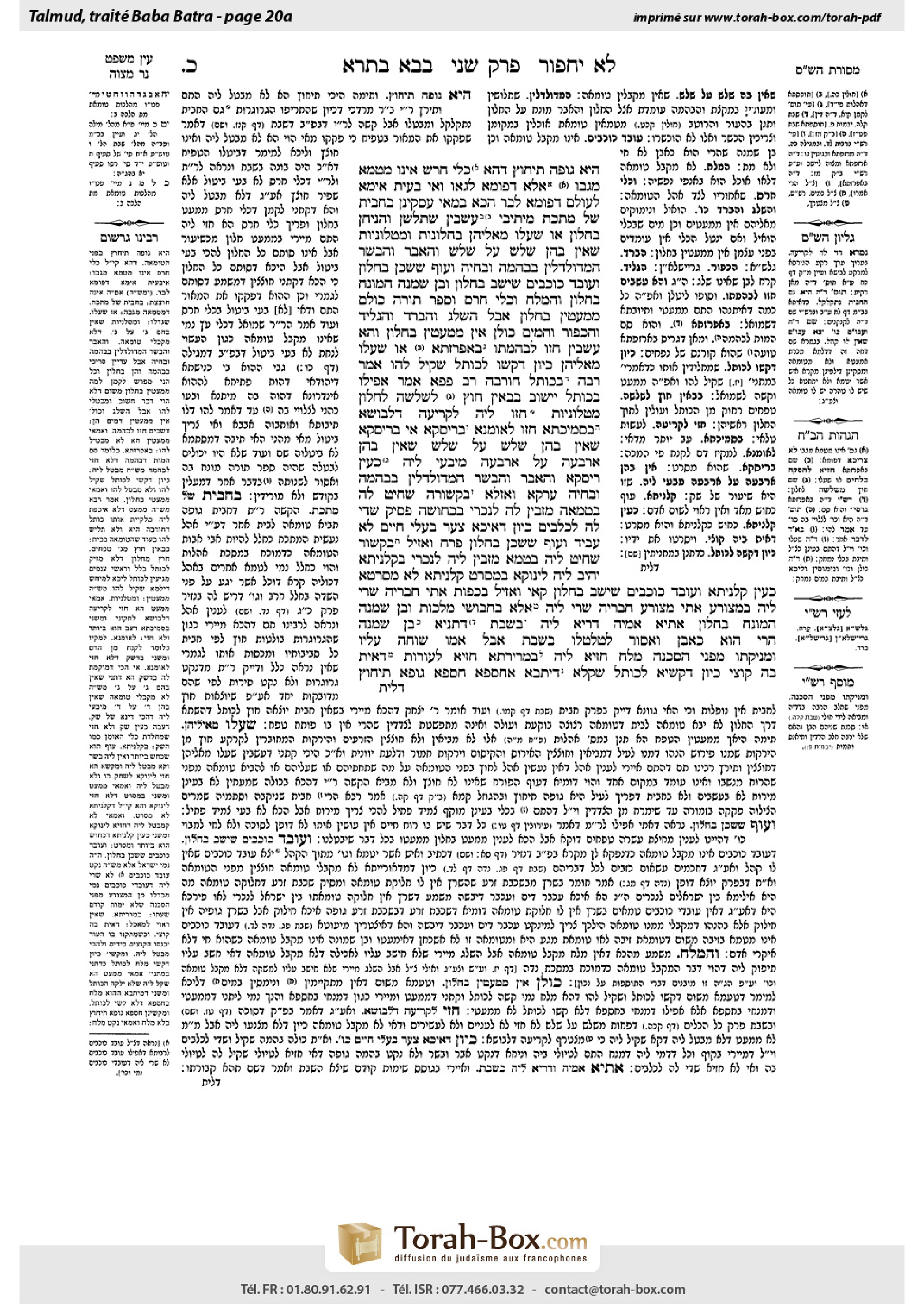
Bava Batra 20a: Talmud study for Daf Yomi
Study the Talmud for Daf Yomi with scanned pages, Hebrew text, English translations from Sefaria and AI-generated French translations.
Passage selection and English or AI-generated French translation are available where the scan has annotations. Daf Study is independent of Torah-Box and Sefaria.
Browse Bava Batra · בבא בתרא · All tractatesBava Batra 20a text and translations
This page of Bava Batra includes the Aramaic text, an English translation and an AI-generated French translation, alongside the scan above.
בבא בתרא כ׳ א · Aramaic and Hebrew text
הִיא גּוּפַהּ תֵּיחוּץ, דְּהָא כְּלִי חֶרֶשׂ אֵינוֹ מִטַּמֵּא מִגַּבּוֹ! אֶלָּא דְּפוּמָּא לְגָאו. וְאִי בָּעֵית אֵימָא: לְעוֹלָם דְּפוּמָּא לְבַר, הָכָא בְּמַאי עָסְקִינַן – בְּחָבִית שֶׁל מַתֶּכֶת.
מֵיתִיבִי: עֲשָׂבִין שֶׁתְּלָשָׁן וְהִנִּיחָן בַּחַלּוֹן, אוֹ שֶׁעָלוּ מֵאֲלֵיהֶן בַּחַלּוֹנוֹת; וּמַטְלוֹנִיּוֹת שֶׁאֵין בָּהֶן שָׁלֹשׁ עַל שָׁלֹשׁ; וְהָאֵבֶר וְהַבָּשָׂר הַמְדוּלְדָּלִין בִּבְהֵמָה וּבְחַיָּה; וְעוֹף שֶׁשָּׁכַן בַּחַלּוֹן, וְגוֹי שֶׁיָּשַׁב בַּחַלּוֹן, וּבֶן שְׁמֹנֶה הַמּוּנָּח בַּחַלּוֹן; וְהַמֶּלַח, וּכְלִי חֶרֶס, וְסֵפֶר תּוֹרָה – כּוּלָּם מְמַעֲטִין בַּחַלּוֹן. אֲבָל הַשֶּׁלֶג, וְהַבָּרָד, וְהַגְּלִיד, וְהַכְּפוֹר, וְהַמַּיִם – כּוּלָּן אֵין מְמַעֲטִין בַּחַלּוֹן.
וְהָא עֲשָׂבִין חֲזוּ לִבְהֶמְתּוֹ! בְּאַפְרַזְתָּא.
אוֹ שֶׁעָלוּ מֵאֲלֵיהֶן. כֵּיוָן דְּקָשׁוּ לְכוֹתֶל – שָׁקֵיל לְהוּ! אָמַר רַבָּה: בְּכוֹתֶל חוּרְבָּה. רַב פָּפָּא אָמַר: אֲפִילּוּ בְּכוֹתֶל יִישּׁוּב – בְּבָאִין חוּץ לִשְׁלֹשָׁה לַחַלּוֹן.
מַטְלוֹנִיּוֹת – חֲזוּ לֵיהּ לִקְרִיעָה דִלְבוּשָׁא! בִּסְמִיכְתָּא. חֲזוּ לְאוּמָּנָא! בְּרִיסַּקָּא.
אִי בְּרִיסַּקָּא, ״שֶׁאֵין בָּהֶן שָׁלֹשׁ עַל שָׁלֹשׁ״?! ״שֶׁאֵין בָּהֶן אַרְבָּעָה עַל אַרְבָּעָה״ מִיבְּעֵי לֵיהּ! כְּעֵין רִיסַּקָּא.
וְהָאֵבֶר וְהַבָּשָׂר הַמְדוּלְדָּלִין בִּבְהֵמָה וּבְחַיָּה – עָרְקָא וְאָזְלָא! בִּקְשׁוּרָה.
שָׁחֵיט לַהּ! בִּטְמֵאָה. מְזַבֵּין לַהּ לְגוֹי! בִּכְחוּשָׁה. פָּסֵיק, שָׁדֵי לַהּ לִכְלָבִים! כֵּיוָן דְּאִיכָּא צַעַר בַּעֲלֵי חַיִּים, לָא עָבֵיד.
וְעוֹף שֶׁשָּׁכַן בַּחַלּוֹן. פָּרַח וְאָזֵיל! בְּקָשׁוּר. שָׁחֵיט לֵיהּ! בְּטָמֵא. מְזַבֵּין לֵיהּ לְגוֹי! בִּקְלָנִיתָא.
יָהֵיב לֵיהּ לְיָנוֹקָא! בִּמְסָרֵט. קְלָנִיתָא לָא מְסָרְטָא! כְּעֵין קְלָנִיתָא.
וְגוֹי שֶׁיָּשַׁב בַּחַלּוֹן. קָאֵי וְאָזֵיל! בְּכָפוּת. אָתֵי חַבְרֵיהּ, שָׁרֵי לֵיהּ! בִּמְצוֹרָע. אָתֵי מְצוֹרָע חַבְרֵיהּ, שָׁרֵי לֵיהּ! אֶלָּא בַּחֲבוּשֵׁי מַלְכוּת.
וּבֶן שְׁמֹנֶה הַמּוּנָּח בַּחַלּוֹן. אָתְיָא אִמֵּיהּ, דָּרְיָא לֵיהּ! בְּשַׁבָּת; דְּתַנְיָא: בֶּן שְׁמֹנֶה הֲרֵי הוּא כְּאֶבֶן, וְאָסוּר לְטַלְטְלוֹ בְּשַׁבָּת. אֲבָל אִמּוֹ שׁוֹחָה עָלָיו וּמְנִיקָתוֹ, מִפְּנֵי הַסַּכָּנָה.
מֶלַח – חַזְיָא לֵיהּ! בִּמְרִירְתָּא. חַזְיָא לְעוֹרוֹת! דְּאִית בַּהּ קוֹצֵי.
כֵּיוָן דְּקַשְׁיָא לְכוֹתֶל, שָׁקְלָא! דְּיָתְבָא אַחַסְפָּא. חַסְפָּא גּוּפָא תֵּיחוּץ!
Bava Batra 20a · English translation
let the barrel itself serve as a barrier. It should not be susceptible to impurity in this case, as an earthenware vessel does not contract impurity if its exterior is exposed to impurity. Rather, one must say that its opening faces inward, and it is rendered impure because the impurity enters through its opening. And if you wish, say instead that actually its opening faces outward, and with what are we dealing here? We are dealing with a metal barrel, which does contract impurity through its exterior.
The Gemara raises another objection to the assumption that an item for which there is a use does not reduce the dimensions of a window, even if is not susceptible to impurity, from a baraita (Tosefta, Oholot 14:6): With regard to grass that one plucked and placed in a window or that grew on its own in windows; and scraps of fabric that do not measure three by three fingerbreadths; and a limb or flesh dangling from an animal or a beast; and a bird resting in the window; and a gentile sitting in the window; and a child born after eight months of pregnancy, who is not expected to survive, that is placed in the window; and salt; and an earthenware vessel; and a Torah scroll, all these reduce the dimensions of the window. Consequently, impurity passes through only if there remains an open space of a square handbreadth. But with regard to snow, hail, frost, ice, and water, all these do not reduce the dimensions of a window.
The Gemara proceeds to challenge Shmuel’s ruling from each of the cases of the baraita. The Gemara asks: But according to Shmuel, who says that an item that has a use is not considered part of the window and does not reduce the dimensions of the space, grass is fit for consumption by one’s animal, so it will not remain in the window. Yet the baraita states that grass reduces the dimensions of the window. The Gemara answers: This is referring to afrazta, which is poisonous grass that is unfit for an animal to consume.
The baraita teaches: Or grass that grew on its own also reduces the dimensions of the window. The Gemara asks: But since the grass damages the wall, the owner will remove it. Therefore, it should not serve as a barrier to impurity. Rabba says: This is referring to a wall of a ruin, whose structural integrity is insignificant, and therefore the owner will not trouble himself to remove the grass. Rav Pappa says: The baraita may even be referring to a wall in a settled house, and it is referring to a case where the grass comes from three handbreadths beyond the window. In other words, the grass does not grow on the window but takes root some distance away, and from there it reaches the window. The homeowner is not particular about this grass and will not uproot it.
The Gemara further asks: Why do scraps of fabric reduce the dimensions of the window? After all, they are fit for patching a tear in a garment. The Gemara answers: This is referring to thick scraps, which are unsuitable for patching. The Gemara challenges: Nevertheless, they are fit for a bloodletter to wipe up the blood at the point of incision. The Gemara answers: It is referring to sackcloth, which scratches the skin, and would not be used for that purpose.
The Gemara asks: If it is referring to sackcloth, why does the baraita state that it is not three by three fingerbreadths? It should have said that it is not four by four handbreadths. Rough woven material of the kind used for sacks rather than clothes is susceptible to impurity only if its area measures at least four by four handbreadths. The Gemara answers: It is not actual sackcloth; rather, it is like sackcloth, i.e., it is stiff, and will therefore not be used by a bloodletter, but is woven like regular clothing.
The baraita teaches: And a limb or flesh dangling from an animal or a beast reduces the dimensions of a window. The Gemara asks: According to the opinion of Shmuel, why should this be so? After all, the animal can arise and escape, and therefore it should not be considered as part of the window. The Gemara answers: This is referring to an animal that is tied in place.
The Gemara challenges: But the owner of the animal will take it and slaughter it. The Gemara answers: It is referring to an animal that is non-kosher and will not be slaughtered. The Gemara challenges: Even so, he will take it and sell it to a gentile. The Gemara responds: It is referring to a lean animal, which no one will buy. The Gemara continues: Even if the animal does not move, there is a use for the part that is dangling, since he can cut it off and throw it to the dogs. The Gemara answers: Since there is suffering to an animal if he cuts it off, he will not do that.
The baraita further teaches: And a bird resting in the window reduces its dimensions. The Gemara challenges: But it will fly away, and therefore it should not be considered as part of the window. The Gemara answers: This is referring to a bird that is tied in place. The Gemara further challenges: But the owner will take it and slaughter it. The Gemara answers: This is referring to a non-kosher bird, which he will not slaughter. The Gemara continues: Even if it is non-kosher he will take it and sell it to a gentile. The Gemara responds: It is referring to a kelanita, a type of bird that is so bony that no one would purchase it to consume it.
The Gemara asks: But even so, he can give it to a child to play with, so why does it reduce the dimensions of the window? The Gemara answers: It is referring to a bird that scratches. The Gemara challenges: But a kelanita does not scratch. The Gemara answers: The baraita is referring to a type of bird that is like a kelanita in that it is bony, but is inclined to scratch people.
The baraita further states: And a gentile sitting in the window reduces its dimensions. The Gemara asks: But the gentile will arise and leave, so why does he reduce the dimensions of the window? The Gemara answers: This is referring to someone who is tied in place. The Gemara continues: Another person will come and release him. The Gemara answers: This is referring to a leper, whom people are afraid to touch. The Gemara challenges: Another leper will come and release him. Rather, this is referring to a prisoner of the monarchy. Since he is confined as a punishment, others are afraid to release him.
The baraita teaches: And a child born after eight months of pregnancy who is placed in the window reduces its dimensions. The Gemara challenges: Perhaps his mother will come and remove him from there. The Gemara answers: This is referring to Shabbat, when it is prohibited to move this child, as it is taught in a baraita: A child born after eight months is like a stone with regard to the halakhot of set-aside [muktze], and therefore it is prohibited to move him; but his mother may bend over the child and nurse him, due to the danger that failure to nurse will cause her to fall ill.
The baraita teaches: Salt reduces the dimensions of a window. The Gemara challenges: It is fit for use and people will remove it from there. The Gemara answers: This is referring to bitter salt, which is not used as a seasoning. The Gemara challenges: Nevertheless, it is fit for tanning hides. The Gemara responds: It is referring to salt that has thorns mixed with it, and therefore it will not be used for tanning.
The Gemara challenges: Even so, since this salt is damaging to the wall, he will remove it from there. The Gemara answers: This is referring to a case where it sits on a shard of earthenware, and consequently it does not damage the wall. The Gemara states: If it is resting on earthenware, let the shard itself serve as a barrier against the spreading of the impurity. Why, then, is the salt mentioned?
Bava Batra 20a · Traduction française (IA)
que le tonneau lui-même serve de barrière. Il ne devrait pas être sujet à la souillure dans ce cas, car un vase en terre ne contracte pas la souillure si son extérieur est exposé à la souillure. En revanche, on doit dire que son ouverture est tournée vers l'intérieur, et qu'il est rendu souillé parce que la souillure entre par son ouverture. Et si vous le souhaitez, dites plutôt qu'en réalité son ouverture est tournée vers l'extérieur, et de quoi sommes-nous en train de parler ? Nous parlons d'un tonneau en métal, qui contracte la souillure à travers son extérieur.
Le Guemara soulève une autre objection contre l'hypothèse selon laquelle un objet ayant une utilité ne réduit pas les dimensions d'une fenêtre, même s'il n'est pas sujet à la souillure, d'après une baraïta (Tosefta, Oholot 14:6) : Concernant l'herbe que l'on a arrachée et placée dans une fenêtre ou qui a poussé naturellement dans les fenêtres ; et les morceaux de tissu qui ne mesurent pas trois par trois doigts ; et un membre ou de la chair pendante d'un animal ou d'un bête ; et un oiseau reposant dans la fenêtre ; et un non-Juif assis dans la fenêtre ; et un enfant né après huit mois de grossesse, qui n'est pas attendu pour survivre, placé dans la fenêtre ; et le sel ; et un vase en terre ; et un rouleau de Torah, tous ces objets réduisent les dimensions de la fenêtre. Ainsi, la souillure passe uniquement si un espace ouvert d'un carré de main reste. Mais concernant la neige, la grêle, le gel, la glace et l'eau, tous ces éléments ne réduisent pas les dimensions d'une fenêtre.
Le Guemara poursuit en questionnant la décision de Shmuel à partir de chaque cas de la baraïta. Le Guemara demande : Mais selon Shmuel, qui dit qu'un objet ayant une utilité n'est pas considéré comme faisant partie de la fenêtre et ne réduit pas les dimensions de l'espace, l'herbe est adaptée à la consommation par l'animal, donc elle ne restera pas dans la fenêtre. Cependant, la baraïta affirme que l'herbe réduit les dimensions de la fenêtre. Le Guemara répond : Il s'agit d'afrazta, une herbe vénéneuse qui n'est pas adaptée à la consommation par l'animal.
La baraïta enseigne : L'herbe qui pousse naturellement réduit également les dimensions de la fenêtre. Le Guemara demande : Mais puisque l'herbe endommage le mur, le propriétaire la retirera. Ainsi, elle ne devrait pas servir de barrière à la souillure. Rabba dit : Il s'agit d'un mur d'une ruine, dont l'intégrité structurelle est insignifiante, et donc le propriétaire ne se donnera pas la peine de retirer l'herbe. Rav Pappa dit : La baraïta pourrait même parler d'un mur d'une maison habitée, et il s'agit d'un cas où l'herbe pousse à trois tefachim de la fenêtre. En d'autres termes, l'herbe ne pousse pas sur la fenêtre mais s'implante à une distance, et d'où elle atteint la fenêtre. Le propriétaire n'a pas d'attachement particulier à cette herbe et ne la retirera pas.
Le Guemara demande encore : Pourquoi les morceaux de tissu réduisent-ils les dimensions de la fenêtre ? Après tout, ils sont adaptés à la réparation d'une déchirure dans une robe. Le Guemara répond : Il s'agit de morceaux épais, qui ne sont pas adaptés à la réparation. Le Guemara conteste : Cependant, ils sont adaptés à un ciseau pour nettoyer le sang au point de l'incision. Le Guemara répond : Il s'agit de tissu de sac, qui gratte la peau, et ne serait pas utilisé à cette fin.
Le Guemara demande : Si c'est du tissu de sac, pourquoi la baraïta dit-il qu'il ne mesure pas trois par trois tefachim ? Il devrait avoir dit qu'il ne mesure pas quatre par quatre tefachim. Le tissu rugueux utilisé pour les sacs plutôt que pour les vêtements est sujet à la souillure uniquement si sa surface mesure au moins quatre par quatre tefachim. Le Guemara répond : Ce n'est pas du tissu de sac réel, mais plutôt quelque chose de semblable au tissu de sac, c'est-à-dire qu'il est rigide, et ne sera donc pas utilisé par un ciseau, mais est tissé comme des vêtements normaux.
La baraïta enseigne : Et un membre ou de la chair pendante d'un animal ou d'une bête réduit les dimensions de la fenêtre. Le Guemara demande : Selon l'opinion de Shmuel, pourquoi devrait-ce être ainsi ? Après tout, l'animal peut se lever et s'échapper, donc il ne devrait pas être considéré comme faisant partie de la fenêtre. Le Guemara répond : Il s'agit d'un animal attaché en place.
Le Guemara conteste : Mais le propriétaire de l'animal le prendra et le sacrifiera. Le Guemara répond : Il s'agit d'un animal non-kosher qui ne sera pas sacrifié. Le Guemara conteste : Même ainsi, il le prendra et le vendra à un non-Juif. Le Guemara répond : Il s'agit d'un animal maigre, que personne ne voudra acheter. Le Guemara continue : Même si l'animal ne bouge pas, il y a une utilité pour la partie qui pend, car il peut le couper et le jeter aux chiens. Le Guemara répond : Comme il y a une souffrance pour l'animal s'il le coupe, il ne le fera pas.
La baraïta enseigne encore : Et un oiseau reposant dans la fenêtre réduit ses dimensions. Le Guemara conteste : Mais il volera, donc il ne devrait pas être considéré comme faisant partie de la fenêtre. Le Guemara répond : Il s'agit d'un oiseau attaché en place. Le Guemara conteste encore : Mais le propriétaire le prendra et le sacrifiera. Le Guemara répond : Il s'agit d'un oiseau non-kosher, qu'il ne sacrifiera pas. Le Guemara continue : Même s'il est non-kosher, il le prendra et le vendra à un non-Juif. Le Guemara répond : Il s'agit d'une kelanita, un type d'oiseau très osseux que personne ne voudra acheter pour le consommer.
Le Guemara demande : Mais même ainsi, il peut le donner à un enfant pour jouer, donc pourquoi réduit-il les dimensions de la fenêtre ? Le Guemara répond : Il s'agit d'un oiseau qui gratte. Le Guemara conteste : Mais une kelanita ne gratte pas. Le Guemara répond : La baraïta parle d'un type d'oiseau semblable à une kelanita, qui est osseux, mais qui a tendance à gratter les gens.
La baraïta ajoute encore : Et un non-Juif assis à la fenêtre réduit ses dimensions. La Guemara demande : Mais le non-Juif se lèvera et partirait, donc pourquoi réduit-il les dimensions de la fenêtre ? La Guemara répond : Cela se réfère à quelqu'un qui est lié à son siège. La Guemara continue : Un autre viendra et le libérera. La Guemara répond : Cela se réfère à un lépreux, dont les gens ont peur de toucher. La Guemara conteste : Un autre lépreux viendra et le libérera. En réalité, cela se réfère à un prisonnier de la monarchie. Puisqu'il est confiné en tant que punition, d'autres ont peur de le libérer.
La baraïta enseigne : Et un enfant né après huit mois de grossesse, placé à la fenêtre, réduit ses dimensions. La Guemara conteste : Peut-être que sa mère viendra et le retirera d'ici. La Guemara répond : Cela se réfère au Shabbat, où il est interdit de déplacer cet enfant, comme il est enseigné dans une baraïta : Un enfant né après huit mois est considéré comme une pierre en ce qui concerne les halakhot de muktze, et par conséquent il est interdit de le déplacer ; cependant, sa mère peut se pencher sur l'enfant et le nourrir, en raison du danger que la négligence entraînerait à son propre mal.
La baraïta enseigne : Le sel réduit les dimensions d'une fenêtre. La Guemara conteste : Il est utilisable et les gens le retireraient d'ici. La Guemara répond : Cela se réfère au sel amer, qui n'est pas utilisé comme épice. La Guemara conteste : Cependant, il est utilisable pour tanner les peaux. La Guemara répond : Cela se réfère à un sel qui contient des épines, et par conséquent il ne sera pas utilisé pour tanner.
La Guemara conteste : Même ainsi, puisque ce sel est nuisible au mur, il le retirera d'ici. La Guemara répond : Cela se réfère à un cas où il est posé sur un fragment de terre cuite, et par conséquent il ne nuit pas au mur. La Guemara affirme : Si on le pose sur de la terre cuite, que ce fragment lui-même serve de barrière contre la propagation de l'impureté. Pourquoi alors mentionne-t-on le sel ?
Traduction française générée par IA à partir de l’édition anglaise de Sefaria. Vérifie toujours un passage avec le texte source.
Text from Sefaria: William Davidson Edition - Vocalized Aramaic (CC BY NC); William Davidson Edition - English (CC BY NC).