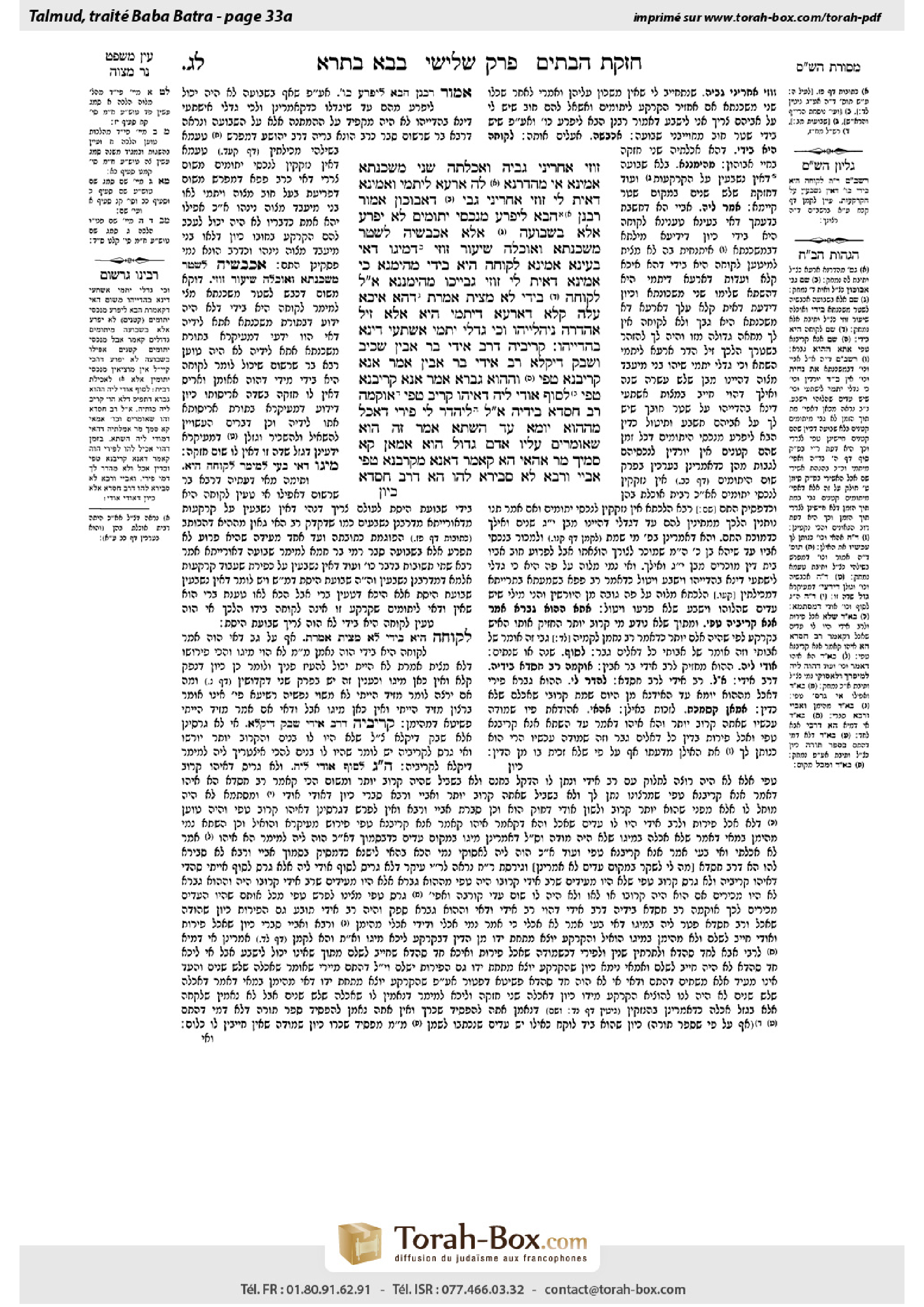
Bava Batra 33a: Talmud study for Daf Yomi
Study the Talmud for Daf Yomi with scanned pages, Hebrew text, English translations from Sefaria and AI-generated French translations.
Passage selection and English or AI-generated French translation are available where the scan has annotations. Daf Study is independent of Torah-Box and Sefaria.
Browse Bava Batra · בבא בתרא · All tractatesBava Batra 33a text and translations
This page of Bava Batra includes the Aramaic text, an English translation and an AI-generated French translation, alongside the scan above.
בבא בתרא ל״ג א · Aramaic and Hebrew text
זוּזִי אַחֲרִינֵי גַּבֵּיהּ, וַאֲכַלְתַּהּ שְׁנֵי מַשְׁכַּנְתָּא.
אָמֵינָא: אִי מַהְדַּרְנָא לַהּ אַרְעָא לְיַתְמֵי, וְאָמֵינָא דְּאִית לִי זוּזִי אַחֲרִינֵי גַּבֵּי דַּאֲבוּכוֹן – אֲמוּר רַבָּנַן: הַבָּא לִיפָּרַע מִנִּכְסֵי יְתוֹמִים – לֹא יִפָּרַע אֶלָּא בִּשְׁבוּעָה. אֶלָּא אֶכְבְּשֵׁיהּ לִשְׁטַר מַשְׁכַּנְתָּא, וְאוֹכְלַהּ שִׁיעוּר זוּזֵי, דְּמִיגּוֹ דְּאִי בָּעֵינָא אָמֵינָא לְקוּחָה הִיא בְּיָדִי – מְהֵימַנָּא, כִּי אָמֵינָא דְּאִית לִי זוּזִי גַּבַּיְיכוּ – מְהֵימַנְנָא.
אֲמַר לֵיהּ: ״לְקוּחָה בְּיָדִי״ לָא מָצֵית אָמְרַתְּ – דְּהָא אִיכָּא עֲלַהּ קָלָא דְּאַרְעָא דְיַתְמֵי הִיא. אֶלָּא זִיל אַהְדְּרַהּ נִיהֲלַיְיהוּ, וְכִי גָּדְלִי יַתְמֵי – אִשְׁתַּעִי דִּינָא בַּהֲדַיְיהוּ.
קְרִיבֵיהּ דְּרַב אִידִי בַּר אָבִין שְׁכֵיב, וּשְׁבַק דִּיקְלָא. רַב אִידִי בַּר אָבִין אָמַר: אֲנָא קָרִיבְנָא טְפֵי; וְהָהוּא גַּבְרָא אֲמַר: אֲנָא קָרִיבְנָא טְפֵי. לְסוֹף אוֹדִי לֵיהּ דְּאִיהוּ קָרִיב טְפֵי, אוֹקְמַהּ רַב חִסְדָּא בִּידֵיהּ.
אֲמַר לֵיהּ: לַיהְדַּר לִי פֵּירֵי דַּאֲכַל מֵהָהוּא יוֹמָא עַד הַשְׁתָּא! אָמַר: זֶה הוּא שֶׁאוֹמְרִים עָלָיו אָדָם גָּדוֹל הוּא? אַמַּאן קָא סְמִיךְ מָר – אַהַאי; הָא קָאָמַר דַּאֲנָא מְקָרַבְנָא טְפֵי! אַבָּיֵי וְרָבָא לָא סְבִירָא לְהוּ הָא דְּרַב חִסְדָּא,
Bava Batra 33a · English translation
other money with him, i.e., he owed me money for a different reason, for which I had no collateral, and I profited from the land for the duration of the years of the collateral.
I then said to myself: If I return the land to the orphans now that the years of collateral have finished, and I say that I have other money with your late father, I will not be able to collect it, as the Sages say that one who comes to collect a debt from the property of orphans can collect only by means of an oath, and I do not wish to take an oath. Rather than do that, I will suppress the document detailing the terms of the collateral, and profit from the land up to the measure of the money that their father owed me. This is legitimate, since if I so desire I can say: It is purchased, and that is why it is in my possession, and I would have been deemed credible, as I profited from the land for the years necessary to establish the presumption of ownership, so when I say that I have money with you, I am also deemed credible.
Abaye said to Rava bar Sharshom: Your reasoning is incorrect. You would not have been able to say: It is purchased, and that is why it is in my possession, as there is publicity concerning it that it is land of orphans. Therefore, you are unable to collect your debt based on the fact that you could have made a more advantageous claim [miggo]. Rather, return the land to the orphans now, and when the orphans become adults, then litigate with them, as you have no other option.
The Gemara relates: A relative of Rav Idi bar Avin died and left a date tree as an inheritance. Another relative took possession of the tree, claiming to be a closer relative than Rav Idi bar Avin. Rav Idi bar Avin said: I am closer in relation to the deceased than he, and that man said: I am closer in relation to the deceased than Rav Idi bar Avin. Ultimately, the other man admitted to Rav Idi bar Avin that, in fact, Rav Idi was closer in relation to the deceased. Rav Ḥisda established the date tree in the possession of Rav Idi bar Avin.
Rav Idi bar Avin said to Rav Ḥisda: The value of the produce that he consumed unlawfully from that day when he took possession of the tree until now should be returned to me. Rav Ḥisda said: Is this he about whom people say: He is a great man? On whom is the Master basing his claim to receive the value of the produce? On this other relative. But he was saying until this point: I am closer in relation to the deceased than he. Therefore, you have ownership of the tree only from the time of his admission, and not from when he took possession of the tree. The Gemara comments: Abaye and Rava do not hold in accordance with this opinion of Rav Ḥisda,
Bava Batra 33a · Traduction française (IA)
d'autres deniers avec lui, c'est-à-dire qu'il me devait de l'argent pour une autre raison, pour laquelle je n'avais pas de caution, et j'ai profité de la terre pendant les années de la caution.
Je me suis alors dit : Si je rends la terre aux orphelins maintenant que les années de caution sont terminées, et si je dis que j'ai d'autres deniers avec votre père défunt, je ne pourrai pas les récupérer, car les Sages disent qu'une personne qui vient récupérer une dette sur la propriété des orphelins ne peut le faire qu'à travers un serment, et je n'ai pas envie de prendre un serment. Plutôt que cela, je supprimerai le document détaillant les termes de la caution, et je profiterai de la terre jusqu'au montant de l'argent que leur père me devait. Cela est légitime, car si je le désire, je pourrai dire : C'est acheté, et c'est pourquoi il est en mon possession, et je serais considéré comme crédible, car j'ai profité de la terre pendant les années nécessaires pour établir la présomption d'ownership, donc quand je dis que j'ai de l'argent avec vous, je suis également considéré comme crédible.
Abaye a dit à Rava bar Sharshom : Votre raisonnement est incorrect. Vous n'auriez pas pu dire : C'est acheté, et c'est pourquoi il est en mon possession, car il y a une publicité concernant cela que c'est une terre d'orphelins. Par conséquent, vous ne pouvez pas récupérer votre dette en invoquant le fait que vous auriez pu faire une revendication plus avantageuse [miggo]. Plutôt, rendez la terre aux orphelins maintenant, et lorsque les orphelins deviendront adultes, litigez avec eux, car vous n'avez plus d'autre option.
La Guemara rapporte : Un parent de Rav Idi bar Avin est décédé et a laissé un palmier de dattes en héritage. Un autre parent s'est emparé du palmier, affirmant être un parent plus proche que Rav Idi bar Avin. Rav Idi bar Avin a dit : Je suis plus proche en relation avec le défunt que lui, et cet homme a dit : Je suis plus proche en relation avec le défunt que Rav Idi bar Avin. Finalement, cet autre homme a admis à Rav Idi bar Avin qu'en effet, Rav Idi était plus proche en relation avec le défunt. Rav Ḥisda a établi le palmier de dattes en possession de Rav Idi bar Avin.
Rav Idi bar Avin a dit à Rav Ḥisda : La valeur des produits qu'il a consommés illégalement depuis le jour où il s'est emparé du palmier jusqu'à présent doit être rendue à moi. Rav Ḥisda a dit : Est-ce celui dont on dit : Il est un grand homme ? Sur qui le Maître base-t-il son revendication de recevoir la valeur des produits ? Sur ce parent autre. Mais jusqu'à ce point, il disait : Je suis plus proche en relation avec le défunt que lui. Par conséquent, vous avez la propriété du palmier uniquement depuis le moment de son admission, et non depuis le moment où il s'est emparé du palmier. La Guemara commente : Abaye et Rava ne suivent pas cette opinion de Rav Ḥisda,
Traduction française générée par IA à partir de l’édition anglaise de Sefaria. Vérifie toujours un passage avec le texte source.
Text from Sefaria: William Davidson Edition - Vocalized Aramaic (CC BY NC); William Davidson Edition - English (CC BY NC).