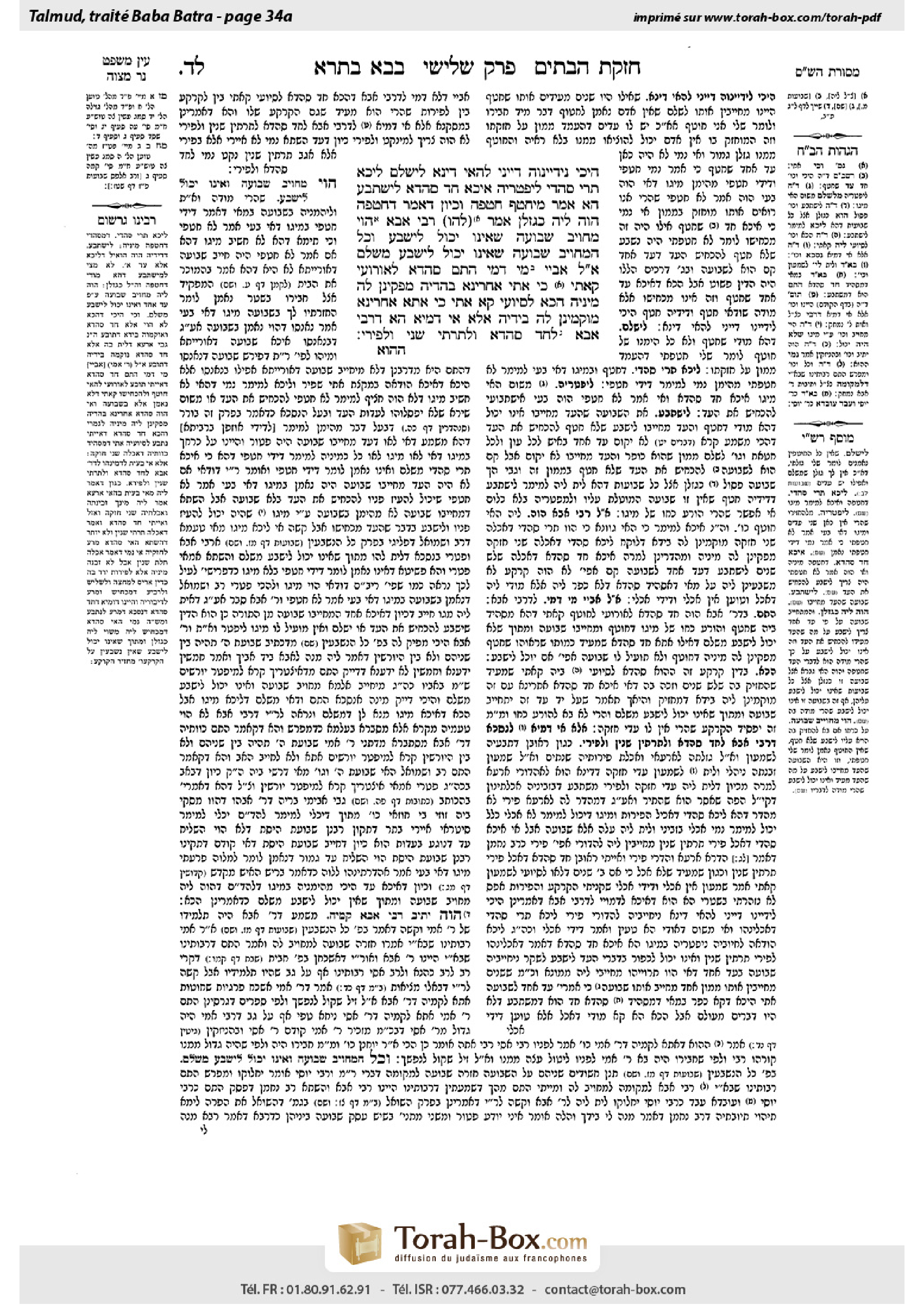
Bava Batra 34a: Talmud study for Daf Yomi
Study the Talmud for Daf Yomi with scanned pages, Hebrew text, English translations from Sefaria and AI-generated French translations.
Passage selection and English or AI-generated French translation are available where the scan has annotations. Daf Study is independent of Torah-Box and Sefaria.
Browse Bava Batra · בבא בתרא · All tractatesBava Batra 34a text and translations
This page of Bava Batra includes the Aramaic text, an English translation and an AI-generated French translation, alongside the scan above.
בבא בתרא ל״ד א · Aramaic and Hebrew text
הֵיכִי נִידַיְּינוּהּ דַּיָּינֵי לְהַאי דִּינָא? לִישַׁלֵּם? לֵיכָּא תְּרֵי סָהֲדִי! לִיפְטְרֵיהּ? אִיכָּא חַד סָהֲדָא! לִישְׁתְּבַע, הָא אָמַר מִיחְטָף חַטְפַהּ, וְכֵיוָן דְּאָמַר דְּחַטְפַהּ – הָוֵה לֵיהּ כְּגַזְלָן!
אֲמַר לְהוּ רַבִּי אַבָּא: הָוֵי מְחוּיָּב שְׁבוּעָה שֶׁאֵינוֹ יָכוֹל לִישָּׁבַע, וְכׇל הַמְחוּיָּב שְׁבוּעָה שֶׁאֵינוֹ יָכוֹל לִישָּׁבַע – מְשַׁלֵּם.
אֲמַר לְהוּ אַבָּיֵי: מִי דָּמֵי?! הָתָם סָהֲדָא לְאוֹרוֹעֵי קָאָתֵי – כִּי אָתֵי אַחֲרִינָא בַּהֲדֵיהּ, מַפְּקִינַן לַהּ מִינֵּיהּ; הָכָא לְסַיּוֹעֵי קָא אָתֵי – כִּי אֲתָא אַחֲרִינָא, מוֹקְמִינַן לַהּ בִּידֵיהּ!
אֶלָּא אִי דָּמְיָא הָא דְּרַבִּי אַבָּא – לְחַד סָהֲדָא וּלְתַרְתֵּי שְׁנֵי – וּלְפֵירֵי.
Bava Batra 34a · English translation
How should judges judge for this judgment? There are reasons not to implement all potential rulings. If they were to order the one who snatched the metal to pay for it, that would not be the correct ruling, because there are not two witnesses who saw him snatch it, and the court does not force payment based on the testimony of one witness. If they were to accept his claim and exempt him entirely, that would not be the correct ruling, because there is one witness who testified against him. If they were to order him to take an oath, which is the usual response to counter the testimony of one witness, didn’t he say that he did in fact snatch it, and since he said that he snatched it and there is no proof that it is his, he is like a robber, and the court does not allow a robber to take an oath.
Rabbi Abba said to them: He is one who is liable to take an oath who is unable to take an oath, and anyone who is liable to take an oath who is unable to take an oath is liable to pay. The Rabbis who were studying before Abaye thought that the case of the witness to the years of profiting and Rabbi Abba’s case are similar, in that since the possessor is unable to take an oath to refute the witness, as he concedes that he profited from the land for those years, he should have to pay for his consumption of the produce.
Abaye said to these Rabbis: Are these two cases comparable? There, in Rabbi Abba’s case, the witness is coming to undermine the position of the one who snatched the metal. This can be seen from the fact that when it would be the case that another witness comes to court and testifies with the first witness, we would take away the piece of metal from the one who snatched it. By contrast, here, in the case of the individual who brought one witness to attest to his profiting from the land, the witness is coming to support the possessor. This can be seen from the fact that when another witness would come to court and testify with the first witness, we would establish the land in his possession. Therefore, the testimony of the one witness does not render the one who profited from the land liable to take an oath.
Rather, if this case of Rabbi Abba is comparable to a case such as this, it is comparable to a case where there is one witness and he testifies to someone’s profiting from land for two years, and the comparison is in terms of payment for the produce that he consumed. In terms of the consumption of the produce, two witnesses would have rendered the possessor liable to pay, as consumption of the produce for only two years does not establish the presumption of ownership. Therefore, one witness renders him liable to take an oath. Since he himself claimed that he profited from the land as the witness testified, he cannot take an oath to contest the testimony. Therefore, he would have to pay for the produce.
Bava Batra 34a · Traduction française (IA)
Comment les juges doivent-ils rendre leur verdict dans ce cas ? Il y a des raisons de ne pas appliquer toutes les décisions possibles. Si les juges ordonnaient à celui qui a volé le métal de le payer, ce ne serait pas la bonne décision, car il n'y a pas deux témoins qui ont vu qu'il l'avait volé, et la cour ne force pas le paiement sur la base du témoignage d'un seul témoin. Si les juges acceptaient son allégation et le dispensaient entièrement, ce ne serait pas la bonne décision non plus, car il y a un témoin qui témoigne contre lui. Si les juges ordonnaient qu'il prenne serment, ce qui est la réponse habituelle pour contester le témoignage d'un seul témoin, n'a-t-il pas dit qu'il avait effectivement volé le métal ? Et puisque qu'il a dit qu'il l'avait volé et qu'il n'y a pas de preuve qu'il appartienne à lui, il est comme un voleur, et la cour ne permet pas à un voleur de prendre serment.
Rabbi Abba dit à ceux-ci : Il est celui qui est tenu de prendre serment mais qui ne peut pas le prendre, et celui qui est tenu de prendre serment mais qui ne peut pas le prendre est tenu de payer. Les Sages qui étudiaient avant Abaye pensaient que le cas du témoin des années de profit et le cas de Rabbi Abba sont comparables, car puisque le possesseur ne peut pas prendre serment pour contester le témoin, car il reconnaît avoir profité du terrain pendant ces années, il devrait payer pour sa consommation des produits.
Abaye dit à ces Sages : Ces deux cas sont-ils comparables ? Là, dans le cas de Rabbi Abba, le témoin vient affaiblir la position de celui qui a volé le métal. Cela se voit du fait que lorsque un autre témoin viendrait devant la cour et témoignerait avec le premier témoin, nous retirerions le métal de celui qui l'avait volé. En revanche, ici, dans le cas de la personne qui a apporté un témoin attestant de son profit sur le terrain, le témoin vient soutenir le possesseur. Cela se voit du fait que lorsque un autre témoin viendrait devant la cour et témoignerait avec le premier témoin, nous établirions la possession du terrain à son profit. Par conséquent, le témoignage d'un seul témoin ne rend pas celui qui a profité du terrain tenu à prendre serment.
Au contraire, si ce cas de Rabbi Abba est comparable à un cas tel que celui-ci, il est comparable à un cas où il y a un seul témoin qui témoigne du profit d'une personne sur un terrain pendant deux ans, et la comparaison est en termes de paiement pour les produits qu'il a consommés. En termes de consommation des produits, deux témoins auraient rendu le possesseur tenu de payer, car la consommation des produits pendant seulement deux ans ne suffit pas à établir la présomption d'ownership. Par conséquent, un seul témoin rendrait lui tenu à prendre serment. Puisqu'il a lui-même affirmé avoir profité du terrain comme le témoin l'avait témoigné, il ne peut pas prendre serment pour contester le témoignage. Par conséquent, il devrait payer pour les produits.
Traduction française générée par IA à partir de l’édition anglaise de Sefaria. Vérifie toujours un passage avec le texte source.
Text from Sefaria: William Davidson Edition - Vocalized Aramaic (CC BY NC); William Davidson Edition - English (CC BY NC).