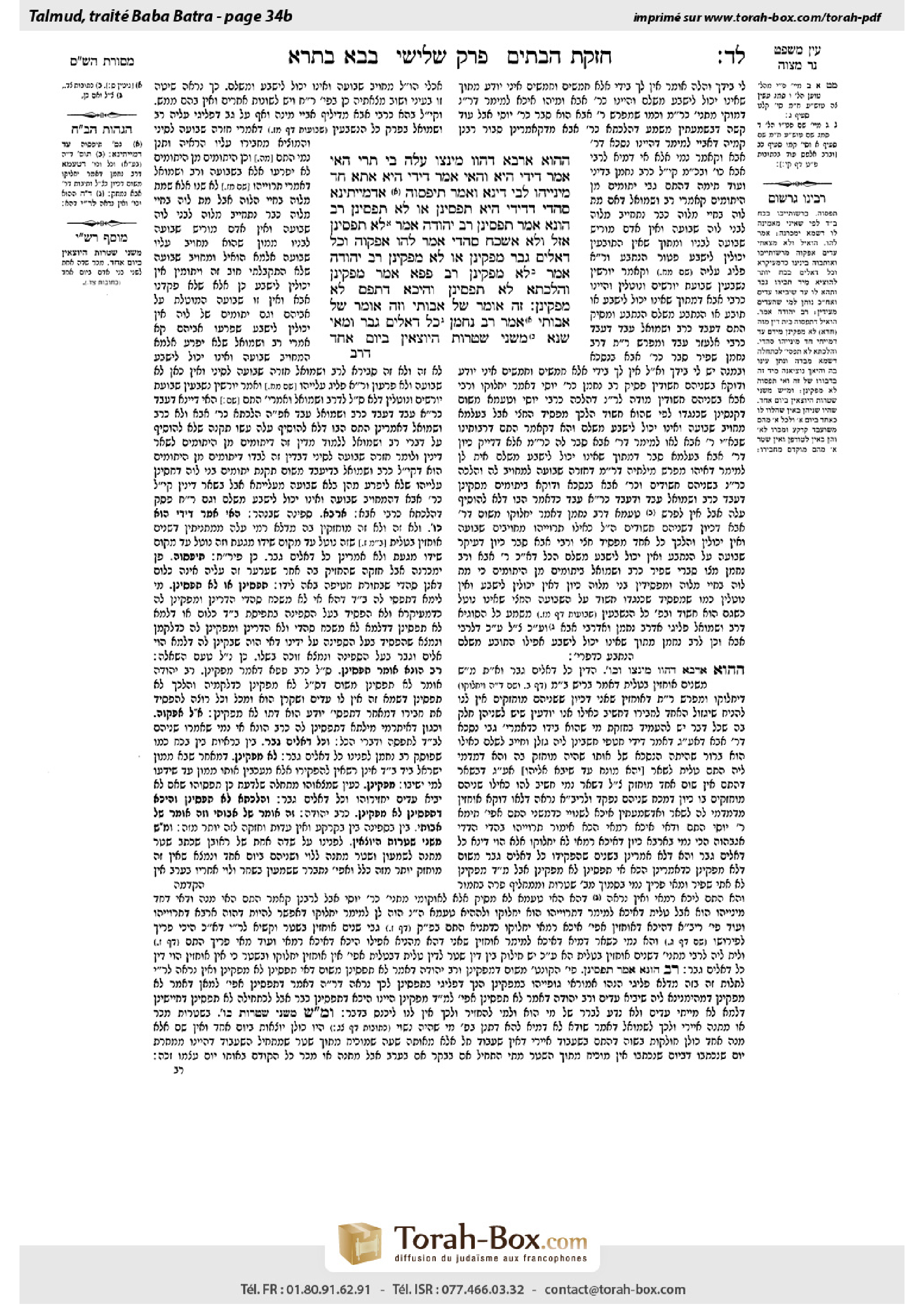
Bava Batra 34b: Talmud study for Daf Yomi
Study the Talmud for Daf Yomi with scanned pages, Hebrew text, English translations from Sefaria and AI-generated French translations.
Passage selection and English or AI-generated French translation are available where the scan has annotations. Daf Study is independent of Torah-Box and Sefaria.
Browse Bava Batra · בבא בתרא · All tractatesBava Batra 34b text and translations
This page of Bava Batra includes the Aramaic text, an English translation and an AI-generated French translation, alongside the scan above.
בבא בתרא ל״ד ב · Aramaic and Hebrew text
הָהוּא אַרְבָּא דַּהֲווֹ מִינְּצוּ עֲלַהּ בֵּי תְרֵי, הַאי אָמַר: ״דִּידִי הִיא״, וְהַאי אָמַר: ״דִּידִי הִיא״. אֲתָא חַד מִינַּיְיהוּ לְבֵי דִינָא, וְאָמַר: תִּיפְסוּהָ אַדְּמַיְיתֵינָא סָהֲדֵי דְּדִידִי הִיא. תָּפְסִינַן, אוֹ לָא תָּפְסִינַן? רַב הוּנָא אָמַר: תָּפְסִינַן. רַב יְהוּדָה אָמַר: לָא תָּפְסִינַן.
אֲזַל, וְלָא אַשְׁכַּח סָהֲדֵי. אֲמַר לְהוּ: אַפְּקוּהָ, וְכֹל דְּאַלִּים גָּבַר. מַפְּקִינַן, אוֹ לָא מַפְּקִינַן? רַב יְהוּדָה אָמַר: לָא מַפְּקִינַן. רַב פָּפָּא אָמַר: מַפְּקִינַן. וְהִלְכְתָא: לָא תָּפְסִינַן, וְהֵיכָא דִּתְפַס – לָא מַפְּקִינַן.
זֶה אוֹמֵר: ״שֶׁל אֲבוֹתַי״, וְזֶה אוֹמֵר: ״שֶׁל אֲבוֹתַי״ – אָמַר רַב נַחְמָן: כֹּל דְּאַלִּים גָּבַר. וּמַאי שְׁנָא מִשְּׁנֵי שְׁטָרוֹת הַיּוֹצְאִין בְּיוֹם אֶחָד –
Bava Batra 34b · English translation
§ The Gemara relates: There was a certain boat that two people were quarreling about with regard to its ownership. This one said: It is mine, and that one also said: It is mine. One of them came to court and said: Seize it until I am able to bring witnesses that it is mine. The Gemara asks: In such a case, do we seize it or do we not seize it? Rav Huna said: We seize it. Rav Yehuda said: We do not seize it, as there is no cause for the court to intervene.
The court seized the boat. The one who requested of the court to seize it went to seek witnesses, but did not find witnesses. He then said to the court: Release the boat, and whoever is stronger prevails, as this is the ruling in a case where there is neither evidence nor presumptive ownership for either litigant. The Gemara asks: In such a case, do we release it or do we not release it? Rav Yehuda said: We do not release it. Rav Pappa said: We release it. The Gemara concludes: And the halakha is that we do not seize property in a case where ownership is uncertain, and where it was seized, we do not release it.
There was an incident where two people dispute the ownership of property. This one says: It belonged to my ancestors and I inherited it from them, and that one says: It belonged to my ancestors and I inherited it from them. There was neither evidence nor presumptive ownership for either litigant. Rav Naḥman said: Whoever is stronger prevails. The Gemara asks: And in what way is this case different from the case where two people produce two deeds of sale or gift for the same field that are issued on one day,
Bava Batra 34b · Traduction française (IA)
§ La Guemara rapporte : Il y avait un bateau dont deux personnes disputaient la propriété. L'une disait : C'est à moi, et l'autre aussi disait : C'est à my. L'un d'eux alla devant le tribunal et dit : Saisissez-le jusqu'à ce que je puisse apporter des témoins qu'il m'appartient. La Guemara demande : Dans un tel cas, devons-nous saisir ou ne devons-nous pas saisir ? Rav Huna dit : Nous saisirons. Rav Yéhuda dit : Nous ne saisirons pas, car il n'y a pas de cause pour que le tribunal intervienne.
Le tribunal saisit le bateau. Celui qui avait demandé au tribunal de saisir dit qu'il allait chercher des témoins, mais n'en trouva pas. Il dit alors au tribunal : Libérez le bateau, car celui qui est le plus fort l'emporte, car c'est ainsi que la décision est rendue dans un cas où il n'y a ni preuve ni propriété présumée pour l'un ou l'autre des parties. La Guemara demande : Dans un tel cas, devons-nous le libérer ou ne devons-nous pas le libérer ? Rav Yéhuda dit : Nous ne le libérons pas. Rav Pappa dit : Nous le libérons. La Guemara conclut : Et la halakha est que nous ne saisirons pas de propriété dans un cas où la propriété est incertaine, et si elle a été saisie, nous ne la libérerons pas.
Il y avait un incident où deux personnes disputaient la propriété d'un bien. L'une disait : Cela appartenait à mes ancêtres et j'ai hérité de leur part, et l'autre disait : Cela appartenait à mes ancêtres et j'ai hérité de leur part. Il n'y avait ni preuve ni propriété présumée pour l'une ou l'autre des parties. Rav Naḥman dit : Celui qui est le plus fort l'emporte. La Guemara demande : Et dans quelle mesure ce cas diffère-t-il du cas où deux personnes produisent deux actes de vente ou de don pour le même champ émis le même jour,
Traduction française générée par IA à partir de l’édition anglaise de Sefaria. Vérifie toujours un passage avec le texte source.
Text from Sefaria: William Davidson Edition - Vocalized Aramaic (CC BY NC); William Davidson Edition - English (CC BY NC).