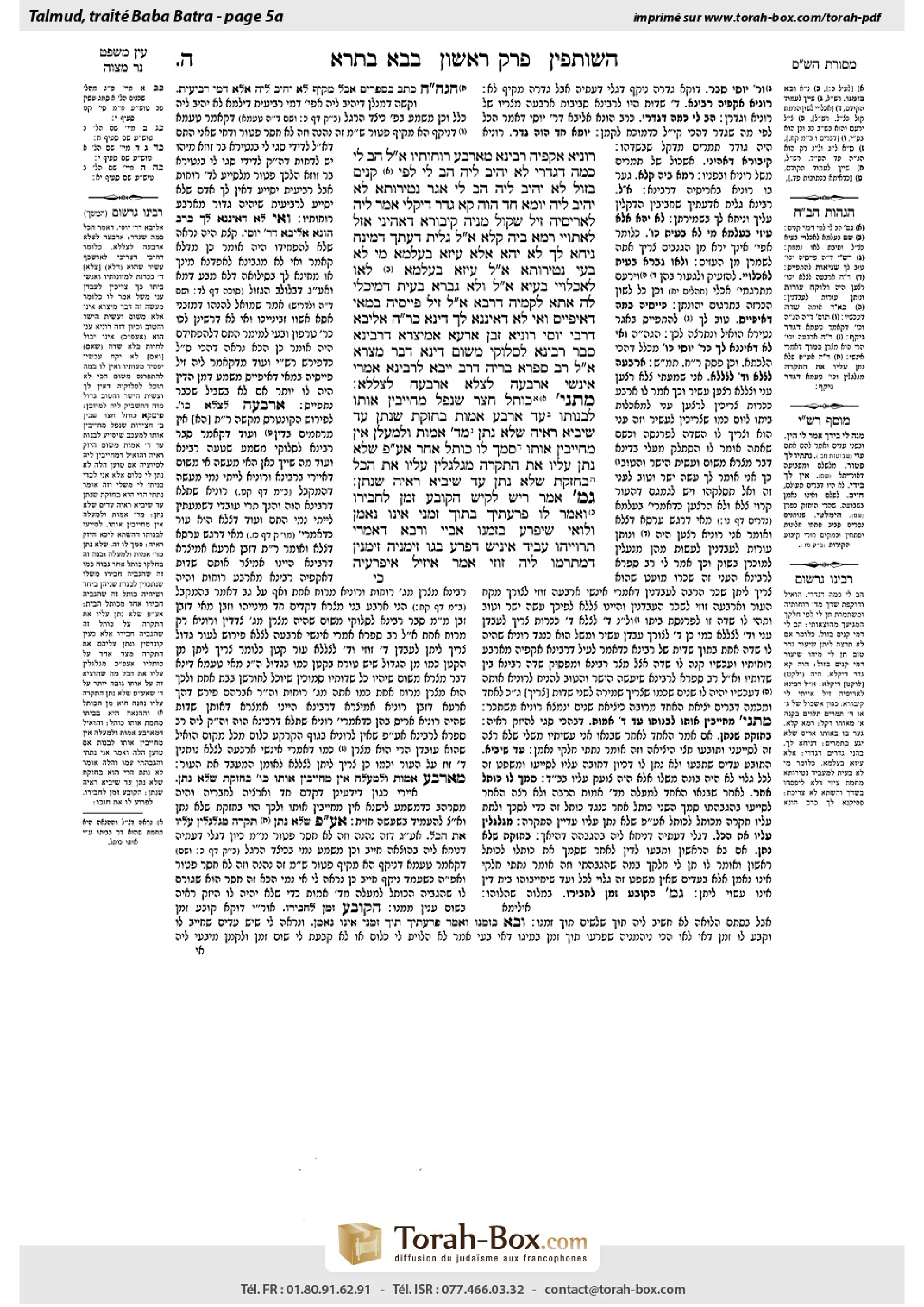
Bava Batra 5a: Talmud study for Daf Yomi
Study the Talmud for Daf Yomi with scanned pages, Hebrew text, English translations from Sefaria and AI-generated French translations.
Passage selection and English or AI-generated French translation are available where the scan has annotations. Daf Study is independent of Torah-Box and Sefaria.
Browse Bava Batra · בבא בתרא · All tractatesBava Batra 5a text and translations
This page of Bava Batra includes the Aramaic text, an English translation and an AI-generated French translation, alongside the scan above.
בבא בתרא ה׳ א · Aramaic and Hebrew text
רוּנְיָא, אַקְּפֵיהּ רָבִינָא מֵאַרְבַּע רוּחוֹתָיו. אֲמַר לֵיהּ: ״הַב לִי כַּמָּה דִּגְדַרִי״, לָא יְהֵיב לֵיהּ. ״הַב לִי לְפִי קָנִים בְּזוֹל״, לָא יְהֵיב לֵיהּ. ״הַב לִי אֲגַר נְטִירוּתָא״, לָא יְהֵיב לֵיהּ.
יוֹמָא חַד הֲוָה קָא גָדֵר דִּיקְלֵי, אֲמַר לֵיהּ לַאֲרִיסֵיהּ: זִיל שְׁקוֹל מִנֵּיהּ קִיבּוּרָא דַאֲהִינֵי. אֲזַל לְאֵתוֹיֵי, רְמָא בֵּיהּ קָלָא. אֲמַר לֵיהּ: גַּלִּית דַּעְתָּךְ דְּמִינַּח נִיחָא לָךְ; לָא יְהֵא אֶלָּא עִיזָּא בְּעָלְמָא, מִי לָא בָּעֵי נְטִירוּתָא? אֲמַר לֵיהּ: עִיזָּא בְּעָלְמָא, לָאו לְאַכְלוֹיֵי בָּעֲיָא? אֲמַר לֵיהּ: וְלָא גַּבְרָא בָּעֵית דְּמַיכְלֵי לַהּ?
אֲתָא לְקַמֵּיהּ דְּרָבָא, אֲמַר לֵיהּ: זִיל פַּיְּיסֵיהּ בְּמַאי דְּאִיפַּיַּיס; וְאִי לָא, דָּאֵינְנָא לָךְ דִּינָא כְּרַב הוּנָא אַלִּיבָּא דְּרַבִּי יוֹסֵי.
רוּנְיָא זְבֵן אַרְעָא אַמִּיצְרָא דְּרָבִינָא. סְבַר רָבִינָא לְסַלּוֹקֵי מִשּׁוּם דִּינָא דְּבַר מִצְרָא; אֲמַר לֵיהּ רַב סָפְרָא בְּרֵיהּ דְּרַב יֵיבָא לְרָבִינָא, אָמְרִי אִינָשֵׁי: אַרְבְּעָה לְצַלָּא, אַרְבְּעָה לְצַלָּלָא.
מַתְנִי׳ כּוֹתֶל חָצֵר שֶׁנָּפַל – מְחַיְּיבִין אוֹתוֹ לִבְנוֹתוֹ עַד אַרְבַּע אַמּוֹת. בְּחֶזְקַת שֶׁנָּתַן, עַד שֶׁיָּבִיא רְאָיָה שֶׁלֹּא נָתַן.
מֵאַרְבַּע אַמּוֹת וּלְמַעְלָן – אֵין מְחַיְּיבִין אוֹתוֹ. סָמַךְ לוֹ כּוֹתֶל אַחֵר, אַף עַל פִּי שֶׁלֹּא נָתַן עָלָיו אֶת הַתִּקְרָה – מְגַלְגְּלִין עָלָיו אֶת הַכֹּל. בְּחֶזְקַת שֶׁלֹּא נָתַן, עַד שֶׁיָּבִיא רְאָיָה שֶׁנָּתַן.
גְּמָ׳ אָמַר רֵישׁ לָקִישׁ: הַקּוֹבֵעַ זְמַן לַחֲבֵירוֹ, וְאָמַר לוֹ: ״פְּרַעְתִּיךָ בְּתוֹךְ זְמַנִּי״ – אֵינוֹ נֶאֱמָן; וּלְוַאי שֶׁיִּפְרַע בִּזְמַנּוֹ. אַבָּיֵי וְרָבָא דְּאָמְרִי תַּרְוַיְיהוּ: עֲבִיד אִינִישׁ דְּפָרַע בְּגוֹ זִימְנֵיהּ – זִימְנִין דְּמִתְרְמוּ לֵיהּ זוּזֵי, אָמַר: אֵיזִיל אֶיפְרְעֵיהּ,
Bava Batra 5a · English translation
It is related that a man named Ronya had a field that was surrounded by fields belonging to Ravina on all four sides. Ravina built partitions around his fields and said to him: Give me your share of the expense in accordance with what I actually spent when I built the partitions, i.e., half the cost of the partitions. Ronya did not give it to him. Ravina said to him: Give me then at least your share of the expense in accordance with a reduced assessment of the price of reeds. Ronya did not give it to him. Ravina said to him: Give me then at least the wage of a watchman. But he did not give even this to him.
One day, Ronya was harvesting dates. Ravina said to his sharecropper: Go take a cluster [kibbura] of dates from him. The sharecropper went to bring them, but Ronya raised his voice at him in protest, whereupon Ravina said to him: You have revealed that you are pleased with the partitions and the protection that they provide you. Even if it were only a goat that entered your field, wouldn’t the field need safeguarding, to prevent the goat from eating the dates? Ronya said to him: If it were only a goat, doesn’t one need merely to chase it away [le’akhluyei]? No partition is required. Ravina said to him: But wouldn’t you need a man to chase the goat away? Pay me then at least the wage of a watchman.
Ravina came before Rava to adjudicate the matter. Rava said to Ronya: Go appease Ravina with what he expressed his willingness to be appeased with, namely, the wage of a watchman. And if not, I will judge you in accordance with the ruling of Rav Huna in accordance with the opinion of Rabbi Yosei, and you will be required to pay half the cost of the partition based on what Ravina actually spent on it.
Incidental to that episode, the Gemara relates another encounter between Ravina and Ronya. Ronya once bought land adjoining property belonging to Ravina. Ravina considered removing him due to the halakha of one whose field borders the field of his neighbor. When land is up for sale, the owners of the adjoining fields have the right of first refusal. If one of the neighbors is willing to match the highest price being offered to the seller, that neighbor has the preemptive right to purchase the property, and if somebody else buys it, that buyer can be removed. Since Ravina owned the adjacent property, he thought that he enjoyed the right of first refusal. Rav Safra, son of Rav Yeiva, said to Ravina: People say: Four dinars for a large hide [tzalla], four for a small hide [tzelala]. Since Ronya also owned land bordering the desired parcel, you cannot remove him even though his plot of land is smaller than yours.
MISHNA: In the case of a dividing wall in a jointly owned courtyard that fell, if one of the owners wishes to rebuild the wall, the court obligates the other owner to build the wall with him up to a height of four cubits. If after the wall was built one of the neighbors claims he alone constructed it and the other did not participate in its building, the latter is nevertheless presumed to have given his share of the money, unless the claimant brings proof that the other did not give his part.
The court does not obligate the reluctant neighbor to contribute to the building of the wall higher than four cubits. But if the reluctant neighbor built another wall close to the wall that had been built higher than four cubits, in order to set a roof over the room that was thereby created, the court imposes upon him the responsibility to pay his share for all of the rebuilt wall, even though he has not yet set a roof over it. Since he has demonstrated his desire to make use of what his neighbor built, he must participate in the cost of its construction. If the builder of the first wall later claims that he did not receive payment from his neighbor, the neighbor is presumed not to have given his share of the money, unless he brings proof that he did in fact give money for the building of the wall.
GEMARA: Reish Lakish says: If a lender set a time for another to repay the loan that he had extended to him and when the debt came due the borrower said to the lender: I already repaid you within the time, he is not deemed credible, as people do not ordinarily repay their debts before they are due. The lender would be happy if the borrower would only repay his debt on time. Abaye and Rava disagree with Reish Lakish, as they both say: A person is apt to repay his debt within its time, i.e., before it is due. This is because sometimes he happens to have money and the borrower says to himself: I will go and repay my debt
Bava Batra 5a · Traduction française (IA)
On relate qu’un homme nommé Ronya possédait un champ entouré par des champs appartenant à Ravina sur les quatre côtés. Ravina construisit des parois autour de ses champs et dit à Ronya : Donne-moi ta part des frais conformément à ce que j’ai réellement dépensé lors de la construction des parois, c’est-à-dire la moitié du coût des parois. Ronya ne lui donna pas cela. Ravina dit à Ronya : Donne-moi alors au moins ta part des frais conformément à une estimation réduite du prix des roseaux. Ronya ne lui donna pas cela non plus. Ravina dit à Ronya : Donne-moi alors au moins le salaire d’un gardien. Mais il ne lui donna même pas cela.
Un jour, Ronya récoltait des dattes. Ravina dit à son fermier : Va prendre un bouquet [kibbura] de dattes chez lui. Le fermier alla apporter cela, mais Ronya cria contre lui en protestant, oùupon Ravina dit à Ronya : Tu as révélé que tu es content des parois et de la protection qu’elles te donnent. Même si c’était seulement un bouc qui entrait dans ton champ, n’aurait-il pas besoin de protection, pour empêcher le bouc de manger les dattes ? Ronya dit à Ravina : Si c’était seulement un bouc, n’a-t-on pas besoin de le chasser simplement [le’akhluyei] ? Une paroi n’est pas requise. Ravina dit à Ronya : Mais n’aurais-tu pas besoin d’un homme pour chasser le bouc ? Paie-moi alors au moins le salaire d’un gardien.
Ravina alla devant Rava pour régler cette affaire. Rava dit à Ronya : Va rassurer Ravina avec ce qu’il a exprimé son désir d’être rassuré, à savoir le salaire d’un gardien. Et si ce n’est pas le cas, je jugerai selon la décision de Rav Huna selon l’opinion de Rabbi Yosei, et tu seras tenu de payer la moitié du coût de la paroi selon ce que Ravina a réellement dépensé pour elle.
Incidentellement à cet épisode, la Guemara rapporte une autre rencontre entre Ravina et Ronya. Ronya acheta un terrain adjacent à la propriété de Ravina. Ravina considérait de le faire expulser en raison de la halakha d’un propriétaire dont le champ est adjacent à celui de son voisin. Lorsqu’un terrain est à vendre, les propriétaires des champs adjacents ont le droit de préférence. Si l’un des voisins est prêt à offrir le prix le plus élevé proposé au vendeur, ce voisin a le droit préférentiel d’acheter la propriété, et si quelqu’un d’autre l’achète, ce acheteur peut être expulsé. Comme Ravina possédait la propriété adjacente, il pensait qu’il avait le droit de préférence. Rav Safra, fils de Rav Yeiva, dit à Ravina : Les gens disent : quatre dinars pour une grande peau [tzalla], quatre pour une petite peau [tzelala]. Comme Ronya possédait également un terrain adjacent au terrain souhaité, tu ne peux pas l’expulser même si sa parcelle de terre est plus petite que la tienne.
MICHNA : Dans le cas d’une paroi divisant un cour d’honneur partagé qui s’est effondrée, si l’un des propriétaires souhaite reconstruire la paroi, la cour oblige l’autre propriétaire à reconstruire la paroi avec lui jusqu’à une hauteur de quatre coudées. Si après que la paroi fut reconstruite, l’un des voisins affirme qu’il seul l’a construite et que l’autre n’a pas participé à sa construction, l’autre est néanmoins présomption de avoir donné sa part d’argent, à moins que le prétendant ne fournisse une preuve que l’autre n’a pas donné sa part.
La cour ne force pas le voisin réticent à contribuer à la construction de la paroi au-delà de quatre coudées. Mais si le voisin réticent construit une autre paroi près de la paroi déjà construite au-delà de quatre coudées, afin de mettre un toit sur la pièce ainsi créée, la cour impose à lui de payer sa part pour toute la paroi reconstruite, même s’il n’a pas encore mis de toit. Comme il a montré son désir d’utiliser ce que son voisin a construit, il doit participer au coût de sa construction. Si le constructeur de la première paroi affirme plus tard qu’il n’a pas reçu de paiement de son voisin, le voisin est présomé de n’avoir pas donné sa part d’argent, à moins qu’il ne fournisse une preuve qu’il a effectivement donné de l’argent pour la construction de la paroi.
GUEMARA : Reish Lakish dit : Si un prêteur fixe une date pour que l’autre rembourse le prêt qu’il lui a octroyé, et lorsque la dette est due, le prêteur dit au prêteur : J’ai déjà remboursé ma dette dans le délai, il n’est pas considéré comme crédible, car les gens ne remboursent généralement pas leurs dettes avant qu’elles ne soient dues. Le prêteur serait heureux que le prêteur rembourse sa dette à temps. Abaye et Rava s’opposent à Reish Lakish, car ils disent tous les deux : Une personne a tendance à rembourser sa dette dans le délai, c’est-à-dire avant qu’elle ne soit due. C’est parce que parfois il a de l’argent et le prêteur se dit : Je vais aller rembourser ma dette.
Traduction française générée par IA à partir de l’édition anglaise de Sefaria. Vérifie toujours un passage avec le texte source.
Text from Sefaria: William Davidson Edition - Vocalized Aramaic (CC BY NC); William Davidson Edition - English (CC BY NC).