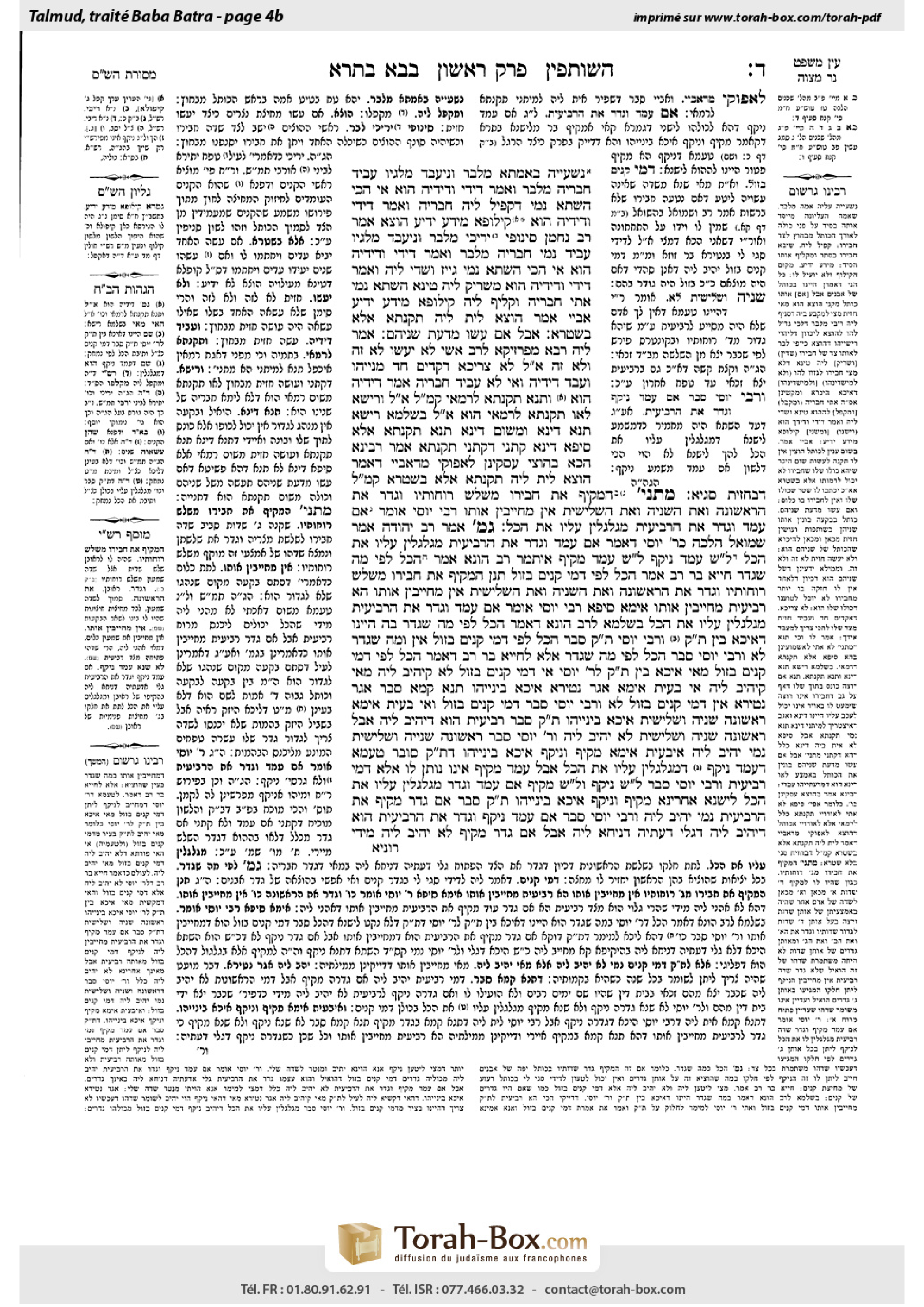
Bava Batra 4b: Talmud study for Daf Yomi
Study the Talmud for Daf Yomi with scanned pages, Hebrew text, English translations from Sefaria and AI-generated French translations.
Passage selection and English or AI-generated French translation are available where the scan has annotations. Daf Study is independent of Torah-Box and Sefaria.
Browse Bava Batra · בבא בתרא · All tractatesBava Batra 4b text and translations
This page of Bava Batra includes the Aramaic text, an English translation and an AI-generated French translation, alongside the scan above.
בבא בתרא ד׳ ב · Aramaic and Hebrew text
נִשְׁעֲיֵיהּ בְּאַמְּתָא מִלְּבַר. וְנֶיעֱבַד מִלְּגָיו! עָבֵיד חַבְרֵיהּ מִלְּבַר, וְאָמַר: דִּידִי וְדִידֵיהּ הוּא. אִי הָכִי, הַשְׁתָּא נָמֵי – דְּקָפֵיל לֵיהּ חַבְרֵיהּ, וְאָמַר: דִּידִי וְדִידֵיהּ הוּא! קִילּוּפָא מִידָּע יְדִיעַ.
הוּצָא – אָמַר רַב נַחְמָן: סַינּוֹפֵי יְרֵיכֵי מִלְּבַר. וְנֶיעְבַּד מִלְּגָיו! עָבֵיד נָמֵי חַבְרֵיהּ מִלְּבַר, וְאָמַר: דִּידִי וְדִידֵיהּ הוּא. אִי הָכִי, הַשְׁתָּא נָמֵי – גָּיֵיז וְשָׁדֵי לֵיהּ, וְאָמַר: דִּידִי וְדִידֵיהּ הוּא! מַשְׁרֵיק לֵיהּ טִינָא. הַשְׁתָּא נָמֵי – אָתֵי חַבְרֵיהּ וְקָלֵיף לֵיהּ! קִילּוּפָא מִידָּע יְדִיעַ.
אַבָּיֵי אָמַר: הוּצָא לֵית לֵיהּ תַּקַּנְתָּא אֶלָּא בִּשְׁטָרָא.
אֲבָל אִם עָשׂוּ מִדַּעַת שְׁנֵיהֶם. אֲמַר לֵיהּ רָבָא מִפַּרְזִיקָא לְרַב אָשֵׁי: לָא יַעֲשׂוּ לֹא זֶה וְלֹא זֶה! אֲמַר לֵיהּ: לָא צְרִיכָא, דִּקְדֵים חַד מִנַּיְיהוּ וַעֲבַד דִּידֵיהּ, וְאִי לָא עָבֵיד חַבְרֵיהּ – אָמַר: דִּידֵיהּ הוּא.
וְתַנָּא – תַּקַּנְתָּא לְרַמַּאי קָא מַשְׁמַע לַן?! אֲמַר לֵיהּ: וְרֵישָׁא – לָאו תַּקַּנְתָּא לְרַמַּאי הוּא?!
אֲמַר לֵיהּ: בִּשְׁלָמָא רֵישָׁא – תְּנָא דִּינָא, וּמִשּׁוּם דִּינָא תְּנָא תַּקַּנְתָּא; אֶלָּא סֵיפָא, דִּינָא קָתָנֵי – דְּקָתָנֵי תַּקַּנְתָּא?! אָמַר רָבִינָא: הָכָא בְּהוּצֵי עָסְקִינַן, לְאַפּוֹקֵי מִדְּאַבַּיֵּי – דְּאָמַר: הוּצָא לֵית לֵיהּ תַּקַּנְתָּא אֶלָּא בִּשְׁטָרָא; קָא מַשְׁמַע לַן דְּבַחֲזִית סַגִּיא.
מַתְנִי׳ הַמַּקִּיף אֶת חֲבֵירוֹ מִשָּׁלֹשׁ רוּחוֹתָיו, וְגָדַר אֶת הָרִאשׁוֹנָה וְאֶת הַשְּׁנִיָּה וְאֶת הַשְּׁלִישִׁית – אֵין מְחַיְּיבִין אוֹתוֹ. רַבִּי יוֹסֵי אוֹמֵר: אִם עָמַד וְגָדַר אֶת הָרְבִיעִית – מְגַלְגְּלִין עָלָיו אֶת הַכֹּל.
גְּמָ׳ אָמַר רַב יְהוּדָה אָמַר שְׁמוּאֵל: הֲלָכָה כְּרַבִּי יוֹסֵי, דְּאָמַר: אִם עָמַד וְגָדַר אֶת הָרְבִיעִית – מְגַלְגְּלִין עָלָיו אֶת הַכֹּל. לָא שְׁנָא עָמַד נִיקָּף, לָא שְׁנָא עָמַד מַקִּיף.
אִיתְּמַר, רַב הוּנָא אָמַר: הַכֹּל לְפִי מַה שֶּׁגָּדַר. חִיָּיא בַּר רַב אָמַר: הַכֹּל לְפִי דְּמֵי קָנִים בְּזוֹל.
תְּנַן: הַמַּקִּיף אֶת חֲבֵירוֹ מִשָּׁלֹשׁ רוּחוֹתָיו, וְגָדַר אֶת הָרִאשׁוֹנָה וְאֶת הַשְּׁנִיָּה וְאֶת הַשְּׁלִישִׁית – אֵין מְחַיְּיבִין אוֹתוֹ. הָא רְבִיעִית – מְחַיְּיבִין אוֹתוֹ; אֵימָא סֵיפָא, רַבִּי יוֹסֵי אוֹמֵר: אִם עָמַד וְגָדַר אֶת הָרְבִיעִית – מְגַלְגְּלִין עָלָיו אֶת הַכֹּל.
בִּשְׁלָמָא לְרַב הוּנָא, דְּאָמַר: הַכֹּל לְפִי מַה שֶּׁגָּדַר בָּהּ, הַיְינוּ דְּאִיכָּא בֵּין תַּנָּא קַמָּא וְרַבִּי יוֹסֵי – תַּנָּא קַמָּא סָבַר: הַכֹּל לְפִי דְּמֵי קָנִים בְּזוֹל – אִין, וּמַה שֶּׁגָּדַר – לָא; וְרַבִּי יוֹסֵי סָבַר: הַכֹּל לְפִי מַה שֶּׁגָּדַר.
אֶלָּא לְחִיָּיא בַּר רַב, דְּאָמַר: הַכֹּל לְפִי דְּמֵי קָנִים בְּזוֹל, מַאי אִיכָּא בֵּין תַּנָּא קַמָּא לְרַבִּי יוֹסֵי? אִי דְּמֵי קָנִים בְּזוֹל לָא קָיָהֵיב לֵיהּ, מַאי קָיָהֵיב לֵיהּ?
אִי בָּעֵית אֵימָא: אֲגַר נְטִירָא אִיכָּא בֵּינַיְיהוּ – תַּנָּא קַמָּא סָבַר: אֲגַר נְטִירָא – אִין, דְּמֵי קָנִים בְּזוֹל – לָא; וְרַבִּי יוֹסֵי סָבַר: דְּמֵי קָנִים בְּזוֹל.
וְאִי בָּעֵית אֵימָא: רִאשׁוֹנָה שְׁנִיָּה וּשְׁלִישִׁית אִיכָּא בֵּינַיְיהוּ – תַּנָּא קַמָּא סָבַר: רְבִיעִית הוּא דְּיָהֵיב לֵיהּ, אֲבָל רִאשׁוֹנָה שְׁנִיָּה וּשְׁלִישִׁית – לָא יָהֵיב לֵיהּ; וְרַבִּי יוֹסֵי סָבַר: רִאשׁוֹנָה שְׁנִיָּיה וּשְׁלִישִׁית נָמֵי יָהֵיב לֵיהּ.
אִיבָּעֵית אֵימָא: מַקִּיף וְנִיקָּף אִיכָּא בֵּינַיְיהוּ – דְּתַנָּא קַמָּא סוֹבֵר: טַעְמָא דְּעָמַד נִיקָּף דִּמְגַלְגְּלִין עָלָיו אֶת הַכֹּל, אֲבָל עָמַד מַקִּיף – אֵינוֹ נוֹתֵן לוֹ אֶלָּא דְּמֵי רְבִיעִית.
וְרַבִּי יוֹסֵי סָבַר: לָא שְׁנָא נִיקָּף וְלָא שְׁנָא מַקִּיף, אִם עָמַד וְגָדַר – מְגַלְגְּלִין עָלָיו אֶת הַכֹּל.
לִישָּׁנָא אַחֲרִינָא: מַקִּיף וְנִיקָּף אִיכָּא בֵּינַיְיהוּ – תַּנָּא קַמָּא סָבַר: אִם גָּדַר מַקִּיף אֶת הָרְבִיעִית – נָמֵי יָהֵיב לֵיהּ; וְרַבִּי יוֹסֵי סָבַר: אִם עָמַד נִיקָּף וְגָדַר אֶת הָרְבִיעִית – הוּא דְּיָהֵיב לֵיהּ, דְּגַלִּי דַּעְתֵּיהּ דְּנִיחָא לֵיהּ; אֲבָל אִם גָּדַר מַקִּיף – לָא יָהֵיב לֵיהּ מִידֵּי.
Bava Batra 4b · English translation
The party who builds the wall should smear it with clay up to a cubit at the top of the wall on the outside. The Gemara suggests: Let him do this on the inside. The Gemara explains: In that case, his neighbor might also do it on the outside, that is, on the side facing his own property, and say: The wall is both mine and his. The Gemara responds: If so, that is, if there is a concern for such deception, now also when the person who builds the wall smears it with clay on the outside, his neighbor can peel it off and say: The wall is both mine and his. The Gemara explains: Peeling clay is noticeable and the deception will not succeed.
The Gemara asks: If he builds a partition of palm branches, how does he make a border mark? Rav Naḥman said: He directs the tips of the branches to the outside. The Gemara suggests: Let him do this to the inside. The Gemara states: If he so directs the branches, his neighbor might also do the same to the outside, that is, to the side facing his own property, and say: The partition is both mine and his. The Gemara objects: If so, that is, if there is concern for such deception, now also when the one who builds the partition directs the tips of the branches to the outside, the neighbor can cut off the tips and throw them away, and say: The partition is both mine and his. The Gemara counsels: He should smear the tips of the palm branches with clay. The Gemara comments: Now also, the neighbor might come and peel the clay off. The Gemara answers: Peeling is noticeable.
Abaye said: One who builds a partition of palm branches has no remedy to prove who erected it, except with a written document. The neighbor should draw up a document stating that he has no claim to the space or to the partition, because they belong exclusively to the other neighbor.
§ The mishna teaches: Nevertheless, in a place where it is not customary to build a partition between two people’s fields, if they made such a partition with the agreement of the two of them, they build it in the middle, i.e., on the property line, and make a border mark on the one side and on the other side. Therefore, if the wall later falls, the assumption is that the space where the wall stood and the stones belong to both of them, to be divided equally. Rava from Parzika said to Rav Ashi: Neither this one nor that one should make a border mark. Rav Ashi said to him: No, this ruling is necessary in a case where one of them went ahead and made a border mark for himself, so that if his neighbor does not make one as well, the first one will say that it is entirely his.
Rava from Parzika asked him: And is the tanna of the mishna teaching us a remedy to be used against a swindler? Rav Ashi said to him: But isn’t the former clause of the mishna’s ruling also a remedy to be used against a swindler? That clause teaches that one who builds a wall should make a border mark to indicate that the wall is his.
Rava from Parzika said to him: Granted, in the former clause the tanna taught the halakha that if one wishes to build a partition between his own field and that of his neighbor, he does so at his own expense and on his own land, and due to the need to teach that halakha he also taught a remedy to be used against a swindler. But does he teach a halakha in the latter clause, so that he also teaches a remedy to be used against a swindler? Ravina said: Here, in the latter clause, we are dealing with a barrier made of palm branches. This is to the exclusion of the opinion of Abaye, who said: One who builds a partition of palm branches has no remedy to prove who erected it, except with a written document. He teaches us that a border mark suffices.
MISHNA: With regard to one who surrounds another on three sides, that is, he owns parcels of land on three sides of the other person’s field, and he built a partition on the first, the second, and the third sides, the court does not obligate the neighbor who owns the inner field to contribute to the construction of the partition if he does not wish to do so. Rabbi Yosei says: If he arose and built a partition on the fourth side of the field, the court imposes upon the owner of the inner field the responsibility to pay his share for all of the partitions.
GEMARA: Rav Yehuda says that Shmuel says: The halakha is in accordance with the opinion of Rabbi Yosei, who says that if he arose and built a partition on the fourth side of the field, the court imposes upon the owner of the inner field the responsibility to pay his share for all of the partitions. The Gemara comments: It is no different if it was the owner of the surrounded field who arose and built a partition on the fourth side, and it is no different if it was the owner of the surrounding field who arose and built a partition on the fourth side. The halakha is the same in both cases.
It was stated that the amora’im disagreed with regard to the following point. Rav Huna says that when Rabbi Yosei said the court obligates the owner of the inner field to pay his share for all of the partitions, he pays in accordance with what the other person actually spent when he built the partitions. That is, the owner of the inner field must contribute his share according to the cost of the partition his neighbor built. Ḥiyya bar Rav says: He must pay his share for all of the partitions in accordance with a reduced assessment of the price of reeds, and no more. The owner of the surrounded field can claim he had no desire for a more substantial partition.
The Gemara attempts to bring a proof from what we learned in the mishna: With regard to one who surrounds another on three sides, that is, he owns parcels of land on three sides of the other person’s field, and he built a partition on the first, the second, and the third sides, the court does not obligate the neighbor who owns the inner field to contribute to the construction of the partition. By inference, if he also built a partition on the fourth side of the field, the court does obligate the owner of the inner field to contribute to the building of the partition. The Gemara continues with its proof: Say the latter clause of the mishna: Rabbi Yosei says: If he arose and built a partition on the fourth side of the field, the court imposes upon the owner of the inner field the responsibility to pay his share for all of the partitions. The first tanna and Rabbi Yosei seem to be stating the same ruling.
Granted, according to Rav Huna, who says that the owner of the inner field pays for all of the partitions in accordance with what the other person actually spent when he built the partitions, this is the difference between the first tanna and Rabbi Yosei: The first tanna maintains that yes, he pays his share for all of the partitions in accordance with a reduced assessment of the price of reeds, but not a larger sum in accordance with what the other person actually spent when he built the partitions. And Rabbi Yosei maintains that he pays his share for all of the partitions in accordance with what the other person actually spent when he built the partitions.
But according to Ḥiyya bar Rav, who says he pays his share for all of the partitions in accordance with the value of a partition fashioned from inexpensive reeds, what difference is there between the first tanna and Rabbi Yosei? If according to the first tanna he does not give him his share for all of the partitions in accordance with a reduced assessment of the price of reeds, what does he give him?
The Gemara answers: If you wish, say there is a practical difference between them with regard to the wage of a watchman. The first tanna maintains that yes, since his field is safeguarded by the partition which surrounds it, the one who built the partition can demand payment of the wage of a watchman. He cannot, however, demand the cost of building the partition, not even the other’s share for all of the partitions in accordance with a reduced assessment of the price of reeds. And Rabbi Yosei maintains that he can demand the other’s share for all of the partitions in accordance with a reduced assessment of the price of reeds.
And if you wish, say there is a practical difference between them with regard to the partitions built on the first, second, and third sides of the inner field. The first tanna maintains that the owner of the inner field must give to his neighbor money for the partition built on the fourth side, but he is not required to give him money for the partitions built on the first, second, and third sides. And Rabbi Yosei maintains that he must also give him money for the partitions built on the first, the second, and the third sides.
The Gemara suggests another difference between the two opinions: If you wish, say there is a practical difference between them with regard to the issue of whether the partition on the fourth side was built by the owner of the surrounding field or by the owner of the surrounded field. This is because the first tanna maintains that the reason the owner of the surrounded field must contribute his share of the entire expense is that he arose and built a partition on the fourth side of his field. Therefore, the court imposes upon him the responsibility to pay his share for all of the partitions, because his actions demonstrate that he wants the partition between their fields. But if the owner of the surrounding field arose and built a partition on the fourth side of the field, the owner of the surrounded field must give him only his share of the value of the partition of the fourth side.
And Rabbi Yosei maintains that it is no different if it was the owner of the surrounded field who arose and built a partition on the fourth side, and it is no different if it was the owner of the surrounding field who arose and built a partition on the fourth side. If either one arose and built a partition on the fourth side, the court imposes upon the owner of the inner field the obligation to pay his share for all of the partitions.
The Gemara reports another version of this last answer: There is a practical difference between them with regard to the issue of whether the partition on the fourth side was built by the owner of the surrounding field or by the owner of the surrounded field. The first tanna maintains that even if the owner of the surrounding field built a partition on the fourth side, the owner of the surrounded field also gives him his share of the cost of the partitions. And Rabbi Yosei maintains that only if the owner of the surrounded field arose and built a partition on the fourth side does he give the owner of the surrounding field his share of the cost of the partitions. Why is that? Because he reveals that he is pleased with the partitions. But if the owner of the surrounding field built a partition on the fourth side, the owner of the surrounded field does not give him anything, as he can continue to claim that he has no interest in the partitions.
Bava Batra 4b · Traduction française (IA)
La personne qui construit le mur doit le recouvrir de boue jusqu'à un cubit au sommet du mur sur l'extérieur. La Guemara suggère : Faites-le à l'intérieur. La Guemara explique : Dans ce cas, son voisin pourrait aussi le faire sur l'extérieur, c'est-à-dire sur le côté faisant face à sa propre propriété, et dire : Le mur est à moi et à lui. La Guemara répond : Si tel est le cas, c'est-à-dire s'il y a un souci de tromperie de cette sorte, maintenant aussi lorsque la personne qui construit le mur recouvre le mur de boue sur l'extérieur, son voisin peut le décoller et dire : Le mur est à moi et à lui. La Guemara explique : Décoller la boue est visible et la tromperie ne réussira pas.
La Guemara pose la question : Si on construit une séparation de branches de palmier, comment doit-on marquer la limite ? Rav Naḥman dit : On oriente les pointes des branches vers l'extérieur. La Guemara suggère : Faites-le à l'intérieur. La Guemara affirme : Si on oriente les branches ainsi, son voisin pourrait aussi le faire de la même manière sur l'extérieur, c'est-à-dire sur le côté faisant face à sa propre propriété, et dire : La séparation est à moi et à lui. La Guemara s'oppose : Si tel est le cas, c'est-à-dire s'il y a un souci de tromperie de cette sorte, maintenant aussi lorsque la personne qui construit la séparation oriente les pointes des branches vers l'extérieur, le voisin peut couper les pointes et les jeter, et dire : La séparation est à moi et à lui. La Guemara conseille : On doit recouvrir les pointes des branches de palmier de boue. La Guemara commente : Maintenant aussi, le voisin pourrait venir décoller la boue. La Guemara répond : Décoller est visible.
Abaye dit : Celui qui construit une séparation de branches de palmier n'a pas de moyen pour prouver qui l'a construite, sauf avec un document écrit. Le voisin devrait rédiger un document indiquant qu'il n'a pas de revendication sur l'espace ou sur la séparation, car ils appartiennent exclusivement à l'autre voisin.
§ La mitsva enseigne : Toutefois, dans un lieu où il n'est pas coutumier de construire une séparation entre deux champs, si les deux construisent une telle séparation avec l'accord des deux, ils la construisent au milieu, c'est-à-dire sur la limite des propriétés, et marquent la limite d'un côté et de l'autre. Ainsi, si le mur tombe plus tard, on suppose que l'espace où le mur était et les pierres appartiennent aux deux, à être divisé équitablement. Rava de Parzika dit à Rav Ashi : Ni celui-ci ni celui-là ne doit marquer la limite. Rav Ashi dit à lui : Non, cette décision est nécessaire dans le cas où l'un d'eux a déjà marqué la limite pour lui-même, de sorte que si son voisin ne la marque pas également, le premier dira que c'est entièrement à lui.
Rava de Parzika demanda à lui : Et la tanna de la mitsva nous enseigne-t-elle un remède contre un escroc ? Rav Ashi dit à lui : Mais n'est-ce pas la première partie de la décision de la mitsva aussi un remède contre un escroc ? Cette clause enseigne que celui qui construit un mur doit marquer la limite pour indiquer que le mur est à lui.
Rava de Parzika dit à lui : D'accord, dans la première clause la tanna a enseigné la halakha que si l'on veut construire une séparation entre son propre champ et celui de son voisin, il le fait à ses frais et sur sa propre terre, et en raison du besoin d'enseigner cette halakha, il a aussi enseigné un remède contre un escroc. Mais enseigne-t-il une halakha dans la seconde clause, de sorte qu'il enseigne aussi un remède contre un escroc ? Ravina dit : Ici, dans la seconde clause, nous sommes en présence d'une barrière faite de branches de palmier. Cela est en opposition avec l'opinion d'Abaye, qui dit : Celui qui construit une séparation de branches de palmier n'a pas de moyen pour prouver qui l'a construite, sauf avec un document écrit. Il nous enseigne que marquer la limite suffit.
MICHNA: Concernant celui qui entoure un autre sur trois côtés, c'est-à-dire qui possède des parcelles de terre sur trois côtés du champ de l'autre personne, et qui a construit une séparation sur le premier, le deuxième et le troisième côtés, la cour ne s'oblige pas le voisin qui possède le champ intérieur à contribuer à la construction de la séparation s'il ne veut pas le faire. Rabbi Yosei dit : Si l'on s'est levé et a construit une séparation sur le quatrième côté du champ, la cour impose à l'propriétaire du champ intérieur la responsabilité de payer sa part pour toutes les séparations.
GUEMARA: Rav Yehuda dit que Shmuel dit : La halakha est selon l'opinion de Rabbi Yosei, qui dit que si l'on s'est levé et a construit une séparation sur le quatrième côté du champ, la cour impose à l'propriétaire du champ intérieur la responsabilité de payer sa part pour toutes les séparations. La Guemara commente : Ce n'est pas différent si c'était l'propriétaire du champ entouré qui s'était levé et avait construit une séparation sur le quatrième côté, et ce n'est pas différent si c'était l'propriétaire du champ entourant qui s'était levé et avait construit une séparation sur le quatrième côté. La halakha est la même dans les deux cas.
Il a été dit que les amoraïm étaient en désaccord concernant le point suivant. Rav Huna dit que lorsque Rabbi Yosei a dit que la cour impose à l'propriétaire du champ intérieur de payer sa part pour toutes les séparations, il paie selon ce que l'autre personne a effectivement dépensé lorsqu'il a construit les séparations. C'est-à-dire que l'propriétaire du champ intérieur doit contribuer sa part selon le coût de la séparation que son voisin a construite. Ḥiyya bar Rav dit : Il doit payer sa part pour toutes les séparations selon une estimation réduite du prix des roseaux, et pas plus. L'propriétaire du champ entouré peut réclamer qu'il n'avait pas envie d'une séparation plus solide.
La Guemara tente de présenter une preuve à partir de ce que nous avons appris dans la mitsna : concernant celui qui entoure un autre sur trois côtés, c'est-à-dire qu'il possède des parcelles de terre sur trois côtés du champ de l'autre, et qu'il a construit une clôture sur le premier, le second et le troisième côté, la cour ne charge pas le voisin qui possède le champ intérieur de contribuer à la construction de la clôture. Par conséquent, si il a également construit une clôture sur le quatrième côté du champ, la cour charge alors l'propriétaire du champ intérieur de contribuer à la construction de la clôture. La Guemara continue avec sa preuve : disons la dernière partie de la mitsna : Rabbi Yosei dit : Si il est monté et a construit une clôture sur le quatrième côté du champ, la cour impose à l'propriétaire du champ intérieur la responsabilité de payer sa part pour toutes les clôtures. Le premier tanna et Rabbi Yosei semblent énoncer la même décision.
D'accord, selon Rav Huna, qui dit que l'propriétaire du champ intérieur paie pour toutes les clôtures selon ce que l'autre a effectivement dépensé lors de la construction des clôtures, c'est la différence entre le premier tanna et Rabbi Yosei : le premier tanna maintient que oui, il paie sa part pour toutes les clôtures selon une estimation réduite du prix des roseaux, mais pas une somme plus grande selon ce que l'autre a effectivement dépensé lors de la construction des clôtures. Et Rabbi Yosei maintient que il paie sa part pour toutes les clôtures selon ce que l'autre a effectivement dépensé lors de la construction des clôtures.
Mais selon Ḥiyya bar Rav, qui dit qu'il paie sa part pour toutes les clôtures selon la valeur d'une clôture faite avec des roseaux peu coûteux, quelle est la différence entre le premier tanna et Rabbi Yosei ? Si selon le premier tanna il ne lui donne pas sa part pour toutes les clôtures selon une estimation réduite du prix des roseaux, qu'est-ce qu'il lui donne alors ?
La Guemara répond : Si tu veux, dis qu'il existe une différence pratique entre eux concernant le salaire d'un gardien. Le premier tanna maintient que oui, puisque son champ est protégé par la clôture qui l'entoure, celui qui a construit la clôture peut exiger le salaire d'un gardien. Il ne peut toutefois exiger le coût de la construction de la clôture, pas même la part de l'autre pour toutes les clôtures selon une estimation réduite du prix des roseaux. Et Rabbi Yosei maintient qu'il peut exiger la part de l'autre pour toutes les clôtures selon une estimation réduite du prix des roseaux.
Et si tu veux, dis qu'il existe une différence pratique entre eux concernant les clôtures construites sur les premiers, deuxième et troisième côtés du champ intérieur. Le premier tanna maintient que l'propriétaire du champ intérieur doit donner à son voisin de l'argent pour la clôture construite sur le quatrième côté, mais il n'est pas tenu de lui donner de l'argent pour les clôtures construites sur les premiers, deuxième et troisième côtés. Et Rabbi Yosei maintient qu'il doit aussi lui donner de l'argent pour les clôtures construites sur les premiers, deuxième et troisième côtés.
La Guemara suggère une autre différence entre les deux opinions : si l'on veut, on peut dire qu'il existe une différence pratique entre eux concernant la question de savoir si la clôture sur le quatrième côté a été construite par l'propriétaire du champ entourant ou par l'propriétaire du champ entouré. Cela est dû au fait que le premier tanna maintient que la raison pour laquelle l'propriétaire du champ entouré doit contribuer à l'ensemble des dépenses est qu'il a monté et construit une clôture sur le quatrième côté de son champ. Par conséquent, la cour impose sur lui la responsabilité de payer sa part pour toutes les clôtures, car ses actions montrent qu'il veut la clôture entre leurs champs. Mais si l'propriétaire du champ entourant a monté et construit une clôture sur le quatrième côté du champ, l'propriétaire du champ entouré doit lui donner seulement sa part de la valeur de la clôture du quatrième côté.
Et Rabbi Yosei maintient que cela n'est pas différent si c'était l'propriétaire du champ entouré qui a monté et construit une clôture sur le quatrième côté, et cela n'est pas différent si c'était l'propriétaire du champ entourant qui a monté et construit une clôture sur le quatrième côté. Si l'un d'eux a monté et construit une clôture sur le quatrième côté, la cour impose à l'propriétaire du champ intérieur l'obligation de payer sa part pour toutes les clôtures.
La Guemara rapporte une autre version de cette dernière réponse : il existe une différence pratique entre eux concernant la question de savoir si la clôture sur le quatrième côté a été construite par l'propriétaire du champ entourant ou par l'propriétaire du champ entouré. Le premier tanna maintient que même si l'propriétaire du champ entourant a construit une clôture sur le quatrième côté, l'propriétaire du champ entouré doit aussi lui donner sa part du coût des clôtures. Et Rabbi Yosei maintient que cela n'est vrai que si l'propriétaire du champ entouré a construit une clôture sur le quatrième côté, alors il doit donner à l'propriétaire du champ entourant sa part du coût des clôtures. Pourquoi ? Parce qu'il révèle qu'il est satisfait des clôtures. Mais si l'propriétaire du champ entourant a construit une clôture sur le quatrième côté, l'propriétaire du champ entouré ne lui donne rien, car il peut continuer à affirmer qu'il n'a pas d'intérêt pour les clôtures.
Traduction française générée par IA à partir de l’édition anglaise de Sefaria. Vérifie toujours un passage avec le texte source.
Text from Sefaria: William Davidson Edition - Vocalized Aramaic (CC BY NC); William Davidson Edition - English (CC BY NC).