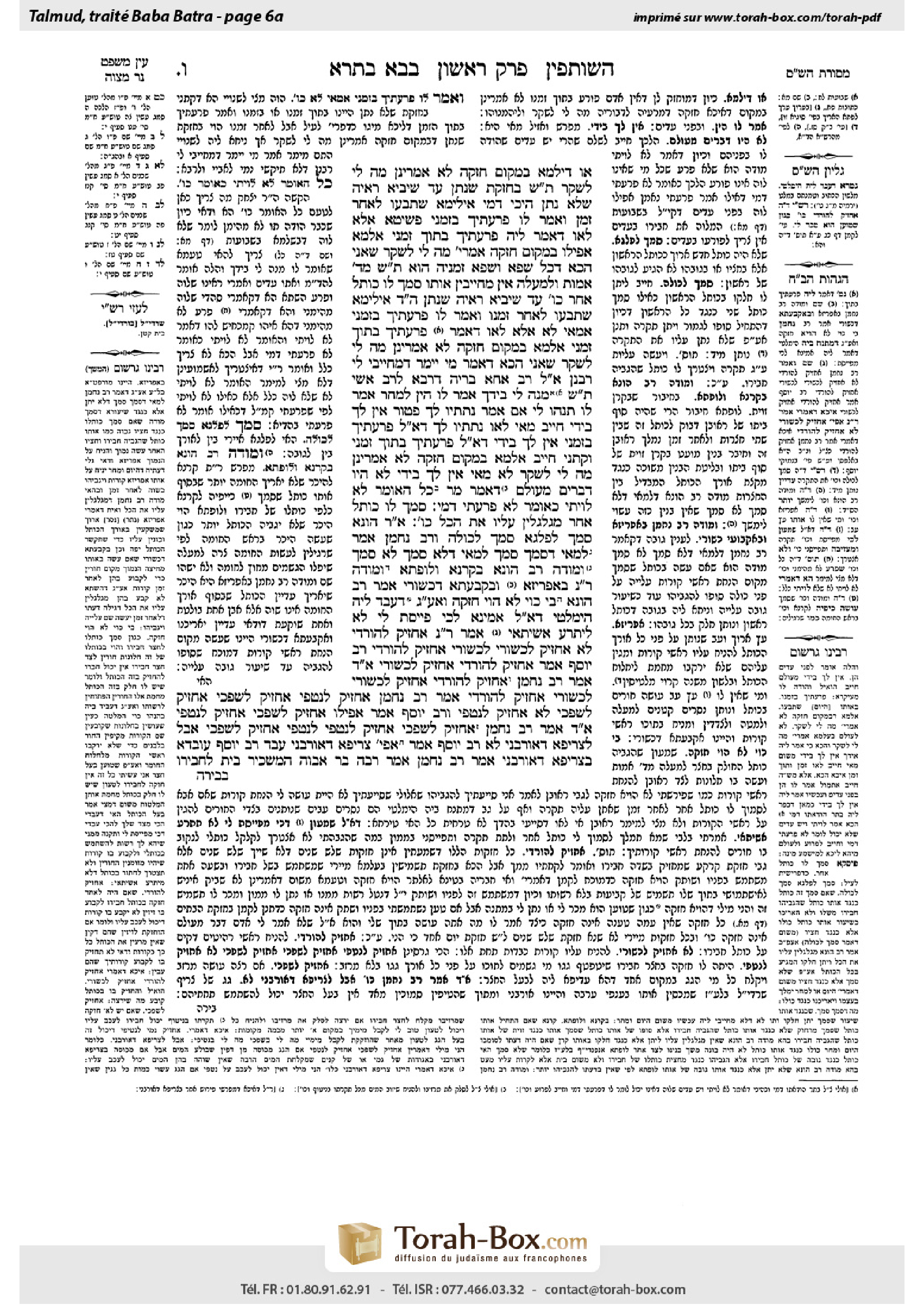
Bava Batra 6a: Talmud study for Daf Yomi
Study the Talmud for Daf Yomi with scanned pages, Hebrew text, English translations from Sefaria and AI-generated French translations.
Passage selection and English or AI-generated French translation are available where the scan has annotations. Daf Study is independent of Torah-Box and Sefaria.
Browse Bava Batra · בבא בתרא · All tractatesBava Batra 6a text and translations
This page of Bava Batra includes the Aramaic text, an English translation and an AI-generated French translation, alongside the scan above.
בבא בתרא ו׳ א · Aramaic and Hebrew text
אוֹ דִילְמָא, בִּמְקוֹם חֲזָקָה – לָא אָמְרִינַן ״מַה לִּי לְשַׁקֵּר״? תָּא שְׁמַע: בְּחֶזְקַת שֶׁנָּתַן, עַד שֶׁיָּבִיא רְאָיָה שֶׁלֹּא נָתַן.
הֵיכִי דָמֵי? אִילֵּימָא שֶׁתְּבָעוֹ לְאַחַר זְמַן, וְאָמַר לוֹ: ״פְּרַעְתִּיךָ בִּזְמַנִּי״, פְּשִׁיטָא! אֶלָּא לָאו דַּאֲמַר לֵיהּ: ״פְּרַעְתִּיךָ בְּתוֹךְ זְמַנִּי״? אַלְמָא אֲפִילּוּ בִּמְקוֹם חֲזָקָה, אָמְרִינַן ״מַה לִּי לְשַׁקֵּר״! שָׁאנֵי הָכָא, דְּכׇל שָׂפָא וְשָׂפָא זִמְנֵיהּ הוּא.
תָּא שְׁמַע: מֵאַרְבַּע אַמּוֹת וּלְמַעְלָה – אֵין מְחַיְּיבִין אוֹתוֹ. סָמַךְ לוֹ כּוֹתֶל אַחֵר כּוּ׳, עַד שֶׁיָּבִיא רְאָיָה שֶׁנָּתַן.
הֵיכִי דָמֵי? אִילֵּימָא שֶׁתְּבָעוֹ לְאַחַר זְמַנּוֹ, וְאָמַר לוֹ: ״פְּרַעְתִּיךָ בִּזְמַנִּי״, אַמַּאי לָא? אֶלָּא לָאו דְּאָמַר: ״פְּרַעְתִּיךָ בְּתוֹךְ זְמַנִּי״? אַלְמָא בִּמְקוֹם חֲזָקָה לָא אָמְרִינַן ״מַה לִּי לְשַׁקֵּר״! שָׁאנֵי הָכָא, דְּאָמַר: מִי יֵימַר דִּמְחַיְּיבִי לִי רַבָּנַן?
אֲמַר לֵיהּ רַב אַחָא בְּרֵיהּ דְּרָבָא לְרַב אָשֵׁי, תָּא שְׁמַע: ״מָנֶה לִי בְּיָדְךָ״, אָמַר לוֹ: ״הִין״. לְמָחָר אָמַר לוֹ: ״תְּנֵהוּ לִי״; אִם אָמַר: ״נְתַתִּיו לָךְ״ – פָּטוּר. ״אֵין לְךָ בְּיָדִי״ – חַיָּיב.
מַאי, לָאו ״נְתַתִּיו לָךְ״ – דַּאֲמַר לֵיהּ: ״פְּרַעְתִּיךָ בִּזְמַנִּי״; ״אֵין לְךָ בְּיָדִי״ – דַּאֲמַר לֵיהּ: ״פְּרַעְתִּיךָ בְּתוֹךְ זְמַנִּי״? וְקָתָנֵי: חַיָּיב; אַלְמָא בִּמְקוֹם חֲזָקָה – לָא אָמְרִינַן ״מַה לִּי לְשַׁקֵּר״! לָא; מַאי ״אֵין לְךָ בְּיָדִי״ – ״לֹא הָיוּ דְבָרִים מֵעוֹלָם״, דְּאָמַר מָר: כׇּל הָאוֹמֵר ״לֹא לָוִיתִי״ – כְּאוֹמֵר ״לֹא פָּרַעְתִּי״ דָּמֵי.
סָמַךְ לוֹ כּוֹתֶל אַחֵר – מְגַלְגְּלִין עָלָיו אֶת הַכֹּל כּוּ׳. אָמַר רַב הוּנָא: סְמַךְ לְפַלְגָא, סְמַךְ לְכוּלַּהּ. וְרַב נַחְמָן אָמַר: לְמַאי דִּסְמַךְ – סְמַךְ, לְמַאי דְּלָא סְמַךְ – לָא סְמַךְ.
וּמוֹדֶה רַב הוּנָא בְּקַרְנָא וְלוּפְתָּא. וּמוֹדֶה רַב נַחְמָן בְּאַפְרִיזָא, וּבִקְבַעְתָּא דִכְשׁוּרֵי.
אָמַר רַב הוּנָא: בֵּי כַוֵּי – לָא הָוֵי חֲזָקָה, וְאַף עַל גַּב דַּעֲבַד לֵיהּ הִימְלָטֵי. דְּאָמַר לֵיהּ, אָמֵינָא: לְכִי פָּיְיסַתְּ לִי, לָא לִיתְּרַע אֲשִׁיתַאי.
אָמַר רַב נַחְמָן: אַחְזֵיק לְהוּרְדֵי – לָא אַחְזֵיק לִכְשׁוּרֵי, לִכְשׁוּרֵי – אַחְזֵיק לְהוּרְדֵי. רַב יוֹסֵף אָמַר: אַחְזֵיק לְהוּרְדֵי – אַחְזֵיק לִכְשׁוּרֵי.
אִיכָּא דְּאָמְרִי, אָמַר רַב נַחְמָן: אַחְזֵיק לְהוּרְדֵי – אַחְזֵיק לִכְשׁוּרֵי, לִכְשׁוּרֵי – אַחְזֵיק לְהוּרְדֵי.
אָמַר רַב נַחְמָן: אַחְזֵיק לְנִטְפֵי – אַחְזֵיק לְשָׁפְכֵי, אַחְזֵיק לְשָׁפְכֵי – לָא אַחְזֵיק לְנִטְפֵי. וְרַב יוֹסֵף אָמַר: אֲפִילּוּ אַחְזֵיק לְשָׁפְכֵי – אַחְזֵיק לְנִטְפֵי.
אִיכָּא דְּאָמְרִי, אָמַר רַב נַחְמָן: אַחְזֵיק לְשָׁפְכֵי – אַחְזֵיק לְנִטְפֵי; לְנִטְפֵי – אַחְזֵיק לְשָׁפְכֵי, אֲבָל לִצְרִיפָא דְאוּרְבָּנֵי – לָא. רַב יוֹסֵף אָמַר: אֲפִילּוּ צְרִיפָא דְאוּרְבָּנֵי. עֲבַד רַב יוֹסֵף עוֹבָדָא בִּצְרִיפָא דְאוּרְבָּנֵי.
אָמַר רַב נַחְמָן אָמַר רַבָּה בַּר אֲבוּהּ: הַמַּשְׂכִּיר בַּיִת לַחֲבֵירוֹ
Bava Batra 6a · English translation
Or perhaps where there is a presumption against a person’s claim, we do not say that the borrower can claim: Why would I lie? The Gemara suggests: Come and hear a proof from the mishna: If after the wall was built one of the neighbors claims he alone constructed it and the other did not participate in its building, the latter is nevertheless presumed to have given his share of the money, unless the claimant brings proof that the other did not give his share.
The Gemara clarifies the matter: What are the circumstances of the case? If we say that one partner demanded that the other party pay the money after the time that the payment became due, i.e., after the wall was rebuilt, and the other partner said to him: I paid you at the time that the payment became due, it is obvious that he is presumed to have given him the money. Rather, is it not a case where he said to him: I paid you within the time, i.e., before the payment became due? Apparently, even where there is a presumption against a person’s claim, we say that the defendant can claim: Why would I lie? The Gemara rejects this proof: Here it is different, because the time to pay is upon the completion of each and every row. Therefore, it is as if he said: I paid you at the time that the payment became due.
The Gemara suggests: Come and hear another proof from the continuation of the mishna. The court does not obligate the reluctant neighbor to contribute to the building of the part of the wall that is above four cubits. But if the reluctant neighbor built another wall close to the wall that was built higher than four cubits, in order to set a roof over the room that was thereby created, the court imposes upon him the responsibility to pay his share for all of the rebuilt wall, even though he has not yet set a roof over it. If the builder of the first wall later claims that he did not receive payment from his neighbor, the neighbor is presumed not to have given his share of the money, unless he brings proof that he did in fact give money for the building of the wall.
The Gemara clarifies: What are the circumstances of the case? If we say that one partner demanded that the other party pay the money after the time that the payment became due, and he, the latter, said to him: I paid you at the time that the payment became due, why is he not deemed credible? Rather, is it not that he said: I paid you within the time, before the payment became due? And with regard to this case, the mishna states that he is not deemed credible. Apparently, where there is a presumption against a person’s claim, we do not say that the defendant can claim: Why would I lie? The Gemara rejects this proof: Here it is different, since the reluctant neighbor says: Who says that the Rabbis will obligate me to pay for this additional part of the wall? In such a case he certainly does not pay before the payment becomes due. The mishna does not provide a proof one way or the other.
Rav Aḥa, son of Rava, said to Rav Ashi: Come and hear a proof from what is taught in a mishna (Shevuot 38b): If one said to another: I have one hundred dinars in your possession, and the other one said to him in the presence of witnesses: Yes, that is so; and the next day the lender said to the borrower: Give me the money that you owe me, the halakha is as follows: If the borrower said: I already gave it to you, he is exempt. But if he said: Nothing of yours is in my possession, he is liable.
The Gemara clarifies the matter: What, is it not that when he says: I already gave it to you, he is saying to him: I repaid you at the time that the payment became due; and when he says: Nothing of yours is in my possession, he is saying to him: I repaid you within the time, before the payment became due? And yet, the mishna teaches with regard to the latter case that he is liable. Apparently, where there is a presumption against a person’s claim, we do not say that the borrower can claim: Why would I lie? The Gemara rejects this proof: No, what does he mean when he says: Nothing of yours is in my possession? He is saying: There were never such matters; i.e., the purported loan never occurred. As the Master says: Anyone who says: I did not borrow, is treated as one who says: I did not repay, and since it is known by his own admission that he borrowed money, he is liable to pay.
§ The mishna teaches: But if the reluctant neighbor built another wall close to the wall that was built higher than four cubits, in order to set a roof over the room that was thereby created, the court imposes upon him the responsibility to pay his share for all of the rebuilt wall. Rav Huna says: If he built another wall close to the first wall that was half the length or the height of the wall that was built higher than four cubits, it is as if he built it close to the height and length of the entire wall. Since he can easily add to his wall so that it will be equal in length or height to the wall the neighbor rebuilt, he must therefore pay half the cost of the entire rebuilt wall. And Rav Naḥman says: With regard to that which he built close, he built it close; with regard to that which he did not build close, he did not yet build it close. Accordingly, he is required to pay an additional share only for the part of the wall corresponding to the new wall he built.
And Rav Huna concedes with regard to an attachment to the corner of his house that he is not required to pay half the cost of the entire rebuilt wall. If he built the extension of his house in this manner, it is not considered as if he built it close to the entire wall, as it is unlikely that he will add to it. And Rav Naḥman concedes that in a case in which he places a heavy beam [be’afriza] on the wall that can support a roof, or carves into the wall indentations to fix beams in place, then even if he has not yet made use of the entire height of the wall, he has demonstrated his desire to do so in the future, and therefore he must pay half the cost of the entire wall.
§ The mishna teaches that if the builder of the first wall later claims that he did not receive payment from his neighbor, the neighbor is presumed not to have given his share of the money, unless he brings proof that he did in fact give money for the building of the wall. Rav Huna says: Even if openings in the wall were built on the side facing the reluctant partner and these openings are suited to serve as beam rests, this does not create a presumption that the reluctant partner contributed his share to the building of the wall. And this is the halakha even if the builder of the wall made sills for these openings. As the builder of the wall can say to his neighbor: I said to myself that when you will appease me and pay me for the construction of the wall, you might want to attach beams to it, and I do not want the foundations of my wall to be damaged by your fashioning new openings in it. Therefore, from the outset, I built the wall with these openings.
With regard to the use of a neighbor’s wall, Rav Naḥman says: If one acquired the privilege to place thin beams on his neighbor’s wall, i.e., if one had used the wall in that manner in the past and the owner did not protest, so the one using it can maintain that he had acquired from the owner the right to do so, he has not acquired the privilege to place thick beams there. But if he acquired the privilege to place thick beams on the wall, he has acquired the privilege to place thin beams there. Rav Yosef says: If he acquired the privilege to place thin beams, he also has acquired the privilege to place thick beams.
There are those who say that Rav Naḥman says: If one acquired the privilege to place thin beams on his neighbor’s wall, he has acquired the privilege to place thick beams there; and if he acquired the privilege to place thick beams, he has acquired the privilege to place thin beams. This version of Rav Naḥman’s statement accords with the statement of Rav Yosef.
With regard to a similar matter, Rav Naḥman says: If one acquired the privilege to let water drip from his roof into his neighbor’s courtyard, he has acquired the privilege to let the water pour there through a drainpipe. If the neighbor did not protest about the water dripping from the roof into his courtyard, he would certainly allow him to build a drainpipe, which would limit the water to a single place. But if he acquired the privilege to let the water pour through a drainpipe into his neighbor’s courtyard, he has not acquired the privilege to let water drip there from his roof. And Rav Yosef says: Even if he acquired the privilege to let water pour there through a drainpipe, he also has acquired the privilege to let water drip there from his roof.
There are those who say that Rav Naḥman said: If one acquired the privilege to let water pour through a drainpipe into his neighbor’s courtyard, he has acquired the privilege to let water drip there from his roof; and if he acquired the privilege to let water drip from his roof into his neighbor’s courtyard, he has acquired the privilege to let water pour there through a drainpipe. But he has not acquired the privilege to let water drip from a hut whose roof is composed of willow branches into his neighbor’s courtyard. Rav Yosef said: He has acquired the privilege to let water drip there even from a hut whose roof is composed of willow branches. The Gemara comments: Rav Yosef performed an action, i.e., issued a practical ruling, with regard to a hut whose roof is composed of willow branches, allowing the neighbor to let water drip from there after he had acquired the privilege to use a drainpipe.
Rav Naḥman says that Rabba bar Avuh says: If one rents a room to another
Bava Batra 6a · Traduction française (IA)
Peut-être que dans un cas où il y a une présomption contre la revendication d'une personne, nous ne disons pas que le prêteur puisse affirmer : Pourquoi mentirais-je ? La Guemara suggère : Venez écouter une preuve tirée de la Michna : Si après que le mur ait été construit, l'un des voisins affirme qu'il a seul construit le mur et que l'autre n'a pas participé à sa construction, le second est néanmoins présomptionnellement considéré comme ayant donné sa part d'argent, à moins que le plaignant ne produise une preuve selon laquelle l'autre n'a pas donné sa part.
La Guemara clarifie la question : Quelles sont les circonstances du cas ? Si nous disons qu'un partenaire exigeait que l'autre paie l'argent après le délai prévu, c'est-à-dire après que le mur ait été reconstruit, et que l'autre partenaire lui dit : J'ai payé à l'époque où le paiement était dû, il est évident qu'il est présomptionnellement considéré comme ayant donné l'argent. Plutôt, n'est-ce pas un cas où il dit : J'ai payé à l'intérieur du délai, c'est-à-dire avant que le paiement ne soit dû ? Apparemment, même dans un cas où il y a une présomption contre la revendication d'une personne, nous disons que le défendeur peut affirmer : Pourquoi mentirais-je ? La Guemara rejette cette preuve : Ici, c'est différent, car le délai de paiement est au terme de chaque rangée. Par conséquent, c'est comme s'il disait : J'ai payé à l'époque où le paiement était dû.
La Guemara suggère : Venez écouter une autre preuve tirée de la continuation de la Michna. La cour ne charge pas le voisin réticent de contribuer à la construction de la partie du mur qui dépasse quatre cubits. Mais si le voisin réticent construit un autre mur à proximité du mur qui dépasse quatre cubits, afin de créer un toit sur la pièce ainsi formée, la cour impose à lui de payer sa part pour l'ensemble du mur reconstruit, même s'il n'a pas encore posé de toit. Si le constructeur du premier mur affirme plus tard qu'il n'a pas reçu de paiement de son voisin, le voisin est présomptionnellement considéré comme n'ayant pas donné sa part d'argent, à moins qu'il ne produise une preuve selon laquelle il a effectivement versé de l'argent pour la construction du mur.
La Guemara clarifie : Quelles sont les circonstances du cas ? Si nous disons qu'un partenaire exigeait que l'autre paie l'argent après le délai prévu, et qu'il, le second, lui dit : J'ai payé à l'époque où le paiement était dû, pourquoi n'est-il pas considéré comme crédible ? Plutôt, n'est-ce pas que il dit : J'ai payé à l'intérieur du délai, avant que le paiement ne soit dû ? Et concernant ce cas, la Michna indique qu'il n'est pas considéré comme crédible. Apparemment, dans un cas où il y a une présomption contre la revendication d'une personne, nous ne disons pas que le défendeur puisse affirmer : Pourquoi mentirais-je ? La Guemara rejette cette preuve : Ici, c'est différent, car le voisin réticent dit : Qui dit que les Sages m'obligent à payer pour cette partie supplémentaire du mur ? Dans ce cas, il ne paie certainement pas avant que le paiement ne soit dû. La Michna ne fournit pas de preuve dans un sens ou dans l'autre.
Rav Acha, fils de Rava, dit à Rav Ashi : Venez écouter une preuve tirée de ce qui est enseigné dans une Michna (Shevuot 38b) : Si l'un dit à l'autre : J'ai cent dinars en votre possession, et l'autre dit à lui, en présence de témoins : Oui, c'est ainsi ; et le lendemain, le prêteur dit au prêteur : Donnez-moi l'argent que vous me devez, la halakha est la suivante : Si le prêteur dit : J'ai déjà donné l'argent, il est exempt. Mais si il dit : Rien de vôtre n'est en mon possession, il est responsable.
La Guemara clarifie la question : Qu'est-ce que cela signifie, quand il dit : J'ai déjà donné l'argent, il dit à lui : J'ai remboursé à l'époque où le paiement était dû ; et quand il dit : Rien de vôtre n'est en mon possession, il dit à lui : J'ai remboursé à l'intérieur du délai, avant que le paiement ne soit dû ? Et pourtant, la Michna enseigne que dans ce dernier cas, il est responsable. Apparemment, dans un cas où il y a une présomption contre la revendication d'une personne, nous ne disons pas que le prêteur puisse affirmer : Pourquoi mentirais-je ? La Guemara rejette cette preuve : Non, que veut-il dire quand il dit : Rien de vôtre n'est en mon possession ? Il dit : Il n'y a jamais eu de tels affaires ; c'est-à-dire que le prêt n'a jamais eu lieu. Comme le Maître dit : Quiconque dit : Je n'ai pas emprunté, est traité comme celui qui dit : Je n'ai pas remboursé, et puisque c'est connu par son propre aveu qu'il a emprunté de l'argent, il est responsable de le rembourser.
§ La Michna enseigne : Mais si le voisin réticent construit un autre mur à proximité du mur qui dépasse quatre cubits, afin de créer un toit sur la pièce ainsi formée, la cour impose à lui la responsabilité de payer sa part pour l'ensemble du mur reconstruit. Rav Huna dit : Si le voisin construit un autre mur à proximité du premier mur, dont la longueur ou la hauteur est la moitié du mur qui dépasse quatre cubits, c'est comme s'il avait construit à proximité de la hauteur et de la longueur du mur entier. Puisqu'il peut facilement ajouter à son mur afin qu'il soit égal en longueur ou en hauteur au mur que le voisin a reconstruit, il doit donc payer la moitié du coût de l'ensemble du mur reconstruit. Et Rav Naḥman dit : Concernant ce qu'il a construit à proximité, il l'a construit à proximité ; concernant ce qu'il n'a pas construit à proximité, il n'a pas encore construit à proximité. Ainsi, il est tenu de payer une part supplémentaire uniquement pour la partie du mur correspondant au mur qu'il a construit.
Et Rav Huna reconnaît que concernant une extension au coin de sa maison, il n'est pas tenu de payer la moitié du coût de l'ensemble du mur reconstruit. Si il a construit l'extension de sa maison ainsi, cela n'est pas considéré comme s'il avait construit à proximité du mur entier, car il est peu probable qu'il l'ajoute. Et Rav Naḥman reconnaît que dans un cas où il place une poutre lourde [be’afriza] sur le mur qui peut supporter un toit, ou qu'il taille des entailles dans le mur pour fixer des poutres, alors même s'il n'a pas encore utilisé l'ensemble de la hauteur du mur, il a démontré son désir de le faire à l'avenir, et par conséquent, il doit payer la moitié du coût du mur entier.
§ La Michna enseigne que si le constructeur du premier mur affirme ultérieurement ne pas avoir reçu de paiement de son voisin, le voisin est considéré comme n'ayant pas donné sa part d'argent, à moins qu'il ne fournisse une preuve qu'il a effectivement versé de l'argent pour la construction du mur. Rav Huna dit : Même si des ouvertures dans le mur ont été construites du côté visant le partenaire réticent et que ces ouvertures sont adaptées à servir de supports pour des poutres, cela ne crée pas de présomption que le partenaire réticent a contribué sa part à la construction du mur. Et c'est ainsi que la halakha est même si le constructeur du mur a construit des sills pour ces ouvertures. Comme le constructeur du mur peut dire à son voisin : Je me suis dit que lorsque tu viendras me rassurer et me payer pour la construction du mur, tu pourrais vouloir attacher des poutres à ce mur, et je n'ai pas envie que les fondations de mon mur ne soient endommagées par ton façonnage d'ouvertures nouvelles dans ce mur. Ainsi, dès le départ, j'ai construit ce mur avec ces ouvertures.
En ce qui concerne l'utilisation d'un mur du voisin, Rav Naḥman dit : Si l'on a acquis le privilège de poser des poutres fines sur le mur de son voisin, c'est-à-dire si l'on a utilisé le mur ainsi par le passé et que l'propriétaire n'a pas protesté, de sorte que l'utilisateur peut affirmer avoir acquis du propriétaire le droit de le faire, il n'a pas acquis le privilège de poser des poutres épaisses là. Mais si l'on a acquis le privilège de poser des poutres épaisses sur le mur, l'on a acquis le privilège de poser des poutres fines là. Rav Yosef dit : Si l'on a acquis le privilège de poser des poutres fines, l'on a aussi acquis le privilège de poser des poutres épaisses là.
Certains disent que Rav Naḥman dit : Si l'on a acquis le privilège de poser des poutres fines sur le mur de son voisin, l'on a acquis le privilège de poser des poutres épaisses là ; et si l'on a acquis le privilège de poser des poutres épaisses, l'on a acquis le privilège de poser des poutres fines là. Cette version de l'affirmation de Rav Naḥman correspond à celle de Rav Yosef.
En ce qui concerne une affaire similaire, Rav Naḥman dit : Si l'on a acquis le privilège de laisser couler de l'eau de son toit dans la cour de son voisin, l'on a acquis le privilège de laisser l'eau couler là par un gouttière. Si le voisin n'a pas protesté contre le fait que l'eau coule de son toit dans sa cour, il permettrait certainement à l'autre de construire une gouttière, ce qui limiterait l'eau à un seul endroit. Mais si l'on a acquis le privilège de laisser l'eau couler par une gouttière dans la cour de son voisin, l'on n'a pas acquis le privilège de laisser l'eau couler de son toit là. Et Rav Yosef dit : Même si l'on a acquis le privilège de laisser l'eau couler là par une gouttière, l'on a aussi acquis le privilège de laisser l'eau couler de son toit là.
Certains disent que Rav Naḥman a dit : Si l'on a acquis le privilège de laisser l'eau couler par une gouttière dans la cour de son voisin, l'on a acquis le privilège de laisser l'eau couler de son toit là ; et si l'on a acquis le privilège de laisser l'eau couler de son toit dans la cour de son voisin, l'on a acquis le privilège de laisser l'eau couler là par une gouttière. Mais l'on n'a pas acquis le privilège de laisser l'eau couler d'une hutte dont le toit est composé de branches de saule dans la cour de son voisin. Rav Yosef a dit : L'on a acquis le privilège de laisser l'eau couler là même d'une hutte dont le toit est composé de branches de saule. La Guemara commente : Rav Yosef a accompli une action, c'est-à-dire a émis un jugement pratique, concernant une hutte dont le toit est composé de branches de saule, permettant au voisin de laisser l'eau couler d'ici après qu'il ait acquis le privilège d'utiliser une gouttière.
Rav Naḥman dit que Rabba bar Avuh dit : Si l'on loue une pièce à un autre
Traduction française générée par IA à partir de l’édition anglaise de Sefaria. Vérifie toujours un passage avec le texte source.
Text from Sefaria: William Davidson Edition - Vocalized Aramaic (CC BY NC); William Davidson Edition - English (CC BY NC).