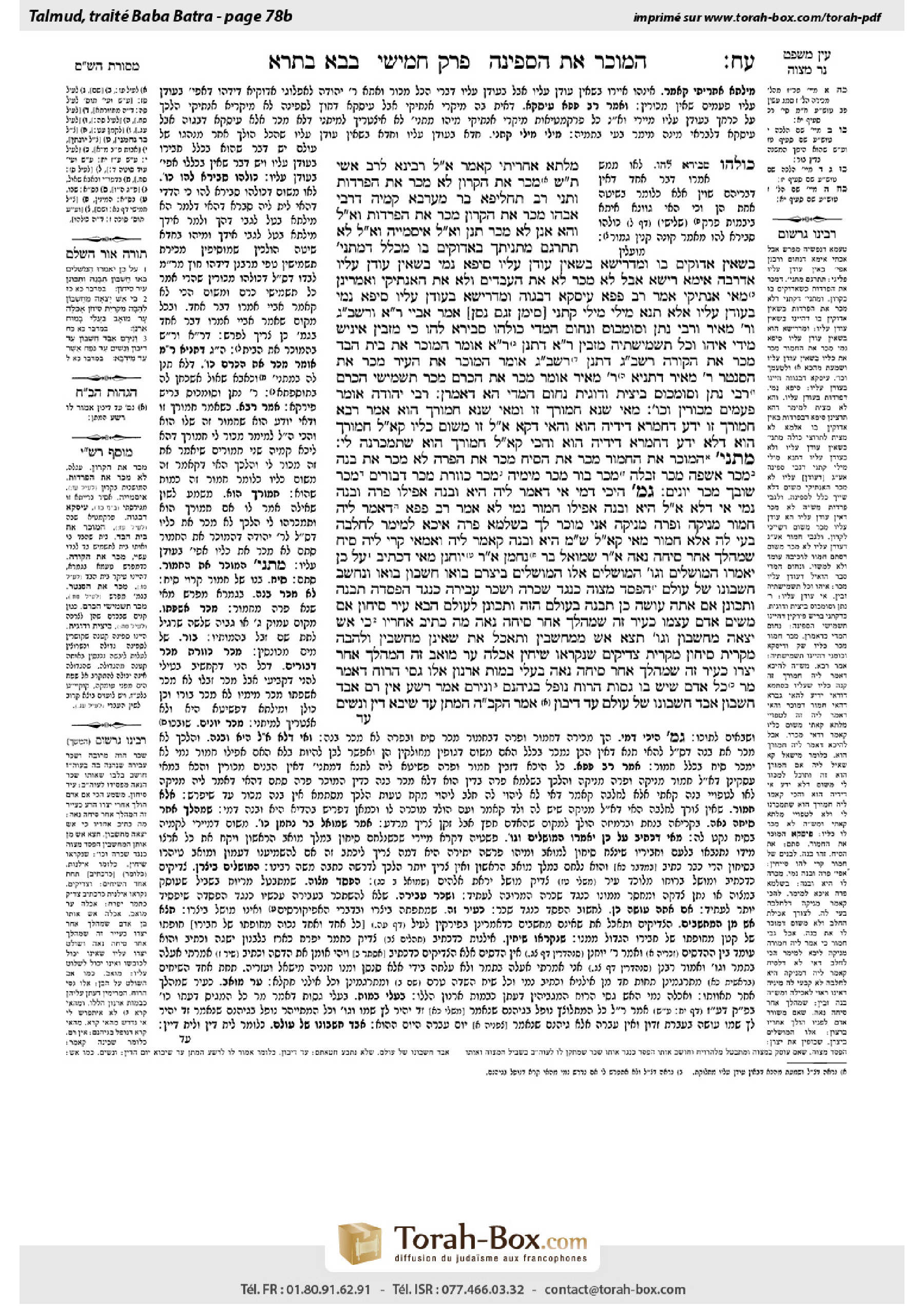
Bava Batra 78b: Talmud study for Daf Yomi
Study the Talmud for Daf Yomi with scanned pages, Hebrew text, English translations from Sefaria and AI-generated French translations.
Passage selection and English or AI-generated French translation are available where the scan has annotations. Daf Study is independent of Torah-Box and Sefaria.
Browse Bava Batra · בבא בתרא · All tractatesBava Batra 78b text and translations
This page of Bava Batra includes the Aramaic text, an English translation and an AI-generated French translation, alongside the scan above.
בבא בתרא ע״ח ב · Aramaic and Hebrew text
מִלְּתָא אַחֲרִיתִי קָאָמַר.
אֲמַר לֵיהּ רָבִינָא לְרַב אָשֵׁי, תָּא שְׁמַע: מָכַר אֶת הַקָּרוֹן – לֹא מָכַר אֶת הַפְּרָדוֹת. וְתָנֵי רַב תַּחְלִיפָא בַּר מַעְרְבָא קַמֵּיהּ דְּרַבִּי אֲבָהוּ: מָכַר אֶת הַקָּרוֹן – מָכַר אֶת הַפְּרָדוֹת. וַאֲמַר לֵיהּ: וְהָא אֲנַן ״לֹא מָכַר״ תְּנַן! וַאֲמַר לֵיהּ: אִיסְמְיַיהּ? וַאֲמַר לֵיהּ: לָא, תִּתַּרְגֵּם מַתְנִיתָךְ בַּאֲדוּקִים בּוֹ.
מִכְּלָל דְּמַתְנִיתִין בְּשֶׁאֵין אֲדוּקִים בּוֹ; וּמִדְּרֵישָׁא בְּשֶׁאֵין עוֹדָן עָלָיו – סֵיפָא נָמֵי בְּשֶׁאֵין עוֹדָן עָלָיו!
אַדְּרַבָּה – אֵימָא רֵישָׁא: אֲבָל לֹא מָכַר לֹא אֶת הָעֲבָדִים וְלֹא אֶת הָאַנְתִיקֵי. וְאָמְרִינַן, מַאי ״אַנְתִיקֵי״? אָמַר רַב פָּפָּא: עִיסְקָא דִּבְגַוַּהּ. וּמִדְּרֵישָׁא בְּעוֹדָן עָלָיו. סֵיפָא נָמֵי בְּעוֹדָן עָלָיו! אֶלָּא תְּנָא – מִילֵּי מִילֵּי קָתָנֵי.
[סִימָן: זַגָּם, נִסָּן] אָמַר אַבָּיֵי: רַבִּי אֱלִיעֶזֶר, וְרַבָּן שִׁמְעוֹן בֶּן גַּמְלִיאֵל, וְרַבִּי מֵאִיר, וְרַבִּי נָתָן, וְסוֹמְכוֹס, וְנַחוּם הַמָּדִי – כּוּלְּהוּ סְבִירָא לְהוּ: כִּי מְזַבֵּין אִינִישׁ מִידֵּי, אִיהוּ וְכֹל תַּשְׁמִישְׁתֵּיהּ מְזַבֵּין.
רַבִּי אֱלִיעֶזֶר – דִּתְנַן, רַבִּי אֱלִיעֶזֶר אוֹמֵר: הַמּוֹכֵר אֶת בֵּית הַבַּד – מָכַר אֶת הַקּוֹרָה. רַבָּן שִׁמְעוֹן בֶּן גַּמְלִיאֵל – דִּתְנַן, רַבָּן שִׁמְעוֹן בֶּן גַּמְלִיאֵל אוֹמֵר: הַמּוֹכֵר אֶת הָעִיר – מָכַר אֶת הַסַּנְטֵר. רַבִּי מֵאִיר – דְּתַנְיָא, רַבִּי מֵאִיר אוֹמֵר: מָכַר אֶת הַכֶּרֶם – מָכַר תַּשְׁמִישֵׁי הַכֶּרֶם. רַבִּי נָתָן וְסוֹמְכוֹס – בִּיצִּית וְדוּגִית. נַחוּם הַמָּדִי – הָא דַּאֲמַרַן.
רַבִּי יְהוּדָה אוֹמֵר: פְּעָמִים מְכוּרִין וְכוּ׳. מַאי שְׁנָא ״חֲמוֹרְךָ זוֹ״, וּמַאי שְׁנָא ״חֲמוֹרְךָ הוּא״?
אָמַר רָבָא: ״חֲמוֹרְךָ זוֹ״ – יָדַע דַּחֲמָרָא דִידֵיהּ הוּא, וְהַאי דְּקָא אָמַר לֵיהּ: ״זוֹ״ – מִשּׁוּם כֵּלָיו קָאָמַר לֵיהּ. ״חֲמוֹרְךָ הוּא״ – דְּלָא יֵדַע דַּחֲמָרָא דִידֵיהּ הוּא, וְהָכִי קָאָמַר לֵיהּ: חֲמוֹרְךָ הוּא – שֶׁתִּמְכְּרֶנָּה לִי?
מַתְנִי׳ הַמּוֹכֵר אֶת הַחֲמוֹר – מָכַר אֶת הַסְּיָח. מָכַר אֶת הַפָּרָה – לֹא מָכַר אֶת בְּנָהּ. מָכַר אַשְׁפָּה – מָכַר זִבְלָהּ. מָכַר בּוֹר – מָכַר מֵימֶיהָ. מָכַר כַּוֶּורֶת – מָכַר דְּבוֹרִים. מָכַר שׁוֹבָךְ – מָכַר יוֹנִים.
גְּמָ׳ הֵיכִי דָמֵי? אִי דְּאָמַר לֵיהּ: ״הִיא וּבְנָהּ״ – אֲפִילּוּ פָּרָה וּבְנָהּ נָמֵי! אִי דְּלָא אָמַר לֵיהּ ״הִיא וּבְנָהּ״ – אֲפִילּוּ חֲמוֹר נָמֵי לָא!
אָמַר רַב פָּפָּא: דְּאָמַר לֵיהּ: ״חֲמוֹר מְנִיקָה וּפָרָה מְנִיקָה אֲנִי מוֹכֵר לָךְ״; בִּשְׁלָמָא פָּרָה – אִיכָּא לְמֵימַר לַחֲלָבָהּ בָּעֵי לַהּ; אֶלָּא חֲמוֹר – מַאי קָאָמַר לֵיהּ? שְׁמַע מִינַּהּ – הִיא וּבְנָהּ קָאָמַר לֵיהּ; וְאַמַּאי קָרֵי לֵיהּ ״סְיָח״ – שֶׁמְּהַלֵּךְ אַחַר סִיחָה נָאָה.
אָמַר רַבִּי שְׁמוּאֵל בַּר נַחְמָן אָמַר רַבִּי יוֹחָנָן, מַאי דִּכְתִיב: ״עַל כֵּן יֹאמְרוּ הַמֹּשְׁלִים וְגוֹ׳״?
״הַמֹּשְׁלִים״ – אֵלּוּ הַמּוֹשְׁלִים בְּיִצְרָם. ״בּוֹאוּ חֶשְׁבּוֹן״ – בּוֹאוּ וּנְחַשֵּׁב חֶשְׁבּוֹנוֹ שֶׁל עוֹלָם; הֶפְסֵד מִצְוָה כְּנֶגֶד שְׂכָרָהּ, וּשְׂכַר עֲבֵירָה כְּנֶגֶד הֶפְסֵדָהּ.
״תִּבָּנֶה וְתִכּוֹנֵן״ – אִם אַתָּה עוֹשֶׂה כֵּן, תִּבָּנֶה בָּעוֹלָם הַזֶּה וְתִכּוֹנֵן לָעוֹלָם הַבָּא. ״עִיר סִיחוֹן״ – אִם מֵשִׂים אָדָם עַצְמוֹ כְּעַיִר זֶה, שֶׁמְּהַלֵּךְ אַחַר סִיחָה נָאָה – מָה כְּתִיב אַחֲרָיו? ״כִּי אֵשׁ יָצְאָה מֵחֶשְׁבּוֹן וְגוֹ׳״ – תֵּצֵא אֵשׁ מִמְּחַשְּׁבִין, וְתֹאכַל אֶת שֶׁאֵינָן מְחַשְּׁבִין.
״וְלֶהָבָה מִקִּרְיַת סִיחֹן״ – מִקִּרְיַת צַדִּיקִים שֶׁנִּקְרְאוּ ״שִׂיחִין״. ״אָכְלָה עָר מוֹאָב״ – זֶה הַמְהַלֵּךְ אַחַר יִצְרוֹ, כְּעַיִר זֶה שֶׁמְּהַלֵּךְ אַחַר סִיחָה נָאָה. ״בַּעֲלֵי בָּמוֹת אַרְנֹן״ – אֵלּוּ גַּסֵּי הָרוּחַ, דְּאָמַר מָר: כׇּל אָדָם שֶׁיֵּשׁ בּוֹ גַּסּוּת הָרוּחַ, נוֹפֵל בְּגֵיהִנָּם.
״וַנִּירָם״ – אָמַר רָשָׁע: אֵין רָם, ״אָבַד חֶשְׁבּוֹן״ – אָבַד חֶשְׁבּוֹנוֹ שֶׁל עוֹלָם; ״עַד דִּיבֹן״ – אָמַר הַקָּדוֹשׁ בָּרוּךְ הוּא: הַמְתֵּן עַד שֶׁיָּבֹא דִּין, ״וַנַּשִּׁים
Bava Batra 78b · English translation
was speaking of a different matter and was not necessarily addressing the same case discussed in the beginning of the mishna.
Ravina said to Rav Ashi: Come and hear a resolution of the dilemma, as it was taught in the previous mishna: If one sold a wagon he has not sold the mules that pull the wagon. And Rav Taḥlifa, from the West, i.e., Eretz Yisrael, taught a baraita before Rabbi Abbahu: If one sold a wagon, he has sold the mules along with it. And Rabbi Abbahu said to him: But didn’t we learn in the mishna that he has not sold the mules? And Rav Taḥlifa said to him: Should I erase this baraita? And Rabbi Abbahu said to him: No, you should explain that your baraita is referring to a case where the mules are fastened to the wagon.
One can learn by inference from Rabbi Abbahu’s statement that the mishna is referring to a situation where the mules are not fastened to the wagon. And since the first clause, i.e., the previous mishna, is referring to a case corresponding to where the vessels are not on the donkey, i.e., the mules are not fastened to the wagon, the latter clause, the mishna here, must also be referring to a situation where the vessels are not on the donkey.
The Gemara rejects this proof: On the contrary, say the first clause, i.e., the preceding mishna: One who sells a ship sells the mast along with it, but he has not sold either the slaves or the antikei. And we said: What is the meaning of antikei? Rav Pappa said: It means the merchandise that is in the ship. But according to your logic, since the first clause, i.e., the mishna concerning the ship, is referring to a case where the merchandise is on the ship, the latter clause, the mishna here, must also be referring to a case where the vessels are on the donkey. Rather, the tanna teaches each statement individually, and the circumstances of one ruling do not prove that another ruling is referring to a parallel case.
The Gemara provides a mnemonic based on the letters of the names of the tanna’im who appear here: Zayin, gimmel, mem; nun, samekh, nun. Abaye said: Rabbi Eliezer, and Rabban Shimon ben Gamliel, and Rabbi Meir, and Rabbi Natan, and Sumakhos, and Naḥum the Mede all hold that when a person sells an item, he sells it and all of its accoutrements.
Rabbi Eliezer holds this, as we learned in a mishna (67b) that Rabbi Eliezer says: One who sells an olive press has sold the beam used for pressing the olives, despite the fact that the beam can be removed from the press. Rabban Shimon ben Gamliel holds this, as we learned in a mishna (68b) that Rabban Shimon ben Gamliel says: One who sells a city has sold the city’s guardsman. Rabbi Meir holds this, as it is taught in a baraita that Rabbi Meir says: If one sold a vineyard, he has sold the accoutrements of the vineyard. Rabbi Natan and Sumakhos hold this, as they state with regard to the bitzit and the dugit, i.e., the light-going boats of the ship, which they claim are sold when the ship is sold (73a). Naḥum the Mede holds this, as is evident from that which we said in the mishna here.
§ The mishna teaches that Rabbi Yehuda says: There are times when the vessels are sold, and there are times when they are not sold. How so? If the donkey was before him and its vessels were on it, and the buyer said to him: Sell me this donkey of yours, its vessels are sold. If the buyer said: Is the donkey yours? I wish to purchase it, its vessels are not sold. The Gemara asks: What is different in a case where the buyer said: Sell me this donkey of yours, and what is different in a case where he said: Is the donkey yours?
Rava said that when the buyer says: Sell me this donkey of yours, he knows that the donkey belongs to the seller, and as for that which he said to him: This, he said that to him due to its vessels. By contrast, when the buyer says: Is the donkey yours, this indicates that the buyer does not know that the donkey belongs to the seller, and this is what he is saying to him: Is the donkey yours that you can sell it to me? In this case, he is interested only in the donkey and not its vessels.
MISHNA: One who sells a female donkey has sold its foal along with it. But one who sold a cow has not sold its young. One who sold a dunghill has sold its manure. One who sold a cistern has sold its water. One who sold a beehive has sold the bees in it, and likewise one who sold a dovecote has sold the doves.
GEMARA: The mishna teaches that if one sells a donkey he has sold its foal, but if one sells a cow he has not sold its calf. The Gemara asks: What are the circumstances? If this is a case where the seller says to the buyer that he is selling it and its young, even the cow and its young should be sold as well. If this is a case where he does not say to him that he is selling it and its young, even the donkey should not be sold with its foal.
Rav Pappa said: This is referring to a case where the seller said to the buyer: I am selling you a nursing donkey, or: I am selling you a nursing cow. Granted, with regard to the cow, one could say that he needs it for its milk, and the suckling calf would not necessarily be included in the sale. But with regard to the donkey, for what reason is he saying to him that the donkey is nursing? Since he does not need the milk of a donkey, learn from here that he is saying to him that he is selling it and its young. The Gemara adds tangentially: And why does the mishna call a donkey foal a seyaḥ? It is because it follows after and obeys pleasant talk [siḥa], whereas an old donkey must be led forcibly.
The Gemara cites a related discussion. Rabbi Shmuel bar Naḥman says that Rabbi Yoḥanan says: What is the meaning of that which is written: “Therefore they that speak in parables [hamoshlim] say: Come to Heshbon! Let the city [ir] of Sihon be built and established! For a fire is gone out of Heshbon, a flame from the city of Sihon; it has devoured Ar of Moab, the lords of the high places of Arnon” (Numbers 21:27–28)?
The Gemara interprets these verses homiletically. “Hamoshlim”; these are the people who rule over [hamoshlim] their evil inclination. They will say: “Come to Heshbon,” meaning: Come and let us calculate the account of [ḥeshbono] the world, i.e., the financial loss incurred by the fulfillment of a mitzva in contrast to its reward, and the reward for committing a transgression, i.e., the pleasure and gain received, in contrast to the loss it entails.
“Let it be built and established” means that if you make this calculation, you will be built in this world and you will be established in the World-to-Come. The phrase “city [ir] of Sihon” means that if a person fashions himself like this young donkey [ayir] that follows after pleasant talk [siḥa], i.e., if one is easily tempted to listen to his inclination, what is written after it? “For a fire is gone out of Heshbon…it has devoured,” i.e., a fire will go out from those who calculate the effect of their deeds in the world, and will consume those who do not calculate and examine their ways but instead do as they please.
A similar interpretation applies to the continuation of the verse: “A flame from the city of Sihon”; this means that a flame will come from the city of righteous people, who are called trees [siḥin]. “It has devoured Ar of Moab”; this is referring to one who follows after his inclination like this young donkey [ayir] that follows after pleasant talk. “The lords of the high places of Arnon”; this is referring to the arrogant. As the Master says: Every person who has arrogance in him will fall into Gehenna.
The Gemara interprets a subsequent verse: “We have shot at them [vanniram], Heshbon is perished, even until Dibon, and we have laid waste even until Nophah, which reaches until Medeba” (Numbers 21:30). “Vanniram”; this indicates that the wicked person says: There is no higher [ein ram] power governing the world. “Heshbon is perished” means: The account [ḥeshbon] of the world has perished, i.e., they claim there is no accountability for one’s actions. “Even until Dibon [divon]”; the Holy One, Blessed be He, says: Wait until judgment comes [yavo din]. “And we have laid waste
Bava Batra 78b · Traduction française (IA)
Il parlait d'une autre question et ne s'adressait pas nécessairement au même cas discuté au début de la mitsna.
Ravina dit à Rav Ashi : Viens écouter une résolution de ce dilemme, car cela a été enseigné dans la mitsna précédente : Si l'on vend une charrette, l'on n'a pas vendu les mules qui la tractent. Et Rav Taḥlifa, du West, c'est-à-dire d'Israël, a enseigné une baraïta avant Rabbi Abbahu : Si l'on vend une charrette, l'on a vendu les mules avec elle. Et Rabbi Abbahu dit à lui : Mais n'avons-nous pas appris dans la mitsna que l'on n'avait pas vendu les mules ? Et Rav Taḥlifa dit à lui : Dois-je effacer cette baraïta ? Et Rabbi Abbahu dit à lui : Non, tu dois expliquer que ta baraïta fait référence à un cas où les mules sont attachées à la charrette.
On peut en déduire par l'inférence de la déclaration de Rabbi Abbahu que la mitsna fait référence à un cas où les mules ne sont pas attachées à la charrette. Et puisque la première clause, c'est-à-dire la mitsna précédente, fait référence à un cas où les objets ne sont pas sur le âne, c'est-à-dire les mules ne sont pas attachées à la charrette, la seconde clause, la mitsna ici, doit aussi faire référence à un cas où les objets ne sont pas sur le âne.
La Guemara rejette cette preuve : Au contraire, disent les premières clauses, c'est-à-dire la mitsva précédente : Celui qui vend un navire vend le mât avec lui, mais il n'a pas vendu les esclaves ou les antikei. Et nous avons dit : Quelle est la signification des antikei ? Rav Pappa dit : Cela signifie les marchandises qui sont dans le navire. Mais selon votre logique, puisque la première clause, c'est-à-dire la mitsva concernant le navire, fait référence à un cas où les marchandises sont sur le navire, la seconde clause, la mitsva ici, doit aussi faire référence à un cas où les objets sont sur le âne. En réalité, le tanna enseigne chaque déclaration individuellement, et les circonstances d'une décision ne prouvent pas que l'autre décision fait référence à un cas parallèle.
La Guemara fournit un mnémonique basé sur les lettres des noms des tannaïm qui apparaissent ici : Zayin, gimmel, mem ; nun, samekh, nun. Abaye dit : Rabbi Eliezer, et Rabban Shimon ben Gamliel, et Rabbi Meir, et Rabbi Natan, et Sumakhos, et Naḥum le Médé, tous affirment que lorsqu'une personne vend un objet, elle vend l'objet et tous ses accessoires.
Rabbi Eliezer affirme cela, comme nous l'avons appris dans une mitsva (67b) que Rabbi Eliezer dit : Celui qui vend une presse d'olive a vendu le poteau utilisé pour presser les olives, même si le poteau peut être retiré de la presse. Rabban Shimon ben Gamliel affirme cela, comme nous l'avons appris dans une mitsva (68b) que Rabban Shimon ben Gamliel dit : Celui qui vend une ville a vendu ses gardes. Rabbi Meir affirme cela, comme il est enseigné dans une baraïta que Rabbi Meir dit : Si l'on vend un domaine viticole, l'on a vendu les accessoires du domaine viticole. Rabbi Natan et Sumakhos affirment cela, comme ils affirment concernant la bitzit et la dugit, c'est-à-dire les bateaux légers du navire, qui sont vendus lorsqu'on vend le navire (73a). Naḥum le Médé affirme cela, comme il est évident de ce que nous avons dit dans la mitsva ici.
§ La mitsva enseigne que Rabbi Yehuda dit : Il y a des moments où les objets sont vendus, et des moments où ils ne le sont pas. Comment cela ? Si l'âne était devant lui et ses objets étaient sur lui, et que l'acheteur dit à lui : Vends-moi ton âne, ses objets sont vendus. Si l'acheteur dit : Est-ce ton âne ? Je veux l'acheter, ses objets ne sont pas vendus. La Guemara demande : Quelle est la différence dans le cas où l'acheteur dit : Vends-moi ton âne, et quelle est la différence dans le cas où il dit : Est-ce ton âne ?
Rava dit que lorsque l'acheteur dit : Vends-moi ton âne, il sait que l'âne appartient au vendeur, et ce qu'il a dit à lui, c'est à cause de ses objets. En revanche, lorsque l'acheteur dit : Est-ce ton âne, cela indique que l'acheteur ne sait pas que l'âne appartient au vendeur, et c'est ce qu'il lui demande : Est-ce ton âne que tu peux le vendre à moi ? Dans ce cas, il s'intéresse uniquement à l'âne et non à ses objets.
MICHNA : Celui qui vend une jument a vendu son poulain avec elle. Mais celui qui a vendu une vache n'a pas vendu son petit. Celui qui a vendu un tas de crottins a vendu ses crottins. Celui qui a vendu un puits a vendu son eau. Celui qui a vendu une ruche a vendu les abeilles qui y sont, et de même celui qui a vendu un colombier a vendu les moineaux.
GUEMARA : La mitsva enseigne que si l'on vend un âne, l'on a vendu son poulain, mais si l'on vend une vache, l'on n'a pas vendu son petit. La Guemara demande : Quelles sont les circonstances ? Si c'est un cas où le vendeur dit au acheteur qu'il vend l'âne et son petit, même la vache et son petit devraient être vendus. Si c'est un cas où il ne dit pas au acheteur qu'il vend l'âne et son petit, même l'âne ne devrait pas être vendu avec son poulain.
Rav Pappa dit : Cela fait référence à un cas où le vendeur dit au acheteur : Je vends un âne allaitant, ou : Je vends une vache allaitante. Bien sûr, concernant la vache, on pourrait dire qu'il en a besoin pour son lait, et le petit ne serait pas nécessairement inclus dans la vente. Mais concernant l'âne, pour quelle raison dit-il au acheteur que l'âne est allaitant ? Puisque l'on n'a pas besoin du lait d'un âne, apprends-en ici qu'il dit au acheteur qu'il vend l'âne et son petit. La Guemara ajoute en passant : Et pourquoi la mitsva appelle un poulain d'âne un seyaḥ ? C'est parce qu'il suit après et obéit à la parole agréable [siḥa], tandis qu'un âne âgé doit être conduit par la force.
La Guemara cite une discussion connexe. Rabbi Shmuel bar Naḥman dit que Rabbi Yoḥanan dit : Quelle est la signification de ce qui est écrit : « Par conséquent, ceux qui parlent en paraboles [hamoshlim] disent : Viens à Heshbon ! Construis et établis la ville [ir] de Sihon ! Car un feu est sorti de Heshbon, une flamme de la ville de Sihon ; il a dévoré Ar de Moab, les chefs des hauteurs d'Arnon » (Nombres 21:27–28) ?
La Guemara interprète ces versets de manière allégorique. « Hamoshlim » : ce sont les gens qui dominent [hamoshlim] leur penchant mauvais. Ils diront : « Viens à Heshbon », c'est-à-dire : viens et permettons-nous de calculer le compte [ḥeshbono] du monde, c'est-à-dire la perte subie par l'accomplissement d'une mitsva par rapport à sa récompense, et la récompense de commettre une transgression, c'est-à-dire le plaisir et le gain reçus, par rapport à la perte qu'ils entraînent.
« Que cela soit édifié et établi » signifie que si tu fais ce calcul, tu seras édifié dans ce monde et établi dans le Monde à Venir. La phrase « ville [ir] de Sihon » signifie que si une personne se modèle sur ce petit âne [ayir] qui suit les belles paroles [siḥa], c'est-à-dire si l'on est facilement tenté d'écouter son penchant, que dit-on après cela ? « Un feu est sorti de Heshbon… il l'a dévoré », c'est-à-dire un feu sortira de ceux qui calculent l'effet de leurs actes dans le monde, et dévorerait ceux qui ne calculent pas et n'examinent pas leurs voies mais agissent selon leur bon plaisir.
Une interprétation similaire s'applique à la continuation du verset : « Un feu de la ville de Sihon » : cela signifie qu'un feu viendra de la ville des justes, qui sont appelés arbres [siḥin]. « Il a dévoré Ar de Moab » : cela fait référence à celui qui suit son penchant comme ce petit âne [ayir] qui suit les belles paroles. « Les seigneurs des hauteurs d'Arnon » : cela fait référence aux arrogants. Comme le Maître dit : Tout homme qui a de l'arrogance en lui tombera en Gehenna.
La Guemara interprète un verset suivant : « Nous avons tiré contre eux [vanniram], Heshbon est détruit, jusqu'à Dibon, et nous avons dévasté jusqu'à Nophah, qui atteint jusqu'à Medeba » (Nombres 21:30). « Vanniram » : cela indique que le méchant dit : Il n'y a pas de pouvoir supérieur [ein ram] qui gouverne le monde. « Heshbon est détruit » signifie : Le compte [ḥeshbon] du monde est détruit, c'est-à-dire qu'ils affirment qu'il n'y a pas de responsabilité pour ses actes. « Jusqu'à Dibon [divon] » : le Saint, le Très Haut, dit : Attendez jusqu'à ce que le jugement arrive [yavo din]. « Et nous avons dévasté »
Traduction française générée par IA à partir de l’édition anglaise de Sefaria. Vérifie toujours un passage avec le texte source.
Text from Sefaria: William Davidson Edition - Vocalized Aramaic (CC BY NC); William Davidson Edition - English (CC BY NC).