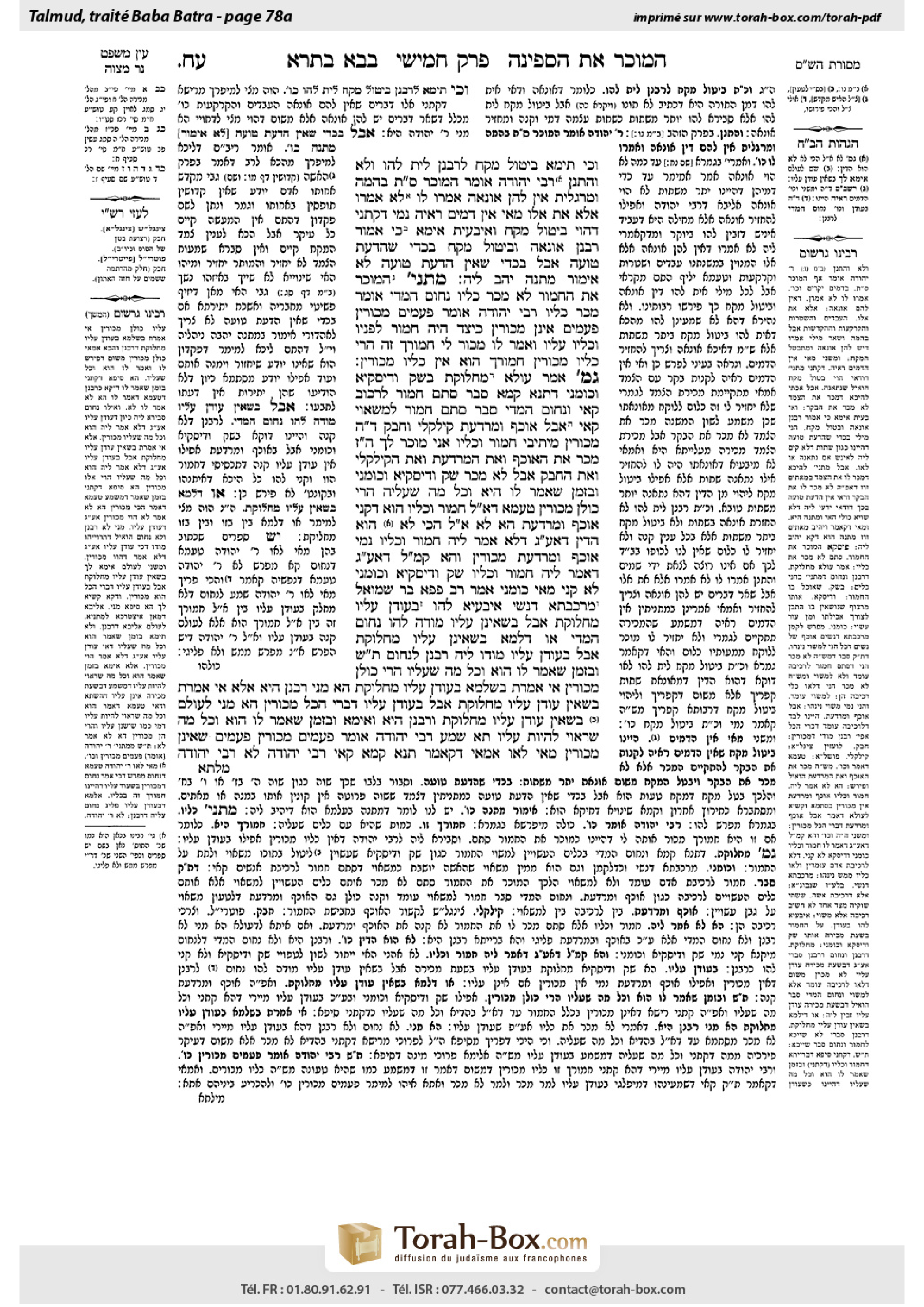
Bava Batra 78a: Talmud study for Daf Yomi
Study the Talmud for Daf Yomi with scanned pages, Hebrew text, English translations from Sefaria and AI-generated French translations.
Passage selection and English or AI-generated French translation are available where the scan has annotations. Daf Study is independent of Torah-Box and Sefaria.
Browse Bava Batra · בבא בתרא · All tractatesBava Batra 78a text and translations
This page of Bava Batra includes the Aramaic text, an English translation and an AI-generated French translation, alongside the scan above.
בבא בתרא ע״ח א · Aramaic and Hebrew text
וְכִי תֵּימָא בִּיטּוּל מִקָּח לְרַבָּנַן לֵית לְהוּ, וְלָא?! וְהָתְנַן, רַבִּי יְהוּדָה אוֹמֵר: הַמּוֹכֵר סֵפֶר תּוֹרָה, בְּהֵמָה וּמַרְגָּלִית – אֵין לָהֶן אוֹנָאָה. אָמְרוּ לוֹ: לֹא אָמְרוּ אֶלָּא אֶת אֵלּוּ!
מַאי ״אֵין דָּמִים רְאָיָה״ נָמֵי דְּקָתָנֵי – דְּהָוֵי בִּיטּוּל מִקָּח. וְאִיבָּעֵית אֵימָא: כִּי אֲמוּר רַבָּנַן אוֹנָאָה וּבִיטּוּל מִקָּח – בִּכְדֵי שֶׁהַדַּעַת טוֹעָה, אֲבָל בִּכְדֵי שֶׁאֵין הַדַּעַת טוֹעָה – לָא; אֵימוֹר מַתָּנָה יְהַב לֵיהּ.
מַתְנִי׳ הַמּוֹכֵר אֶת הַחֲמוֹר – לֹא מָכַר כֵּלָיו. נַחוּם הַמָּדִי אוֹמֵר: מָכַר כֵּלָיו. רַבִּי יְהוּדָה אוֹמֵר: פְּעָמִים מְכוּרִין, פְּעָמִים אֵינָן מְכוּרִין – כֵּיצַד? הָיָה חֲמוֹר לְפָנָיו, וְכֵלָיו עָלָיו, וְאָמַר לוֹ: ״מְכוֹר לִי חֲמוֹרְךָ זֶה״ – הֲרֵי כֵּלָיו מְכוּרִין. ״חֲמוֹרְךָ הוּא״ – אֵין כֵּלָיו מְכוּרִין.
גְּמָ׳ אָמַר עוּלָּא: מַחֲלוֹקֶת בְּשַׂק וְדִיסַקַּיָּא וְכוּמְנִי – דְּתַנָּא קַמָּא סָבַר: סְתָם חֲמוֹר לִרְכּוֹב קָאֵי, וְנַחוּם הַמָּדִי סָבַר: סְתָם חֲמוֹר לְמַשּׂאוֹי קָאֵי; אֲבָל אוּכָּף וּמַרְדַּעַת, קִילְקְלִי וַחֲבָק – דִּבְרֵי הַכֹּל מְכוּרִין.
מֵיתִיבִי: ״חֲמוֹר וְכֵלָיו אֲנִי מוֹכֵר לָךְ״ – הֲרֵי זֶה מָכַר אֶת הָאוּכָּף, וְאֶת הַמַּרְדַּעַת, וְאֶת הַקִּילְקְלִי, וְאֶת הַחֲבָק. אֲבָל לֹא מָכַר שַׂק, וְדִיסַקַּיָּא, וְכוּמְנִי. וּבִזְמַן שֶׁאָמַר לוֹ: ״הִיא וְכֹל מַה שֶּׁעָלֶיהָ״ – הֲרֵי כּוּלָּן מְכוּרִין. טַעְמָא דְּאָמַר לֵיהּ: ״חֲמוֹר וְכֵלָיו״ – הוּא דְּקָנֵי אוּכָּף וּמַרְדַּעַת, הָא לָא אֲמַר לֵיהּ הָכִי – לָא!
הוּא הַדִּין דְּאַף עַל גַּב דְּלָא אֲמַר לֵיהּ ״חֲמוֹר וְכֵלָיו״ – נָמֵי אוּכָּף וּמַרְדַּעַת מְכוּרִין; וְהָא קָא מַשְׁמַע לַן – דְּאַף עַל גַּב דַּאֲמַר לֵיהּ: ״חֲמוֹר וְכֵלָיו״ – שַׂק וְדִיסַקַּיָּא וְכוּמְנִי לָא קָנֵי.
מַאי ״וְכוּמְנִי״? אָמַר רַב פָּפָּא בַּר שְׁמוּאֵל: מַרְכַּבְתָּא דְנָשֵׁי.
אִיבַּעְיָא לְהוּ: בְּעוֹדָן עָלָיו מַחֲלוֹקֶת, אֲבָל בְּשֶׁאֵינָן עָלָיו – מוֹדֵה לְהוּ נַחוּם הַמָּדִי; אוֹ דִלְמָא, בְּשֶׁאֵינָן עָלָיו מַחֲלוֹקֶת, אֲבָל בְּעוֹדָן עָלָיו – מוֹדוּ לֵיהּ רַבָּנַן לְנָחוּם? תָּא שְׁמַע: וּבִזְמַן שֶׁאָמַר לוֹ: ״הוּא וְכֹל מַה שֶּׁעָלָיו״ – הֲרֵי כּוּלָּן מְכוּרִין.
אִי אָמְרַתְּ בִּשְׁלָמָא בְּעוֹדָן עָלָיו מַחְלוֹקֶת, הָא מַנִּי – רַבָּנַן הִיא. אֶלָּא אִי אָמְרַתְּ בְּשֶׁאֵין עוֹדָן עָלָיו מַחְלוֹקֶת, אֲבָל בְּעוֹדָן עָלָיו – דִּבְרֵי הַכֹּל מְכוּרִין; הָא מַנִּי?
לְעוֹלָם בְּשֶׁאֵין עוֹדָן עָלָיו מַחְלוֹקֶת, וְרַבָּנַן הִיא; וְאֵימָא: וּבִזְמַן שֶׁאָמַר לוֹ: ״הוּא וְכֹל מַה שֶּׁרָאוּי לִהְיוֹת עָלָיו״.
תָּא שְׁמַע, רַבִּי יְהוּדָה אוֹמֵר: פְּעָמִים מְכוּרִין, פְּעָמִים שֶׁאֵינָן מְכוּרִין. מַאי, לָאו אַמַּאי דְּקָאָמַר תַּנָּא קַמָּא קָאֵי רַבִּי יְהוּדָה? לָא, רַבִּי יְהוּדָה
Bava Batra 78a · English translation
And if you would say that the Rabbis do not hold that in a case of exploitation of less than one-sixth one must return the money and that if it was more than one-sixth there is nullification of the transaction, can it be maintained that they do not accept these halakhot? But didn’t we learn in a mishna (Bava Metzia 56b) that Rabbi Yehuda says: Even in the case of one who sells a Torah scroll, an animal, or a pearl, these items are not subject to the halakhot of exploitation, as they have no fixed price. The Rabbis said to him: The early Sages stated that only these items listed earlier in the mishna, i.e., land, slaves, and documents, are not subject to the halakhot of exploitation. Therefore, the Rabbis should agree that the sale of the yoke is nullified.
The Gemara answers: What is the meaning of the mishna that teaches that according to the opinion of the Rabbis the sum of money is not proof? This means that the transaction is nullified. And if you wish, say instead that the sale of the yoke is not nullified, because when the Sages spoke of exploitation and the nullification of a transaction, they meant that these halakhot apply only in a case where the difference in price is an amount about which one could be mistaken and believe that this is the correct price. But when the difference in price is so great a sum that one could not be mistaken, this sale is not subject to the halakhot of exploitation. In that case, one must say that the buyer gave the extra money to the seller as a gift; he could not have thought that this was the actual price of the object.
MISHNA: One who sells a donkey has not sold its vessels, i.e., its equipment, with it. Naḥum the Mede says: He has sold its vessels. Rabbi Yehuda says: There are times when the vessels are sold, and there are times when they are not sold. How so? If the donkey was before him and its vessels were on it, and the buyer said to him: Sell me this donkey of yours, its vessels are sold. If the buyer said to him: Is the donkey yours; I wish to purchase it, its vessels are not sold.
GEMARA: Ulla says: The dispute in the mishna is referring to the donkey’s sack and the saddlebag [disakkaya] and the kumni, a term explained later in the Gemara. As the first tanna holds: An ordinary donkey is used primarily for riding, and therefore these articles, which are not used for riding but for carrying burdens, are not included in the sale. And Naḥum the Mede holds: An ordinary donkey is used for carrying burdens, and therefore the items that serve this purpose are sold along with the donkey. But with regard to the saddle and the saddlecloth, the harness and the saddle band, everyone agrees that they are sold, as they are used both for riding and for carrying burdens.
The Gemara raises an objection from a baraita. If a seller says: I am selling you a donkey and its vessels, this one has sold the saddle, and the saddlecloth, and the harness, and the saddle band. But he has not sold the sack, and the saddlebag, and the kumni. And when the seller said to the buyer: I am selling it and everything that is on it, to you; the donkey and all of these items are sold. It can be inferred from here that the reason that the buyer acquires the saddle and the saddlecloth is that the seller said to him: I am selling you a donkey and its vessels. By inference, if the seller did not say this, the buyer does not acquire them.
The Gemara answers: The same is true even if the seller did not say to him: I am selling you a donkey and its vessels. In that case as well, the saddle and the saddlecloth are sold. And this is what the baraita teaches us: That even though the seller said to him: I am selling you a donkey and its vessels, the buyer still does not acquire the sack and the saddlebag and the kumni.
The Gemara inquires: What is the meaning of: And the kumni? Rav Pappa bar Shmuel said: This is the saddle used by women.
A dilemma was raised before the Sages: Does this dispute apply only to a case where the vessels are on the donkey, but when the vessels are not on the donkey, Naḥum the Mede concedes to the Rabbis that they are not sold? Or perhaps the dispute applies to a case where the vessels are not on the donkey, but when the vessels are on the donkey the Rabbis concede to Naḥum that the vessels are sold. The Gemara suggests: Come and hear a proof from the aforementioned baraita: And when the seller said to the buyer: I am selling it and everything that is on it, the donkey and all of these items are sold. In this case, the vessels are on the donkey, and everything is sold.
Granted, if you say that the dispute applies when the vessels are on the donkey, in accordance with whose opinion is this ruling? It is the opinion of the Rabbis that although in general one does not acquire the vessels, if the seller explicitly says that he is selling the donkey and everything on it, the buyer acquires it all. But if you say that the dispute applies when the vessels are not on the donkey, but when the vessels are on the donkey everyone agrees that they are sold, in accordance with whose opinion is this ruling? Even according to the opinion of the Rabbis there is no need to say explicitly that he is selling everything.
The Gemara answers: Actually, the dispute applies when the vessels are not on the donkey, and the baraita is in accordance with the opinion of the Rabbis, and the language of the baraita should be emended to say: And when he said to him: I am selling it and everything that is fit to be on it, i.e., those items usually found on a donkey, everything is sold.
The Gemara suggests another proof: Come and hear a solution from the mishna. Rabbi Yehuda says: There are times when the vessels are sold, and there are times when they are not sold. What, is it not the case that Rabbi Yehuda is referring to that which the first tanna said? If so, the dispute between the Rabbis and Naḥum the Mede must be referring to a case where the vessels are on the donkey, as Rabbi Yehuda addresses the same set of circumstances. The Gemara rejects this proof: No, Rabbi Yehuda
Bava Batra 78a · Traduction française (IA)
Et si l'on disait que les Rabbins ne considèrent pas que dans un cas d'exploitation inférieur à un sixième on doive rendre l'argent et que si c'était supérieur à un sixième, la transaction est annulée, peut-on soutenir qu'ils ne reconnaissent pas ces halakhot ? Mais n'avons-nous pas appris dans une mitsva (Bava Metzia 56b) que Rabbi Yéhuda dit : Même dans le cas d'une personne qui vend un rouleau de Torah, un animal ou une perle, ces objets ne sont pas soumis aux halakhot de l'exploitation, car ils n'ont pas de prix fixe. Les Rabbins lui répondent : Les tannaïm ont dit que seuls ces objets mentionnés plus tôt dans la mitsva, c'est-à-dire la terre, les esclaves et les documents, ne sont pas soumis aux halakhot de l'exploitation. Ainsi, les Rabbins devraient convenir que la vente du joug est annulée.
Le Guemara répond : Quelle est la signification de la mitsva qui enseigne que selon l'opinion des Rabbins, la somme d'argent n'est pas preuve ? Cela signifie que la transaction est annulée. Et si l'on veut, on peut dire plutôt que la vente du joug n'est pas annulée, car lorsque les Sages parlaient d'exploitation et d'annulation de la transaction, ils signifiaient que ces halakhot s'appliquent uniquement dans un cas où la différence de prix est une somme à propos de laquelle on pourrait être trompé et croire que c'est le prix correct. Mais lorsque la différence de prix est une somme si grande qu'on ne pourrait pas être trompé, cette vente n'est pas soumise aux halakhot de l'exploitation. Dans ce cas, on doit dire que l'acheteur a donné l'argent supplémentaire au vendeur en tant que cadeau ; il ne pouvait pas penser que c'était le prix réel de l'objet.
MICHNA : Celui qui vend un âne n'a pas vendu ses outils, c'est-à-dire son équipement, avec lui. Naḥum le Médé dit : Il a vendu ses outils. Rabbi Yéhuda dit : Il y a des fois où les outils sont vendus et des fois où ils ne le sont pas. Comment cela ? Si l'âne était devant lui et ses outils étaient sur lui, et que l'acheteur lui disait : Vends-moi cet âne que tu as, ses outils sont vendus. Si l'acheteur lui disait : Est-ce ton âne ? Je veux l'acheter, ses outils ne sont pas vendus.
GUEMARA : Ulla dit : Le débat dans la mitsva fait référence au sac de l'âne et à la sacoche de selle [disakkaya] et au kumni, un terme expliqué plus tard dans le Guemara. Comme le premier tanna maintient : Un âne ordinaire est utilisé principalement pour monter, et donc ces articles, qui ne sont pas utilisés pour monter mais pour porter des charges, ne sont pas inclus dans la vente. Et Naḥum le Médé maintient : Un âne ordinaire est utilisé pour porter des charges, et donc les articles qui servent à cela sont vendus avec l'âne. Mais concernant la selle et la couverture de selle, le harnais et la ceinture de selle, tout le monde convient qu'ils sont vendus, car ils sont utilisés à la fois pour monter et pour porter des charges.
Le Guemara soulève un objet à partir d'une baraïta. Si un vendeur dit : Je vends à toi un âne et ses outils, ce dernier a vendu la selle, la couverture de selle, le harnais et la ceinture de selle. Mais il n'a pas vendu le sac, la sacoche de selle et le kumni. Et lorsque le vendeur disait à l'acheteur : Je vends cela et tout ce qui est sur cela à toi ; l'âne et tous ces objets sont vendus. On peut en déduire ici que la raison pour laquelle l'acheteur acquiert la selle et la couverture de selle est que le vendeur lui disait : Je vends à toi un âne et ses outils. Par conséquent, si le vendeur n'avait pas dit cela, l'acheteur ne l'acquiert pas.
Le Guemara répond : C'est pareil même si le vendeur n'avait pas dit à l'acheteur : Je vends à toi un âne et ses outils. Dans ce cas également, la selle et la couverture de selle sont vendues. Et c'est ce que la baraïta nous enseigne : Même si le vendeur disait à l'acheteur : Je vends à toi un âne et ses outils, l'acheteur ne possède pas encore le sac, la sacoche de selle et le kumni.
Le Guemara interroge : Quelle est la signification de : Et le kumni ? Rav Pappa bar Shmuel dit : C'est la selle utilisée par les femmes.
Un dilemme a été soulevé devant les Sages : Ce débat s'applique-t-il uniquement à un cas où les outils sont sur l'âne, mais lorsque les outils ne sont pas sur l'âne, Naḥum le Médé reconnaît que ce sont des outils non vendus ? Ou peut-être le débat s'applique-t-il à un cas où les outils ne sont pas sur l'âne, mais lorsque les outils sont sur l'âne, les Sages reconnaissent à Naḥum que les outils sont vendus. Le Guemara suggère : Venez et entendez une preuve à partir de la baraïta mentionnée plus haut : Et lorsque le vendeur disait à l'acheteur : Je vends cela et tout ce qui est sur cela à toi ; l'âne et tous ces objets sont vendus. Dans ce cas, les outils sont sur l'âne, et tout est vendu.
Admettons, si l'on dit que le débat s'applique lorsque les outils sont sur le chameau, selon quel avis est-ce que cette décision est prise ? C'est l'avis des Rabbins qui, bien que généralement on ne acquière pas les outils, si le vendeur dit explicitement qu'il vend le chameau et tout ce qui est sur lui, l'acheteur l'acquiert. Mais si l'on dit que le débat s'applique lorsque les outils ne sont pas sur le chameau, mais lorsque les outils sont sur le chameau tout le monde convient qu'ils sont vendus, selon quel avis est-ce que cette décision est prise ? Même selon l'avis des Rabbins, il n'est pas nécessaire de dire explicitement qu'il vend tout.
Le Guemara répond : En réalité, le débat s'applique lorsque les outils ne sont pas sur le chameau, et la baraïta est selon l'avis des Rabbins, et la formulation de la baraïta devrait être corrigée pour dire : Et lorsque il disait à lui : Je vends cela et tout ce qui est adapté à être sur cela, c'est-à-dire ces objets généralement trouvés sur un chameau, tout est vendu.
Le Guemara suggère une autre preuve : Venez et entendez une solution à partir de la mitsna. Rabbi Yéhuda dit : Il y a des fois où les outils sont vendus et des fois où ils ne le sont pas. Qu'est-ce que cela signifie, que Rabbi Yéhuda ne fait pas référence à ce que le premier tanna a dit ? Si c'est le cas, le débat entre les Rabbins et Naḥum le Médé doit faire référence à un cas où les outils sont sur le chameau, car Rabbi Yéhuda aborde la même situation. Le Guemara rejette cette preuve : Non, Rabbi Yéhuda
Traduction française générée par IA à partir de l’édition anglaise de Sefaria. Vérifie toujours un passage avec le texte source.
Text from Sefaria: William Davidson Edition - Vocalized Aramaic (CC BY NC); William Davidson Edition - English (CC BY NC).