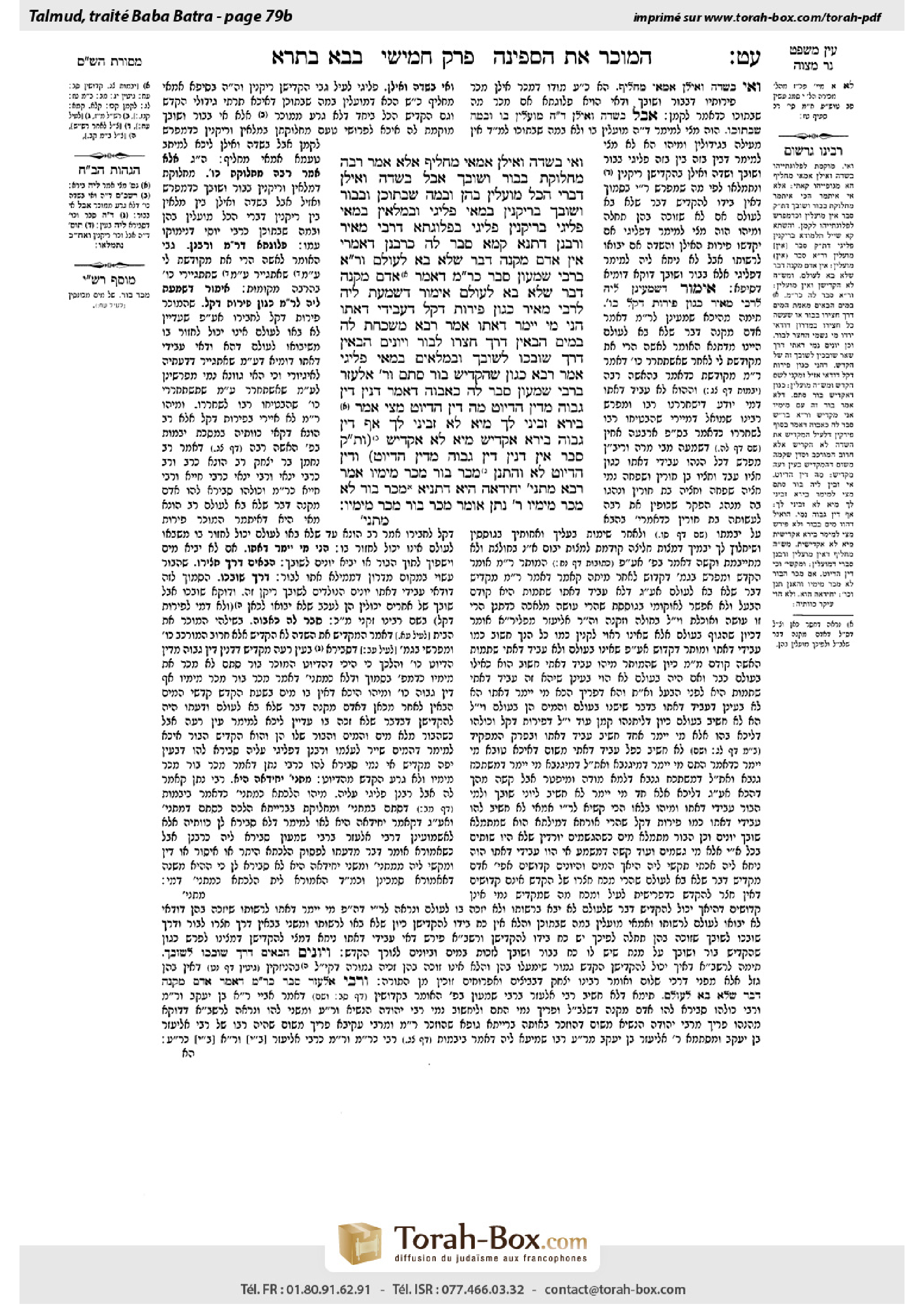
Bava Batra 79b: Talmud study for Daf Yomi
Study the Talmud for Daf Yomi with scanned pages, Hebrew text, English translations from Sefaria and AI-generated French translations.
Passage selection and English or AI-generated French translation are available where the scan has annotations. Daf Study is independent of Torah-Box and Sefaria.
Browse Bava Batra · בבא בתרא · All tractatesBava Batra 79b text and translations
This page of Bava Batra includes the Aramaic text, an English translation and an AI-generated French translation, alongside the scan above.
בבא בתרא ע״ט ב · Aramaic and Hebrew text
וְאִי בְּשָׂדֶה וְאִילָן, אַמַּאי מַחְלִיף? אֶלָּא אָמַר רַבָּה: מַחֲלוֹקֶת בְּבוֹר וְשׁוֹבָךְ, אֲבָל בְּשָׂדֶה וְאִילָן – דִּבְרֵי הַכֹּל מוֹעֲלִין בָּהֶן וּבְמַה שֶּׁבְּתוֹכָן.
וּבְבוֹר וְשׁוֹבָךְ – בְּרֵיקָנִין בְּמַאי פְּלִיגִי, וּבִמְלֵאִין בְּמַאי פְּלִיגִי? בְּרֵיקָנִין – פְּלִיגִי בִּפְלוּגְתָּא דְּרַבִּי מֵאִיר וְרַבָּנַן;
דְּתַנָּא קַמָּא סָבַר לַהּ כְּרַבָּנַן, דְּאָמְרִי: אֵין אָדָם מַקְנֶה דָּבָר שֶׁלֹּא בָּא לָעוֹלָם; וְרַבִּי אֶלְעָזָר בְּרַבִּי שִׁמְעוֹן סָבַר כְּרַבִּי מֵאִיר, דְּאָמַר: אָדָם מַקְנֶה דָּבָר שֶׁלֹּא בָּא לָעוֹלָם.
אֵימוֹר דְּשָׁמְעַתְּ לֵיהּ לְרַבִּי מֵאִיר – כְּגוֹן פֵּירוֹת דֶּקֶל, דַּעֲבִידִי דְּאָתוּ; הָנֵי – מִי יֵימַר דְּאָתוּ? אָמַר רָבָא: מַשְׁכַּחַתְּ לַהּ בְּמַיִם הַבָּאִין דֶּרֶךְ חֲצֵרוֹ לַבּוֹר, וְיוֹנִים הַבָּאִין דֶּרֶךְ שׁוֹבָכוֹ לַשּׁוֹבָךְ.
וּבִמְלֵאִים בְּמַאי פְּלִיגִי? אָמַר רָבָא: כְּגוֹן שֶׁהִקְדִּישׁ בּוֹר סְתָם; וְרַבִּי אֶלְעָזָר בְּרַבִּי שִׁמְעוֹן סָבַר לַהּ כַּאֲבוּהּ, דְּאָמַר: דָּנִין דִּין גָּבוֹהַּ מִדִּין הֶדְיוֹט,
מָה דִּין הֶדְיוֹט – מָצֵי אֲמַר: בֵּירָא זַבֵּינִי לָךְ, מַיָּא לָא זַבֵּינִי לָךְ; אַף דִּין גָּבוֹהַּ – בֵּירָא אַקְדֵּישׁ, מַיָּא לָא אַקְדֵּישׁ. וְתַנָּא קַמָּא סָבַר: אֵין דָּנִין דִּין גָּבוֹהַּ מִדִּין הֶדְיוֹט.
וְדִין הֶדְיוֹט לָא?! וְהָתְנַן: מָכַר בּוֹר – מָכַר מֵימָיו! אָמַר רָבָא: מַתְנִיתִין יְחִידָאָה הִיא – דְּתַנְיָא: מָכַר בּוֹר – לֹא מָכַר מֵימָיו. רַבִּי נָתָן אוֹמֵר: מָכַר בּוֹר – מָכַר מֵימָיו.
Bava Batra 79b · English translation
And if their dispute is referring to a field and a tree, why does Rabbi Elazar, son of Rabbi Shimon, reverse his opinion? Rather, Rabba’s statement must be adjusted, and this is what Rabba said: This dispute between the first tanna and Rabbi Elazar, son of Rabbi Shimon, applies only in the cases of a cistern and a dovecote. But in the cases of a field and a tree, everyone agrees that one is liable for misuse of consecrated property if one derives benefit from them or their contents.
The Gemara asks: And in the cases of a cistern and a dovecote, where the cistern and the dovecote are empty, with regard to what matter do they disagree? And similarly, where the cistern and the dovecote are full, with regard to what do they disagree? The Gemara answers: In the cases of a cistern and a dovecote that are empty, they disagree with regard to the matter that is the subject of the dispute between Rabbi Meir and the Rabbis.
The first tanna and Rabbi Elazar, son of Rabbi Shimon, disagree because the first tanna holds in accordance with the opinion of the Rabbis, who say: A person cannot transfer ownership of an object that has not yet come into the world, i.e., that one does not currently own. Therefore, one cannot consecrate water or doves that will enter the cistern or dovecote only in the future. And Rabbi Elazar, son of Rabbi Shimon, holds in accordance with the opinion of Rabbi Meir, who says: A person can transfer ownership of an object that has not yet come into the world.
The Gemara raises a difficulty with regard to this answer: You can say that you heard Rabbi Meir express this opinion in a case such as the fruit of palm trees, which are likely to come into existence, as the trees naturally produce fruit. But with regard to these doves and water, who can say that they will come? Rava said: You can find cases where one consecrates water or doves that are likely to arrive, e.g., in the case of water that comes by way of his courtyard into the cistern when it rains, so that he does not need to fill the cistern. And similarly with regard to doves that come by way of his other, full dovecote into this empty dovecote.
The Gemara asks: And in cases where the cistern and the dovecote are full, with regard to what matter do they disagree? Rava said: This dispute concerns a case where he consecrated a cistern without specification. And Rabbi Elazar, son of Rabbi Shimon, holds in accordance with the opinion of his father, who says: One infers the halakha of consecration to the Most High from the halakha of transactions between one ordinary person [hedyot] and another.
The Gemara elaborates: Just as the halakha with regard to transactions between one ordinary person and another is that one can say: I sold you the cistern but I did not sell you the water it contains, so too, the halakha in the case of consecration to the Most High is that one can say: I consecrated the cistern but I did not consecrate the water within it. And the first tanna holds that one does not infer the halakha of consecration to the Most High from the halakha of transactions between one ordinary person and another. Rather, one who consecrates property does so generously, i.e., the most expansive meaning is assumed for his vow of consecration, and therefore even if he did not say so explicitly, he consecrated the water together with the cistern.
The Gemara asks: And does the halakha concerning a transaction with an ordinary person say that one does not sell the water along with the cistern? But didn’t we learn in the mishna (78b) that one who sold a cistern has sold its water? Rava said: The ruling in the mishna is an individual opinion, as it is taught in a baraita: One who sold a cistern has not sold its water. Rabbi Natan says: One who sold a cistern has sold its water.
Bava Batra 79b · Traduction française (IA)
Et si leur débat porte sur un champ et un arbre, pourquoi Rabbi Elazar, fils de Rabbi Shimon, change-t-il d'avis ? Plutôt, la déclaration de Rabba doit être ajustée, et c'est ce que Rabba a dit : Ce débat entre le premier tanna et Rabbi Elazar, fils de Rabbi Shimon, s'applique uniquement aux cas d'un puits et d'un colombier. Mais dans les cas d'un champ et d'un arbre, tout le monde s'accorde sur le fait qu'on est tenu responsable de l'usage abusif de la propriété consacrée si l'on en tire un bénéfice ou de leur contenu.
La Guemara pose la question : Et dans les cas d'un puits et d'un colombier vides, concernant quel sujet se désaccordent-ils ? Et de même, lorsque le puits et le colombier sont pleins, concernant quel sujet se désaccordent-ils ? La Guemara répond : Dans les cas d'un puits et d'un colombier vides, ils se désaccordent concernant la matière qui est au centre du débat entre Rabbi Meir et les Rabbins.
Le premier tanna et Rabbi Elazar, fils de Rabbi Shimon, se désaccordent car le premier tanna suit l'opinion des Rabbins, qui disent : Une personne ne peut transférer la propriété d'un objet qui n'a pas encore été créé dans le monde, c'est-à-dire qu'on ne possède pas actuellement. Par conséquent, on ne peut consacrer de l'eau ou des moineaux qui entreront dans le puits ou le colombier seulement à l'avenir. Et Rabbi Elazar, fils de Rabbi Shimon, suit l'opinion de Rabbi Meir, qui dit : Une personne peut transférer la propriété d'un objet qui n'a pas encore été créé dans le monde.
La Guemara soulève une difficulté concernant cette réponse : On peut dire que l'on a entendu Rabbi Meir exprimer cette opinion dans un cas tel que les fruits des palmiers, qui sont susceptibles de venir à l'existence, puisque les arbres produisent naturellement des fruits. Mais concernant ces moineaux et cette eau, qui peut dire qu'ils viendront ? Rava a dit : On peut trouver des cas où l'on consacre de l'eau ou des moineaux susceptibles d'arriver, par exemple dans le cas de l'eau qui vient par son courtil vers le puits lors de la pluie, de sorte qu'il n'a pas besoin de remplir le puits. Et de même concernant les moineaux qui viennent par son autre colombier plein vers ce colombier vide.
La Guemara pose la question : Et dans les cas où le puits et le colombier sont pleins, concernant quel sujet se désaccordent-ils ? Rava a dit : Ce débat concerne un cas où l'on a consacré un puits sans précision. Et Rabbi Elazar, fils de Rabbi Shimon, suit l'opinion de son père, qui dit : On infère la halakha de la consécration au Très Haut à partir de la halakha des transactions entre un homme ordinaire et un autre.
La Guemara développe : Tout comme la halakha concernant les transactions entre un homme ordinaire et un autre est que l'on peut dire : J'ai vendu le puits mais je n'ai pas vendu l'eau qu'il contient, de même, la halakha dans le cas de la consécration au Très Haut est que l'on peut dire : J'ai consacré le puits mais je n'ai pas consacré l'eau qu'il contient. Et le premier tanna maintient que l'on ne peut inférer la halakha de la consécration au Très Haut à partir de la halakha des transactions entre un homme ordinaire et un autre. Plutôt, celui qui consacre une propriété le fait généreusement, c'est-à-dire qu'on assume la signification la plus large pour sa promesse de consécration, et par conséquent même s'il n'a pas dit cela explicitement, il a consacré l'eau avec le puits.
La Guemara pose la question : Et la halakha concernant une transaction avec un homme ordinaire dit-elle que l'on ne vend pas l'eau avec le puits ? Mais n'avons-nous pas appris dans la mitsva (78b) que celui qui vend un puits a vendu son eau ? Rava a dit : La décision de la mitsva est une opinion individuelle, comme il est enseigné dans une baraïta : Celui qui vend un puits n'a pas vendu son eau. Rabbi Natan dit : Celui qui vend un puits a vendu son eau.
Traduction française générée par IA à partir de l’édition anglaise de Sefaria. Vérifie toujours un passage avec le texte source.
Text from Sefaria: William Davidson Edition - Vocalized Aramaic (CC BY NC); William Davidson Edition - English (CC BY NC).