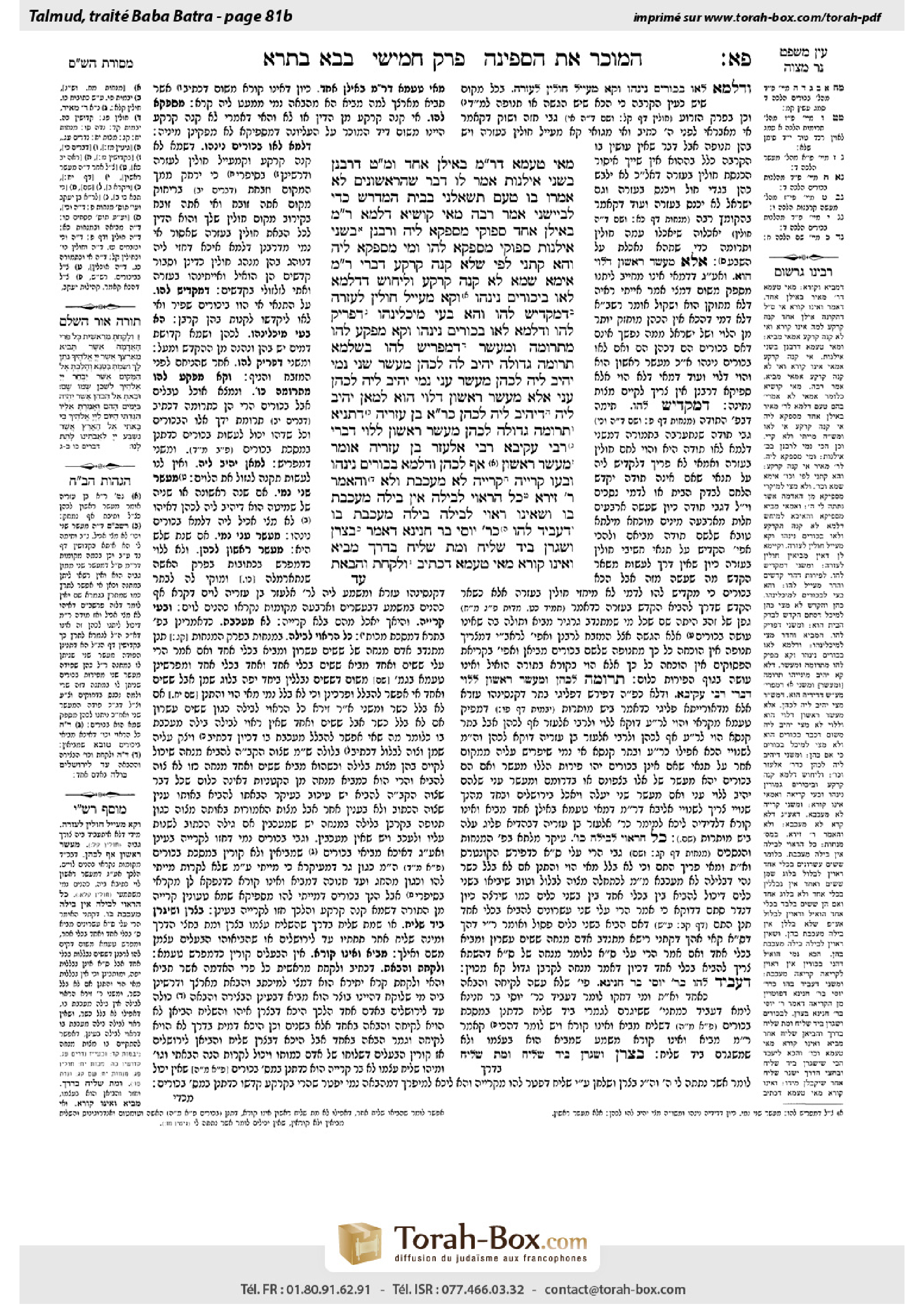
Bava Batra 81b: Talmud study for Daf Yomi
Study the Talmud for Daf Yomi with scanned pages, Hebrew text, English translations from Sefaria and AI-generated French translations.
Passage selection and English or AI-generated French translation are available where the scan has annotations. Daf Study is independent of Torah-Box and Sefaria.
Browse Bava Batra · בבא בתרא · All tractatesBava Batra 81b text and translations
This page of Bava Batra includes the Aramaic text, an English translation and an AI-generated French translation, alongside the scan above.
בבא בתרא פ״א ב · Aramaic and Hebrew text
מַאי טַעְמָא דְּרַבִּי מֵאִיר בְּאִילָן אֶחָד, וּמַאי טַעְמָא דְּרַבָּנַן בִּשְׁנֵי אִילָנוֹת? אָמַר לוֹ: דָּבָר שֶׁהָרִאשׁוֹנִים לֹא אָמְרוּ בּוֹ טַעַם, תִּשְׁאָלֵנִי בְּבֵית הַמִּדְרָשׁ כְּדֵי לְבַיְּישֵׁנִי?
אָמַר רַבָּה: מַאי קוּשְׁיָא? דִּלְמָא רַבִּי מֵאִיר בְּאִילָן אֶחָד סַפּוֹקֵי מְסַפְּקָא לֵיהּ, וְרַבָּנַן בִּשְׁנֵי אִילָנוֹת סַפּוֹקֵי מְסַפְּקָא לְהוּ!
וּמִי מְסַפְּקָא לֵיהּ? וְהָא קָתָנֵי: לְפִי שֶׁלֹּא קָנָה קַרְקַע, דִּבְרֵי רַבִּי מֵאִיר! אֵימָא: שֶׁמָּא לֹא קָנָה קַרְקַע.
וְלֵיחוּשׁ דְּדִלְמָא לָאו בִּיכּוּרִים נִינְהוּ, וְקָא מְעַיֵּיל חוּלִּין לָעֲזָרָה! דְּמַקְדֵּישׁ לְהוּ. וְהָא בָּעֵי מֵיכְלִינְהוּ! דְּפָרֵיק לְהוּ. וְדִלְמָא לָאו בִּכּוּרִים נִינְהוּ, וְקָא מַפְקַע לְהוּ מִתְּרוּמָה וּמַעֲשֵׂר! דְּמַפְרֵישׁ לְהוּ.
בִּשְׁלָמָא תְּרוּמָה גְּדוֹלָה – יָהֵיב לַהּ לְכֹהֵן, מַעֲשֵׂר שֵׁנִי נָמֵי – יָהֵיב לֵיהּ לְכֹהֵן, מַעְשַׂר עָנִי נָמֵי – יָהֵיב לֵיהּ לְכֹהֵן עָנִי, אֶלָּא מַעֲשֵׂר רִאשׁוֹן – דְּלֵוִי הוּא! לְמַאן יָהֵיב לֵיהּ?
דְּיָהֵיב לֵיהּ לְכֹהֵן, כְּרַבִּי אֶלְעָזָר בֶּן עֲזַרְיָה – דְּתַנְיָא: תְּרוּמָה גְּדוֹלָה לְכֹהֵן, מַעֲשֵׂר רִאשׁוֹן לְלֵוִי, דִּבְרֵי רַבִּי עֲקִיבָא. רַבִּי אֶלְעָזָר בֶּן עֲזַרְיָה אוֹמֵר: מַעֲשֵׂר רִאשׁוֹן אַף לְכֹהֵן. וְדִלְמָא בִּכּוּרִים נִינְהוּ, וּבָעוּ קְרִיָּיהּ! קְרִיָּיהּ לֹא מְעַכֶּבֶת.
וְלָא?! וְהָאָמַר רַבִּי זֵירָא: כׇּל הָרָאוּי לְבִילָּה, אֵין בִּילָּה מְעַכֶּבֶת בּוֹ; וְשֶׁאֵינוֹ רָאוּי לְבִילָּה, בִּילָּה מְעַכֶּבֶת בּוֹ!
דְּעָבֵיד לְהוּ כְּרַבִּי יוֹסֵי בַּר חֲנִינָא, דְּאָמַר: בְּצָרָן וְשִׁגְּרָן בְּיַד שָׁלִיחַ, וּמֵת שָׁלִיחַ בַּדֶּרֶךְ – מֵבִיא וְאֵינוֹ קוֹרֵא. מַאי טַעְמָא? דִּכְתִיב: ״וְלָקַחְתָּ וְהֵבֵאתָ״ –
Bava Batra 81b · English translation
What is the rationale of Rabbi Meir that in the case of one tree, an individual is obligated to bring first fruits but does not recite the passage, and what is the rationale of the Rabbis that in the case of two trees, an individual is obligated to bring the first fruits but does not recite the passage? If one owns the ground and is obligated to bring the first fruits to the Temple, he should also recite the passage of thanks. If he does not own the ground and therefore is not obligated to recite the passage, why does he bring the first fruits to the Temple? Rabbi Elazar said to Rabbi Shimon ben Elyakim: Do you ask me publicly, in the study hall, about a matter for which the early Sages did not give a reason, in order to embarrass me? In other words, I do not know the reason, as not even the early Sages explained this matter.
Rabba said: What is the difficulty? Perhaps Rabbi Meir is uncertain, in the case of an individual who purchases one tree, whether or not the buyer owns the ground, and the Rabbis are uncertain, in the case of an individual who purchases two trees, whether or not the buyer owns the ground. Due to this uncertainty, the owner of the tree must bring the first fruits to the Temple, as he might be obligated in this mitzva. He does not recite the passage of thanks because it is not definitely established that he is obligated to bring the fruits.
The Gemara asks: And is Rabbi Meir really uncertain whether the buyer owns the ground? But it teaches: Since he did not acquire any land; this is the statement of Rabbi Meir. Rabbi Meir states definitively that the owner of the tree does not own the ground. The Gemara answers: Say that the baraita should be emended as follows: Perhaps he did not acquire any land.
The Gemara asks: But let us be concerned that perhaps these fruits are not first fruits, and he is bringing non-sacred fruit to the Temple courtyard, which is prohibited. The Gemara answers: The case is where he consecrates them. The Gemara asks: But the priest is required to eat first fruits, and he cannot do so if they are consecrated. The Gemara answers: The case is where the priest redeems them. The Gemara asks: But perhaps they are not first fruits, and thereby he removes them from the obligation of teruma and tithes, as one does not separate teruma and tithes from first fruits. The Gemara answers: The case is where he separates teruma and tithes from the fruits, due to the uncertainty over their status.
The Gemara asks: Granted, the teruma gedola that he separates from these fruits he gives to a priest, and the priest may partake of it, as it has the halakhic status of either first fruits or teruma gedola, both of which are eaten by a priest. It is understood with regard to the second tithe as well; he gives it to a priest, who eats it in Jerusalem, either as first fruits or as second tithe. If it is the third or the sixth year of the Sabbatical cycle, when instead of second tithe one is obligated to give the poor man’s tithe, here too, he gives it to a poor priest, who eats it as either first fruits or poor man’s tithe. But with regard to first tithe, which is given to a Levite, to whom can he give it? A Levite may not eat first fruits.
The Gemara answers: The case is where he gives it to a priest, in accordance with the opinion of Rabbi Elazar ben Azarya. As it is taught in a baraita: Teruma gedola is given only to a priest, and first tithe is given only to a Levite; this is the statement of Rabbi Akiva. Rabbi Elazar ben Azarya says: First tithe may also be given to a priest. The Gemara asks: But perhaps they are in fact first fruits and require recitation of the passage of thanks, and yet the owner does not recite it due to the uncertainty. The Gemara answers: The recitation is not indispensable, i.e., one can perform the mitzva of bringing first fruits without the recitation.
The Gemara asks: And is the recitation not indispensable? But doesn’t Rabbi Zeira say in the context of offerings: For any measure of flour that is suitable for mixing with oil in a meal-offering, the lack of mixing does not invalidate the meal-offering. Even though there is a mitzva to mix the oil and the flour ab initio, the meal-offering is fit for sacrifice even if the oil and the flour are not mixed. And for any measure of flour that is not suitable for mixing with oil in a meal-offering, the lack of mixing invalidates the meal-offering. The principle is: Ab initio requirements prevent the fulfillment of a mitzva in situations where they are not merely absent but impossible. Accordingly, first fruits that are unfit for recitation should not be brought to the Temple.
The Gemara answers: The case is where he renders them exempt from the obligation of recitation, in accordance with the opinion of Rabbi Yosei bar Ḥanina, who says: If one harvested the fruits and sent them in the possession of an agent, and the agent died on the way, the owner or any other person brings the first fruits but does not recite the passage of thanks. What is the reason? As it is written: And you shall take, and you shall bring. The Gemara is citing from the following verse with a slight variation: “And you shall take of the first of all the fruit of the ground, which you shall bring in from your land that the Lord your God gives you” (Deuteronomy 26:2).
Bava Batra 81b · Traduction française (IA)
Quel est le raisonnement du Rabbi Meir selon lequel, dans le cas d'un seul arbre, une personne est tenue de présenter les premiers fruits mais ne récite pas la prière, et quel est le raisonnement des Sages selon lequel, dans le cas de deux arbres, une personne est tenue de présenter les premiers fruits mais ne récite pas la prière ? Si une personne possède la terre et est tenue de présenter les premiers fruits au Temple, elle devrait aussi réciter la prière de remerciement. Si elle ne possède pas la terre et n'est donc pas tenue de réciter la prière, pourquoi présente-t-elle les premiers fruits au Temple ? Le Rabbi Elazar a dit au Rabbi Shimon ben Elyakim : Est-ce que tu me poses publiquement, dans la salle de étude, une question sur laquelle les Sages anciens n'ont pas donné de raison, afin de m'humilier ? En d'autres termes, je ne sais pas la raison, car même les Sages anciens n'ont pas expliqué cette question.
Rabba a dit : Quel est le problème ? Peut-être que le Rabbi Meir est incertain, dans le cas d'une personne qui achète un seul arbre, quant à savoir si l'acheteur possède la terre, et les Sages sont incertains, dans le cas d'une personne qui achète deux arbres, quant à savoir si l'acheteur possède la terre. En raison de cette incertitude, l'propriétaire de l'arbre doit présenter les premiers fruits au Temple, car il pourrait être tenu de cette mitsva. Il ne récite pas la prière de remerciement car il n'est pas certain qu'il soit tenu de présenter les fruits.
La Guemara pose la question : Et le Rabbi Meir est-il vraiment incertain quant à savoir si l'acheteur possède la terre ? Mais il enseigne : Puisque l'acheteur n'a pas acquis de terre ; c'est l'opinion du Rabbi Meir. Le Rabbi Meir affirme définitivement que l'propriétaire de l'arbre ne possède pas la terre. La Guemara répond : Dites que la baraïta devrait être corrigée ainsi : Peut-être qu'il n'a pas acquis de terre.
La Guemara pose la question : Mais soyons-nous inquiets que ces fruits ne soient pas des premiers fruits, et qu'il les apporte dans le Cour du Temple, ce qui est interdit. La Guemara répond : Le cas est celui où il les consacre. La Guemara pose la question : Mais le prêtre est tenu de manger les premiers fruits, et il ne peut le faire s'ils sont consacrés. La Guemara répond : Le cas est celui où le prêtre les rachète. La Guemara pose la question : Mais peut-être qu'ils ne sont pas des premiers fruits, et ainsi il les enlève de l'obligation de terouma et de dîmes, car on ne sépare pas terouma et dîmes des premiers fruits. La Guemara répond : Le cas est celui où il sépare terouma et dîmes des fruits, en raison de l'incertitude sur leur statut.
La Guemara pose la question : D'accord, la terouma gedola qu'il sépare de ces fruits, il la donne à un prêtre, et le prêtre peut en manger, car elle a le statut halakhique de premier fruits ou de terouma gedola, les deux étant mangés par un prêtre. C'est compris également concernant la deuxième dîme ; il la donne à un prêtre, qui l'eat à Jérusalem, soit comme premier fruits soit comme deuxième dîme. Si c'est la troisième ou la sixième année du cycle sabbatique, où au lieu de la deuxième dîme on est tenu de donner la dîme du pauvre, ici aussi, il la donne à un prêtre pauvre, qui l'eat soit comme premier fruits soit comme dîme du pauvre. Mais concernant la première dîme, qui est donnée à un Lévi, à qui peut-il la donner ? Un Lévi ne peut pas manger les premiers fruits.
La Guemara répond : Le cas est celui où il la donne à un prêtre, conformément à l'opinion du Rabbi Elazar ben Azaria. Comme il est enseigné dans une baraïta : La terouma gedola est donnée uniquement à un prêtre, et la première dîme est donnée uniquement à un Lévi ; c'est l'opinion du Rabbi Akiva. Le Rabbi Elazar ben Azaria dit : La première dîme peut aussi être donnée à un prêtre. La Guemara pose la question : Mais peut-être qu'ils sont effectivement des premiers fruits et nécessitent la récitation de la prière de remerciement, et pourtant l'owner ne la récite pas en raison de l'incertitude. La Guemara répond : La récitation n'est pas indispensable, c'est-à-dire qu'on peut accomplir la Mitsva de présenter les premiers fruits sans la récitation.
La Guemara pose la question : Et la récitation n'est pas indispensable ? Mais ne dit pas Rabbi Zeira, dans le contexte des offrandes : Pour toute mesure de farine adaptée à l'association avec l'huile dans une offrande de farine, l'absence d'association ne rend pas l'offrande invalide. Même si la Mitsva de mélanger l'huile et la farine dès le début existe, l'offrande est propre à l'offrande même si l'huile et la farine ne sont pas mélangées. Et pour toute mesure de farine non adaptée à l'association avec l'huile dans une offrande de farine, l'absence d'association rend l'offrande invalide. Le principe est : Les exigences dès le début empêchent l'accomplissement d'une Mitsva dans les cas où elles ne sont pas seulement absentes mais impossibles. Ainsi, les premiers fruits inadaptés à la récitation ne devraient pas être apportés au Temple.
La Guemara répond : Le cas est celui où il les rend exemptes de l'obligation de récitation, conformément à l'opinion du Rabbi Yosei bar Ḥanina, qui dit : Si l'on a récolté les fruits et les a envoyés en possession d'un agent, et que l'agent est mort en chemin, l'propriétaire ou toute autre personne apporte les premiers fruits mais ne récite pas la prière de remerciement. Quelle est la raison ? Comme il est écrit : Et tu prendras, et tu apporteras. La Guemara cite le verset suivant avec une légère variation : « Et tu prendras de la première des fruits de la terre, que tu apporteras de ta terre que l'Éternel ton Dieu t'a donnée » (Deutéronome 26:2).
Traduction française générée par IA à partir de l’édition anglaise de Sefaria. Vérifie toujours un passage avec le texte source.
Text from Sefaria: William Davidson Edition - Vocalized Aramaic (CC BY NC); William Davidson Edition - English (CC BY NC).