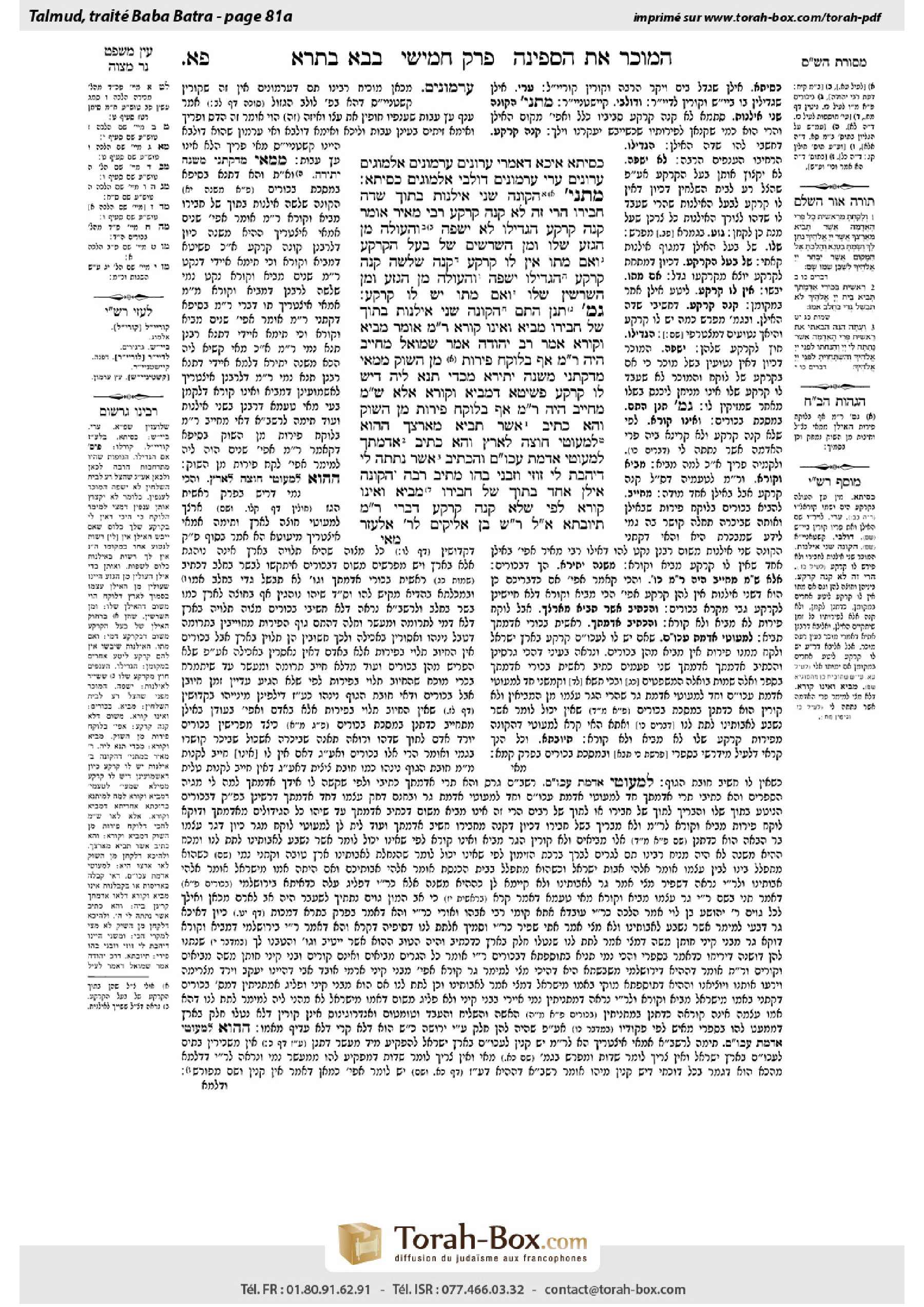
Bava Batra 81a: Talmud study for Daf Yomi
Study the Talmud for Daf Yomi with scanned pages, Hebrew text, English translations from Sefaria and AI-generated French translations.
Passage selection and English or AI-generated French translation are available where the scan has annotations. Daf Study is independent of Torah-Box and Sefaria.
Browse Bava Batra · בבא בתרא · All tractatesBava Batra 81a text and translations
This page of Bava Batra includes the Aramaic text, an English translation and an AI-generated French translation, alongside the scan above.
בבא בתרא פ״א א · Aramaic and Hebrew text
כְּסִיתָא. אִיכָּא דְּאָמְרִי: עֲרוֹנִים, עַרְמוֹנִים, אַלְמוּגִּים. עֲרוֹנִים – עָרֵי, עַרְמוֹנִים – דּוּלְבֵי, אַלְמוּגִּים – כְּסִיתָא.
מַתְנִי׳ הַקּוֹנֶה שְׁנֵי אִילָנוֹת בְּתוֹךְ שְׂדֵה חֲבֵירוֹ – הֲרֵי זֶה לֹא קָנָה קַרְקַע. רַבִּי מֵאִיר אוֹמֵר: קָנָה קַרְקַע. הִגְדִּילוּ – לֹא יְשַׁפֶּה. וְהָעוֹלֶה מִן הַגֶּזַע – שֶׁלּוֹ; וּמִן הַשׇּׁרָשִׁים – שֶׁל בַּעַל הַקַּרְקַע. וְאִם מֵתוּ – אֵין לוֹ קַרְקַע.
קָנָה שְׁלֹשָׁה – קָנָה קַרְקַע. הִגְדִּילוּ – יְשַׁפֶּה. וְהָעוֹלֶה מִן הַגֶּזַע וּמִן הַשׇּׁרָשִׁין – שֶׁלּוֹ. וְאִם מֵתוּ – יֵשׁ לוֹ קַרְקַע.
גְּמָ׳ תְּנַן הָתָם: הַקּוֹנֶה שְׁנֵי אִילָנוֹת בְּתוֹךְ שֶׁל חֲבֵירוֹ – מֵבִיא וְאֵינוֹ קוֹרֵא. רַבִּי מֵאִיר אוֹמֵר: מֵבִיא וְקוֹרֵא.
אָמַר רַב יְהוּדָה אָמַר שְׁמוּאֵל: מְחַיֵּיב הָיָה רַבִּי מֵאִיר אַף בְּלוֹקֵחַ פֵּירוֹת מִן הַשּׁוּק. מִמַּאי? מִדְּקָתָנֵי מִשְׁנָה יַתִּירָא – מִכְּדֵי תְּנָא לֵיהּ דְּיֵשׁ לוֹ קַרְקַע, פְּשִׁיטָא דְּמֵבִיא וְקוֹרֵא.
אֶלָּא שְׁמַע מִינַּהּ, מְחַיֵּיב הָיָה רַבִּי מֵאִיר אַף בְּלוֹקֵחַ פֵּירוֹת מִן הַשּׁוּק.
וְהָא כְּתִיב: ״אֲשֶׁר תָּבִיא מֵאַרְצְךָ״! הָהוּא לְמַעוֹטֵי חוּצָה לָאָרֶץ.
וְהָא כְּתִיב: אַדְמָתְךָ! לְמַעוֹטֵי אַדְמַת גּוֹי. וְהָכְתִיב: ״אֲשֶׁר נָתַתָּה לִי״! דִּיהַבְתְּ לִי זוּזֵי וּזְבַנִי בְּהוּ.
מֵתִיב רַבָּה: הַקּוֹנֶה אִילָן אֶחָד בְּתוֹךְ שֶׁל חֲבֵירוֹ – מֵבִיא וְאֵינוֹ קוֹרֵא, לְפִי שֶׁלֹּא קָנָה קַרְקַע; דִּבְרֵי רַבִּי מֵאִיר. תְּיוּבְתָּא.
אָמַר לוֹ רַבִּי שִׁמְעוֹן בֶּן אֶלְיָקִים לְרַבִּי אֶלְעָזָר:
Bava Batra 81a · English translation
refers to coral trees [kasita]. There are those who say that the other three are as follows: Aronim, armonim, and almugim. Aronim refers to laurel trees [arei], armonim to plane trees [dulevei], and almugim to coral trees [kasita].
MISHNA: With regard to one who buys two trees in the field of another, this one has not acquired any ground, but only the trees. Rabbi Meir says: He has acquired the ground under them. The mishna states a halakha in accordance with the opinion of the first tanna: If the trees grew, the owner of the field may not cut down their branches, despite the fact that their shade damages his field. And that which grows out of the trunk is his, i.e., it belongs to the owner of the tree, but that which grows out of the roots belongs to the owner of the ground. And if the trees died, their owner has no rights to the ground where the trees had stood.
If one bought three trees, he has acquired the ground along with them. If they grew, the owner of the field may cut down their branches, as he sold a specific piece of land along with the trees, not his entire field. And that which grows out of the trunk and out of the roots is his, i.e., it belongs to the owner of the trees. And if the trees died, the owner of the trees still has possession of the ground, as it was sold along with the trees.
GEMARA: We learned in a mishna elsewhere (Bikkurim 1:6): With regard to one who buys two trees in the field of another, he brings the first fruits but does not recite the passages of thanks to God that appear in the Torah (Deuteronomy 26:1–11), as the land does not belong to him and therefore he cannot state: “I have brought the first of the fruit of the land, which You, Lord, have given me” (Deuteronomy 26:10). Rabbi Meir says: He brings the first fruits and also recites the passage.
Rav Yehuda says that Shmuel says: Rabbi Meir would obligate even one who buys fruit from the marketplace to bring first fruits, not only one who grew the fruits on his own tree. From where did he derive this halakha? From the fact that the tanna teaches an apparently superfluous mishna. Since Rabbi Meir already taught in the mishna here that the owner of two trees has possession of the ground, isn’t it obvious that he brings first fruits and recites the passage? What is added by his statement in the mishna in Bikkurim?
Rather, learn from the mishna in Bikkurim that Rabbi Meir would obligate even one who buys fruit from the marketplace to bring first fruits to the Temple. Rabbi Meir is saying that even if the halakha is in accordance with the opinion of the Rabbis that one who buys two trees does not own the ground between them, he still must bring the first fruits and recite the passage of thanks.
The Gemara asks: But isn’t it written: “Which you shall bring in from your land” (Deuteronomy 26:2)? This verse indicates that the fruit must be the produce of your land, not land that belongs to another. The Gemara answers: That verse serves to exclude land that is outside of Eretz Yisrael, which is not the land of the Jewish people. It does not exclude land that does not belong to that specific individual.
The Gemara asks: But isn’t it written: “The choicest first fruits of your land you shall bring” (Exodus 23:19)? The Gemara answers: This serves to exclude fruit bought by a Jew that was grown on the land of a gentile in Eretz Yisrael. The Gemara asks: But isn’t it written: “I have brought the first of the fruit of the land, which You, Lord, have given me” (Deuteronomy 26:10)? If he purchased the fruit, then the land on which it grew was not given to him by God. The Gemara answers that the phrase “which You have given me” can mean that You have given me money, and with that money I bought this fruit.
Rabba raises an objection to the opinion of Shmuel from a baraita: One who buys one tree in the field of another brings first fruits but does not recite the passage, as he did not acquire any land; this is the statement of Rabbi Meir. This is a conclusive refutation of Shmuel’s opinion, as he said that according to Rabbi Meir even one who simply purchases fruit is obligated to bring first fruits to the Temple.
Apropos the discussion of the obligation to bring first fruits of one who buys a tree in the field of another, Rabbi Shimon ben Elyakim said to Rabbi Elazar:
Bava Batra 81a · Traduction française (IA)
il s'agit des arbres coraux [kasita]. Certains disent que les trois autres sont les suivants : Aronim, armonim et almugim. Aronim désigne les arbres lauriers [arei], armonim les arbres platanes [dulevei], et almugim les arbres coraux [kasita].
MICHNA : Concernant celui qui achète deux arbres dans le champ d'autrui, il n'a pas acquis de terrain, mais seulement les arbres. Rabbi Meïr dit : Il a acquis le terrain sous eux. La mishna énonce une halakha conformément à l'opinion du premier tanna : Si les arbres ont poussé, l'propriétaire du champ ne peut pas couper leurs branches, même si leur ombre nuit à son champ. Et ce qui pousse du tronc appartient à l'propriétaire des arbres, mais ce qui pousse des racines appartient à l'propriétaire du terrain. Et si les arbres sont morts, leur propriétaire n'a plus de droits sur le terrain où ils étaient plantés.
Si l'on achète trois arbres, on acquiert le terrain avec eux. Si les arbres ont poussé, l'propriétaire du champ peut couper leurs branches, car il a vendu une parcelle spécifique de terrain avec les arbres, pas son champ entier. Et ce qui pousse du tronc et des racines appartient à l'propriétaire des arbres. Et si les arbres sont morts, l'propriétaire des arbres conserve la possession du terrain, car il a été vendu avec les arbres.
GUEMARA : Nous avons appris dans une mishna ailleurs (Bikkurim 1:6) : Concernant celui qui achète deux arbres dans le champ d'autrui, il apporte les premiers fruits mais ne récite pas les passages de gratitude à Dieu qui apparaissent dans la Torah (Deutéronome 26:1–11), car le terrain n'appartient pas à lui et donc il ne peut pas dire : « J'ai apporté les premiers fruits des fruits du sol, que Tu, Seigneur, as donnés à moi » (Deutéronome 26:10). Rabbi Meïr dit : Il apporte les premiers fruits et récite le passage.
Rav Yéhouda dit que Shmuel dit : Rabbi Meïr imposerait même à celui qui achète des fruits au marché d'apporter les premiers fruits, pas seulement à celui qui a cultivé les fruits sur son propre arbre. D'où a-t-il tiré cette halakha ? De ce que le tanna enseigne une mishna apparemment superflue. Puisque Rabbi Meïr a déjà enseigné dans la mishna ici que l'propriétaire de deux arbres possède le terrain, n'est-ce pas évident qu'il apporte les premiers fruits et récite le passage ? Qu'est-ce que rajoute son déclaration dans la mishna de Bikkurim ?
Plutôt, apprenez de la mishna de Bikkurim que Rabbi Meïr imposerait même à celui qui achète des fruits au marché d'apporter les premiers fruits au Temple. Rabbi Meïr dit que même si la halakha suit l'opinion des Rabbins selon laquelle celui qui achète deux arbres ne possède pas le terrain entre eux, il doit tout de même apporter les premiers fruits et réciter le passage de gratitude.
La Guemara demande : Mais n'est-il pas écrit : « Qui tu as tiré de ton sol » (Deutéronome 26:2) ? Cette verset indique que les fruits doivent être la production de votre sol, pas un sol qui appartient à un autre. La Guemara répond : Ce verset sert à exclure les terres en dehors d'Éretz Yisraël, qui n'appartiennent pas au peuple juif. Il ne sert pas à exclure les terres qui n'appartiennent pas à cette personne spécifique.
La Guemara demande : Mais n'est-il pas écrit : « Les premiers fruits les plus choisis de ton sol tu apporteras » (Exode 23:19) ? La Guemara répond : Cela sert à exclure les fruits achetés par un Juif cultivés sur la terre d'un non-Juif en Éretz Yisraël. La Guemara demande : Mais n'est-il pas écrit : « J'ai apporté les premiers fruits des fruits du sol, que Tu, Seigneur, as donnés à moi » (Deutéronome 26:10) ? Si il a acheté les fruits, alors le sol où ils ont poussé n'était pas donné à lui par Dieu. La Guemara répond que la phrase « que Tu as donnés à moi » peut signifier que Tu as donné de l'argent, et avec cet argent j'ai acheté ces fruits.
Rabba éleve une objection contre l'opinion de Shmuel à partir d'une baraïta : Celui qui achète un arbre dans le champ d'autrui apporte les premiers fruits mais ne récite pas le passage, car il n'a pas acquis de terrain ; c'est l'opinion de Rabbi Meïr. C'est une réfutation définitive de l'opinion de Shmuel, car il disait que selon Rabbi Meïr même celui qui achète simplement des fruits est tenu d'apporter les premiers fruits au Temple.
A propos de la discussion sur l'obligation de présenter les premiers fruits à celui qui achète un arbre dans le champ d'autrui, Rabbi Shim'on ben Eliaqim dit à Rabbi Eléazar :
Traduction française générée par IA à partir de l’édition anglaise de Sefaria. Vérifie toujours un passage avec le texte source.
Text from Sefaria: William Davidson Edition - Vocalized Aramaic (CC BY NC); William Davidson Edition - English (CC BY NC).