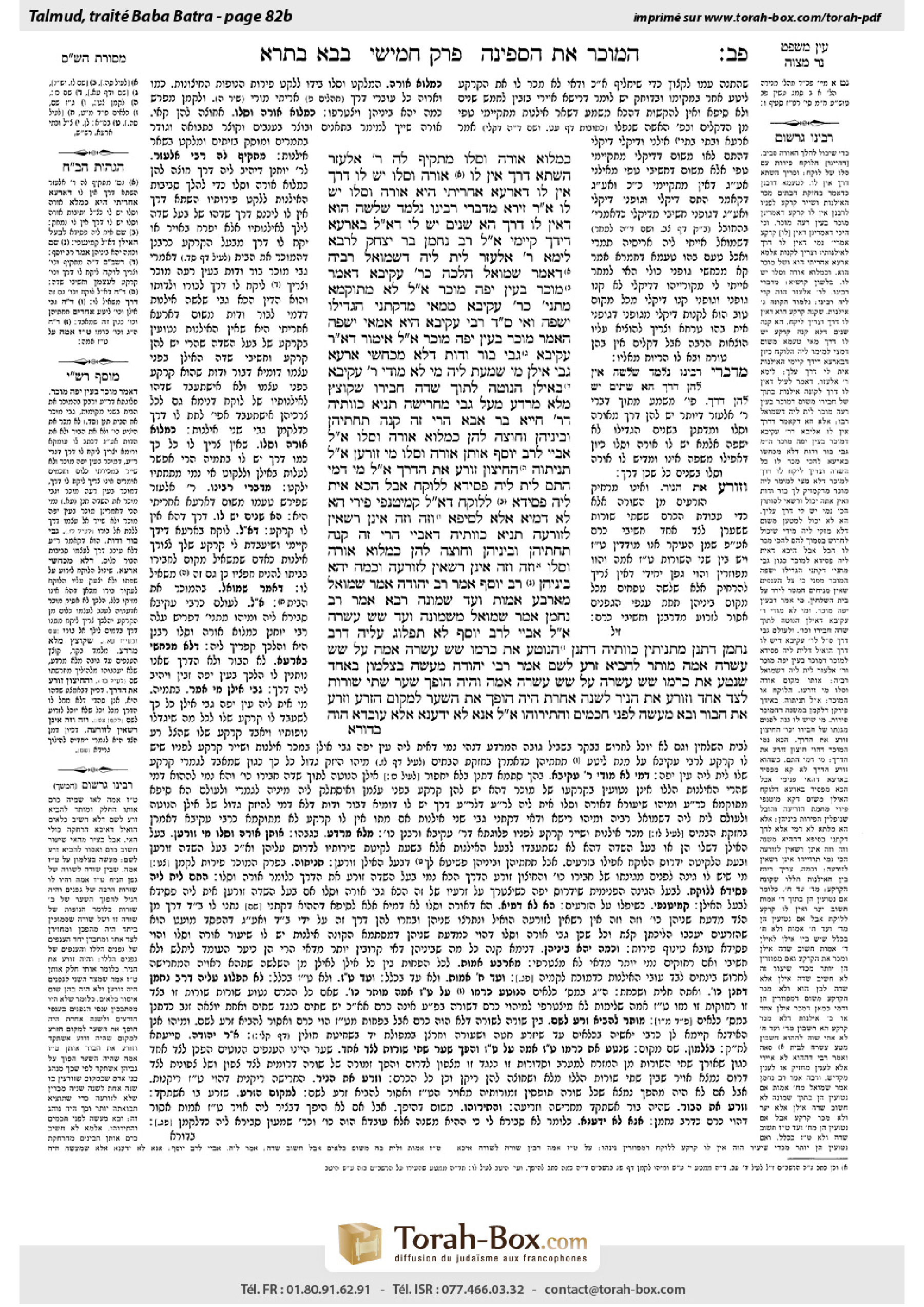
Bava Batra 82b: Talmud study for Daf Yomi
Study the Talmud for Daf Yomi with scanned pages, Hebrew text, English translations from Sefaria and AI-generated French translations.
Passage selection and English or AI-generated French translation are available where the scan has annotations. Daf Study is independent of Torah-Box and Sefaria.
Browse Bava Batra · בבא בתרא · All tractatesBava Batra 82b text and translations
This page of Bava Batra includes the Aramaic text, an English translation and an AI-generated French translation, alongside the scan above.
בבא בתרא פ״ב ב · Aramaic and Hebrew text
כִּמְלוֹא אוֹרֶה וְסַלּוֹ. מַתְקֵיף לַהּ רַבִּי אֶלְעָזָר: הַשְׁתָּא דֶּרֶךְ אֵין לוֹ, אוֹרֶה וְסַלּוֹ יֵשׁ לוֹ?! דֶּרֶךְ אֵין לוֹ – דְּאַרְעָא אַחֲרִיתִי הִיא; אוֹרֶה וְסַלּוֹ – יֵשׁ לוֹ?!
אָמַר רַבִּי זֵירָא: מִדִּבְרֵי רַבֵּינוּ נִלְמַד, שְׁלֹשָׁה – הוּא דְּאֵין לוֹ דֶּרֶךְ, הָא שְׁנַיִם – יֵשׁ לוֹ, דְּאָמַר לֵיהּ: בְּאַרְעָא דִּידָךְ קָיְימִי.
אֲמַר לֵיהּ רַב נַחְמָן בַּר יִצְחָק לְרָבָא: לֵימָא רַבִּי אֶלְעָזָר לֵית לֵיהּ דִּשְׁמוּאֵל רַבֵּיהּ – דְּאָמַר שְׁמוּאֵל: הֲלָכָה כְּרַבִּי עֲקִיבָא, דְּאָמַר: מוֹכֵר בְּעַיִן יָפָה מוֹכֵר?
אֲמַר לֵיהּ: לָא מִתּוֹקְמָא מַתְנִיתִין כְּרַבִּי עֲקִיבָא.
מִמַּאי? מִדְּקָתָנֵי: הִגְדִּילוּ – יְשַׁפֶּה, וְאִי סָלְקָא דַּעְתָּךְ רַבִּי עֲקִיבָא הִיא, אַמַּאי יְשַׁפֶּה? הָאָמַר: מוֹכֵר בְּעַיִן יָפָה מוֹכֵר!
אֲמַר לֵיהּ: אֵימוֹר דְּאָמַר רַבִּי עֲקִיבָא – גַּבֵּי בּוֹר וָדוּת, דְּלָא מַכְחֲשִׁי אַרְעָא; גַּבֵּי אִילָן מִי שָׁמְעַתְּ לֵיהּ?
מִי לָא מוֹדֵי רַבִּי עֲקִיבָא בְּאִילָן הַנּוֹטֶה לְתוֹךְ שְׂדֵה חֲבֵירוֹ, שֶׁקּוֹצֵץ מְלֹא מַרְדֵּעַ מֵעַל גַּבֵּי מַחֲרֵישָׁה?
תַּנְיָא כְּווֹתֵיהּ דְּרַבִּי חִיָּיא בַּר אַבָּא: הֲרֵי זֶה קָנָה תַּחְתֵּיהֶן וּבֵינֵיהֶן, וְחוּצָה לָהֶן כִּמְלוֹא אוֹרֶה וְסַלּוֹ.
אֲמַר לֵיהּ אַבָּיֵי לְרַב יוֹסֵף: אוֹתָן אוֹרֶה וְסַלּוֹ, מִי זוֹרְעָן? אֲמַר לֵיהּ, תְּנֵיתוּהָ: הַחִיצוֹן זוֹרֵעַ אֶת הַדֶּרֶךְ.
אֲמַר לֵיהּ: מִי דָּמֵי?! הָתָם לֵית לֵיהּ פְּסֵידָא לְלוֹקֵחַ, אֲבָל הָכָא – אִית לֵיהּ פְּסֵידָא לְלוֹקֵחַ, דַּאֲמַר לֵיהּ: קָמִיטַּנְּפִי פֵּירֵי.
הָא לָא דָּמְיָא אֶלָּא לְסֵיפָא: וְזֶה וָזֶה אֵינָן רַשָּׁאִין לְזוֹרְעָהּ.
תַּנְיָא כְּווֹתֵיהּ דְּאַבָּיֵי: הֲרֵי זֶה קָנָה תַּחְתֵּיהֶן וּבֵינֵיהֶן, וְחוּצָה לָהֶן כִּמְלוֹא אוֹרֶה וְסַלּוֹ; וְזֶה וָזֶה אֵינָן רַשָּׁאִין לְזוֹרְעָהּ.
וְכַמָּה יְהֵא בֵּינֵיהֶן? רַב יוֹסֵף אָמַר רַב יְהוּדָה אָמַר שְׁמוּאֵל: מֵאַרְבַּע אַמּוֹת וְעַד שְׁמוֹנֶה. רָבָא אָמַר רַב נַחְמָן אָמַר שְׁמוּאֵל: מִשְּׁמוֹנֶה וְעַד שֵׁשׁ עֶשְׂרֵה. אֲמַר לֵיהּ אַבָּיֵי לְרַב יוֹסֵף: לָא תִּפְלוֹג עֲלֵיהּ דְּרַב נַחְמָן, דִּתְנַן מַתְנִיתִין כְּווֹתֵיהּ –
דִּתְנַן: הַנּוֹטֵעַ אֶת כַּרְמוֹ שֵׁשׁ עֶשְׂרֵה אַמָּה עַל שֵׁשׁ עֶשְׂרֵה אַמָּה, מוּתָּר לְהָבִיא זֶרַע לְשָׁם.
אָמַר רַבִּי יְהוּדָה: מַעֲשֶׂה בְּצַלְמוֹן, בְּאֶחָד שֶׁנָּטַע אֶת כַּרְמוֹ שֵׁשׁ עֶשְׂרֵה עַל שֵׁשׁ עֶשְׂרֵה אַמָּה, וְהָיָה הוֹפֵךְ שְׂעַר שְׁתֵּי שׁוּרוֹת לְצַד אֶחָד, וְזוֹרֵעַ אֶת הַנִּיר; לְשָׁנָה אַחֶרֶת הָיָה הוֹפֵךְ אֶת הַשֵּׂעָר לִמְקוֹם הַזֶּרַע, וְזָרַע אֶת הַבּוּר; וּבָא מַעֲשֶׂה לִפְנֵי חֲכָמִים וְהִתִּירוּהוּ.
אֲמַר לֵיהּ: אֲנָא לָא יָדַעְנָא, אֶלָּא עוֹבָדָא הֲוָה
Bava Batra 82b · English translation
he has acquired an area sufficient for a gatherer of figs and his basket in hand to stand close to the tree. Rabbi Elazar objects to this: Now that the halakha is that the buyer has no path and must purchase a path through the field to access his trees; if so, does he have possession of an area for the gatherer and his basket? The Gemara elaborates: He has no path, even though he has no other means of gaining access to the trees, as the ground he acquired along with the trees is considered another land and is not part of the rest of the field. Why, then, would he have possession of an area for a gatherer and his basket?
Rabbi Zeira says: From the statement, i.e., the objection, of our teacher, we learn that it is in the case of three trees that the owner of the trees has no path, as the buyer acquired a separate piece of land along with the trees. But in the case of two trees the buyer has a path, as he says to the owner of the field: My trees are standing on your land, and as I am allowed to use your field to tend to my trees I have the right to walk through your land to reach them.
Rav Naḥman bar Yitzḥak said to Rava: Shall we say that Rabbi Elazar does not accept the opinion of Shmuel, who was his teacher? As Shmuel says: The halakha is in accordance with the opinion of Rabbi Akiva, who says: One who sells, sells generously. According to Rabbi Akiva, one sells in a manner that is advantageous for the buyer, and is presumed to have included in the sale even items that were not explicitly specified. In this case, as he has sold a tree that remains on his property, the seller grants the buyer the right to access his tree.
Rava said to him: Even if Rabbi Elazar himself agrees with Rabbi Akiva, the mishna cannot be explained in accordance with the opinion of Rabbi Akiva. Rather, the mishna must be in accordance with the opinion of the Rabbis, who hold that one who sells does so sparingly, and the difficulty that Rabbi Elazar raised against Rabbi Yoḥanan is predicated on the fact that the mishna is in accordance with the opinion of the Rabbis.
From where does Rava derive that the mishna is not in accordance with the opinion of Rabbi Akiva? From the fact that the mishna teaches: If the three trees grew, the owner of the land may cut down the branches that extend into his field. And if it enters your mind that the mishna is in accordance with the opinion of Rabbi Akiva, why may he cut them down? Doesn’t Rabbi Akiva say that one who sells, sells generously?
Rav Naḥman bar Yitzḥak said to him: This does not prove that the mishna is not in accordance with the opinion of Rabbi Akiva. You can say that Rabbi Akiva stated his ruling in the case of a pit and a cistern that are situated in a field belonging to another, which one sells in a generous manner, as they do not weaken the land. But did you hear him say that the seller is generous toward the buyer with regard to a tree, which can weaken the land?
Doesn’t Rabbi Akiva concede in the case of a tree that leans out into the field of another, in which the owner of the other field cuts down the branches until the full height of an ox-goad, the handle that protrudes over a plow? Since the extending branches impede his efforts to plow his field, it is permitted for him to cut them down. This indicates that even according to Rabbi Akiva one does not grant privileges that are detrimental to his own interests. If so, the mishna can be explained even in accordance with the opinion of Rabbi Akiva, which indicates that Rabbi Elazar does not accept his ruling.
The Gemara points out: It is taught in a baraita in accordance with the statement of Rabbi Ḥiyya bar Abba: If one buys three trees in a field belonging to another, this buyer has acquired the ground that is found underneath the trees, and the area between them, and outside of the trees and their branches an area sufficient for a gatherer of figs and his basket.
Abaye said to Rav Yosef: Those areas around the trees that are designated for a gatherer of figs and his basket are used for this purpose only at specific times. Who sows that land during the rest of the year, the owner of the trees or the owner of the field? Rav Yosef said to him: You learned the answer in a mishna (99b): If one owns a garden that is surrounded by the garden of another, the owner of the inner garden has a right to a path through the outer garden. Even so, the owner of the outer garden may sow the path.
Abaye said to him: Are the cases comparable? There, in the case of the outer and inner gardens, there is no loss suffered by the buyer when the owner of the outer garden sows the path, as he can still pass through it. But here, there is a loss for the buyer, as the one who bought the trees says to the owner of the field: The fruits that fall from the trees will become soiled by the plants.
This case is similar only to the last clause of that mishna, which states: If the owner of the inner garden is given a side path, so that he suffers a loss of some kind because he cannot take the shortest path to reach his garden, both this owner of the inner garden and that owner of the outer garden are not permitted to sow the path. Similarly, here too, neither the owner of the trees nor the owner of the field are permitted to sow the place designated for the gatherer of figs and his basket.
The Gemara comments: It is taught in a baraita in accordance with the opinion of Abaye: This buyer has acquired the ground that is found underneath the trees, and the area between them, and outside of the trees and their branches an area sufficient for a gatherer of figs and his basket. And both this owner of the field and that owner of the trees are not permitted to sow it.
The Gemara inquires: And how much space must there be between the three trees for them to be considered one unit, which means that the land is acquired by the owner of the trees? Rav Yosef says that Rav Yehuda says that Shmuel says: The distance between the trees must be from four cubits to eight cubits. Rava says that Rav Naḥman says that Shmuel says: It must be from eight cubits to sixteen cubits. Abaye said to Rav Yosef: Do not disagree with Rav Naḥman, as we learned in a mishna in accordance with his opinion.
As we learned in a mishna (Kilayim 4:9): One who plants his vineyard sixteen cubits by sixteen cubits, i.e., he leaves sixteen cubits between each row of vines, is permitted to bring other species of seeds to the empty spaces between the rows and sow them there. This is not considered a violation of the biblical prohibition with regard to sowing diverse crops in a vineyard, which is one of the prohibitions of diverse kinds.
Rabbi Yehuda said: There was an incident in the city of Tzalmon, where one individual planted his vineyard sixteen by sixteen cubits. And he would turn the branches of two rows that were facing each other to one side, so that there was a space of sixteen cubits between the two rows, and sow the clearing. The following year he would turn the branches to the place that was sown the year before, and would sow the land that had been left uncultivated the previous year, as it had been filled with the branches from the vines. And the incident came before the Sages and they permitted it. This demonstrates that sixteen cubits between plants is required for them to be considered separate units.
Rav Yosef said to him: I do not know about this, but there was a similar incident
Bava Batra 82b · Traduction française (IA)
il a acquis une surface suffisante pour un récolteur de figues et son panier à la main pour se tenir près de l'arbre. Rabbi Eléazar s'oppose à cela : puisque la halakha est que l'acheteur n'a pas de chemin et doit acheter un chemin à travers le champ pour accéder à ses arbres ; si c'est ainsi, a-t-il la possession d'une surface pour le récolteur et son panier ? La Guemara développe : il n'a pas de chemin, même s'il n'a pas d'autre moyen d'accéder aux arbres, car la terre qu'il a acquise avec les arbres est considérée comme une autre terre et n'appartient pas à la restant du champ. Pourquoi alors a-t-il la possession d'une surface pour un récolteur et son panier ?
Rabbi Zéira dit : d'après l'objection de notre maître, nous apprenons que c'est dans le cas de trois arbres que l'propriétaire des arbres n'a pas de chemin, car l'acheteur a acquis une parcelle de terre séparée avec les arbres. Mais dans le cas de deux arbres, l'acheteur a un chemin, car il dit à l'propriétaire du champ : mes arbres sont plantés sur votre terre, et comme je suis autorisé à utiliser votre champ pour entretenir mes arbres, j'ai le droit de marcher sur votre terre pour y accéder.
Rav Naḥman bar Yitzḥak dit à Rava : devons-nous dire que Rabbi Eléazar ne reconnaît pas l'opinion de Shmuel, qui était son maître ? Car Shmuel dit : la halakha suit l'opinion de Rabbi Akiva, qui dit : celui qui vend vend généreusement. Selon Rabbi Akiva, on vend de manière avantageuse pour l'acheteur, et on suppose qu'il a inclus dans la vente même les choses non spécifiées. Dans ce cas, comme il a vendu un arbre restant sur sa propriété, le vendeur accorde à l'acheteur le droit d'accéder à son arbre.
Rava dit à lui : même si Rabbi Eléazar lui-même est d'accord avec Rabbi Akiva, la mitsna ne peut pas être expliquée selon l'opinion de Rabbi Akiva. Plutôt, la mitsna doit suivre l'opinion des Rabbins, qui pensent que celui qui vend vend parcimonieusement, et la difficulté que Rabbi Eléazar a soulevée contre Rabbi Yoḥanan est fondée sur le fait que la mitsna suit l'opinion des Rabbins.
D'où Rava dérive-t-il que la mitsna ne suit pas l'opinion de Rabbi Akiva ? De ce que la mitsna enseigne : si les trois arbres ont poussé, l'propriétaire de la terre peut couper les branches qui s'étendent dans son champ. Et si cela entre en votre tête que la mitsna suit l'opinion de Rabbi Akiva, pourquoi peut-il les couper ? N'a-t-il pas dit que celui qui vend vend généreusement ?
Rav Naḥman bar Yitzḥak dit à lui : cela ne prouve pas que la mitsna ne suit pas l'opinion de Rabbi Akiva. Vous pouvez dire que Rabbi Akiva a formulé sa décision dans le cas d'un puits et d'une citerne situés dans un champ appartenant à un autre, que l'on vend de manière généreuse, car ils ne affaiblissent pas la terre. Mais avez-vous entendu qu'il dise que le vendeur est généreux envers l'acheteur concernant un arbre, qui peut affaiblir la terre ?
N'est-ce pas que Rabbi Akiva reconnaît dans le cas d'un arbre qui s'étend dans le champ d'un autre, où l'owner du champ coupe les branches jusqu'à la hauteur d'une verge, le manche qui dépasse sur une charrue ? Puisque les branches étendues entravent ses efforts pour labourer son champ, il est permis de les couper. Cela indique que même selon Rabbi Akiva, on ne donne pas de privilèges qui nuisent à ses propres intérêts. Si c'est ainsi, la mitsva peut être expliquée même selon l'opinion de Rabbi Akiva, ce qui indique que Rabbi Eléazar ne reconnaît pas sa décision.
La Guemara souligne : il est enseigné dans une baraïta selon l'opinion de Rabbi Ḥiyya bar Abba : si l'on achète trois arbres dans un champ appartenant à un autre, cet acheteur a acquis la terre qui se trouve sous les arbres, et la surface entre eux, et en dehors des arbres et de leurs branches, une surface suffisante pour un récolteur de figues et son panier.
Abaye dit à Rav Yosef : ces zones autour des arbres désignées pour un récolteur de figues et son panier sont utilisées à cet effet uniquement à des moments spécifiques. Qui cultive cette terre pendant l'année restante, l'owner des arbres ou l'owner du champ ? Rav Yosef dit à lui : vous avez appris la réponse dans une mitsva (99b) : si l'on possède un jardin entouré par le jardin d'un autre, l'owner du jardin intérieur a le droit à un chemin à travers le jardin extérieur. Même ainsi, l'owner du jardin extérieur peut cultiver le chemin.
Abaye dit à lui : les cas sont-ils comparables ? Là, dans le cas des jardins extérieur et intérieur, il n'y a pas de perte subie par l'acheteur lorsque l'propriétaire du jardin extérieur cultive le chemin, car il peut toujours passer par là. Mais ici, il y a une perte pour l'acheteur, car celui qui a acheté les arbres dit à l'propriétaire du champ : les fruits qui tombent des arbres deviendront souillés par les plantes.
Ce cas est comparable uniquement à la dernière clause de cette mitsna, qui stipule : si l'propriétaire du jardin intérieur est donné un chemin latéral, de sorte qu'il subit une perte en ne pouvant prendre le chemin le plus court pour atteindre son jardin, à la fois l'propriétaire du jardin intérieur et celui du jardin extérieur ne sont pas autorisés à cultiver le chemin. De même, ici aussi, ni l'propriétaire des arbres ni celui du champ ne sont autorisés à cultiver la place désignée pour le récolteur de figues et son panier.
La Guemara commente : il est enseigné dans une baraïta selon l'opinion d'Abaye : cet acheteur a acquis la terre qui se trouve sous les arbres, et la surface entre eux, et en dehors des arbres et de leurs branches, une surface suffisante pour un récolteur de figues et son panier. Et à la fois l'propriétaire du champ et celui des arbres ne sont pas autorisés à cultiver cette surface.
La Guemara pose la question : Et quelle distance doit-il y avoir entre les trois arbres pour qu'ils soient considérés comme une unité, ce qui signifie que la terre est acquise par l'propriétaire des arbres ? Rav Yosef dit que Rav Yehuda dit que Shmuel dit : La distance entre les arbres doit être entre quatre coudées et huit coudées. Rava dit que Rav Naḥman dit que Shmuel dit : Elle doit être entre huit coudées et seize coudées. Abaye dit à Rav Yosef : Ne discute pas avec Rav Naḥman, car nous avons appris dans une mitsva selon son avis.
Comme nous avons appris dans une mitsva (Kilayim 4:9) : Celui qui plante son vignoble seize coudées par seize coudées, c'est-à-dire qu'il laisse seize coudées entre chaque rangée de vigne, est autorisé à apporter d'autres semences à l'espace vide entre les rangées et à les semer là. Cela ne constitue pas une violation de la prohibition biblique concernant la culture de cultures mixtes dans un vignoble, qui est l'une des prohibitions des espèces diverses.
Rabbi Yehuda dit : Il y avait un incident dans la ville de Tzalmon, où un individu plantait son vignoble seize par seize coudées. Et il tournait les branches de deux rangées qui se faisaient face vers un côté, de sorte qu'il y avait une distance de seize coudées entre les deux rangées, et il semait l'espace libre. L'année suivante, il tournait les branches vers l'endroit qui avait été semé l'année précédente, et il semait la terre qui avait été laissée inoccupée l'année précédente, car elle était remplie des branches des vignes. Et l'incident est venu devant les Sages et ils l'ont autorisé. Cela démontre que seize coudées entre les plantes est requis pour qu'elles soient considérées comme des unités distinctes.
Rav Yosef dit à lui : Je ne sais pas sur ce sujet, mais il y a eu un incident similaire
Traduction française générée par IA à partir de l’édition anglaise de Sefaria. Vérifie toujours un passage avec le texte source.
Text from Sefaria: William Davidson Edition - Vocalized Aramaic (CC BY NC); William Davidson Edition - English (CC BY NC).