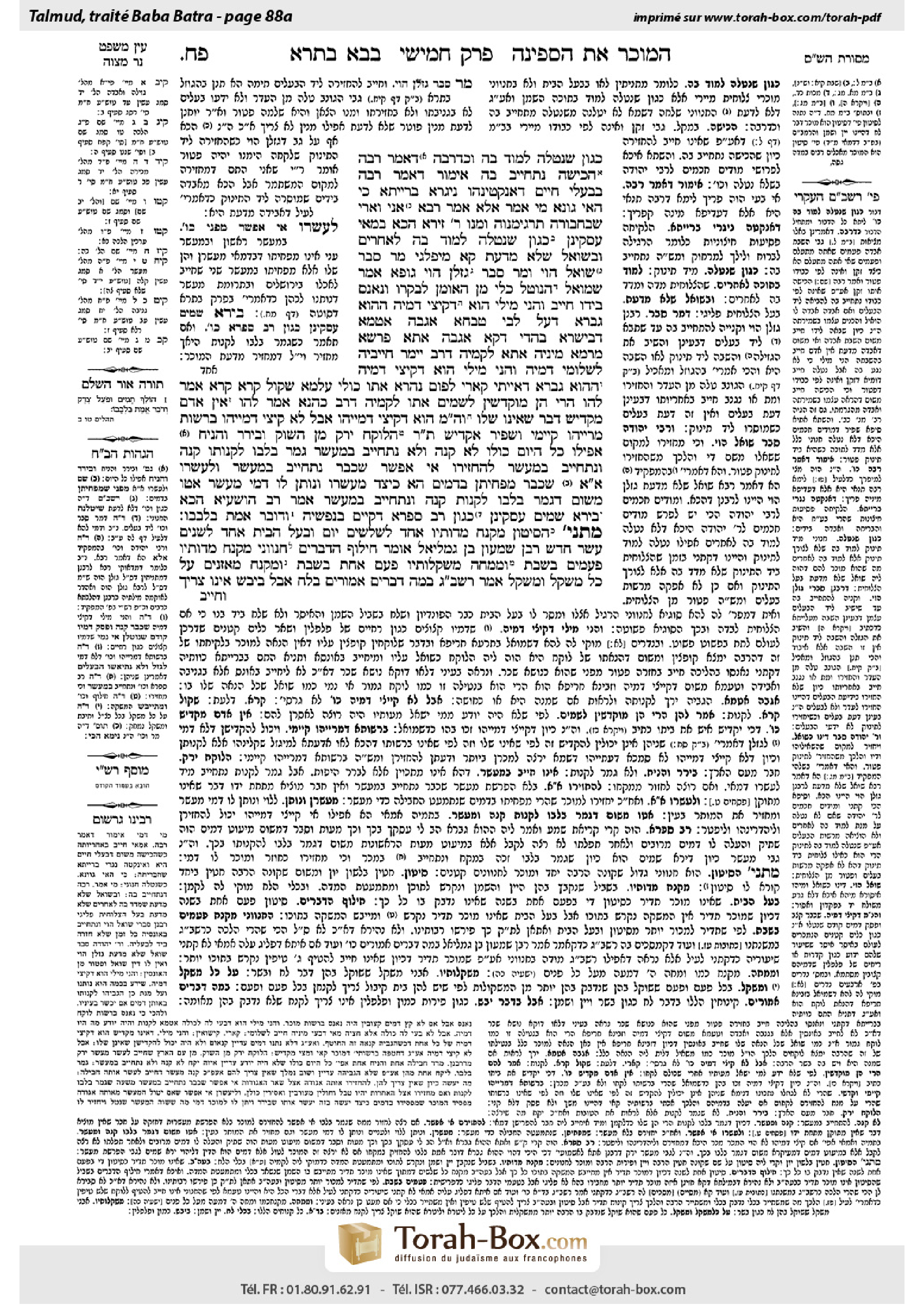
Bava Batra 88a: Talmud study for Daf Yomi
Study the Talmud for Daf Yomi with scanned pages, Hebrew text, English translations from Sefaria and AI-generated French translations.
Passage selection and English or AI-generated French translation are available where the scan has annotations. Daf Study is independent of Torah-Box and Sefaria.
Browse Bava Batra · בבא בתרא · All tractatesBava Batra 88a text and translations
This page of Bava Batra includes the Aramaic text, an English translation and an AI-generated French translation, alongside the scan above.
בבא בתרא פ״ח א · Aramaic and Hebrew text
כְּגוֹן שֶׁנְּטָלָהּ לָמוֹד בָּהּ, וְכִדְרַבָּה – דְּאָמַר רַבָּה: הִכִּישָׁהּ – נִתְחַיֵּיב בָּהּ.
אֵימוֹר דְּאָמַר רַבָּה – בְּבַעֲלֵי חַיִּים, דְּאַנְקְטִינְהוּ נִיגְרָא בָּרָיָיתָא; כִּי הַאי גַּוְנָא מִי אָמַר?!
אֶלָּא אָמַר רָבָא: אֲנִי וַאֲרִי שֶׁבַּחֲבוּרָה תַּרְגֵּימְנוּהָ – וּמַנּוּ? רַבִּי זֵירָא; הָכָא בְּמַאי עָסְקִינַן – כְּגוֹן שֶׁנְּטָלָהּ לָמוֹד בָּהּ לַאֲחֵרִים.
וּבְשׁוֹאֵל שֶׁלֹּא מִדַּעַת קָא מִיפַּלְגִי – מָר סָבַר: שׁוֹאֵל הָוֵי, וּמָר סָבַר: גַּזְלָן הָוֵי.
גּוּפָא – אָמַר שְׁמוּאֵל: הַנּוֹטֵל כְּלִי מִן הָאוּמָּן לְבַקְּרוֹ, וְנֶאֱנַס בְּיָדוֹ – חַיָּיב. וְהָנֵי מִילֵּי הוּא דְּקַיְצִי דְּמֵיהּ.
הַהוּא גַּבְרָא דְּעָל לְבֵי טַבָּחָא, אַגְבַּהּ אַטְמָא דְבִישְׂרָא. בַּהֲדֵי דְּקָא אַגְבַּהּ, אֲתָא פָּרָשָׁא מִרְמֵא מִינֵּיהּ. אֲתָא לְקַמֵּיהּ דְּרַב יֵימַר, חַיְּיבֵיהּ לְשַׁלּוֹמֵי דְּמָיהּ. וְהָנֵי מִילֵּי הוּא דְּקַיְצִי דְּמָיהּ.
הַהוּא גַּבְרָא דְּאַיְיתִי קָארֵי לְפוּם נַהֲרָא. אֲתוֹ כּוּלֵּי עָלְמָא, שְׁקוּל קָרָא קָרָא. אֲמַר לְהוּ: הֲרֵי הֵן מוּקְדָּשִׁין לַשָּׁמַיִם.
אֲתוֹ לְקַמֵּיהּ דְּרַב כָּהֲנָא, אֲמַר לְהוּ: אֵין אָדָם מַקְדִּישׁ דָּבָר שֶׁאֵינוֹ שֶׁלּוֹ. וְהָנֵי מִילֵּי הוּא דְּקַיְצִי דְּמַיְיהוּ, אֲבָל לָא קַיְצִי דְּמַיְיהוּ – בִּרְשׁוּת מָרַיְיהוּ קָיְימִי, וְשַׁפִּיר אַקְדֵּישׁ.
תָּנוּ רַבָּנַן: הַלּוֹקֵחַ יָרָק מִן הַשּׁוּק, וּבֵירַר וְהִנִּיחַ – אֲפִילּוּ כׇּל הַיּוֹם כּוּלּוֹ, לֹא קָנָה וְלֹא נִתְחַיֵּיב בְּמַעֲשֵׂר.
גָּמַר בְּלִבּוֹ לִקְנוֹתוֹ – קָנָה וְנִתְחַיֵּיב בְּמַעֲשֵׂר. לְהַחְזִירוֹ אִי אֶפְשָׁר – שֶׁכְּבָר נִתְחַיֵּיב בְּמַעֲשֵׂר, וּלְעַשְּׂרוֹ אִי אֶפְשָׁר – שֶׁכְּבָר מַפְחִיתָן בְּדָמִים. הָא כֵּיצַד? מְעַשְּׂרוֹ, וְנוֹתֵן לוֹ דְּמֵי מַעֲשֵׂר.
אַטּוּ מִשּׁוּם דְּגָמַר בְּלִבּוֹ לִקְנוֹת, קָנָה וְנִתְחַיֵּיב בְּמַעֲשֵׂר?! אָמַר רַב הוֹשַׁעְיָא: הָכָא בִּירֵא שָׁמַיִם עָסְקִינַן, כְּגוֹן רַב סָפְרָא, דְּקַיֵּים בְּנַפְשֵׁיהּ ״וְדֹבֵר אֱמֶת בִּלְבָבוֹ״.
מַתְנִי׳ הַסִּיטוֹן מְקַנֵּחַ מִדּוֹתָיו אֶחָד לִשְׁלשִׁים יוֹם. וּבַעַל הַבַּיִת, אֶחָד לִשְׁנֵים עָשָׂר חֹדֶשׁ. רַבָּן שִׁמְעוֹן בֶּן גַּמְלִיאֵל אוֹמֵר: חִילּוּף הַדְּבָרִים.
חֶנְווֹנִי, מְקַנֵּחַ מִדּוֹתָיו פַּעֲמַיִם בְּשַׁבָּת, וּמְמַחֶה מִשְׁקְלוֹתָיו פַּעַם אַחַת בְּשַׁבָּת, וּמְקַנֵּח מֹאזְנַיִם עַל כׇּל מִשְׁקָל וּמִשְׁקָל. אָמַר רַבָּן שִׁמְעוֹן בֶּן גַּמְלִיאֵל: בַּמֶּה דְּבָרִים אֲמוּרִים – בְּלַח, אֲבָל בְּיָבֵשׁ – אֵינוֹ צָרִיךְ.
Bava Batra 88a · English translation
The mishna is referring to a case where the storekeeper took the jug from the child in order to measure with it for him, and because he took it in his hands, he is liable in the event of an accident, in accordance with the opinion of Rabba. As Rabba says: With regard to the obligation to return lost animals, even in a case where the finder is exempt from caring for the animal and returning it to its owner, e.g., if he is an elderly person and it is beneath his dignity, if he struck the animal in order to lead it, then he becomes obligated to return it. Likewise, the Rabbis here maintain that the storekeeper’s action renders him liable for the jug.
The Gemara asks: You can say that Rabba says his statement with regard to animals, as the finder taught them to take steps away, i.e., he worsened the situation, as he causes them to stray even further from their owner. Nevertheless, in a case like this, where the storekeeper took the jug from the child, did Rabba say that the storekeeper is liable? The storekeeper’s action does not make it any more likely that the jug will break.
Rather, Rava said: I and the lion of the group explained it. And who is this great Sage, referred to as a lion? It is Rabbi Zeira, and the explanation is as follows: Here we are dealing with a case where the storekeeper took the jug from the child in order to measure with it for others, without the knowledge of the father.
And the Rabbis and Rabbi Yehuda disagree with regard to a borrower who takes an item without the owner’s knowledge. One Sage, Rabbi Yehuda, holds that the storekeeper is considered like any other borrower and once he returns the jug to the child, he is no longer responsible for it. And one Sage, i.e., the Rabbis, holds that someone who borrows without the owner’s knowledge is a robber and is obligated to return the item to its owner. Therefore, the storekeeper must pay for the jug that the child broke before it reached the father.
The Gemara returns to the matter itself. Shmuel says: With regard to one who takes a vessel from a craftsman in order to examine it, and an accident occurred while it was in his possession and it broke, he is liable to pay restitution for the vessel. The Gemara explains: And this statement applies only in a case where the monetary value of the vessel is fixed, because he examines the vessel merely to ensure there is nothing wrong with it, and it is assumed that if he finds no defect he will buy it.
The Gemara relates: There was a certain man who entered a butcher shop and lifted a thigh of meat to examine it. While he was lifting it, a horseman came and seized it from him. The buyer came before Rav Yeimar, who deemed him liable to pay its monetary value to the seller, because it was seized from him after he had lifted it. The Gemara again notes: And this matter, i.e., halakha, applies only in a place where the monetary value of the item is fixed, and therefore lifting it is equivalent to finalizing the sale.
The Gemara relates a similar incident: There was a certain man who brought pumpkins to the city of Pum Nahara. Everyone came and took a pumpkin with the intention of buying it, but had yet to pay for it. The seller was angry, and since he did not know from whom to demand payment, he said to them: The pumpkins are hereby consecrated to Heaven.
They came before Rav Kahana to inquire about the halakhic status of the pumpkins. Rav Kahana said to them: This statement has no effect, as a person cannot consecrate an item that is not his, and since the buyers had lifted the pumpkins, they no longer belonged to the seller. Once again the Gemara points out: And this matter, i.e., halakha, applies only in a place where the item’s monetary value is fixed, and therefore lifting it is akin to finalizing the sale. But if the item’s monetary value is not fixed, it remains in the jurisdiction of its owner, and the seller did well, i.e., was successful, in that he consecrated it.
§ The Sages taught: In the case of one who wishes to buy vegetables from the market and the seller is an am ha’aretz, i.e., one who is unreliable with regard to tithes, in which case the buyer is required to separate tithes after his purchase, and he selected superior-quality vegetables from inferior-quality vegetables and placed them to the side, as he was considering purchasing them, even if he did this all day, if he does not decide to buy the vegetables he does not acquire them and does not become obligated in separating tithes.
If he had determined to buy the vegetables he selected, he acquires them and becomes obligated in separating tithes. In such a case, it is not possible for him to decide to not buy the vegetables and to return them to the seller in their present state, as they have already became obligated in tithes, and, likewise, it is not possible to tithe them and return them to the seller, as he would then lower their monetary value. How should he proceed? He should tithe the produce, give the tithes to an appropriate recipient, and give the seller money in exchange for the tithes that he separated from it.
The Gemara asks: Is that to say that because one determined to buy the produce, even though he says nothing and performs no act of acquisition, he acquires the produce and becomes obligated in tithes? Rav Hoshaya said: Here, we are dealing with a buyer who is God-fearing, such as Rav Safra, who himself fulfilled the verse: “And speaks truth in his heart” (Psalms 15:2). With regard to business matters Rav Safra considered himself bound by his thoughts at the time of negotiations, even if he did not express them verbally or perform any action (see Makkot 24a). A person on the ethical level of Rav Safra acquires the produce and becomes obligated to separate tithes from the moment that he decides to buy it.
MISHNA: A wholesaler [hassiton] must clean his measuring vessels, which are used for measuring liquids such as oil and wine, once every thirty days, because the residue of the liquids sticks to the measure and reduces its capacity. And a homeowner who sells his goods must clean his measuring vessels only once every twelve months. Rabban Shimon ben Gamliel says: The matters are reversed. In the case of one who is constantly using his vessels for selling merchandise the residue does not adhere to the measuring vessel, and therefore a wholesaler must clean his measures only once a year. But in the case of a homeowner, who does not sell as often, the residue adheres to the measuring vessel; therefore, he must clean them every thirty days.
A storekeeper, who constantly sells merchandise in small quantities, cleans his measuring vessels twice a week and cleans his weights once a week; and he cleans the pans of his scales after each and every weighing, to ensure that no merchandise has adhered to the pans, thereby increasing their weight. Rabban Shimon ben Gamliel said: In what case is this statement, that it is necessary to clean a measuring vessel, said? With regard to moist items, which are likely to adhere to the measuring vessels. But with regard to dry goods, which do not adhere to the measuring vessels, one does not need to clean his measuring vessels.
Bava Batra 88a · Traduction française (IA)
La Michna fait référence à un cas où le marchand a pris le bidon du petit enfant afin de le mesurer pour lui, et en raison du fait qu'il l'a pris dans ses mains, il est tenu responsable en cas d'accident, conformément à l'opinion de Rabba. Comme Rabba dit : En ce qui concerne l'obligation de rendre un animal perdu, même dans un cas où le trouver est exempt de s'occuper de l'animal et de le rendre à son propriétaire, par exemple, s'il s'agit d'une personne âgée et que cela est en dehors de son honneur, si l'on frappe l'animal afin de le faire avancer, alors il devient tenu de le rendre. De même, les Sages ici maintiennent que l'action du marchand le rend responsable du bidon.
Le Guemara pose la question : Vous pouvez dire que Rabba dit cela en ce qui concerne les animaux, comme le trouver a appris qu'il faut les éloigner, c'est-à-dire qu'il a aggravé la situation, car il cause leur éloignement encore davantage de leur propriétaire. Cependant, dans un cas comme celui-ci, où le marchand a pris le bidon du petit enfant, Rabba a-t-il dit que le marchand est responsable ? L'action du marchand ne rend pas le bidon plus susceptible de se briser.
Plutôt, Rava dit : Moi et le lion du groupe avons expliqué cela. Et qui est ce Sage important, appelé un lion ? C'est Rabbi Zéira, et l'explication est la suivante : Nous sommes ici dans un cas où le marchand a pris le bidon du petit enfant afin de le mesurer pour les autres, sans la connaissance du père.
Et les Sages et Rabbi Yéhuda s'opposent quant à un emprunteur qui prend un objet sans la connaissance du propriétaire. Un Sage, Rabbi Yéhuda, considère que le marchand est comme n'importe quel autre emprunteur et une fois qu'il rend le bidon au petit enfant, il n'est plus responsable de lui. Un autre Sage, c'est-à-dire les Sages, considère que celui qui emprunte sans la connaissance du propriétaire est un voleur et est tenu de rendre l'objet à son propriétaire. Ainsi, le marchand doit payer pour le bidon que l'enfant a cassé avant qu'il n'atteigne le père.
Le Guemara retourne à la question principale. Shmuel dit : En ce qui concerne celui qui prend un récipient d'un artisan afin de l'examiner, et qu'un accident survient pendant qu'il est en sa possession et qu'il se brise, il est tenu de payer la réparation du récipient. Le Guemara explique : Et cette déclaration s'applique uniquement dans un cas où la valeur monétaire du récipient est fixe, car il l'examine simplement pour s'assurer qu'il n'y a pas de défaut, et on suppose qu'il achètera le récipient s'il ne trouve aucun défaut.
Le Guemara rapporte : Il y avait un certain homme qui est entré dans une boucherie et a soulevé une cuisse de viande pour l'examiner. Tandis qu'il la soulevait, un cavalier est venu et l'a arrachée de ses mains. L'acheteur est venu devant Rav Yéimar, qui l'a déclaré responsable de payer sa valeur monétaire au vendeur, car il avait été arraché après qu'il l'avait soulevé. Le Guemara note à nouveau : Et cette question, c'est-à-dire la halakha, s'applique uniquement dans un lieu où la valeur monétaire de l'objet est fixe, et donc soulever l'objet équivaut à finaliser la vente.
Le Guemara rapporte un incident similaire : Il y avait un certain homme qui apporta des citrouilles à la ville de Pum Nahara. Tout le monde vint prendre une citrouille avec l'intention d'acheter, mais n'avait pas encore payé. Le vendeur était en colère, et puisqu'il ne savait pas à qui demander le paiement, il dit à tous : Les citrouilles sont désormais consacrées au Royaume des Cieux.
Ils vinrent devant Rav Kahana pour demander le statut halakhique des citrouilles. Rav Kahana dit à tous : Cette déclaration n'a aucun effet, car une personne ne peut pas consacrer un objet qui n'est pas le sien, et puisque les acheteurs avaient soulevé les citrouilles, elles n'appartenaient plus au vendeur. Une fois de plus, le Guemara souligne : Et cette question, c'est-à-dire la halakha, s'applique uniquement dans un lieu où la valeur monétaire de l'objet est fixe, et donc soulever l'objet équivaut à finaliser la vente. Mais si la valeur monétaire de l'objet n'est pas fixe, il reste sous la juridiction de son propriétaire, et le vendeur a bien fait, c'est-à-dire a réussi, en consacrant l'objet.
§ Les Sages enseignèrent : Dans le cas d'une personne qui veut acheter des légumes du marché et le vendeur est un am ha'aretz, c'est-à-dire une personne peu fiable en ce qui concerne les dîmes, dans ce cas l'acheteur est tenu de séparer les dîmes après son achat, et s'il a sélectionné des légumes de qualité supérieure parmi des légumes de qualité inférieure et les a mis de côté, en considérant les acheter, même s'il a fait cela toute la journée, s'il ne décide pas d'acheter les légumes, il ne les acquiert pas et n'est pas tenu de séparer les dîmes.
Si l'avait décidé d'acheter les légumes qu'il avait sélectionnés, il les acquiert et devient tenu de séparer les dîmes. Dans ce cas, il n'est pas possible qu'il décide de ne pas acheter les légumes et de les rendre au vendeur dans leur état actuel, car ils sont déjà tenus de séparer les dîmes, et de même, il n'est pas possible de les dîmer et de les rendre au vendeur, car cela réduirait leur valeur monétaire. Comment doit-il procéder ? Il doit dîmer la production, donner les dîmes à un destinataire approprié, et donner de l'argent au vendeur en échange des dîmes qu'il a séparées.
Le Guemara pose la question : Est-ce que cela signifie que parce qu'une personne a décidé d'acheter les produits, même s'il ne dit rien et ne fait aucun acte d'acquisition, il acquiert les produits et devient tenu de séparer les dîmes ? Rav Hoshaya a dit : Ici, nous sommes dans le cas d'un acheteur craignant Dieu, comme Rav Safra, qui lui-même a accompli la parole : « Et parle la vérité dans son cœur » (Psaumes 15:2). En ce qui concerne les affaires commerciales, Rav Safra considérait qu'il était lié par ses pensées lors des négociations, même s'il ne les avait pas exprimées verbalement ou ne les avait pas réalisées (voir Makkot 24a). Une personne sur le niveau éthique de Rav Safra acquiert les produits et devient tenu de séparer les dîmes dès le moment où il décide d'acheter.
MICHNA : Un grossiste [hassiton] doit nettoyer ses instruments de mesure, utilisés pour mesurer des liquides tels que l'huile et le vin, une fois par mois, car les résidus des liquides s'attardent sur les instruments et réduisent leur capacité. Et un propriétaire qui vend ses marchandises doit nettoyer ses instruments de mesure une fois par an. Rabban Shimon ben Gamliel dit : Les choses sont inversées. Dans le cas d'une personne qui utilise constamment ses instruments pour vendre des marchandises, les résidus ne s'attardent pas sur les instruments de mesure, et par conséquent, le grossiste doit nettoyer ses instruments une fois par an. Mais dans le cas d'un propriétaire, qui ne vend pas aussi souvent, les résidus s'attardent sur les instruments de mesure ; par conséquent, il doit les nettoyer chaque mois.
Un marchand, qui vend constamment des marchandises en petites quantités, nettoie ses instruments de mesure deux fois par semaine et nettoie ses poids une fois par semaine ; et il nettoie les plateaux de ses balances après chaque pesée, afin de s'assurer que rien ne s'attarde sur les plateaux, ce qui augmenterait leur poids. Rabban Shimon ben Gamliel a dit : Dans quel cas cette déclaration, selon laquelle il est nécessaire de nettoyer un instrument de mesure, est-elle émise ? Celle-ci concerne les articles humides, qui sont susceptibles de s'attarder sur les instruments de mesure. Mais concernant les marchandises sèches, qui ne s'attardent pas sur les instruments de mesure, on n'a pas besoin de nettoyer ses instruments de mesure.
Traduction française générée par IA à partir de l’édition anglaise de Sefaria. Vérifie toujours un passage avec le texte source.
Text from Sefaria: William Davidson Edition - Vocalized Aramaic (CC BY NC); William Davidson Edition - English (CC BY NC).