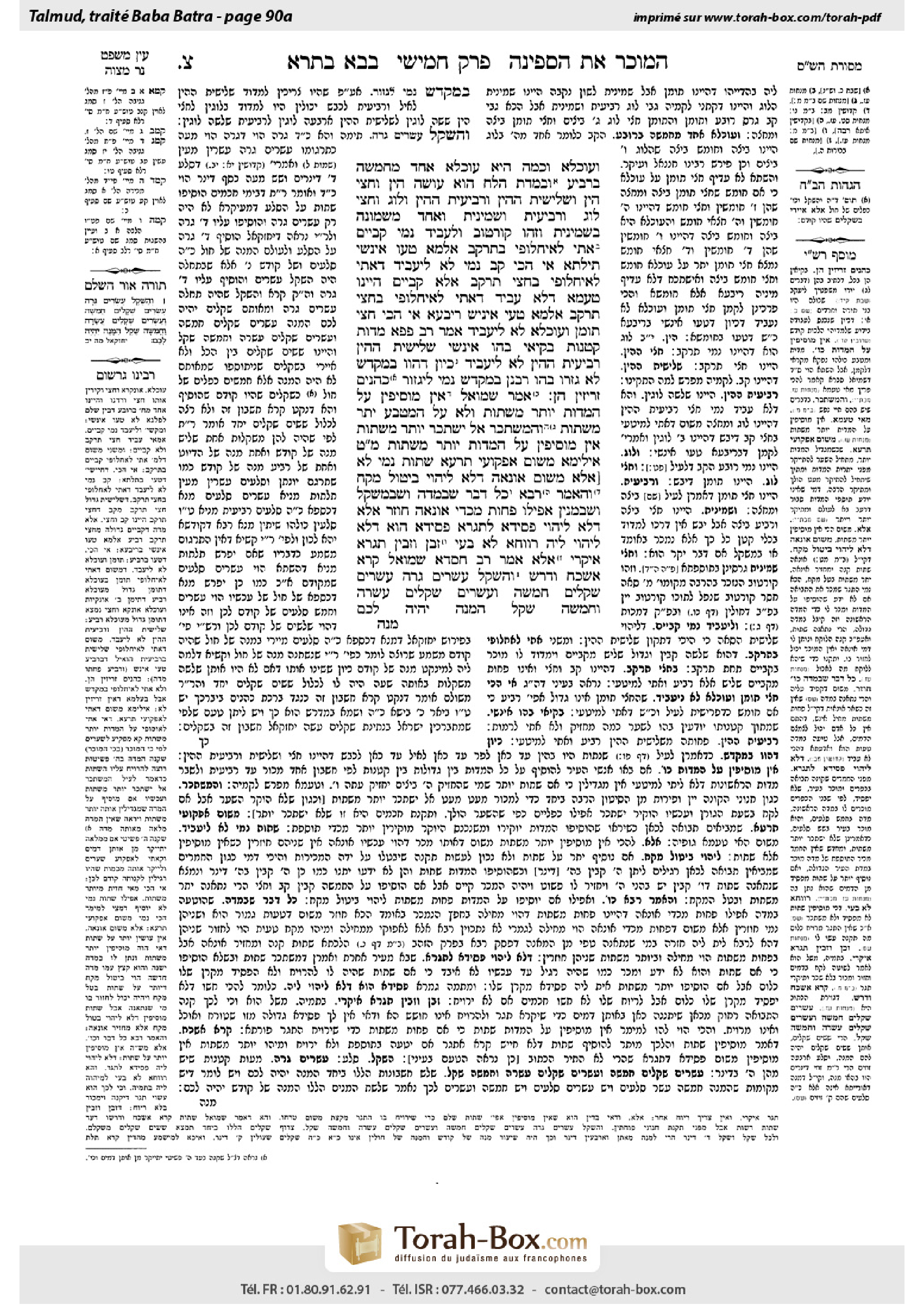
Bava Batra 90a: Talmud study for Daf Yomi
Study the Talmud for Daf Yomi with scanned pages, Hebrew text, English translations from Sefaria and AI-generated French translations.
Passage selection and English or AI-generated French translation are available where the scan has annotations. Daf Study is independent of Torah-Box and Sefaria.
Browse Bava Batra · בבא בתרא · All tractatesBava Batra 90a text and translations
This page of Bava Batra includes the Aramaic text, an English translation and an AI-generated French translation, alongside the scan above.
בבא בתרא צ׳ א · Aramaic and Hebrew text
וְעוּכְלָא. וְכַמָּה הִיא עוּכְלָא? אֶחָד מֵחֲמִשָּׁה בִּרְבִיעַ. וּבְמִדַּת הַלַּח הוּא עוֹשֶׂה הִין, וַחֲצִי הִין, וּשְׁלִישִׁית הַהִין, וּרְבִיעִית הַהִין, וְלוֹג, וַחֲצִי לוֹג, וּרְבִיעִית, וּשְׁמִינִית, וְאֶחָד מִשְּׁמוֹנָה בִּשְׁמִינִית – וְזֶהוּ קוּרְטוֹב.
וְלֶעְבֵּיד נָמֵי קַבַּיִים! אָתֵי לְאִיחַלּוֹפֵי בְּתַרְקַב. אַלְמָא טָעוּ אִינָשֵׁי תִּילְתָּא – אִי הָכִי, קַב נָמֵי לָא לֶיעְבֵּיד; דְּאָתֵי לְאִיחַלּוֹפֵי בַּחֲצִי תַּרְקַב! אֶלָּא קַבַּיִים הַיְינוּ טַעְמָא דְּלָא עָבֵיד – דְּאָתֵי לְאִיחַלּוֹפֵי בַּחֲצִי תַּרְקַב.
אַלְמָא טָעֵי אִינִישׁ רִיבְעָא – אִי הָכִי, חֲצִי תּוֹמֶן וְעוּכְלָא לָא לֶיעְבֵּיד! אָמַר רַב פָּפָּא: מִדּוֹת קְטַנּוֹת בְּקִיאִי בְּהוּ אִינָשֵׁי.
שְׁלִישִׁית הַהִין, רְבִיעִית הַהִין – לָא לֶיעְבֵּיד! כֵּיוָן דַּהֲווֹ בַּמִּקְדָּשׁ, לָא גְּזַרוּ בְּהוּ רַבָּנַן. בַּמִּקְדָּשׁ נָמֵי לִיגְזוֹר! כֹּהֲנִים זְרִיזִין הֵן.
אָמַר שְׁמוּאֵל: אֵין מוֹסִיפִין עַל הַמִּדּוֹת יוֹתֵר מִשְּׁתוּת, וְלֹא עַל הַמַּטְבֵּעַ יָתֵר מִשְּׁתוּת, וְהַמִּשְׂתַּכֵּר אַל יִשְׁתַּכֵּר יוֹתֵר מִשְּׁתוּת. אֵין מוֹסִיפִין עַל הַמִּדּוֹת יוֹתֵר מִשְּׁתוּת – מַאי טַעְמָא? אִילֵּימָא מִשּׁוּם אַפְקוֹעֵי תַּרְעָא, שְׁתוּת נָמֵי לָא!
אֶלָּא מִשּׁוּם אוֹנָאָה – דְּלָא לֶיהֱוֵי בִּיטּוּל מִקָּח? וְהָאָמַר רָבָא: כׇּל דָּבָר שֶׁבְּמִדָּה וְשֶׁבְּמִשְׁקָל וְשֶׁבְּמִנְיָן – אֲפִילּוּ פָּחוֹת מִכְּדֵי אוֹנָאָה חוֹזֵר!
אֶלָּא דְּלָא לֶיהֱוֵי פְּסֵידָא לְתַגָּרָא.
פְּסֵידָא הוּא דְּלָא לֶיהֱוֵי לֵיהּ – רַוְוחָא לָא בָּעֵי?! זְבַן וְזַבֵּין – תַּגָּרָא אִיקְּרִי?!
אֶלָּא אָמַר רַב חִסְדָּא: שְׁמוּאֵל קְרָא אַשְׁכַּח וּדְרַשׁ – ״וְהַשֶּׁקֶל – עֶשְׂרִים גֵּרָה; עֶשְׂרִים שְׁקָלִים, חֲמִשָּׁה וְעֶשְׂרִים שְׁקָלִים, עֲשָׂרָה וַחֲמִשָּׁה שֶׁקֶל – הַמָּנֶה יִהְיֶה לָכֶם״.
Bava Batra 90a · English translation
and an ukla. And how much is an ukla? It is one-fifth of a quarter of a kav. And in the case of liquid measures, one may prepare a hin, which is twelve log; and a half-hin, or six log; and a third-hin, or four log; and a quarter-hin, three log; and a log; and a half-log; and a quarter-log; and an eighth-log; and an eighth of an eighth-log, and this, the last mentioned, is a kortov.
The Gemara asks: And let one also prepare a measure equal to two kav. The Gemara answers that this measure is not used, lest people come to mistake it for a tarkav, which is three kav. The Gemara observes: Apparently, people err by one-third of a measure. If that is so, one should also not prepare a measure equal to a kav, as people may come to mistake it for a half-tarkav, which is equal to one and one-half kav. Rather, this is the reason that one may not prepare a two-kav measure: That people might come to mistake it for a half-tarkav, which is equal to one and one-half kav.
The Gemara again suggests: Apparently, people err by one-quarter of a measure. If that is so, one should also not prepare measures of a half-tomen, which is one-sixteenth of a kav, and an ukla, which is one-twentieth of a kav. Since they differ by only one-fifth, there is a concern that people might mistake one measure for the other. Rav Pappa said: People are well-versed in small measures and can distinguish between them.
The Gemara continues: If people err by one-quarter of a measure, then since one may prepare a measure equal to four log, one-third of a hin, let one not prepare a measure equal to three log, one-quarter of a hin. The Gemara answers: Since these measures were used in the Temple, the Sages did not decree that they not be used. The Gemara asks: In the Temple as well, let the Sages decree that they should not be used, in case the two measures are mistaken for each other. The Gemara answers: The priests who serve in the Temple are vigilant and would not commit this error.
§ Shmuel says: If the residents of a certain place want to change the standard of their measures and augment them by a certain fraction, they may not increase the measures by more than one-sixth, and they may not increase the value of a coin by more than one-sixth of its previous value. And one who profits from his sales may not profit by more than one-sixth. The Gemara analyzes these statements. When Shmuel said: They may not increase the measures by more than one-sixth, what is the reason for this? If we say it is because doing so causes market prices to rise, the same concern should apply to raising the prices by one-sixth, and therefore this should also not be allowed.
Rather, you will say that the prohibition is due to concern for exploitation; and they may increase the measures only by up to one-sixth, so that there will not be nullification of the transaction, as the transaction is nullified only when the disparity is more than one-sixth of the value of the item. The Gemara raises an objection: But doesn’t Rava say: With regard to any item that is otherwise subject to the halakhot of exploitation, and it is sold by measure, or by weight, or by number, even if the disparity was less than the measure of exploitation in the transaction, the transaction is reversed. A disparity of one-sixth between the value of an item and its price constitutes exploitation only in cases where there is room for error in assessing the value of an item. In a case where the details of the item are easily quantifiable, any deviation from the designated quantity results in a nullification of the transaction.
Rather, the prohibition is so that there will not be a loss suffered by the merchant, who might not realize that a new standard was issued, and sell in accordance with the old standard. Since a merchant usually enjoys a profit of one-sixth of the value of an item, if the standard is not increased by more than this amount he will not suffer a loss, as at worst he will forfeit his profit margin.
This Gemara notes: This explanation is also difficult, since even if the aim is to ensure that there will not be a loss for the merchant, does he not need to earn a profit? There is a well-known adage in this regard: If you buy and sell without making any profit, will you be called a merchant? A merchant must profit from his sales; therefore, if this decree was instituted for the protection of merchants, the Sages should have ensured that they earn a profit.
Rather, Rav Ḥisda said: The prohibition is not based on logical reasoning. Instead, Shmuel found a verse and interpreted it homiletically: “And the shekel shall be twenty gera; twenty shekels, five and twenty shekels, ten, and five shekels, shall be your maneh” (Ezekiel 45:12). According to this verse, the combination of all of these numbers, sixty shekels, is equivalent to a maneh.
Bava Batra 90a · Traduction française (IA)
et un ukla. Et combien est un ukla ? C'est un cinquième d'un quart de kav. Et dans le cas des mesures de liquide, on peut préparer un hin, qui est douze log ; et un demi-hin, ou six log ; et un tiers-hin, ou quatre log ; et un quart-hin, trois log ; et un log ; et un demi-log ; et un quart-log ; et un huitième-log ; et un huitième d'un huitième-log, et ce dernier, mentionné ci-dessus, est un kortov.
La Guemara pose la question : Et l'on doit aussi préparer une mesure égale à deux kav. La Guemara répond que cette mesure n'est pas utilisée, de peur que les gens ne la confondent avec un tarkav, qui est trois kav. La Guemara observe : Apparemment, les gens s'égarent d'un tiers d'une mesure. Si c'est le cas, on ne devrait pas non plus préparer une mesure égale à un kav, car les gens pourraient la confondre avec un demi-tarkav, qui équivaut à un et un demi kav. C'est pour cette raison que l'on ne doit pas préparer une mesure égale à deux kav : afin que les gens ne confondent pas cette mesure avec un demi-tarkav, qui équivaut à un et un demi kav.
La Guemara suggère à nouveau : Apparemment, les gens s'égarent d'un quart d'une mesure. Si c'est le cas, on ne devrait pas non plus préparer des mesures de demi-tomen, qui est un seizième de kav, et d'un ukla, qui est un vingtième de kav. Puisque ces mesures diffèrent seulement d'un cinquième, il y a une crainte que les gens puissent confondre l'une pour l'autre. Rav Pappa a dit : Les gens sont bien informés sur les petites mesures et peuvent les distinguer les unes des autres.
La Guemara continue : Si les gens s'égarent d'un quart d'une mesure, alors puisque l'on peut préparer une mesure égale à quatre log, un tiers d'un hin, on ne doit pas préparer une mesure égale à trois log, un quart d'un hin. La Guemara répond : Puisque ces mesures ont été utilisées dans le Temple, les Sages n'ont pas décrété qu'elles ne soient pas utilisées. La Guemara pose la question : Dans le Temple également, les Sages devraient décréter qu'elles ne soient pas utilisées, en cas de confusion entre les deux mesures. La Guemara répond : Les prêtres qui servent dans le Temple sont vigilants et ne commettraient pas cette erreur.
§ Shmuel dit : Si les habitants d'une certaine ville veulent changer la norme de leurs mesures et les augmenter d'une certaine fraction, ils ne peuvent pas augmenter les mesures d'un sixième, et ils ne peuvent pas augmenter la valeur d'une monnaie d'un sixième de sa valeur précédente. Et celui qui profite de ses ventes ne peut pas profiter d'un sixième. La Guemara analyse ces déclarations. Lorsque Shmuel a dit : Ils ne peuvent pas augmenter les mesures d'un sixième, quelle est la raison de cela ? Si l'on dit que c'est en raison de la crainte de l'exploitation, la même préoccupation devrait s'appliquer à l'augmentation des prix d'un sixième, et donc cela ne devrait pas être autorisé non plus.
Plutôt, tu diras que l'interdiction est due à la crainte de l'exploitation ; et ils peuvent augmenter les mesures seulement jusqu'à un sixième, afin qu'il n'y ait pas d'annulation de la transaction, car la transaction est annulée seulement lorsque la différence est supérieure à un sixième de la valeur de l'objet. La Guemara soulève un objet : Mais n'a-t-il pas dit Rava : Concernant tout objet soumis aux halakhot de l'exploitation, et vendu par mesure, ou par poids, ou par nombre, même si la différence était inférieure à la mesure d'exploitation dans la transaction, la transaction est annulée. Une différence d'un sixième entre la valeur d'un objet et son prix constitue une exploitation uniquement dans les cas où il y a de la place pour une erreur dans l'évaluation de la valeur d'un objet. Dans un cas où les détails de l'objet sont facilement quantifiables, toute déviation de la quantité désignée annule la transaction.
Plutôt, l'interdiction est telle que le marchand ne doive pas subir une perte, qui pourrait ne pas réaliser qu'une nouvelle norme a été émise et vendre selon l'ancienne norme. Puisque le marchand profite généralement d'un sixième de la valeur d'un objet, si la norme n'est pas augmentée d'un montant supérieur à cela, il ne subira pas de perte, car au pire il perdra sa marge de profit.
Cette Guemara note : Cette explication est également difficile, car même si l'objectif est de garantir qu'il n'y ait pas de perte pour le marchand, n'a-t-il pas besoin de gagner un profit ? Il existe une adage bien connue à ce sujet : Si vous achetez et vendez sans réaliser de profit, serez-vous appelé un marchand ? Un marchand doit gagner un profit de ses ventes ; donc, si ce décret a été institué pour la protection des marchands, les Sages devraient avoir assuré qu'ils gagnent un profit.
Plutôt, Rav Ḥisda a dit : L'interdiction ne repose pas sur un raisonnement logique. Au contraire, Shmuel a trouvé un verset et l'a interprété de manière hérétique : « Et le shekel sera vingt gera ; vingt shekels, cinquante et vingt shekels, dix, et cinq shekels, seront votre maneh » (Ezechiel 45:12). Selon ce verset, la combinaison de tous ces nombres, soixante shekels, équivaut à un maneh.
Traduction française générée par IA à partir de l’édition anglaise de Sefaria. Vérifie toujours un passage avec le texte source.
Text from Sefaria: William Davidson Edition - Vocalized Aramaic (CC BY NC); William Davidson Edition - English (CC BY NC).