Bava Batra 90b: Talmud study for Daf Yomi
Study the Talmud for Daf Yomi with scanned pages, Hebrew text, English translations from Sefaria and AI-generated French translations.
Passage selection and English or AI-generated French translation are available where the scan has annotations. Daf Study is independent of Torah-Box and Sefaria.
Browse Bava Batra · בבא בתרא · All tractatesBava Batra 90b text and translations
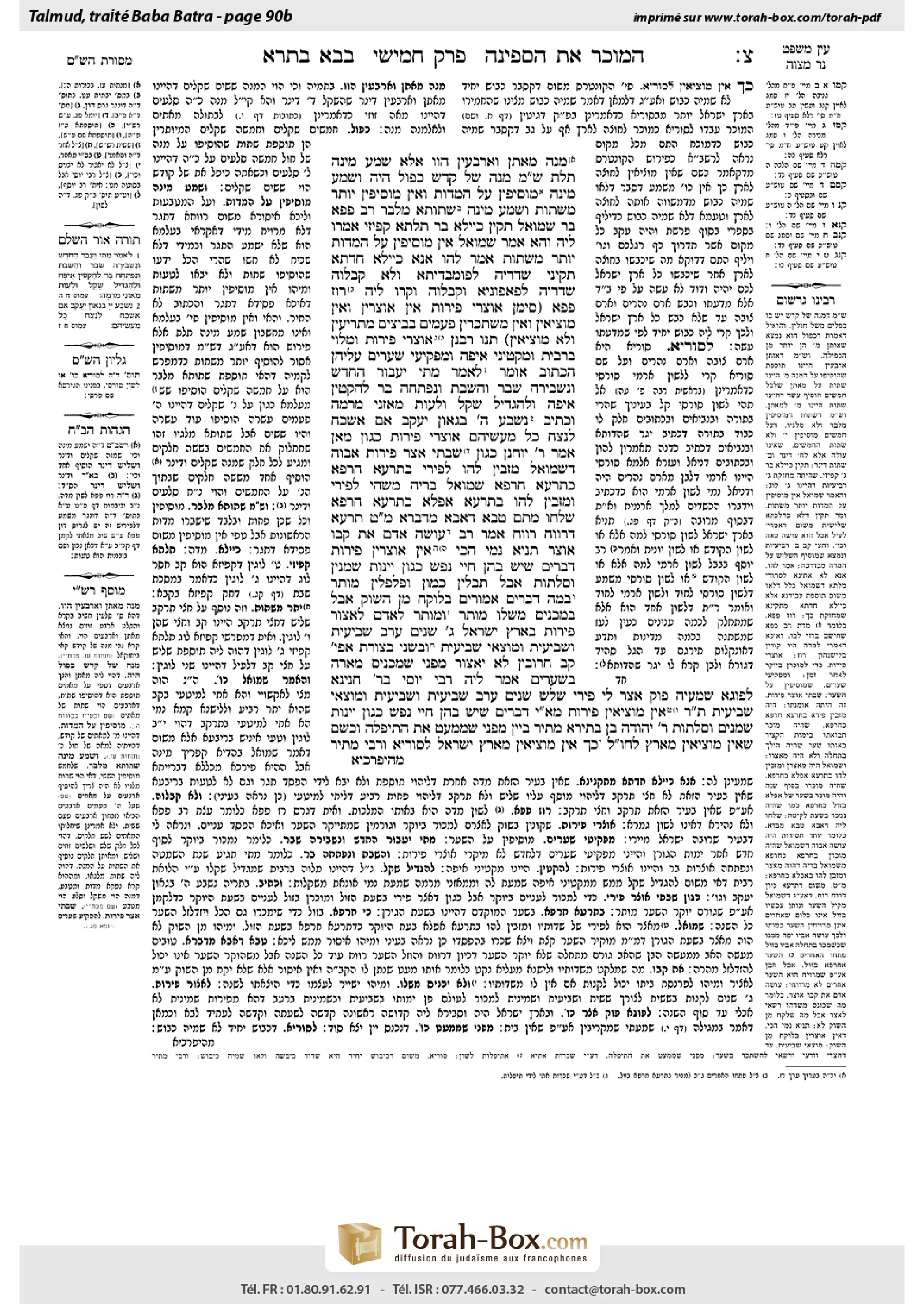
This page of Bava Batra includes the Aramaic text, an English translation and an AI-generated French translation, alongside the scan above.
בבא בתרא צ׳ ב · Aramaic and Hebrew text
מָנֶה?! מָאתָן וְאַרְבְּעִין הָווּ! אֶלָּא שְׁמַע מִינַּהּ תְּלָת: שְׁמַע מִינַּהּ מָנֶה שֶׁל קֹדֶשׁ – כָּפוּל הָיָה; וּשְׁמַע מִינַּהּ מוֹסִיפִין עַל הַמִּדּוֹת – וְאֵין מוֹסִיפִין יוֹתֵר מִשְּׁתוּת; וּשְׁמַע מִינַּהּ שְׁתוּתָא – מִלְּבַר.
רַב פָּפָּא בַּר שְׁמוּאֵל תַּקֵּין כְּיָילָא בַּר תְּלָתָא קְפִיזֵי. אֲמַרוּ לֵיהּ, וְהָא אָמַר שְׁמוּאֵל: אֵין מוֹסִיפִין עַל הַמִּדּוֹת יוֹתֵר מִשְּׁתוּת! אֲמַר לְהוּ: אֲנָא כְּיָילָא חַדְתָּא תַּקֵּינִי. שַׁדְּרֵיהּ לְפוּמְבְּדִיתָא – וְלָא קַבְּלוּהּ, שַׁדְּרֵיהּ לְפַאפּוּנְיָא – וְקַבְּלוּהּ; וְקָרוּ לֵיהּ: ״רוּז פָּפָּא״.
(סִימָן: אוֹצְרֵי פֵירוֹת, אֵין אוֹצְרִין, וְאֵין מוֹצִיאִין, וְאֵין מִשְׂתַּכְּרִין פַּעֲמַיִם בְּבֵיצִים, מַתְרִיעִין, וְלֹא מוֹצִיאִין.)
תָּנוּ רַבָּנַן: אוֹצְרֵי פֵירוֹת, וּמַלְוֵי בְּרִבִּית, וּמַקְטִינֵי אֵיפָה, וּמַפְקִיעֵי שְׁעָרִים – עֲלֵיהֶן הַכָּתוּב אוֹמֵר: ״לֵאמֹר מָתַי יַעֲבֹר הַחֹדֶשׁ וְנַשְׁבִּירָה שֶּׁבֶר, וְהַשַּׁבָּת וְנִפְתְּחָה בָּר, לְהַקְטִין אֵיפָה וּלְהַגְדִּיל שֶׁקֶל, וּלְעַוֵּת מֹאזְנֵי מִרְמָה״. וּכְתִיב: ״נִשְׁבַּע ה׳ בִּגְאוֹן יַעֲקֹב, אִם אֶשְׁכַּח לָנֶצַח כׇּל מַעֲשֵׂיהֶם״.
אוֹצְרֵי פֵירוֹת – כְּגוֹן מַאן? אָמַר רַבִּי יוֹחָנָן: כְּגוֹן שַׁבְּתַי אַצָּר פֵּירוֹת.
אֲבוּהּ דִּשְׁמוּאֵל מְזַבֵּין לְהוּ לְפֵירֵי בְּתַרְעָא חָרְפָא, כְּתַרְעָא חָרְפָא. שְׁמוּאֵל בְּרֵיהּ, מַשְׁהֵי לְפֵירֵי, וּמְזַבֵּין לְהוּ בְּתַרְעָא אַפְלָא – כְּתַרְעָא חָרְפָא. שְׁלַחוּ מִתָּם: טָבָא דְּאַבָּא מִדִּבְרָא. מַאי טַעְמָא? תַּרְעָא דְּרָוַוח – רָוַוח.
אָמַר רַב: עוֹשֶׂה אָדָם אֶת קַבּוֹ אוֹצָר. תַּנְיָא נָמֵי הָכִי: אֵין אוֹצְרִין פֵּירוֹת – דְּבָרִים שֶׁיֵּשׁ בָּהֶן חַיֵּי נֶפֶשׁ, כְּגוֹן: יֵינוֹת, שְׁמָנִין וּסְלָתוֹת. אֲבָל תְּבָלִין, כַּמּוֹן וּפִלְפְּלִין – מוּתָּר. בַּמֶּה דְּבָרִים אֲמוּרִים – בְּלוֹקֵחַ מִן הַשּׁוּק, אֲבָל בְּמַכְנִיס מִשֶּׁלּוֹ – מוּתָּר.
וּמוּתָּר לָאָדָם לֶאֱצוֹר פֵּירוֹת בְּאֶרֶץ יִשְׂרָאֵל שָׁלֹשׁ שָׁנִים – עֶרֶב שְׁבִיעִית, וּשְׁבִיעִית, וּמוֹצָאֵי שְׁבִיעִית.
וּבִשְׁנֵי בַצּוֹרֶת – אֲפִילּוּ קַב חָרוּבִין לֹא יֶאֱצוֹר, מִפְּנֵי שֶׁמַּכְנִיס מְאֵרָה בַּשְּׁעָרִים. אֲמַר לֵיהּ רַבִּי יוֹסֵי בְּרַבִּי חֲנִינָא לְפוּגָא שַׁמָּעֵיהּ: פּוּק אֱצַר לִי פֵּירֵי שָׁלֹשׁ שָׁנִים – עֶרֶב שְׁבִיעִית, וּשְׁבִיעִית, וּמוֹצָאֵי שְׁבִיעִית.
תָּנוּ רַבָּנַן: אֵין מוֹצִיאִין פֵּירוֹת מֵאֶרֶץ יִשְׂרָאֵל – דְּבָרִים שֶׁיֵּשׁ בָּהֶן חַיֵּי נֶפֶשׁ, כְּגוֹן: יֵינוֹת, שְׁמָנִים וּסְלָתוֹת. רַבִּי יְהוּדָה בֶּן בְּתֵירָא מַתִּיר בַּיַּיִן, מִפְּנֵי שֶׁמְּמַעֵט אֶת הַתִּיפְלָה. וּכְשֵׁם שֶׁאֵין מוֹצִיאִין מֵאֶרֶץ לְחוּץ לָאָרֶץ, כָּךְ אֵין מוֹצִיאִין מֵאֶרֶץ יִשְׂרָאֵל לְסוּרְיָא. וְרַבִּי מַתִּיר
Bava Batra 90b · English translation
This is problematic: How can a maneh consist of sixty shekels? Since each biblical shekel is equivalent to four dinars, if a maneh is equal to sixty shekels, a maneh is two hundred and forty dinars. But a maneh is actually equal to twenty-five shekels, which is one hundred dinars. Rather, one can learn from the verse three matters: Learn from it that the sacred maneh was doubled, so that it equaled fifty dinars, not twenty-five. And furthermore, as Ezekiel stated that the maneh will be sixty dinars, not fifty, learn from it that a community may increase measures, but they may not increase them by more than one-sixth. And learn from it that the one-sixth is calculated from the outside, i.e., it is one-sixth of the final sum, which is one-fifth of the previous sum.
The Gemara relates: Rav Pappa bar Shmuel instituted a new measure of three kefiza, which is equal to three log. The Sages said to him: But doesn’t Shmuel say that one may not increase the measures by more than one-sixth? You have added one-third, as there already exists a measure of a half-kav, which is the equivalent of two log. Rav Pappa bar Shmuel said to them: I instituted a new measure. He sent the measure to Pumbedita, and they did not accept it; he sent it to the city of Paphunya, and they accepted it and called it the measure of Pappa.
§ The Gemara provides a mnemonic for the ensuing discussions: Hoarders of produce; one may not hoard; and one may not export; and one may not earn a profit; twice from the sale of eggs; they sound the alarm; and one may not leave.
The Sages taught: Hoarders of produce, who drive up prices by causing a shortage of available goods, and usurers, and those sellers who falsely reduce their measures, and those who raise market prices by selling for more than the accepted price, about them the verse states: “You that would swallow the needy and destroy the poor of the land, saying: When will the new moon be gone, that we may sell produce? And the Shabbat, that we may set forth grain? Making the measure small, and the shekel great, and falsifying the balances of deceit” (Amos 8:4–5). And it is written: “The Lord has sworn by the pride of Jacob: Surely I will never forget any of their works” (Amos 8:7).
The Gemara asks: Hoarders of produce, such as whom? Rabbi Yoḥanan said: Such as Shabbtai, the hoarder of produce, who would buy and hoard large amounts of produce and later sell it at a high price.
The Gemara relates: Shmuel’s father would sell produce during the period of the early market price, when produce is cheap, for the early market price. His son Shmuel acted differently, and would keep the produce and sell it during the period of the late market price, when produce is expensive, for the early market price. They sent a message from there, Eretz Yisrael: The practice of the father is better than that of the son. What is the reason for this? A market price that has been eased and starts out low will remain eased, with little increase over the course of the year. Therefore, one who makes produce available at the beginning of the season, like Shmuel’s father, aids people during the entire year. By contrast, a market price that starts out high, because people are not making their produce available at the market, is not easily lowered.
Rav says: A person may turn his own kav into a storeroom, i.e., he may hoard the produce of his own field and sell it only at a later stage, without violating the prohibition of hoarding produce. This is also taught in a baraita: One may not hoard produce of items that contain an element of basic sustenance, such as wines, oils, and flours, but in the case of spices, such as cumin and pepper, it is permitted. In what case is this statement said? It is with regard to one who buys that produce from the market to resell later; but with regard to one who brings in produce from his own field, it is permitted for any type of produce.
The baraita continues: And it is permitted for a person to hoard produce in Eretz Yisrael for these three years: The year preceding the Sabbatical Year, the Sabbatical Year, and the year that follows the Sabbatical Year, because the land lies fallow during the seventh year, the Sabbatical Year, and the produce of the sixth year must last through these three years, until near the end of the eighth year.
And in years of drought one may not hoard even a kav of carobs, because he thereby brings a curse on market prices, as everyone is fearful of selling and even a small fluctuation in supply can cause a significant rise in prices. Rabbi Yosei, son of Rabbi Ḥanina, who was living in Eretz Yisrael, said to his servant Fuga: Go and hoard produce for me for the coming three years: The year preceding the Sabbatical Year, the Sabbatical Year, and the year that follows the Sabbatical Year.
§ The Sages taught: One may not export produce from Eretz Yisrael if it consists of items that contain an element of basic sustenance, such as wines, oils, and flours, because this causes them to become more expensive in Eretz Yisrael. Rabbi Yehuda ben Beteira permits export in the case of wine, because this lessens licentiousness in Eretz Yisrael. And just as one may not export these types of produce from Eretz Yisrael to outside of Eretz Yisrael, so too one may not export them from Eretz Yisrael to Syria, as Syria is not considered part of Eretz Yisrael in this context. And Rabbi Yehuda HaNasi permits the export of produce
Bava Batra 90b · Traduction française (IA)
Cela pose un problème : comment un maneh peut-il être composé de soixante sicles ? Puisque chaque sicle biblique équivaut à quatre dinars, si un maneh est égal à soixante sicles, un maneh est de deux cent quarante dinars. Mais un maneh est en réalité égal à vingt-cinq sicles, ce qui équivaut à cent dinars. Plutôt, on peut apprendre de la parole trois choses : apprendre que le maneh sacré a été doublé, de sorte qu'il équivalait à cinquante dinars, et non vingt-cinq. Et de plus, comme Ézéchiel a dit que le maneh sera de soixante dinars, et non cinquante, apprendre que la communauté peut augmenter les mesures, mais pas plus d'un sixième. Et apprendre que ce sixième est calculé à partir de l'extérieur, c'est-à-dire qu'il s'agit du sixième de la somme finale, qui est le cinquième de la somme précédente.
Le Guemara rapporte : Rav Pappa bar Shmuel a institué une nouvelle mesure de trois kefiza, ce qui équivaut à trois log. Les Sages lui dirent : Mais ne dit-on pas que l'on ne peut pas augmenter les mesures de plus d'un sixième ? Tu as ajouté un tiers, car il existe déjà une mesure de demi-kav, équivalant à deux log. Rav Pappa bar Shmuel répondit à ceux-ci : J'ai institué une nouvelle mesure. Il envoya la mesure à Pumbedita, mais ils ne l'acceptèrent pas ; il l'envoya à la ville de Paphunya, et ils l'acceptèrent et l'appelèrent la mesure de Pappa.
§ Le Guemara fournit un mnémonique pour les discussions qui suivent : Les récolteurs de produits ; on ne peut pas récolter ; et on ne peut pas exporter ; et on ne peut pas gagner un profit ; deux fois à la vente des œufs ; on sonne l'alarme ; et on ne peut pas laisser.
Les Sages enseignèrent : Les récolteurs de produits, qui augmentent les prix en créant une pénurie, et les usuriers, et ceux qui falsifient leurs mesures, et ceux qui augmentent les prix du marché en vendant au-delà du prix habituel, à leur sujet la Parashia dit : « Vous qui dévorez le pauvre et détruisiez les pauvres du pays, disant : Quand la nouvelle lune sera passée, nous pourrons vendre des produits ? Et le sabbat, nous pourrons déposer du grain ? En diminuant la mesure et en augmentant le sicle, et en falsifiant les balances de tromperie » (Amos 8 : 4-5). Et il est écrit : « L'Éternel a juré par la gloire de Jacob : Je ne négligerai pas aucun de leurs œuvres » (Amos 8 : 7).
Le Guemara demande : Quels sont les récolteurs de produits ? Rabbi Yoḥanan dit : Comme Shabbtai, le récolteur de produits, qui achetait et stockait de grandes quantités de produits et les vendait ensuite à un prix élevé.
Le Guemara rapporte : Le père de Shmuel vendait des produits pendant la période du prix initial, lorsque les produits sont abordables, au prix initial. Son fils Shmuel agissait différemment, et conservait les produits pour les vendre pendant la période du prix final, lorsque les produits sont chers, au prix initial. Ils envoyèrent un message d'Israël : La pratique du père est meilleure que celle du fils. Quelle est la raison de cela ? Un prix qui a été réduit et commence bas restera réduit, avec peu d'augmentation tout au long de l'année. Ainsi, celui qui met les produits à la disposition du public au début de la saison, comme le père de Shmuel, aide les gens tout au long de l'année. En revanche, un prix qui commence haut, car les gens ne mettent pas leurs produits sur le marché, n'est pas facile à réduire.
Rav dit : Une personne peut transformer son propre kav en une réserve, c'est-à-dire qu'elle peut stocker les produits de son propre champ et les vendre plus tard sans enfreindre l'interdiction de stocker des produits. Cela est également enseigné dans une baraïta : On ne peut pas stocker des produits qui contiennent un élément de base de subsistance, tels que les vins, les huiles et les farines, mais dans le cas des épices, tels que le cumin et le poivre, cela est permis. Dans quel cas cette déclaration est-elle dite ? C'est concernant celui qui achète ces produits sur le marché pour les revendre plus tard ; mais concernant celui qui apporte des produits de son propre champ, il est permis pour n'importe quel type de produit.
La baraïta continue : Et il est permis à une personne de stocker des produits en Terre d'Israël pendant ces trois ans : l'année précédant l'année sabbatique, l'année sabbatique, et l'année suivant l'année sabbatique, car la terre est en repos pendant l'année sabbatique, et les produits de l'année précédente doivent durer jusqu'à ces trois ans, jusqu'à la fin de l'année suivante.
Et pendant les années de sécheresse, on ne peut pas stocker même un kav de figues, car cela apporte une malédiction sur les prix du marché, car tout le monde a peur de vendre et même une petite fluctuation en quantité peut provoquer une hausse significative des prix. Rabbi Yosei, fils de Rabbi Ḥanina, qui habitait en Terre d'Israël, dit à son serviteur Fuga : Va et stocke des produits pour moi pendant les trois prochaines années : l'année précédant l'année sabbatique, l'année sabbatique, et l'année suivant l'année sabbatique.
§ Les Sages enseignèrent : On ne peut pas exporter des produits de la Terre d'Israël si ceux-ci contiennent un élément de base de subsistance, tels que les vins, les huiles et les farines, car cela les rend plus chers en Terre d'Israël. Rabbi Yehuda ben Beteira permet l'exportation dans le cas du vin, car cela réduit la luxure en Terre d'Israël. Et tout comme on ne peut pas exporter ces types de produits de la Terre d'Israël vers l'extérieur, on ne peut pas non plus les exporter vers la Syrie, car la Syrie n'est pas considérée comme faisant partie de la Terre d'Israël dans ce contexte. Et Rabbi Yehuda HaNasi permet l'exportation des produits
Traduction française générée par IA à partir de l’édition anglaise de Sefaria. Vérifie toujours un passage avec le texte source.
Text from Sefaria: William Davidson Edition - Vocalized Aramaic (CC BY NC); William Davidson Edition - English (CC BY NC).