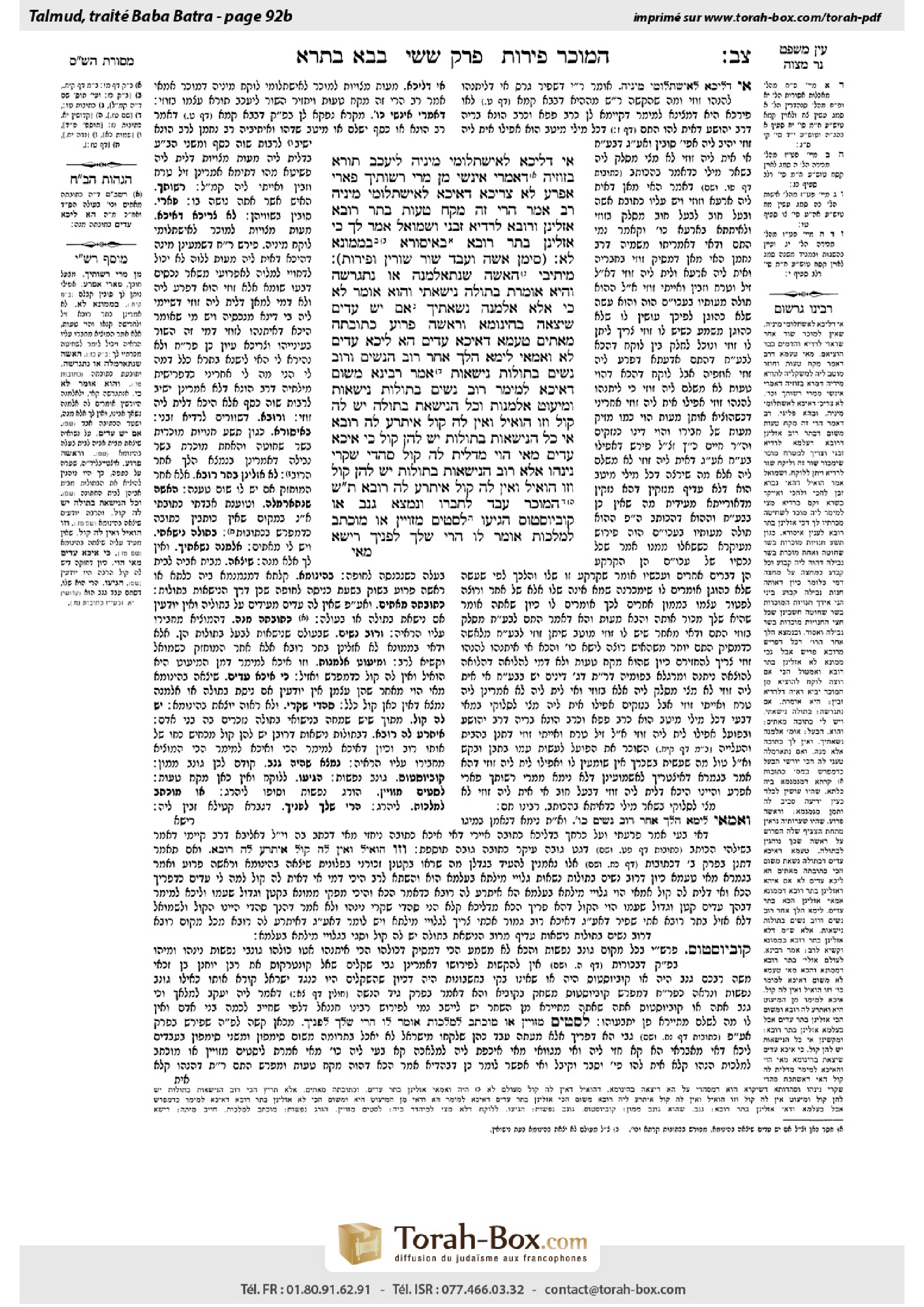
Bava Batra 92b: Talmud study for Daf Yomi
Study the Talmud for Daf Yomi with scanned pages, Hebrew text, English translations from Sefaria and AI-generated French translations.
Passage selection and English or AI-generated French translation are available where the scan has annotations. Daf Study is independent of Torah-Box and Sefaria.
Browse Bava Batra · בבא בתרא · All tractatesBava Batra 92b text and translations
This page of Bava Batra includes the Aramaic text, an English translation and an AI-generated French translation, alongside the scan above.
בבא בתרא צ״ב ב · Aramaic and Hebrew text
אִי דְּלֵיכָּא לְאִישְׁתַּלּוֹמֵי מִינֵּיהּ, לִיעַכַּב תּוֹרָא בְּזוּזֵיהּ! דְּאָמְרִי אִינָשֵׁי: מִן מָרֵי רְשׁוּתָיךְ – פָּארֵי אִפְּרַע!
לָא צְרִיכָא, דְּאִיכָּא לְאִישְׁתַּלּוֹמֵי מִינֵּיהּ.
רַב אָמַר: הֲרֵי זֶה מִקָּח טָעוּת – בָּתַר רוּבָּא אָזְלִינַן, וְרוּבָּא לְרִדְיָא זָבְנִי. וּשְׁמוּאֵל אָמַר לָךְ: כִּי אָזְלִינַן בָּתַר רוּבָּא – בְּאִיסּוּרָא, בְּמָמוֹנָא – לָא.
(סִימָן: אִשָּׁה, וְעֶבֶד, שׁוֹר, שְׁוָרִין, וּפֵירוֹת.)
מֵיתִיבִי: הָאִשָּׁה שֶׁנִּתְאַלְמְנָה אוֹ נִתְגָּרְשָׁה; וְהִיא אוֹמֶרֶת: בְּתוּלָה נִישֵּׂאתִי, וְהוּא אוֹמֵר: לֹא כִי, אֶלָּא אַלְמָנָה נְשָׂאתִיךְ – אִם יֵשׁ עֵדִים שֶׁיָּצְאָה בְּהִינוּמָא, וְרֹאשָׁהּ פָּרוּעַ – כְּתוּבָּתָהּ מָאתַיִם.
טַעְמָא דְּאִיכָּא עֵדִים, הָא לֵיכָּא עֵדִים – לָא; וְאַמַּאי? לֵימָא: הַלֵּךְ אַחַר רוֹב הַנָּשִׁים, וְרוֹב נָשִׁים – בְּתוּלוֹת נִישָּׂאוֹת!
אָמַר רָבִינָא, מִשּׁוּם דְּאִיכָּא לְמֵימַר: רוֹב נָשִׁים בְּתוּלוֹת נִישָּׂאוֹת, וּמִיעוּט אַלְמָנוֹת; וְכׇל הַנִּישֵּׂאת בְּתוּלָה – יֵשׁ לָהּ קוֹל; וְזוֹ, הוֹאִיל וְאֵין לָהּ קוֹל – אִיתְּרַע לֵהּ רוּבָּא.
אִי כׇּל הַנִּישָּׂאוֹת בְּתוּלוֹת יֵשׁ לָהֶן קוֹל, כִּי אִיכָּא עֵדִים מַאי הָוֵי? מִדְּלֵית לַהּ קוֹל – סָהֲדִי שַׁקָּרֵי נִינְהוּ!
אֶלָּא רוֹב הַנִּישָּׂאוֹת בְּתוּלוֹת יֵשׁ לָהֶן קוֹל, וְזוֹ, הוֹאִיל וְאֵין לָהּ קוֹל – אִיתְּרַע לֵהּ רוּבָּא.
תָּא שְׁמַע: הַמּוֹכֵר עֶבֶד לַחֲבֵרוֹ וְנִמְצָא גַּנָּב אוֹ קוּבְיוּסְטוּס, הִגִּיעוֹ. לִסְטִים מְזוּיָּין אוֹ מוּכְתָּב לַמַּלְכוּת – אוֹמֵר לוֹ: הֲרֵי שֶׁלְּךָ לְפָנֶיךָ.
רֵישָׁא –
Bava Batra 92b · English translation
If this is a case where the seller does not have sufficient funds for the buyer to be reimbursed by him, then let the buyer retain the ox itself in lieu of his money, as people say: If you wish to ensure that you will get paid, collect even bran, an inferior commodity, from one who is in your debt. Consequently, even according to the opinion of Rav, the buyer will be likely to retain the ox. What, then, is the practical difference between the opinions of Rav and Shmuel?
The Gemara answers: No, it is necessary to discuss the case where the seller does have sufficient funds for the buyer to be reimbursed by him.
The Gemara explains the logic of each opinion: Rav says: This is a mistaken transaction, as in cases of uncertainty we follow the majority, and since the majority of people purchase oxen for plowing, it is presumed that this buyer also purchased the ox for plowing. Accordingly, since the ox he received was not suitable for plowing, the sale is void. And Shmuel could have said to you: When we follow the majority, that is only with regard to ritual matters, but with regard to monetary matters, such as this, we do not follow the majority. Accordingly, there is no basis for voiding the sale.
The Gemara cites a mnemonic that indicates the topics of the cases it will reference to challenge either Rav’s or Shmuel’s opinion: Woman, and slave, ox, oxen, and produce.
The Gemara raises an objection to Rav’s opinion from a mishna (Ketubot 15b): With regard to a woman who was widowed or divorced, and is in dispute with her husband or his heirs over the value of the payment she should receive for her marriage contract, and she says: When you married me I was a virgin, and so I am entitled to two hundred dinars, and he says: That is not the case; rather, when I married you, you were a widow, and so you are entitled to only one hundred dinars, then if there are witnesses that she went out of her father’s house to her wedding with a veil [hinnuma] or with the hair of her head loose, in the typical manner of virgin brides, that is considered sufficient evidence in support of her claim, and so the payment of her marriage contract is two hundred dinars.
The Gemara infers: The reason that she receives two hundred dinars is that there are witnesses to her claim. Therefore, if there were no witnesses, her claim would not be successful. The Gemara asks: But why? Let us say that since there is an uncertainty, one should follow the majority of women, and since the majority of women marry as virgins, it should be presumed that this woman also married as a virgin. Accordingly she should be entitled to two hundred dinars. Since this is not the case, it is apparent that the majority is not followed in monetary matters.
Ravina said: In this case, one cannot decide the case based on the majority of women because there is room to say that it is so that the majority of women marry as virgins and only a minority marry as widows or non-virgins. But it is also so that there is an additional presumption: The marriage of anyone who marries as a virgin generates publicity of that fact. And with regard to this woman, who is in a dispute over the value of her marriage contract, because her marriage did not generate publicity of her marrying as a virgin, the ability to apply what is true of the majority of women to her case is undermined. Accordingly, there is no proof that the majority is not followed in monetary matters.
The Gemara questions this: If it is really true that the marriage of anyone who marries as a virgin generates publicity of that fact, then even when there are witnesses that she was a virgin bride, what of it? From the fact that her marriage did not generate publicity of her marrying as a virgin, perforce they are false witnesses.
Rather, one must modify the above argument to say that the majority of marriages of women who marry as virgins generate publicity of that fact, and with regard to this woman, since her marriage did not generate publicity of her having been married as a virgin, the ability to apply what is true of the majority of women to her case is undermined.
Come and hear a challenge to Shmuel’s opinion from a baraita: In the case of one who sells a slave to another, and the slave is found to be a thief or a gambler [kuvyustus], and the buyer does not wish to have such a slave, nevertheless it has come to him, i.e., the slave is acquired by the one who purchased him and the transaction is nonrefundable. By contrast, if the slave is found to be an armed bandit [listim] or has been judged and written to be executed by the government, then the buyer can return the slave to the seller and say to him: That which is yours is before you; return the money I paid for him, as the sale is void.
The Gemara explains the proof from the baraita: In the first clause of the baraita,
Bava Batra 92b · Traduction française (IA)
Si c'est un cas où le vendeur n'a pas suffisamment d'argent pour rembourser l'acheteur, alors faites en sorte que l'acheteur garde lui-même le bœuf à la place de son argent, comme on dit : Si vous voulez vous assurer de recevoir votre argent, réclamez même du blé, un produit inférieur, d'une personne qui vous doit de l'argent. Ainsi, même selon l'opinion de Rav, l'acheteur est susceptible de garder le bœuf. Quel est donc le réel point de divergence entre les opinions de Rav et de Shmuel ?
La Guemara répond : Non, il est nécessaire de discuter du cas où le vendeur dispose suffisamment d'argent pour rembourser l'acheteur.
La Guemara explique la logique de chaque opinion : Rav dit : C'est une transaction erronée, car dans les cas d'incertitude, on suit la majorité, et puisque la majorité des gens achètent des bœufs pour la culture, on suppose que cet acheteur a acheté le bœuf pour la culture. Ainsi, puisque le bœuf qu'il a reçu n'était pas adapté à la culture, la vente est nulle. Et Shmuel aurait pu dire à l'acheteur : Lorsqu'on suit la majorité, c'est uniquement en ce qui concerne les questions rituelles, mais en ce qui concerne les questions monétaires, comme celle-ci, on ne suit pas la majorité. Ainsi, il n'y a pas de fondement pour annuler la vente.
La Guemara cite un mnémotechnique qui indique les sujets des cas qu'elle va évoquer pour contredire soit l'opinion de Rava soit celle de Shmuel : femme, esclave, bœuf, bœufs, et produits.
La Guemara évoque un objet d'opposition à l'opinion de Rava à partir d'une mitsva (Ketubot 15b) : En ce qui concerne une femme veuve ou divorcée, en conflit avec son mari ou ses héritiers sur la valeur de la rémunération qu'elle devrait recevoir pour son mariage, et elle dit : Lorsque vous m'avez épousée, j'étais vierge, et donc je suis dûe à deux cents drachmes, et il dit : Ce n'est pas le cas ; plutôt, lorsque vous m'avez épousée, vous étiez veuve, et donc vous êtes dûe à seulement cent drachmes, alors si des témoins affirment qu'elle est sortie de chez son père pour son mariage avec un voile [hinnuma] ou avec les cheveux de sa tête dénoués, dans la manière typique des mariées vierges, cela est considéré comme une preuve en faveur de sa revendication, et donc la rémunération de son mariage est de deux cents drachmes.
La Guemara déduit : La raison pour laquelle elle reçoit deux cents drachmes est qu'il y a des témoins pour sa revendication. Ainsi, si aucun témoins n'existait, sa revendication ne serait pas retenue. La Guemara demande : Mais pourquoi ? Disons que puisque c'est une incertitude, on devrait suivre la majorité des femmes, et puisque la majorité des femmes épousent comme vierges, on devrait supposer que cette femme a épousé comme une vierge. Ainsi, elle devrait être dûe à deux cents drachmes. Puisque cela n'est pas le cas, il est évident que la majorité n'est pas suivie en matière monétaire.
Ravina dit : Dans ce cas, on ne peut pas décider de la cause en se basant sur la majorité des femmes, car il y a une possibilité de dire que la majorité des femmes épousent comme vierges et seulement une minorité épouse comme veuves ou non-virgines. Mais il y a aussi une autre présomption : Le mariage de toute personne qui épouse comme une vierge génère une publicité de ce fait. Et concernant cette femme, qui est en conflit sur la valeur de son mariage, puisque son mariage n'a pas généré une publicité de son mariage comme une vierge, la capacité d'appliquer ce qui est vrai de la majorité des femmes à son cas est affaiblie. Ainsi, il n'y a pas de preuve que la majorité n'est pas suivie en matière monétaire.
La Guemara questionne cela : Si c'est vraiment vrai que le mariage de toute personne qui épouse comme une vierge génère une publicité de ce fait, alors même lorsqu'il y a des témoins qu'elle était une mariée vierge, qu'est-ce que cela change ? Du fait que son mariage n'a pas généré une publicité de son mariage comme une vierge, on doit nécessairement considérer les témoins comme menteurs.
Plutôt, il faut modifier l'argument ci-dessus pour dire que la majorité des mariages de femmes qui épousent comme des vierges génèrent une publicité de ce fait, et concernant cette femme, puisque son mariage n'a pas généré une publicité de son mariage comme une vierge, la capacité d'appliquer ce qui est vrai de la majorité des femmes à son cas est affaiblie.
Venez écouter un défi à l'opinion de Shmuel tiré d'une baraïta : Dans le cas d'une personne qui vend un esclave à un autre, et l'esclave est trouvé être un voleur ou un joueur [kuvyustus], et l'acheteur ne veut pas avoir un tel esclave, néanmoins il lui est arrivé, c'est-à-dire l'esclave est acquis par celui qui l'a acheté et la transaction est irréversible. À l'inverse, si l'esclave est trouvé être un bandit armé [listim] ou s'il a été jugé et notifié d'être exécuté par l'État, alors l'acheteur peut rendre l'esclave au vendeur et lui dire : Ce qui est à toi est devant toi ; rends-moi l'argent que j'ai payé pour lui, car la vente est nulle.
La Guemara explique la preuve tirée de la baraïta : Dans la première partie de la baraïta,
Traduction française générée par IA à partir de l’édition anglaise de Sefaria. Vérifie toujours un passage avec le texte source.
Text from Sefaria: William Davidson Edition - Vocalized Aramaic (CC BY NC); William Davidson Edition - English (CC BY NC).