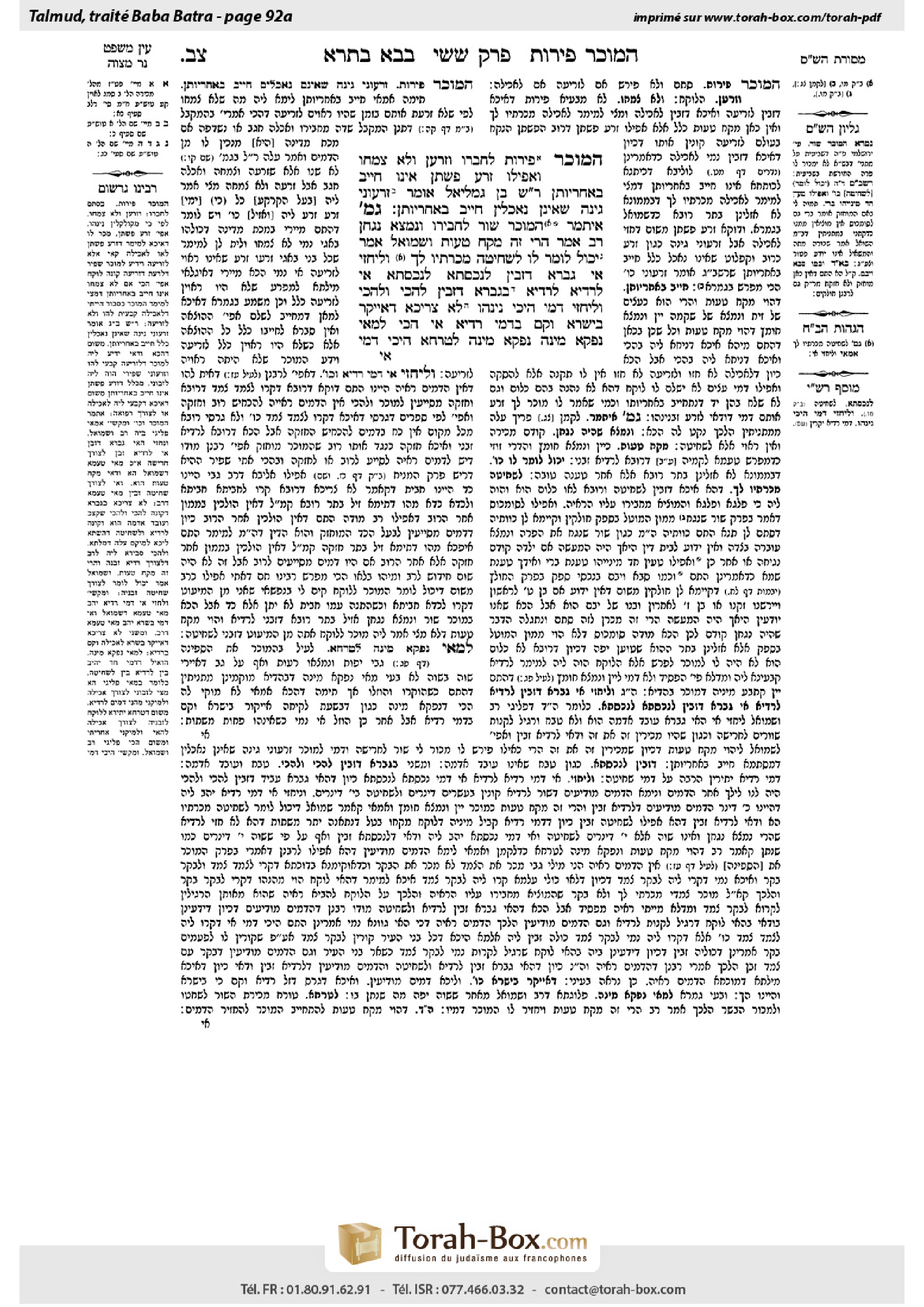
Bava Batra 92a: Talmud study for Daf Yomi
Study the Talmud for Daf Yomi with scanned pages, Hebrew text, English translations from Sefaria and AI-generated French translations.
Passage selection and English or AI-generated French translation are available where the scan has annotations. Daf Study is independent of Torah-Box and Sefaria.
Browse Bava Batra · בבא בתרא · All tractatesBava Batra 92a text and translations
This page of Bava Batra includes the Aramaic text, an English translation and an AI-generated French translation, alongside the scan above.
בבא בתרא צ״ב א · Aramaic and Hebrew text
הַמּוֹכֵר פֵּירוֹת לַחֲבֵרוֹ, וּזְרָעָן וְלֹא צִמֵּחוּ; וַאֲפִילּוּ זֶרַע פִּשְׁתָּן – אֵינוֹ חַיָּיב בְּאַחְרָיוּתָן. רַבָּן שִׁמְעוֹן בֶּן גַּמְלִיאֵל אוֹמֵר: זֵרְעוֹנֵי גִּינָּה שֶׁאֵינָן נֶאֱכָלִין, חַיָּיב בְּאַחְרָיוּתָן.
גְּמָ׳ אִיתְּמַר: הַמּוֹכֵר שׁוֹר לַחֲבֵירוֹ וְנִמְצָא נַגְחָן, רַב אָמַר: הֲרֵי זֶה מִקָּח טָעוּת; וּשְׁמוּאֵל אָמַר, יָכוֹל לוֹמַר לוֹ: לִשְׁחִיטָה מְכַרְתִּיו לָךְ.
וְלִיחְזֵי; אִי גַּבְרָא דְּזָבֵין לְנִכְסְתָא – לְנִכְסְתָא, אִי לְרִדְיָא – לְרִדְיָא! בְּגַבְרָא דְּזָבֵין לְהָכִי וּלְהָכִי.
וְלִיחְזֵי דְּמֵי הֵיכִי נִינְהוּ!
לָא צְרִיכָא; דְּאִיַּיקַּר בִּישְׂרָא, וְקָם בִּדְמֵי רִדְיָא. אִי הָכִי, לְמַאי נָפְקָא מִינַּהּ? נָפְקָא מִינַּהּ לְטִרְחָא.
הֵיכִי דָּמֵי?
Bava Batra 92a · English translation
MISHNA: With regard to one who sells produce to another that is sometimes purchased for consumption and sometimes for planting, and the buyer planted it and it did not sprout, and even if he had sold flaxseeds, which are only occasionally eaten, the seller does not bear financial responsibility for them, i.e., he is not required to compensate the buyer. Since the buyer did not specify that he purchased the produce in order to plant it, the seller can claim that he assumed the buyer intended to eat it. Rabban Shimon ben Gamliel says: If he had sold seeds for garden plants, which are not eaten at all, then the seller bears financial responsibility for them, as they were certainly purchased for planting.
GEMARA: An amoraic dispute was stated with regard to one who sells an ox to another and the ox is found to be one that habitually gores. Rav says: This is a mistaken transaction, since the buyer can claim that he bought the ox specifically for labor, and an ox that gores is not suitable for this function. Therefore, the seller must take back the ox and reimburse the buyer. And Shmuel says: The sale is not voided, as the seller can say to him: I sold it to you for slaughter, and the fact that it gores is immaterial.
The Gemara suggests: But let us see if the buyer is a man who generally purchases oxen for slaughter, in which case it can be presumed that he also purchased this ox for slaughter, or if he is a man who generally purchases oxen for plowing, in which case it can be presumed that he also purchased this ox for plowing. The Gemara answers: The dispute concerns a man who sometimes purchases oxen for this purpose and sometimes for that purpose, and so it is uncertain for which purpose he purchased this ox.
The Gemara persists: But let us see the payment he made; how much was it? Since an ox fit for plowing costs more than one fit only for slaughter, the purpose for which the ox was purchased will be apparent from the price paid.
The Gemara answers: No, it is necessary to discuss the case where the price of an ox to be slaughtered for its meat appreciated and reached the value of an ox for plowing. But if the price disparity is significant, there is no dispute. The Gemara asks: If so, for the sake of what practical difference did they discuss the case? Even if the ox was not suitable for the buyer’s purposes, he could sell it for the same price of the ox he needs. The Gemara answers: The practical difference is with regard to the effort of selling the ox in order to recover its value; who must go to the effort of doing so?
The Gemara clarifies: What are the circumstances of the case under discussion?
Bava Batra 92a · Traduction française (IA)
MICHA : Concernant celui qui vend des produits à un autre, qui sont parfois achetés pour la consommation et parfois pour la plantation, et le acheteur les a plantés et ils n'ont pas germé, et même s'il avait vendu des graines de lin, qui sont rarement mangées, le vendeur n'assume pas la responsabilité financière à leur égard, c'est-à-dire qu'il n'est pas tenu de compenser l'acheteur. Puisque l'acheteur n'a pas spécifié qu'il achetait les produits pour les planter, le vendeur peut affirmer qu'il a supposé que l'acheteur avait l'intention de les manger. Rabban Shimon ben Gamliel dit : Si on avait vendu des graines pour des plantes de jardin, qui ne sont pas mangées du tout, alors le vendeur assume la responsabilité financière à leur égard, car ils ont certainement été achetés pour la plantation.
GUEMARA : Un débat entre les amoraim a été évoqué concernant celui qui vend un bœuf à un autre et le bœuf est trouvé être un bœuf qui attaque habituellement. Rav dit : C'est une transaction erronée, car l'acheteur peut affirmer qu'il a acheté le bœuf spécifiquement pour le travail, et un bœuf qui attaque n'est pas adapté à cette fonction. Par conséquent, le vendeur doit récupérer le bœuf et rembourser l'acheteur. Et Shmuel dit : La vente n'est pas annulée, car le vendeur peut dire à l'acheteur : Je t'ai vendu ce bœuf pour la boucherie, et le fait qu'il attaque est sans importance.
La Guemara suggère : Mais voyons si l'acheteur est un homme qui achète généralement des bœufs pour la boucherie, dans ce cas on peut supposer qu'il a acheté ce bœuf pour la boucherie, ou s'il est un homme qui achète généralement des bœufs pour la labour, dans ce cas on peut supposer qu'il a acheté ce bœuf pour la labour. La Guemara répond : Le débat concerne un homme qui parfois achète des bœufs à cette fin et parfois à celle-ci, et donc il est incertain à quel usage il a acheté ce bœuf.
La Guemara persiste : Mais voyons la somme qu'il a payée ; combien était-ce ? Puisqu'un bœuf adapté à la labour coûte plus qu'un bœuf adapté seulement à la boucherie, l'usage pour lequel le bœuf a été acheté sera évident à partir du prix payé.
La Guemara répond : Non, il faut discuter le cas où le prix d'un bœuf à boucher est monté et est parvenu à la valeur d'un bœuf à la labour. Mais si la différence de prix est importante, il n'y a pas de débat. La Guemara demande : Si tel est le cas, à cause de quelle différence pratique ont-ils discuté ce cas ? Même si le bœuf n'était pas adapté aux besoins du acheteur, il pouvait le vendre au même prix que le bœuf dont il avait besoin. La Guemara répond : La différence pratique concerne l'effort de vendre le bœuf afin de récupérer sa valeur ; qui doit entreprendre cet effort ?
La Guemara clarifie : Quelles sont les circonstances du cas en discussion ?
Traduction française générée par IA à partir de l’édition anglaise de Sefaria. Vérifie toujours un passage avec le texte source.
Text from Sefaria: William Davidson Edition - Vocalized Aramaic (CC BY NC); William Davidson Edition - English (CC BY NC).