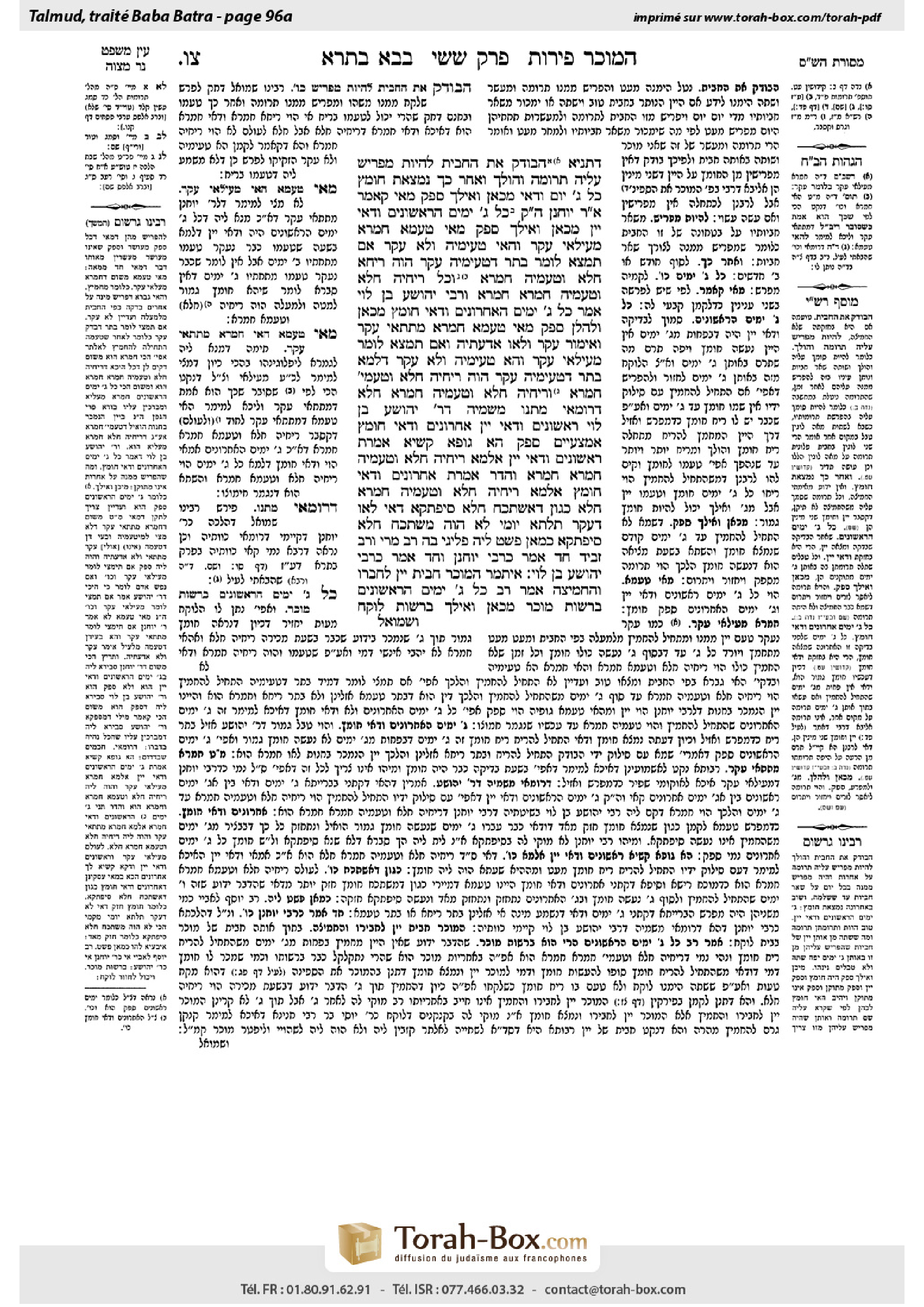
Bava Batra 96a: Talmud study for Daf Yomi
Study the Talmud for Daf Yomi with scanned pages, Hebrew text, English translations from Sefaria and AI-generated French translations.
Passage selection and English or AI-generated French translation are available where the scan has annotations. Daf Study is independent of Torah-Box and Sefaria.
Browse Bava Batra · בבא בתרא · All tractatesBava Batra 96a text and translations
This page of Bava Batra includes the Aramaic text, an English translation and an AI-generated French translation, alongside the scan above.
בבא בתרא צ״ו א · Aramaic and Hebrew text
דְּתַנְיָא: הַבּוֹדֵק אֶת הֶחָבִית לִהְיוֹת מַפְרִישׁ עָלֶיהָ תְּרוּמָה וְהוֹלֵךְ, וְאַחַר כָּךְ נִמְצֵאת חוֹמֶץ; כׇּל שְׁלֹשָׁה יוֹם – וַדַּאי, מִכָּאן וְאֵילָךְ – סָפֵק.
מַאי קָאָמַר? אָמַר רַבִּי יוֹחָנָן, הָכִי קָאָמַר: כׇּל שְׁלֹשָׁה יָמִים הָרִאשׁוֹנִים – וַדַּאי יַיִן, מִכָּאן וְאֵילָךְ – סָפֵק.
מַאי טַעְמָא? חַמְרָא – מֵעִילַּאי עָקַר, וְהַאי טַעֲימֵיהּ וְלָא עֲקַר. אִם תִּמְצָא לוֹמַר: בָּתַר דְּטַעֲימֵיהּ עֲקַר; הָוֵה רֵיחָא חַלָּא וְטַעְמֵיהּ חַמְרָא, וְכֹל רֵיחֵיהּ חַלָּא וְטַעְמֵיהּ חַמְרָא – חַמְרָא.
וְרַבִּי יְהוֹשֻׁעַ בֶּן לֵוִי אָמַר: כׇּל שְׁלֹשָׁה יָמִים הָאַחֲרוֹנִים – וַדַּאי חוֹמֶץ. מִכָּאן וּלְהַלָּן – סָפֵק.
מַאי טַעְמָא? חַמְרָא מִתַּתַּאי עָקַר, וְאֵימוֹר עֲקַר וְלָאו אַדַּעְתֵּיהּ. וְאִם תִּמְצָא לוֹמַר מֵעִילַּאי עָקַר, וְהָא טַעֲימֵיהּ וְלָא עֲקַר; דִּלְמָא בָּתַר דְּטַעֲימֵיהּ עֲקַר – הָוֵה רֵיחֵיהּ חַלָּא וְטַעְמֵיהּ חַמְרָא, וְרֵיחֵיהּ חַלָּא וְטַעְמֵיהּ חַמְרָא – חַלָּא.
דָּרוֹמָאֵי מַתְנוּ מִשְּׁמֵיהּ דְּרַבִּי יְהוֹשֻׁעַ בֶּן לֵוִי: רִאשׁוֹנִים – וַדַּאי יַיִן, אַחֲרוֹנִים – וַדַּאי חוֹמֶץ, אֶמְצָעִיִּים – סָפֵק.
הָא גוּפָא קַשְׁיָא – אָמְרַתְּ: רִאשׁוֹנִים וַדַּאי יַיִן, אַלְמָא רֵיחֵיהּ חַלָּא וְטַעְמֵיהּ חַמְרָא – חַמְרָא; וַהֲדַר אָמְרַתְּ: אַחֲרוֹנִים וַדַּאי חוֹמֶץ, אַלְמָא רֵיחֵיהּ חַלָּא וְטַעְמֵיהּ חַמְרָא – חַלָּא!
כְּגוֹן דְּאִשְׁתְּכַח חַלָּא סִיפְתְּקָא, דְּאִי לָאו דַּעֲקַר תְּלָתָא יוֹמֵי – לָא הֲוָה מִשְׁתְּכַח חַלָּא סִיפְתְּקָא.
כְּמַאן פְּשַׁט לֵיהּ? פְּלִיגִי בַּהּ רַב מָרִי וְרַב זְבִיד; חַד אָמַר: כְּרַבִּי יוֹחָנָן, וְחַד אָמַר: כְּרַבִּי יְהוֹשֻׁעַ בֶּן לֵוִי.
אִיתְּמַר: הַמּוֹכֵר חָבִית יַיִן לַחֲבֵרוֹ, וְהֶחְמִיצָה – אָמַר רַב: כׇּל שְׁלֹשָׁה יָמִים הָרִאשׁוֹנִים בִּרְשׁוּת מוֹכֵר, מִכָּאן וְאֵילָךְ בִּרְשׁוּת לוֹקֵחַ.
Bava Batra 96a · English translation
As it is taught in a baraita (Tosefta, Terumot 2:8): With regard to one who inspects a barrel to see if it still contains enough wine to continually mentally separate teruma from it to exempt other untithed wine he has, until all the wine in that barrel would be teruma and would be given to a priest, and afterward the contents of the barrel were found to have turned to vinegar, which cannot be set aside as teruma for untithed wine, then all three days after he had last inspected it, it is definitely viewed as having been wine, and any wine for which teruma was separated during those days is tithed. From that point onward, more than three days after the previous inspection, it is uncertain as to whether it had already turned to vinegar, and any wine for which teruma was separated during those days is not tithed.
The Gemara clarifies: What is the baraita saying? Rabbi Yoḥanan says that this is what it is saying: For all of the first three days following the inspection, it is definitely viewed as having been wine that had not yet turned to vinegar. From that point onward, it is uncertain as to whether it had already turned to vinegar. Accordingly, any wine for which teruma was separated after those three days by means of designating the contents of that barrel as teruma has an uncertain status.
What is the reason? The process in which wine turns sour and becomes vinegar starts with the wine at the top of the barrel; and it is that wine which he tasted when he inspected it, and at that time it had not yet soured. And even if you say that immediately after he tasted it the wine began to sour, during the following three days it would have the odor of vinegar and its taste would be of wine, and anything that has an odor of vinegar but its taste is of wine is regarded as wine.
And Rabbi Yehoshua ben Levi says that there is a different interpretation of the baraita: For all of the last three days preceding the discovery that the wine had turned into vinegar, it is definitely viewed as having been vinegar. From that point and earlier, until the time it had been inspected, it is uncertain whether or not it was wine or vinegar.
What is the reason? The process in which wine turns sour and becomes vinegar starts with the wine at the bottom of the barrel, and therefore, since the inspection was limited to the wine at the top of the barrel, it is possible to say that wine at the bottom had already started to sour and one was unaware of it. Consequently, it is possible that on the day he tasted it the wine turned entirely into vinegar. And even if you say that the process in which wine turns sour and becomes vinegar starts with the wine at the top of the barrel, and it is that wine that he tasted when he inspected it and at that time it had not yet soured, perhaps immediately after he tasted it the wine began to sour, in which case its odor would be of vinegar and its taste of wine, and anything that has an odor of vinegar but its taste is of wine is regarded as vinegar.
The Sages of the South taught another interpretation of the baraita in the name of Rabbi Yehoshua ben Levi: For the first three days it is definitely viewed as having been wine. For the last three days it is definitely viewed as having been vinegar. The status of the wine during the intervening period is uncertain.
The Gemara asks: This matter itself is difficult, as, since you said that for the first three days it is definitely viewed as having been wine; apparently, if it has the odor of vinegar but its taste is of wine it is regarded as wine. But then you said that for the last three days it is definitely viewed as having been vinegar; apparently, if it has the odor of vinegar but its taste is of wine it is regarded as vinegar, as it can be established only that the odor had changed three days ago.
The Gemara resolves the difficulty: The Sages of the South hold that as long as the wine still tastes like wine, it is regarded as wine. When they said that when a barrel is found to contain vinegar it is certain that the wine had already turned into vinegar three days previously, they were referring to a case where the barrel was found to contain strong vinegar, as, had it not already soured three days previously, the barrel would not have been found to contain strong vinegar; rather, it would contain only mild vinegar.
Rav Yosef claimed that this baraita can serve as proof with regard to which blessing is recited over wine that has the odor of vinegar but tastes like wine. Having cited three different interpretations of the baraita, the Gemara asks: In accordance with whose interpretation did Rav Yosef resolve the question of which blessing to recite? Rav Mari and Rav Zevid disagree about it. One said that Rav Yosef resolved it in accordance with the interpretation of Rabbi Yoḥanan, that this liquid is regarded as wine and the blessing for wine should be recited over it. And one said that Rav Yosef resolved it in accordance with the interpretation of Rabbi Yehoshua ben Levi, that the liquid is regarded as vinegar and the generic blessing: By Whose word all things came to be, should be recited over it. There is no definitive resolution of the dispute.
§ An amoraic dispute was stated with regard to one who sells a barrel of wine to another, and following the sale it turned to vinegar. Rav said: If it soured during any of the first three days following the sale, it is presumed that it had already began to sour in the domain of the seller, and he bears financial responsibility for it; from that point onward, it is presumed that the wine soured in the domain of the buyer, and it is his loss.
Bava Batra 96a · Traduction française (IA)
Comme il est enseigné dans une baraïta (Tosefta, Terumot 2:8) : Concernant celui qui inspecte un tonneau pour vérifier s'il contient encore assez de vin pour continuellement séparer mentalement la terouma afin d'exempter d'autres vins non titrés qu'il possède, jusqu'à ce que tout le vin dans ce tonneau soit considéré comme terouma et soit donné à un prêtre, et ensuite on découvre que le contenu du tonneau est devenu du vinaigre, qui ne peut être mis de côté comme terouma pour un vin non titré, alors les trois jours suivant son dernier inspection, il est certain qu'il s'agit de vin, et tout vin pour lequel la terouma a été séparée pendant ces trois jours est titré. À partir de ce moment, plus de trois jours après l'inspection précédente, il est incertain si le vin avait déjà viré au vinaigre, et tout vin pour lequel la terouma a été séparée pendant ces trois jours n'est pas titré.
Le Guemara clarifie : De quoi la baraïta parle-t-elle ? Rabbi Yoḥanan dit que c'est cela : Pour les trois premiers jours suivant l'inspection, il est certain qu'il s'agit de vin qui n'avait pas encore viré au vinaigre. À partir de ce moment, il est incertain si le vin avait déjà viré au vinaigre. Ainsi, tout vin pour lequel la terouma a été séparée après ces trois jours, en désignant le contenu de ce tonneau comme terouma, a un statut incertain.
Quelle est la raison ? Le processus par lequel le vin devient vinaigre commence par le vin au sommet du tonneau ; c'est ce vin-là que l'inspecteur a goûté lors de son inspection, et à ce moment-là, il n'avait pas encore viré au vinaigre. Et même si l'on dit que dès qu'il a goûté le vin, il a commencé à virer au vinaigre, durant les trois jours suivants, il aurait eu l'odeur du vinaigre et le goût du vin, et tout ce qui a l'odeur du vinaigre mais le goût du vin est considéré comme du vin.
Et Rabbi Yehoshua ben Levi dit que la baraïta a une autre interprétation : Pour les trois derniers jours précédant la découverte que le vin avait viré au vinaigre, il est certain qu'il s'agit de vinaigre. À partir de ce moment et avant, jusqu'au moment de l'inspection, il est incertain si c'était du vin ou du vinaigre.
Quelle est la raison ? Le processus par lequel le vin devient vinaigre commence par le vin au fond du tonneau, et donc, puisque l'inspection était limitée au vin au sommet du tonneau, il est possible de dire que le vin au fond avait déjà commencé à virer au vinaigre et que l'on n'en était pas conscient. Ainsi, il est possible que le jour où il a goûté le vin, le vin ait entièrement viré au vinaigre. Et même si l'on dit que le processus par lequel le vin devient vinaigre commence par le vin au sommet du tonneau, et que c'est ce vin-là que l'inspecteur a goûté lors de son inspection et à ce moment-là il n'avait pas encore viré au vinaigre, peut-être que dès qu'il a goûté le vin, il a commencé à virer au vinaigre, dans ce cas, son odeur serait celle du vinaigre et son goût celui du vin, et tout ce qui a l'odeur du vinaigre mais le goût du vin est considéré comme du vinaigre.
Les Sages du Sud enseignèrent une autre interprétation de la baraïta, en nom de Rabbi Yehoshua ben Levi : Pour les trois premiers jours, il est certain qu'il s'agit de vin. Pour les trois derniers jours, il est certain qu'il s'agit de vinaigre. Le statut du vin pendant la période intermédiaire est incertain.
Le Guemara pose la question : Cette affaire elle-même est difficile, car, puisque vous dites que pour les trois premiers jours il est certain qu'il s'agit de vin, apparemment, si l'odeur est celle du vinaigre mais le goût est celui du vin, il est considéré comme du vin. Mais alors vous dites que pour les trois derniers jours il est certain qu'il s'agit de vinaigre, apparemment, si l'odeur est celle du vinaigre mais le goût est celui du vin, il est considéré comme du vinaigre, car on peut établir qu'il a changé d'odeur il y a trois jours.
Le Guemara résout cette difficulté : Les Sages du Sud affirment que tant que le vin a encore le goût du vin, il est considéré comme du vin. Lorsqu'ils ont dit que lorsqu'un tonneau est trouvé contenant du vinaigre, il est certain que le vin avait déjà viré au vinaigre trois jours auparavant, ils parlaient d'un cas où le tonneau contenait du vinaigre fort, car, s'il n'avait pas déjà viré au vinaigre trois jours auparavant, le tonneau ne serait pas trouvé contenant du vinaigre fort, mais seulement du vinaigre léger.
Rav Yosef affirmait que cette baraïta peut servir de preuve concernant la bénédiction à prononcer sur un vin ayant l'odeur du vinaigre mais le goût du vin. Ayant cité trois interprétations différentes de la baraïta, le Guemara pose la question : Selon quelle interprétation Rav Yosef a-t-il résolu la question de la bénédiction à prononcer ? Rav Mari et Rav Zevid s'opposent sur ce point. L'un dit que Rav Yosef l'a résolu selon l'interprétation de Rabbi Yoḥanan, que ce liquide est considéré comme du vin et la bénédiction pour le vin doit être prononcée sur lui. L'autre dit que Rav Yosef l'a résolu selon l'interprétation de Rabbi Yehoshua ben Levi, que ce liquide est considéré comme du vinaigre et la bénédiction générale : Par la Parole de Qui toutes choses sont venues à l'être, doit être prononcée sur lui. Il n'y a pas de résolution définitive de ce désaccord.
§ Un débat entre les amoraim a été évoqué concernant celui qui vend un tonneau de vin à un autre, et après la vente, le vin est devenu du vinaigre. Rav dit : Si le vin a viré au vinaigre durant l'un des trois premiers jours suivant la vente, on suppose qu'il avait déjà commencé à virer au vinaigre dans le domaine du vendeur, et il assume la responsabilité financière ; à partir de ce moment, on suppose que le vin a viré au vinaigre dans le domaine de l'acheteur, et c'est sa perte.
Traduction française générée par IA à partir de l’édition anglaise de Sefaria. Vérifie toujours un passage avec le texte source.
Text from Sefaria: William Davidson Edition - Vocalized Aramaic (CC BY NC); William Davidson Edition - English (CC BY NC).