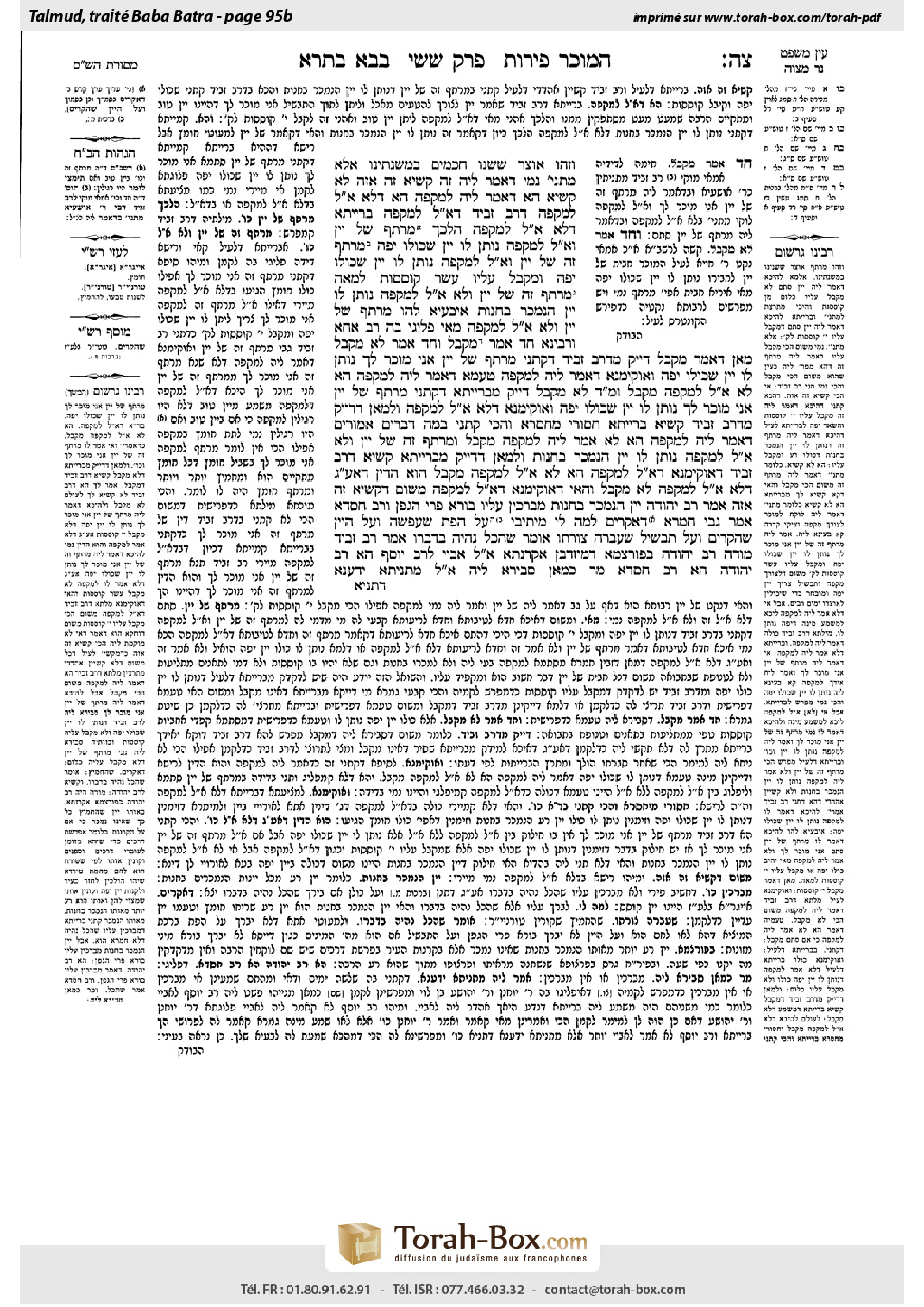
Bava Batra 95b: Talmud study for Daf Yomi
Study the Talmud for Daf Yomi with scanned pages, Hebrew text, English translations from Sefaria and AI-generated French translations.
Passage selection and English or AI-generated French translation are available where the scan has annotations. Daf Study is independent of Torah-Box and Sefaria.
Browse Bava Batra · בבא בתרא · All tractatesBava Batra 95b text and translations
This page of Bava Batra includes the Aramaic text, an English translation and an AI-generated French translation, alongside the scan above.
בבא בתרא צ״ה ב · Aramaic and Hebrew text
וְזֶהוּ אוֹצָר שֶׁשָּׁנוּ חֲכָמִים בְּמִשְׁנָתֵינוּ!
אֶלָּא מַתְנִיתִין נָמֵי דְּאָמַר לֵיהּ ״זֶה״.
קַשְׁיָא ״זֶה״ אַ״זֶּה״!
לָא קַשְׁיָא; הָא דְּאָמַר לֵיהּ לְמִקְפָּה, הָא דְּלָא אָמַר לֵיהּ לְמִקְפָּה. דְּרַב זְבִיד – דְּאָמַר לֵיהּ לְמִקְפָּה, בָּרַיְיתָא – דְּלָא אָמַר לֵיהּ לְמִקְפָּה.
הִלְכָּךְ, ״מַרְתֵּף שֶׁל יַיִן״ וְאָמַר לוֹ לְמִקְפָּה – נוֹתֵן לוֹ יַיִן שֶׁכּוּלּוֹ יָפֶה. ״מַרְתֵּף זֶה שֶׁל יַיִן״ וְאָמַר לֵיהּ לְמִקְפָּה – נוֹתֵן לוֹ יַיִן שֶׁכּוּלּוֹ יָפֶה, וּמְקַבֵּל עָלָיו עֶשֶׂר קוֹסְסוֹת לְמֵאָה. ״מַרְתֵּף זֶה שֶׁל יַיִן״ וְלָא אָמַר לֵיהּ לְמִקְפָּה – נוֹתֵן לוֹ יַיִן הַנִּמְכָּר בַּחֲנוּת.
אִיבַּעְיָא לְהוּ: ״מַרְתֵּף שֶׁל יַיִן״ וְלָא אָמַר לֵיהּ לְמִקְפָּה, מַאי? פְּלִיגִי בַּהּ רַב אַחָא וְרָבִינָא; חַד אָמַר: מְקַבֵּל, וְחַד אָמַר: לָא מְקַבֵּל.
מַאן דְּאָמַר מְקַבֵּל – דָּיֵיק מִדְּרַב זְבִיד, דְּקָתָנֵי: ״מַרְתֵּף שֶׁל יַיִן אֲנִי מוֹכֵר לָךְ״ – נוֹתֵן לוֹ יַיִן שֶׁכּוּלּוֹ יָפֶה, וְאוֹקִימְנָא דְּאָמַר לֵיהּ לְמִקְפָּה; טַעְמָא דְּאָמַר לֵיהּ לְמִקְפָּה, הָא לָא אָמַר לֵיהּ לְמִקְפָּה – מְקַבֵּל.
וּמַאן דְּאָמַר לָא מְקַבֵּל – דָּיֵיק מִבָּרַיְיתָא, דְּקָתָנֵי: ״מַרְתֵּף שֶׁל יַיִן אֲנִי מוֹכֵר לָךְ״ – נוֹתֵן לוֹ יַיִן שֶׁכּוּלּוֹ יָפֶה, וְאוֹקֵימְנָא דְּלָא אָמַר לֵיהּ לְמִקְפָּה.
וּלְמַאן דְּדָיֵיק מִדְּרַב זְבִיד, קַשְׁיָא בָּרַיְיתָא! חַסּוֹרֵי מְחַסְּרָא, וְהָכִי קָתָנֵי: בַּמֶּה דְּבָרִים אֲמוּרִים – דְּאָמַר לֵיהּ לְמִקְפָּה; הָא לָא אָמַר לֵיהּ לְמִקְפָּה – מְקַבֵּל. וּ״מַרְתֵּף זֶה שֶׁל יַיִן״ וְלָא אָמַר לֵיהּ לְמִקְפָּה – נוֹתֵן לוֹ יַיִן הַנִּמְכָּר בַּחֲנוּת.
וּלְמַאן דְּדָיֵיק מִבָּרַיְיתָא, קַשְׁיָא דְּרַב זְבִיד – דְּאוֹקֵימְנָא דְּאָמַר לֵיהּ לְמִקְפָּה, הָא לָא אָמַר לֵיהּ לְמִקְפָּה – מְקַבֵּל!
הוּא הַדִּין דְּאַף עַל גַּב דְּלָא אָמַר לֵיהּ לְמִקְפָּה – לָא מְקַבֵּל, וְהַאי דְּאוֹקֵימְנָא דְּאָמַר לֵיהּ לְמִקְפָּה, מִשּׁוּם דְּקַשְׁיָא ״זֶה״ אַ״זֶּה״.
אָמַר רַב יְהוּדָה: יַיִן הַנִּמְכָּר בַּחֲנוּת – מְבָרְכִין עָלָיו ״בּוֹרֵא פְּרִי הַגֶּפֶן״. וְרַב חִסְדָּא אָמַר: גַּבֵּי חַמְרָא דְּאַקְרֵים לְמָה לִי?
מֵיתִיבִי: עַל הַפַּת שֶׁעִפְּשָׁה, וְעַל הַיַּיִן שֶׁהִקְרִים, וְעַל תַּבְשִׁיל שֶׁעִבְּרָה צוּרָתוֹ – אוֹמֵר ״שֶׁהַכֹּל נִהְיֶה בִּדְבָרוֹ״!
אָמַר רַב זְבִיד: מוֹדֶה רַב יְהוּדָה בְּפוּרְצְמָא דְּמִיזְדַּבַּן אַקַּרְנָתָא.
אָמַר לֵיהּ אַבָּיֵי לְרַב יוֹסֵף: הָא רַב יְהוּדָה, הָא רַב חִסְדָּא; מָר כְּמַאן סְבִירָא לֵיהּ? אָמַר לֵיהּ: מַתְנִיתָא יָדַעְנָא.
Bava Batra 95b · English translation
Rav Zevid concludes: And this is the case of the storeroom, i.e., the cellar, that the Sages taught in the mishna. It is clear from this baraita both that it contradicts the suggested addition to the previous baraita, and that the mishna concerns a case where one specified which wine cellar he was selling.
Rather, as indicated by the baraita, the mishna also concerns a case where one says to the buyer: I am selling you this particular cellar, and because he specified a particular cellar the buyer accepts upon himself the possibility that up to ten barrels per hundred might be sour.
Having retracted the addition to the first baraita, the Gemara asks: If so, it is difficult to reconcile the first baraita, which rules that if the seller specified that he was selling this cellar, he must provide wine that is all of good quality, with the second baraita, that of Rav Zevid, which rules with regard to the same case, in which the seller specified he was selling this cellar, that the buyer accepts that up to ten barrels per hundred may contain souring wine.
The Gemara answers: This is not difficult. This baraita is referring to a case where the buyer said to him that he needs the wine for cooking, and therefore he requires good-quality wine, whereas that baraita is referring to a case where the buyer did not say to him that he needs the wine for cooking. The Gemara elaborates: The second baraita, taught by Rav Zevid, is referring to a case where the buyer said that he needs the wine for cooking, whereas the first baraita is referring to a case where the buyer did not say to him that he requires it for cooking.
The Gemara concludes: Therefore, the halakha is that if one said that he is selling: A wine cellar, and the buyer said to him: I need the wine for cooking, then the seller is obligated to give him wine that is all of good quality. If one said that he is selling: This particular wine cellar, and the buyer said to him: I need the wine for cooking, then the seller is obligated to give him wine that is all of good quality, but the buyer accepts upon himself ten barrels of souring wine in each hundred barrels purchased. If one said that he is selling: This particular wine cellar, and the buyer did not say to him: I need the wine for cooking, then the seller may give to him the wine that is in his possession, even if it is of a quality that is sold in the shops, i.e., it is beginning to sour.
A dilemma was raised before the Sages: If one said that he is selling: A wine cellar, and the buyer did not say to him: I need the wine for cooking, what is the halakha? Rav Aḥa and Ravina disagree about this. One says: The buyer must accept ten barrels of souring wine per hundred, and the other one says: The buyer need not accept any barrels of souring wine.
The Gemara explains their reasoning. The one who says that the buyer must accept ten barrels of souring wine per hundred infers this through a precise reading of the baraita of Rav Zevid, as it teaches: If one says: I am selling to you a wine cellar, then he is required to give him wine that is all of good quality. And we interpreted this baraita as referring to a case where the buyer said to him: I need the wine for cooking. The Gemara explains the inference: The only reason that he must provide him with wine that is all of good quality is that the buyer said to him that he needed it for cooking. By inference, where the buyer does not say to him: I need it for cooking, the buyer must accept ten barrels of souring wine per hundred.
And the one who says that the buyer need not accept any barrels of souring wine infers this through a precise reading of the first baraita, as it teaches: If one says: I am selling to you a wine cellar, then he is required to give him wine that is all of good quality. And we interpreted this baraita as referring to a case where he did not say to him: I need the wine for cooking, and even so, the buyer need not accept any barrels of souring wine.
The Gemara asks: But then, according to the one who infers his opinion through a precise reading of the baraita of Rav Zevid, the first baraita poses a difficulty. The Gemara answers that according to his opinion, the baraita is incomplete and this is what it is teaching: If one says: I am selling to you a cellar of wine, then he is required to give him wine that is all of good quality. In what case is this statement said? It is said in a case where the buyer said to him: I need the wine for cooking. By inference, where the buyer did not say to him: I need the wine for cooking, the buyer must accept ten barrels of souring wine per hundred. And if one said that he is selling: This particular wine cellar, and the buyer did not say to him: I need the wine for cooking, then one may give to him the wine that is in his possession, even if it is of a quality that is sold in the shops, i.e., it is beginning to sour.
The Gemara asks: And according to the one who infers his opinion through a precise reading of the first baraita, the baraita of Rav Zevid poses a difficulty, as we interpreted it as referring to a case where the buyer said to him: I need the wine for cooking. And this opinion inferred that if the buyer did not say to him: I need it for cooking, then the buyer must accept ten barrels of souring wine per hundred.
The Gemara answers: The same is true according to both baraitot, that even where the buyer did not say to him: I need the wine for cooking, the buyer need not accept ten barrels of souring wine. And there is no proof from the fact that we interpreted the baraita as referring to a case where he said to him: I need it for cooking, since we did so only due to the difficulty of the contradiction between the ruling of the first baraita in the case where the seller specified that he was selling this cellar and the ruling of the baraita of Rav Zevid in the same case where the seller specified he was selling this cellar. Due to that difficulty, the entire baraita was interpreted as referring to a case where the buyer said: I need the wine for cooking, despite the fact that in the case where he did not mention a specific cellar it makes no difference whether or not he said so.
§ Apropos wine that is sold in the shops, the Gemara considers additional halakhot pertaining to such wine: Rav Yehuda says: Over wine of the same quality as that which is sold in the shops, one recites the standard blessing for wine: Who creates fruit of the vine. Despite the fact that such wine is not of the highest quality, it is still regarded as wine. And Rav Ḥisda said: Over wine that has formed a film as it begins to sour, why do I need to recite the blessing for wine? Since it has begun to sour, it is no longer regarded as wine. Instead, one should recite the generic blessing recited over foods of lower importance: By Whose word all things came to be.
The Gemara raises an objection to Rav Yehuda’s opinion. It is taught in a baraita: Over bread that has become moldy, and over wine that has formed a film, and over a cooked dish that has spoiled, one recites the blessing: By Whose word all things came to be. Since these foods have partially spoiled, it is inappropriate to recite the specific blessings designated for such foods in their fresh state.
Rav Zevid said: Rav Yehuda concedes that one does not recite the blessing of: Who creates fruit of the vine, on wine made from grape seeds that is sold on the street corners. It is to such significantly inferior wine that the baraita refers. Wine sold in the shops still has the taste and appearance of wine, so one should recite the standard blessing for wine.
Abaye said to Rav Yosef: This is the opinion of Rav Yehuda, and this is the opinion of Rav Ḥisda. In accordance with whose opinion does the Master hold? Rav Yosef said to him: I know a baraita from which it is possible to derive the halakha.
Bava Batra 95b · Traduction française (IA)
Rav Zevid conclut : Et c'est le cas du cellier, c'est-à-dire du cellier, que les Sages ont enseigné dans la mitsva. Il est clair à partir de cette baraïta que cela contredit l'ajout suggéré à la précédente baraïta, et que la mitsva concerne un cas où l'on spécifiait quel cellier on vendait.
Au contraire, comme indiqué par la baraïta, la mitsva concerne également un cas où l'on dit au acheteur : Je vends à toi ce cellier particulier, et parce qu'il a spécifié un cellier particulier, l'acheteur s'engage à accepter que jusqu'à dix barils par cent puissent être des vins rances.
Ayant rétracté l'ajout à la première baraïta, le Guemara pose la question : Si c'est ainsi, il est difficile de concilier la première baraïta, qui stipule que si le vendeur spécifiait qu'il vendait ce cellier, il devait fournir un vin de qualité, avec la deuxième baraïta, celle de Rav Zevid, qui stipule concernant le même cas, où le vendeur spécifiait qu'il vendait ce cellier, que l'acheteur accepte que jusqu'à dix barils par cent puissent être des vins rances.
Le Guemara répond : Ce n'est pas difficile. Cette baraïta fait référence à un cas où l'acheteur a dit au vendeur qu'il avait besoin du vin pour la cuisson, et donc il exigeait un vin de qualité, tandis que l'autre baraïta fait référence à un cas où l'acheteur n'avait pas dit au vendeur qu'il avait besoin du vin pour la cuisson. Le Guemara développe : La deuxième baraïta, enseignée par Rav Zevid, fait référence à un cas où l'acheteur a dit qu'il avait besoin du vin pour la cuisson, tandis que la première baraïta fait référence à un cas où l'acheteur n'avait pas dit au vendeur qu'il en avait besoin pour la cuisson.
Le Guemara conclut : Ainsi, la halakha est que si l'on dit qu'on vend : Un cellier de vin, et l'acheteur dit au vendeur : J'ai besoin du vin pour la cuisson, alors le vendeur est tenu de lui donner un vin de qualité. Si l'on dit qu'on vend : Ce cellier particulier de vin, et l'acheteur dit au vendeur : J'ai besoin du vin pour la cuisson, alors le vendeur est tenu de lui donner un vin de qualité, mais l'acheteur s'engage à accepter dix barils de vin rance par cent barils achetés. Si l'on dit qu'on vend : Ce cellier particulier de vin, et l'acheteur ne dit pas au vendeur : J'ai besoin du vin pour la cuisson, alors le vendeur peut lui donner le vin qu'il possède, même s'il est de qualité vendue dans les boutiques, c'est-à-dire qu'il commence à rancer.
Un dilemme a été soulevé devant les Sages : Si l'on dit qu'on vend : Un cellier de vin, et l'acheteur ne dit pas au vendeur : J'ai besoin du vin pour la cuisson, quelle est la halakha ? Rav Acha et Ravina s'opposent sur ce point. L'un dit : L'acheteur doit accepter dix barils de vin rance par cent, et l'autre dit : L'acheteur n'a pas besoin d'accepter aucun baril de vin rance.
Le Guemara explique leur raisonnement. Celui qui dit que l'acheteur doit accepter dix barils de vin rance par cent infère cela à partir d'une lecture précise de la baraïta de Rav Zevid, car elle enseigne : Si l'on dit : Je vends à toi un cellier de vin, alors il doit lui donner un vin dont toute la qualité est bonne. Et nous avons interprété cette baraïta comme faisant référence à un cas où l'acheteur a dit au vendeur : J'ai besoin du vin pour la cuisson. Le Guemara explique l'inférence : La seule raison pour laquelle il doit lui fournir un vin de qualité est que l'acheteur a dit qu'il avait besoin de la cuisson. Par conséquent, dans un cas où l'acheteur ne dit pas qu'il a besoin de la cuisson, l'acheteur doit accepter dix barils de vin rance par cent.
Et celui qui dit que l'acheteur n'a pas besoin d'accepter aucun baril de vin rance infère cela à partir d'une lecture précise de la première baraïta, car elle enseigne : Si l'on dit : Je vends à toi un cellier de vin, alors il doit lui donner un vin dont toute la qualité est bonne. Et nous avons interprété cette baraïta comme faisant référence à un cas où l'acheteur n'a pas dit au vendeur : J'ai besoin du vin pour la cuisson, et même ainsi, l'acheteur n'a pas besoin d'accepter aucun baril de vin rance.
Le Guemara pose la question : Mais alors, selon celui qui infère son opinion à partir d'une lecture précise de la baraïta de Rav Zevid, la première baraïta pose un problème. Le Guemara répond que selon son opinion, la baraïta est incomplète et c'est ce qu'elle enseigne : Si l'on dit : Je vends à toi un cellier de vin, alors il doit lui donner un vin de qualité. Dans quel cas cette déclaration est-elle faite ? Elle est faite dans un cas où l'acheteur a dit au vendeur : J'ai besoin du vin pour la cuisson. Par conséquent, dans un cas où l'acheteur n'a pas dit au vendeur : J'ai besoin du vin pour la cuisson, l'acheteur doit accepter dix barils de vin rance par cent. Et si l'on dit qu'on vend : Ce cellier particulier de vin, et l'acheteur n'a pas dit au vendeur : J'ai besoin du vin pour la cuisson, alors on peut lui donner le vin qu'il possède, même s'il est de qualité vendue dans les boutiques, c'est-à-dire qu'il commence à rancer.
Le Guemara pose la question : Et selon celui qui infère son opinion à partir d'une lecture précise de la première baraïta, la baraïta de Rav Zevid pose un problème, car nous l'avons interprétée comme faisant référence à un cas où l'acheteur a dit au vendeur : J'ai besoin du vin pour la cuisson. Et cette opinion a inféré que si l'acheteur n'a pas dit au vendeur : J'ai besoin du vin pour la cuisson, alors l'acheteur doit accepter dix barils de vin rance par cent.
La Guemara répond : C’est également vrai selon les deux baraitot, que même lorsqu’un acheteur n’a pas dit à l’autre : J’ai besoin du vin pour la cuisson, l’acheteur n’a pas besoin d’accepter dix barils de vin qui commence à fermenter. Et il n’y a pas de preuve dans le fait que nous avons interprété la baraïta comme se rapportant à un cas où il a dit : J’ai besoin de cela pour la cuisson, car nous l’avons fait uniquement en raison de la difficulté du conflit entre la décision de la première baraïta dans le cas où le vendeur spécifiait qu’il vendait cette cave et la décision de la baraïta de Rav Zevid dans le même cas où le vendeur spécifiait qu’il vendait cette cave. En raison de cette difficulté, toute la baraïta a été interprétée comme se rapportant à un cas où l’acheteur a dit : J’ai besoin du vin pour la cuisson, malgré le fait que dans le cas où il n’a pas mentionné une cave spécifique, il n’y a pas de différence si ou non il a dit cela.
§ En ce qui concerne le vin vendu dans les boutiques, la Guemara examine d’autres halakhot concernant ce vin : Rav Yéhuda dit : Sur du vin de la même qualité que celui vendu dans les boutiques, on récite la bénédiction standard pour le vin : Qui crée les fruits de la vigne. Malgré le fait que ce vin n’est pas de la meilleure qualité, il est encore considéré comme du vin. Et Rav Ḥisda dit : Sur du vin qui a formé une pellicule en commençant à fermenter, pourquoi dois-je réciter la bénédiction pour le vin ? Puisque cela commence à fermenter, il n’est plus considéré comme du vin. Au lieu de cela, on doit réciter la bénédiction générale récitée sur les aliments de moindre importance : Par la parole de qui toutes choses sont venues à l’être.
La Guemara soulève une objection contre l’opinion de Rav Yéhuda. Il est enseigné dans une baraïta : Sur du pain moisi, et sur du vin qui a formé une pellicule, et sur un plat cuit qui a rassis, on récite la bénédiction : Par la parole de qui toutes choses sont venues à l’être. Puisque ces aliments sont partiellement rassis, il est inapproprié de réciter les bénédictions spécifiques destinées à ces aliments dans leur état frais.
Rav Zevid dit : Rav Yéhuda reconnaît que l’on ne récite pas la bénédiction : Qui crée les fruits de la vigne, sur du vin fait à partir des pépins de raisin vendu aux coins de rue. Il s’agit de ce vin considérablement inférieur que la baraïta mentionne. Le vin vendu dans les boutiques conserve encore le goût et l’apparence du vin, donc on doit réciter la bénédiction standard pour le vin.
Abaye dit à Rav Yosef : C’est l’opinion de Rav Yéhuda, et c’est l’opinion de Rav Ḥisda. Selon l’opinion de qui le Maître adopte-t-il ? Rav Yosef répondit à lui : Je connais une baraïta d’où il est possible de déduire la halakha.
Traduction française générée par IA à partir de l’édition anglaise de Sefaria. Vérifie toujours un passage avec le texte source.
Text from Sefaria: William Davidson Edition - Vocalized Aramaic (CC BY NC); William Davidson Edition - English (CC BY NC).