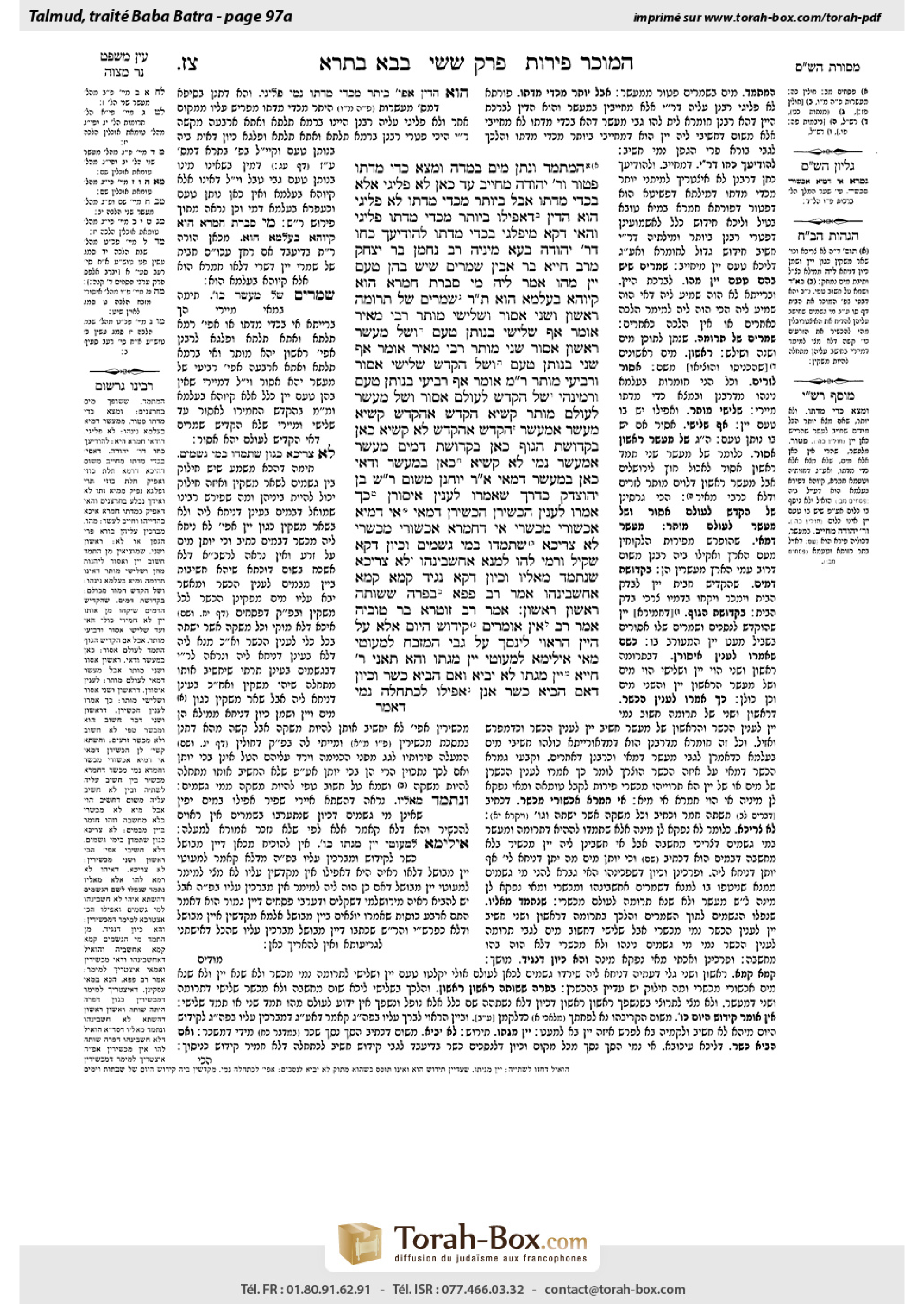
Bava Batra 97a: Talmud study for Daf Yomi
Study the Talmud for Daf Yomi with scanned pages, Hebrew text, English translations from Sefaria and AI-generated French translations.
Passage selection and English or AI-generated French translation are available where the scan has annotations. Daf Study is independent of Torah-Box and Sefaria.
Browse Bava Batra · בבא בתרא · All tractatesBava Batra 97a text and translations
This page of Bava Batra includes the Aramaic text, an English translation and an AI-generated French translation, alongside the scan above.
בבא בתרא צ״ז א · Aramaic and Hebrew text
הַמְתַמֵּד, וְנָתַן מַיִם בְּמִדָּה, וּמָצָא כְּדֵי מִדָּתוֹ – פָּטוּר, וְרַבִּי יְהוּדָה מְחַיֵּיב. עַד כָּאן לָא פְּלִיגִי אֶלָּא בִּכְדֵי מִדָּתוֹ, אֲבָל בְּיוֹתֵר מִכְּדֵי מִדָּתוֹ – לָא פְּלִיגִי!
הוּא הַדִּין דַּאֲפִילּוּ בְּיוֹתֵר מִכְּדֵי מִדָּתוֹ פְּלִיגִי; וְהַאי דְּקָא מִיפַּלְגִי בִּכְדֵי מִדָּתוֹ, לְהוֹדִיעֲךָ כֹּחוֹ דְּרַבִּי יְהוּדָה.
בְּעָא מִינֵּיהּ רַב נַחְמָן בַּר יִצְחָק מֵרַב חִיָּיא בַּר אָבִין: שְׁמָרִים שֶׁיֵּשׁ בָּהֶן טַעַם יַיִן, מַהוּ? אֲמַר לֵיהּ: מִי סָבְרַתְּ חַמְרָא הוּא? קִיּוּהָא בְּעָלְמָא הוּא.
תָּנוּ רַבָּנַן: שְׁמָרִים שֶׁל תְּרוּמָה – רִאשׁוֹן וְשֵׁנִי אָסוּר, וּשְׁלִישִׁי מוּתָּר. רַבִּי מֵאִיר אוֹמֵר: אַף שְׁלִישִׁי, בְּנוֹתֵן טַעַם.
וְשֶׁל מַעֲשֵׂר – רִאשׁוֹן אָסוּר, שֵׁנִי מוּתָּר. רַבִּי מֵאִיר אוֹמֵר: אַף שֵׁנִי, בְּנוֹתֵן טַעַם. וְשֶׁל הֶקְדֵּשׁ – שְׁלִישִׁי אָסוּר, וּרְבִיעִי מוּתָּר. רַבִּי מֵאִיר אוֹמֵר: אַף רְבִיעִי, בְּנוֹתֵן טַעַם.
וּרְמִינְהִי: שֶׁל הֶקְדֵּשׁ – לְעוֹלָם אָסוּר, וְשֶׁל מַעֲשֵׂר – לְעוֹלָם מוּתָּר. קַשְׁיָא הֶקְדֵּשׁ אַהֶקְדֵּשׁ, קַשְׁיָא מַעֲשֵׂר אַמַּעֲשֵׂר!
הֶקְדֵּשׁ אַהֶקְדֵּשׁ לָא קַשְׁיָא – כָּאן בִּקְדוּשַּׁת הַגּוּף, כָּאן בִּקְדוּשַּׁת דָּמִים. מַעֲשֵׂר אַמַּעֲשֵׂר נָמֵי לָא קַשְׁיָא – כָּאן בְּמַעֲשֵׂר וַדַּאי, כָּאן בְּמַעֲשֵׂר דְּמַאי.
אָמַר רַבִּי יוֹחָנָן מִשּׁוּם רַבִּי שִׁמְעוֹן בֶּן יְהוֹצָדָק: כְּדֶרֶךְ שֶׁאָמְרוּ לְעִנְיַן אִיסּוּרָן, כָּךְ אָמְרוּ לְעִנְיַן הֶכְשֵׁירָן.
הֶכְשֵׁירָן דְּמַאי? אִי דְּמַיָּא – אַכְשׁוֹרֵי מַכְשְׁרִי! אִי דְּחַמְרָא – אַכְשׁוֹרֵי מַכְשְׁרִי! לָא צְרִיכָא, שֶׁתִּמְּדוֹ בְּמֵי גְשָׁמִים.
וְכֵיוָן דְּקָא שָׁקֵיל וְרָמֵי לְהוּ לְמָנָא – אַחְשְׁבִינְהוּ! לָא צְרִיכָא, שֶׁנִּתַּמֵּד מֵאֵלָיו.
וְכֵיוָן דְּקָא נָגֵיד – קַמָּא קַמָּא אַחְשְׁבִינְהוּ! אָמַר רַב פָּפָּא: בְּפָרָה שֶׁשּׁוֹתָה רִאשׁוֹן רִאשׁוֹן.
אָמַר רַב זוּטְרָא בַּר טוֹבִיָּה אָמַר רַב: אֵין אוֹמְרִים קִידּוּשׁ הַיּוֹם, אֶלָּא עַל הַיַּיִן הָרָאוּי לִינָּסֵךְ עַל גַּבֵּי הַמִּזְבֵּחַ.
לְמַעוֹטֵי מַאי? אִילֵּימָא לְמַעוֹטֵי יַיִן מִגִּתּוֹ, וְהָא תָּאנֵי רַבִּי חִיָּיא: יַיִן מִגִּתּוֹ לֹא יָבִיא, וְאִם הֵבִיא – כָּשֵׁר; וְכֵיוָן דְּאִם הֵבִיא כָּשֵׁר, אֲנַן אֲפִילּוּ לְכַתְּחִלָּה נָמֵי!
Bava Batra 97a · English translation
In the case of one who produces tamad, a beverage made by steeping grape pomace in water, and he placed a measured amount of water into a container together with the pomace, and after removing the pomace he found that the volume of the tamad produced was equivalent to the amount of water used, one is exempt from the requirement to tithe the tamad, even though the pomace came from grapes that had not been tithed. And Rabbi Yehuda deems one liable to tithe the tamad. The Gemara explains the difficulty posed by this mishna: It would appear that they disagree only with regard to a case where the volume of the tamad produced was equivalent to the amount of water used, but in a case where the volume of the tamad produced was greater than the amount of water used, they do not disagree; rather, they all agree that it must be tithed because it is regarded as wine. This would appear to contradict Rava’s explanation.
The Gemara resolves the difficulty: Actually, the same is true in that they would disagree even where the volume of the tamad produced was greater than the amount of water used. And the reason that the mishna records only that they disagree about a case where the volume of the tamad produced was equivalent to the amount of water used is in order to convey to you the far-reaching nature of the opinion of Rabbi Yehuda, who holds that one is liable to tithe the tamad even in this case.
Rav Naḥman bar Yitzḥak asked Rav Ḥiyya bar Avin: If one steeps pomace and produces tamad that has the taste of wine, what is the blessing that one should recite before drinking it? Rav Ḥiyya bar Avin said to him: Do you hold that such a beverage is wine? It is merely a sharp-flavored beverage, not wine.
§ The Sages taught in a baraita concerning the production of successive batches of tamad of decreasing strengths by reusing the pomace after each time a tamad is produced: With regard to pomace of teruma wine, the first and second products are considered to be teruma, and it is prohibited for a non-priest to drink it. But with regard to the third product, a non-priest is permitted to drink it. Rabbi Meir says: Even with regard to the third product, if the wine that seeps out of the pomace imparts the flavor of wine to the water, it is forbidden to a non-priest.
The baraita continues: And with regard to water added to pomace of second-tithe wine, the first product is also considered to be second tithe, and it is prohibited to drink it outside Jerusalem. But with regard to the second product, it is permitted to drink it anywhere. Rabbi Meir says: Even with regard to the second product, if the wine that seeps out of the pomace imparts the flavor of wine to the water, it may be consumed only in Jerusalem. And with regard to water added to pomace of wine that was consecrated to the Temple, up to the third product it is prohibited to derive any benefit from it, as it is considered to be consecrated, but from the fourth product, it is permitted. Rabbi Meir says: Even with regard to the fourth product, if the wine that seeps out of the pomace imparts the flavor of wine to the water, it is prohibited.
And the Gemara raises a contradiction from a different baraita: Tamad produced from the pomace of wine that was consecrated to the Temple is always forbidden, even after having steeped them many times, and the beverage produced from pomace of second tithe is always permitted, even from the first such product. The Gemara explains: The ruling concerning consecrated pomace is difficult, as it is contradicted by the ruling of the first baraita concerning consecrated pomace. And the ruling concerning second-tithe pomace is difficult, as it is contradicted by the ruling of the first baraita concerning second-tithe pomace.
The Gemara answers: The contradiction between the ruling of one baraita concerning consecrated pomace and the ruling of the other baraita concerning consecrated pomace is not difficult, as one can explain that here, the second baraita is referring to pomace with inherent sanctity, and there, the first baraita is referring to pomace with sanctity that inheres in its value. Also, the contradiction between the ruling of one baraita concerning pomace of second tithe and the ruling of the other baraita concerning pomace of second tithe is not difficult, as one can explain that here, the first baraita is referring to pomace whose status as second tithe is certain and there, the second baraita is referring to pomace of second tithe of doubtfully tithed produce [demai].
Rabbi Yoḥanan says in the name of Rabbi Shimon ben Yehotzadak: In the same way in which the Sages said concerning differing strengths of tamad that with regard to their prohibition, after a certain number of times the tamad produced is not considered to be wine, so too they said the same rulings with regard to their capacity to render foods susceptible to ritual impurity.
The Gemara asks: When the baraita is referring to their capacity to render other foods susceptible to ritual impurity, why does it matter which kind of beverage the tamad is considered to be? Whether the tamad is regarded as water it can render food susceptible to impurity, or whether it is regarded as wine it can render food susceptible to impurity. The Gemara clarifies: No, it is necessary in a case in which one produced tamad with rainwater that he had not previously intended to use. Rainwater does not render food susceptible to ritual impurity, so the tamad will do so only if it is regarded as wine.
The Gemara challenges this: But since he took the rainwater and poured it into a container holding the grape pomace, he has thereby intended it for a use. Even if the resulting tamad is regarded as water, such rainwater renders food susceptible to ritual impurity. The Gemara answers: No, it is necessary in a case where the pomace produced tamad by itself, having been steeped in water that happened to fall upon it.
The Gemara persists: The baraita above states that from the third product, the tamad is regarded as water, which the Gemara has explained is referring to rainwater that one did not intend to use and that consequently cannot render food susceptible to impurity. The Gemara asks: But since he draws off each subsequent lot of tamad that is produced, one by one, in order to allow more rainwater to fall onto the pomace and produce more tamad, he thereby demonstrates his intent to use the rainwater. Therefore, even if the tamad is regarded as water, it should render food susceptible to impurity. The Gemara answers: Rav Pappa says that this is a case of a cow that drank the lots of tamad, one by one, and some inadvertently dripped from the cow’s mouth onto food. Since no person intended to use the tamad, if it is regarded as water it will not render food susceptible to impurity.
§ Rav Zutra bar Toviyya says that Rav says: One may recite the sanctification of the Shabbat day only over wine of a quality that is fit to be poured as a libation upon the altar.
The Gemara asks: This statement is said to exclude what? If we say it is to exclude the use of wine fresh from one’s press, i.e., grape juice, which has not yet fermented, that is difficult. But didn’t Rabbi Ḥiyya teach: One may not bring wine fresh from his press as a libation ab initio, but if one brought it as a libation, it is valid after the fact. And since if one brought it as a libation it is valid after the fact, we should also be able to use it for the sanctification of the Shabbat day, even ab initio.
Bava Batra 97a · Traduction française (IA)
Dans le cas d'une personne qui produit un tamad, un breuvage obtenu en infusant les marc de raisin dans l'eau, et qui a versé une quantité mesurée d'eau dans un récipient avec les marc, et après avoir retiré les marc, il a découvert que le volume du tamad produit était équivalent à la quantité d'eau utilisée, on est dispensé de la tithes du tamad, même si les marc provenaient de raisins non tithés. Rabbi Yehuda considère que l'on est tenu de tithé le tamad. La Guemara explique la difficulté posée par cette mitsva : Il semble que leur désaccord ne concerne que le cas où le volume du tamad produit était équivalent à la quantité d'eau utilisée, mais dans le cas où le volume du tamad produit était supérieur à la quantité d'eau utilisée, ils ne s'opposent pas ; ils s'accordent tous sur le fait qu'il doit être tithé car il est considéré comme du vin. Cela semble contredire l'explication de Rava.
La Guemara résout cette difficulté : En réalité, c'est pareil dans ce cas, car ils s'opposent même lorsque le volume du tamad produit est supérieur à la quantité d'eau utilisée. Et la raison pour laquelle la mitsva mentionne uniquement qu'ils s'opposent dans le cas où le volume du tamad produit est équivalent à la quantité d'eau utilisée est afin de vous faire comprendre la portée de l'opinion de Rabbi Yehuda, qui considère que l'on est tenu de tithé le tamad même dans ce cas.
Rav Naḥman bar Yitzḥak a demandé à Rav Ḥiyya bar Avin : Si l'on infuse des marc et produit un tamad qui a le goût du vin, quelle est la bénédiction que l'on doit réciter avant de boire ce breuvage ? Rav Ḥiyya bar Avin a répondu à lui : Vous considérez-vous que ce breuvage est du vin ? Il s'agit simplement d'un breuvage à saveur forte, pas du vin.
§ Les Sages ont enseigné dans une baraïta concernant la production de lots successifs de tamad de forces décroissantes en réutilisant les marc après chaque production de tamad : En ce qui concerne les marc de vin terouma, le premier et le deuxième produits sont considérés comme terouma, et il est interdit à un non-prêtre de les boire. Mais en ce qui concerne le troisième produit, un non-prêtre est autorisé à le boire. Rabbi Meir dit : Même en ce qui concerne le troisième produit, si le vin qui s'infiltre des marc imprime le goût du vin à l'eau, il est interdit à un non-prêtre de le boire.
La baraïta continue : Et en ce qui concerne l'eau ajoutée aux marc de vin de la deuxième tithe, le premier produit est également considéré comme de la deuxième tithe, et il est interdit de le boire en dehors de Jérusalem. Mais en ce qui concerne le deuxième produit, il est autorisé à être bu partout. Rabbi Meir dit : Même en ce qui concerne le deuxième produit, si le vin qui s'infiltre des marc imprime le goût du vin à l'eau, il peut être consommé uniquement à Jérusalem. Et en ce qui concerne l'eau ajoutée aux marc de vin consacrés au Temple, jusqu'au troisième produit, il est interdit d'en tirer quelque bénéfice que ce soit, car il est considéré comme consacré, mais à partir du quatrième produit, il est autorisé. Rabbi Meir dit : Même en ce qui concerne le quatrième produit, si le vin qui s'infiltre des marc imprime le goût du vin à l'eau, il est interdit.
Et la Guemara soulève une contradiction à partir d'une autre baraïta : Le tamad produit à partir des marc de vin consacrés au Temple est toujours interdit, même après avoir infusé plusieurs fois, et le breuvage produit à partir des marc de la deuxième tithe est toujours autorisé, même à partir du premier tel produit. La Guemara explique : Le règlement concernant les marc consacrés est difficile, car il est contredit par le règlement de la première baraïta concernant les marc consacrés. Et le règlement concernant les marc de la deuxième tithe est difficile, car il est contredit par le règlement de la première baraïta concernant les marc de la deuxième tithe.
La Guemara répond : La contradiction entre le règlement d'une baraïta concernant les marc consacrés et le règlement d'une autre baraïta concernant les marc consacrés n'est pas difficile, car on peut expliquer que ici, la deuxième baraïta fait référence à des marc dont la sanctité est intrinsèque, et là, la première baraïta fait référence à des marc dont la sanctité est inhérente à leur valeur. De même, la contradiction entre le règlement d'une baraïta concernant les marc de la deuxième tithe et le règlement d'une autre baraïta concernant les marc de la deuxième tithe n'est pas difficile, car on peut expliquer que ici, la première baraïta fait référence à des marc dont le statut de deuxième tithe est certain, et là, la deuxième baraïta fait référence à des marc de deuxième tithe de produit tithé en doute [demai].
Rabbi Yoḥanan dit en nom de Rabbi Shimon ben Yehotzadak : De la même manière que les Sages ont dit concernant les différences de force des tamad, que concernant leur interdiction, après un certain nombre de fois, le tamad produit n'est pas considéré comme du vin, ainsi aussi ils ont dit les mêmes règles concernant leur capacité à rendre les aliments sujets à la souillure rituelle.
La Guemara pose la question : Lorsque la baraïta fait référence à leur capacité à rendre d'autres aliments sujets à la souillure rituelle, pourquoi est-il important de savoir quel type de breuvage le tamad est considéré ? Que le tamad soit considéré comme de l'eau, il peut rendre les aliments sujets à la souillure, ou que le tamad soit considéré comme du vin, il peut rendre les aliments sujets à la souillure. La Guemara clarifie : Non, il est nécessaire dans le cas où l'on a produit un tamad avec de l'eau de pluie qu'on n'avait pas initialement l'intention d'utiliser. L'eau de pluie ne rend pas les aliments sujets à la souillure rituelle, donc le tamad le fera seulement s'il est considéré comme du vin.
La Guemara conteste cela : Mais puisque l'on a pris l'eau de pluie et l'a versée dans un récipient contenant les marc de raisin, l'on a ainsi l'intention d'en faire usage. Même si le tamad est considéré comme de l'eau, cette eau de pluie rend les aliments sujets à la souillure rituelle. La Guemara répond : Non, il est nécessaire dans le cas où les marc ont produit le tamad par eux-mêmes, ayant été infusés dans de l'eau qui est tombée dessus.
La Guemara continue : La baraïta ci-dessus indique que du troisième produit, le tamad est considéré comme de l'eau, ce que la Guemara a expliqué signifier de l'eau de pluie que l'on n'avait pas l'intention d'utiliser et qui ne peut donc pas rendre les aliments suspects de souillure. La Guemara pose la question : Cependant, puisqu'il extrait chaque lot de tamad produit, un par un, afin de permettre plus d'eau de pluie à tomber sur la pommade et de produire davantage de tamad, il démontre ainsi son intention d'utiliser l'eau de pluie. Par conséquent, même si le tamad est considéré comme de l'eau, il devrait rendre les aliments suspects de souillure. La Guemara répond : Rav Pappa dit que c'est le cas d'une vache qui a bu les lots de tamad, un par un, et que certaines gouttes sont tombées accidentellement de la bouche de la vache sur les aliments. Puisque personne n'avait l'intention d'utiliser le tamad, si celui-ci est considéré comme de l'eau, il ne rendra pas les aliments suspects de souillure.
§ Rav Zutra bar Toviyya dit que Rav dit : On peut réciter la sanctification du jour de Shabbat uniquement sur du vin d'une qualité convenant à être versé en offrande sur l'autel.
La Guemara pose la question : Cette déclaration est-elle faite pour exclure quelque chose ? Si nous disons qu'elle vise à exclure l'utilisation du vin frais provenant de son pressoir, c'est-à-dire du jus de raisin non encore fermenté, cela est difficile. Mais n'a-t-il pas été enseigné par Rabbi Ḥiyya : On ne peut pas offrir en sacrifice le vin frais provenant de son pressoir ab initio, mais si l'on l'a offert en sacrifice, il est valide après coup. Et puisque si l'on l'a offert en sacrifice, il est valide après coup, nous devrions également pouvoir l'utiliser pour la sanctification du jour de Shabbat, même ab initio.
Traduction française générée par IA à partir de l’édition anglaise de Sefaria. Vérifie toujours un passage avec le texte source.
Text from Sefaria: William Davidson Edition - Vocalized Aramaic (CC BY NC); William Davidson Edition - English (CC BY NC).