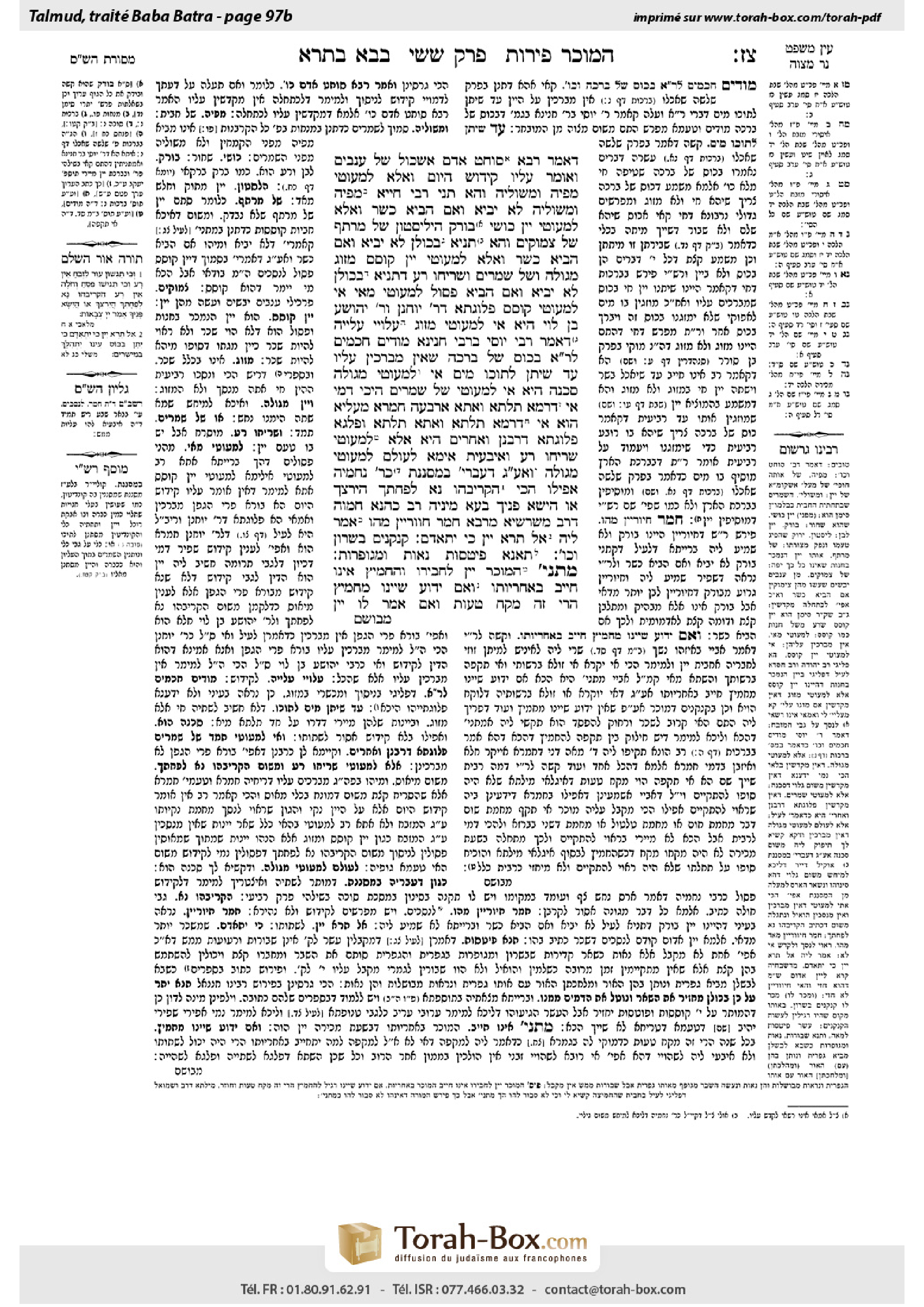
Bava Batra 97b: Talmud study for Daf Yomi
Study the Talmud for Daf Yomi with scanned pages, Hebrew text, English translations from Sefaria and AI-generated French translations.
Passage selection and English or AI-generated French translation are available where the scan has annotations. Daf Study is independent of Torah-Box and Sefaria.
Browse Bava Batra · בבא בתרא · All tractatesBava Batra 97b text and translations
This page of Bava Batra includes the Aramaic text, an English translation and an AI-generated French translation, alongside the scan above.
בבא בתרא צ״ז ב · Aramaic and Hebrew text
דְּאָמַר רָבָא: סוֹחֵט אָדָם אֶשְׁכּוֹל שֶׁל עֲנָבִים, וְאוֹמֵר עָלָיו קִידּוּשׁ הַיּוֹם!
וְאֶלָּא לְמַעוֹטֵי מִפִּיהָ וּמִשּׁוּלֶיהָ? וְהָא תָּנֵי רַבִּי חִיָּיא: מִפִּיהָ וּמִשּׁוּלֶיהָ לֹא יָבִיא, וְאִם הֵבִיא – כָּשֵׁר!
וְאֶלָּא לְמַעוֹטֵי יַיִן כּוּשִׁי; בּוֹרֵק; הֵילִיסְטוֹן; שֶׁל מַרְתֵּף; שֶׁל צִמּוּקִים? וְהָא תַּנְיָא: בְּכוּלָּן לֹא יָבִיא, וְאִם הֵבִיא – כָּשֵׁר!
וְאֶלָּא לְמַעוֹטֵי יַיִן קוֹסֵס; מָזוּג; מְגוּלֶּה; וְשֶׁל שְׁמָרִים; וְשֶׁרֵיחוֹ רַע – דְּתַנְיָא: בְּכוּלָּן לֹא יָבִיא, וְאִם הֵבִיא – פָּסוּל.
לְמַעוֹטֵי מַאי? אִי לְמַעוֹטֵי קוֹסֵס, פְּלוּגְתָּא דְּרַבִּי יוֹחָנָן וְרַבִּי יְהוֹשֻׁעַ בֶּן לֵוִי הִיא!
אִי לְמַעוֹטֵי מָזוּג, עַלּוֹיֵי עַלְּיֵיהּ – דְּאָמַר רַבִּי יוֹסֵי בְּרַבִּי חֲנִינָא: מוֹדִים חֲכָמִים לְרַבִּי אֱלִיעֶזֶר בְּכוֹס שֶׁל בְּרָכָה, שֶׁאֵין מְבָרְכִין עָלָיו עַד שֶׁיִּתֵּן לְתוֹכוֹ מַיִם!
אִי לְמַעוֹטֵי מְגוּלֶּה, סַכָּנָה הִיא!
אִי לְמַעוֹטֵי שֶׁל שְׁמָרִים, הֵיכִי דָמֵי? אִי דִּרְמָא תְּלָתָא וַאֲתָא אַרְבְּעָה, חַמְרָא מְעַלְּיָא הוּא! אִי דִּרְמָא תְּלָתָא וַאֲתָא תְּלָתָא וּפַלְגָא, פְּלוּגְתָּא דְּרַבָּנַן וַאֲחֵרִים הִיא!
אֶלָּא לְמַעוֹטֵי שֶׁרֵיחוֹ רַע. וְאִיבָּעֵית אֵימָא: לְעוֹלָם לְמַעוֹטֵי מְגוּלֶּה – וְאַף עַל גַּב דְּעַבְּרֵיהּ בִּמְסַנֶּנֶת כְּרַבִּי נְחֶמְיָה, אֲפִילּוּ הָכִי – ״הַקְרִיבֵהוּ נָא לְפֶחָתֶךָ הֲיִרְצְךָ אוֹ הֲיִשָּׂא פָנֶיךָ״.
בְּעָא מִינֵּיהּ רַב כָּהֲנָא חֲמוּהּ דְּרַב מְשַׁרְשְׁיָא מֵרָבָא: חֲמַר חִוַּורְיָין, מַהוּ? אֲמַר לֵיהּ: ״אַל תֵּרֶא יַיִן כִּי יִתְאַדָּם״.
קַנְקַנִּים בַּשָּׁרוֹן וְכוּ׳. תָּאנָא: פִּיטָסוֹת נָאוֹת וּמְגוּפָּרוֹת.
מַתְנִי׳ הַמּוֹכֵר יַיִן לַחֲבֵירוֹ, וְהֶחְמִיץ – אֵינוֹ חַיָּיב בְּאַחְרָיוּתוֹ. וְאִם יָדוּעַ שֶׁיֵּינוֹ מַחְמִיץ – הֲרֵי זֶה מִקָּח טָעוּת. וְאִם אָמַר לוֹ: ״יַיִן
Bava Batra 97b · English translation
As Rava says: A person may squeeze the juice from a cluster of grapes and then recite the sanctification of the Shabbat day over it.
Rather, Rav’s statement is to exclude wine that is taken from the mouth of the barrel, which has scum floating in it, and wine taken from the bottom of the barrel, which contains the pomace. The Gemara challenges this: But didn’t Rabbi Ḥiyya teach: One may not bring wine that is taken from the mouth of the barrel or from the bottom of the barrel as a libation ab initio, but if one brought it as a libation it is valid after the fact? Accordingly, it should be fit for use for the sanctification of the Shabbat day.
Rather, Rav’s statement is to exclude black wine, borek wine, sweet wine [heiliston], wine from the cellar, and wine made from raisins. The Gemara challenges: But isn’t it taught in a baraita: With regard to all of these types of wine, one may not bring them as a libation ab initio, but if one brought one of them as a libation it is valid after the fact. Accordingly, it should be fit for use for the sanctification of the Shabbat day.
Rather, Rav’s statement serves to exclude souring wine, diluted wine, wine that has been left uncovered, as there is a concern that a snake may have injected its venom into it, and wine made from grape pomace, and wine that has a foul odor. As it is taught in a baraita: With regard to all of these types of wine, one may not bring them as a libation, and if one brought one of them as a libation, it is disqualified.
The Gemara asks again: Rav’s statement serves to exclude which of these types of wine? If one suggests Rav intended to exclude souring wine, that cannot be, as the status of wine that tastes like wine but has the odor of vinegar is the subject of a dispute between Rabbi Yoḥanan and Rabbi Yehoshua ben Levi (96a).
If one suggests that Rav’s statement serves to exclude diluted wine, why would such wine be disqualified for the sanctification of the Shabbat day? Diluting wine is an improvement of it, as Rabbi Yosei, son of Rabbi Ḥanina, says: Even though the Rabbis disagree with Rabbi Eliezer and hold that over undiluted wine one recites the blessing: Who created the fruit of the vine, nevertheless the Rabbis concede to Rabbi Eliezer with regard to a cup used for a blessing, such as the cup of wine over which Grace after Meals is recited, that one does not recite the blessing over it until he adds water to it to make it palatable.
If one suggests that Rav’s statement serves to exclude wine that has been left uncovered, it would be unnecessary for Rav to teach this, because such wine, which is dangerous to drink, as a snake may have injected its venom into it, is already forbidden.
If one suggests that Rav’s statement serves to exclude wine made from pomace, what are the circumstances? If it is referring to a case where one poured three jugs of water over the pomace and the volume of the resulting beverage came to four jugs, that is considered full-fledged wine, which may certainly be used for the sanctification of the Shabbat day. If it is referring to where one poured three jugs of water over the pomace, and the resulting beverage came to three and a half jugs, this is the subject of a dispute between the Rabbis and Aḥerim, and the halakha is in accordance with the opinion of the Rabbis, who rule that it is not regarded as wine.
Rather, Rav’s statement serves to exclude wine that has a foul odor. And if you wish, say that actually his statement serves to exclude wine that has been left uncovered, and it teaches the novelty that even though one passes it through a sieve, in accordance with the opinion of Rabbi Neḥemya (see Terumot 8:7), nevertheless, it still may not be used for the sanctification of the Shabbat day. This is because it is disrespectful to use inferior wine for a mitzva, as derived from the verse in which God rebukes the Jewish people for offering lame animals as offerings: “Present it now unto your governor; will he be pleased with you or will he accept your person? says the Lord of hosts” (Malachi 1:8).
Rav Kahana, father-in-law of Rav Mesharshiyya, asked Rava: With regard to using white wine for libations and for the sanctification of the Shabbat day, what is the halakha? He said to him in response that the verse states: “Do not look upon the wine when it is red, when it gives its color in the cup, when it glides down smoothly” (Proverbs 23:31), which indicates that red wine is considered to be of a superior quality.
§ The mishna teaches: When purchasing jugs of wine in the Sharon region, he accepts upon himself that up to ten inferior-quality jugs may be present in each hundred jugs purchased. It was taught in a baraita: The buyer must accept ten inferior-quality jugs in one hundred only when even those ten inferior-quality jugs are beautiful and sealed with pitch to strengthen them.
MISHNA: If one sells wine to another and then it sours, the seller does not bear financial responsibility for its loss. But if it is known of this seller that his wine always sours, then this sale is a mistaken transaction, i.e., one based upon false assumptions, as the buyer intended to purchase wine that would maintain its quality; therefore, the seller must reimburse the buyer. And if the seller said to the buyer: It is wine
Bava Batra 97b · Traduction française (IA)
Comme Rava le dit : une personne peut presser le jus d'une grappe de raisins et ensuite réciter la béatitude du jour de la Shabbat sur ce jus.
En réalité, la déclaration de Rava vise à exclure le vin tiré de la bouche du tonneau, qui contient des impuretés flottantes, et le vin tiré du fond du tonneau, qui contient la pâte de raisin. La Guemara conteste cela : mais n'a-t-on pas appris de Rabbi Ḥiyya : on ne peut pas présenter ce genre de vin comme offrande ab initio, mais si l'on l'a présenté comme offrande, il est valide après coup ? Ainsi, il devrait être adapté à l'usage de la béatitude du jour de la Shabbat.
En réalité, la déclaration de Rava vise à exclure le vin noir, le vin de bénédiction, le vin sucré [heiliston], le vin du cellier et le vin fait à partir de raisins secs. La Guemara conteste cela : mais n'a-t-on pas appris dans une baraïta : concernant tous ces types de vin, on ne peut pas présenter ce genre de vin comme offrande ab initio, mais si l'on l'a présenté comme offrande, il est valide après coup ? Ainsi, il devrait être adapté à l'usage de la béatitude du jour de la Shabbat.
En réalité, la déclaration de Rava vise à exclure le vin qui a ranci, le vin dilué, le vin laissé à l'air libre, car il y a un danger que le serpent ait injecté son venin dedans, ainsi que le vin fait à partir de la pâte de raisin, et le vin qui a une odeur nauséabonde. Comme il est enseigné dans une baraïta : concernant tous ces types de vin, on ne peut pas les présenter comme offrande, et si l'on a présenté l'un d'eux comme offrande, il est disqualifié.
La Guemara pose une nouvelle question : la déclaration de Rava vise à exclure quel type de vin parmi ceux-ci ? Si l'on suppose que Rava voulait exclure le vin qui a ranci, cela ne peut pas être, car la question du vin qui a l'odeur du vinaigre est l'objet d'un débat entre Rabbi Yoḥanan et Rabbi Yehoshua ben Levi (96a).
Si l'on suppose que la déclaration de Rava vise à exclure le vin dilué, pourquoi ce vin serait-il disqualifié pour la béatitude du jour de la Shabbat ? Diluer le vin est une amélioration de celui-ci, comme dit Rabbi Yosei, fils de Rabbi Ḥanina : même si les Rabbins divergent avec Rabbi Eliezer et considèrent qu'on récite la bénédiction : Celui qui a créé la fruit de la vigne sur le vin non dilué, néanmoins les Rabbins reconnaissent à Rabbi Eliezer concernant un verre utilisé pour une bénédiction, comme le verre de vin sur lequel on récite la Bérit après le repas, que l'on ne récite pas la bénédiction sur celui-ci jusqu'à ce qu'on y ajoute de l'eau pour le rendre agréable.
Si l'on suppose que la déclaration de Rava vise à exclure le vin laissé à l'air libre, cela serait inutile pour Rava d'enseigner cela, car ce vin, qui est dangereux à boire, car un serpent a pu injecter son venin dedans, est déjà interdit.
Si l'on suppose que la déclaration de Rava vise à exclure le vin fait à partir de la pâte de raisin, quels sont les cas ? Si cela fait référence à un cas où l'on a versé trois seaux d'eau sur la pâte de raisin et que le volume du breuvage résultant est de quatre seaux, cela est considéré comme un vin complet, qui peut certainement être utilisé pour la sanctification du jour de la Shabbat. Si cela fait référence à un cas où l'on a versé trois seaux d'eau sur la pâte de raisin et que le breuvage résultant est de trois et demi seaux, cela est l'objet d'un débat entre les Rabbins et les autres, et la halakha suit l'opinion des Rabbins, qui considèrent qu'il n'est pas considéré comme du vin.
En réalité, la déclaration de Rava vise à exclure le vin qui a une odeur nauséabonde. Et si l'on veut, on peut dire que sa déclaration vise en réalité à exclure le vin laissé à l'air libre, et qu'il enseigne une nouveauté : même si l'on passe ce vin à travers un tamis, selon l'opinion de Rabbi Neḥemya (voir Terumot 8:7), néanmoins, il ne peut pas être utilisé pour la sanctification du jour de la Shabbat. Cela est dû au fait qu'il est impoli d'utiliser un vin inférieur pour une mitsva, comme dérivé de la parole où Dieu réprimande le peuple juif pour offrir des bêtes bovin comme offrandes : « Présente-le maintenant à ton gouverneur ; sera-t-il content de toi ou acceptera-t-il ta personne ? dit l'Éternel des armées » (Malachie 1:8).
Rav Kahana, le beau-père de Rav Mesharshiyya, demanda à Rava : concernant l'utilisation du vin blanc pour les libations et pour la sanctification du jour de la Shabbat, quelle est la halakha ? Il répondit à lui en disant que la parole du Seigneur dit : « Ne regarde pas le vin quand il est rouge, quand il donne sa couleur dans le verre, quand il glisse doucement » (Proverbes 23:31), ce qui indique que le vin rouge est considéré comme étant de meilleure qualité.
§ La mitsna enseigne : lorsqu'on achète des tonneaux de vin dans la région de Sharon, on accepte que jusqu'à dix tonneaux de qualité inférieure puissent être présents par cent tonneaux achetés. Il a été enseigné dans une baraïta : l'acheteur doit accepter dix tonneaux de qualité inférieure par cent seulement lorsque même ces dix tonneaux de qualité inférieure sont beaux et scellés avec de la cire pour les renforcer.
MICHNA : Si l'on vend du vin à un autre et que ce vin se dégrade, le vendeur ne supporte pas la perte financière. Mais si l'on sait que ce vendeur a toujours du vin qui se dégrade, alors cette vente est une transaction erronée, c'est-à-dire basée sur des fausses prémisses, car l'acheteur voulait acheter du vin qui reste bon ; par conséquent, le vendeur doit indemniser l'acheteur. Et si le vendeur dit à l'acheteur : c'est du vin
Traduction française générée par IA à partir de l’édition anglaise de Sefaria. Vérifie toujours un passage avec le texte source.
Text from Sefaria: William Davidson Edition - Vocalized Aramaic (CC BY NC); William Davidson Edition - English (CC BY NC).