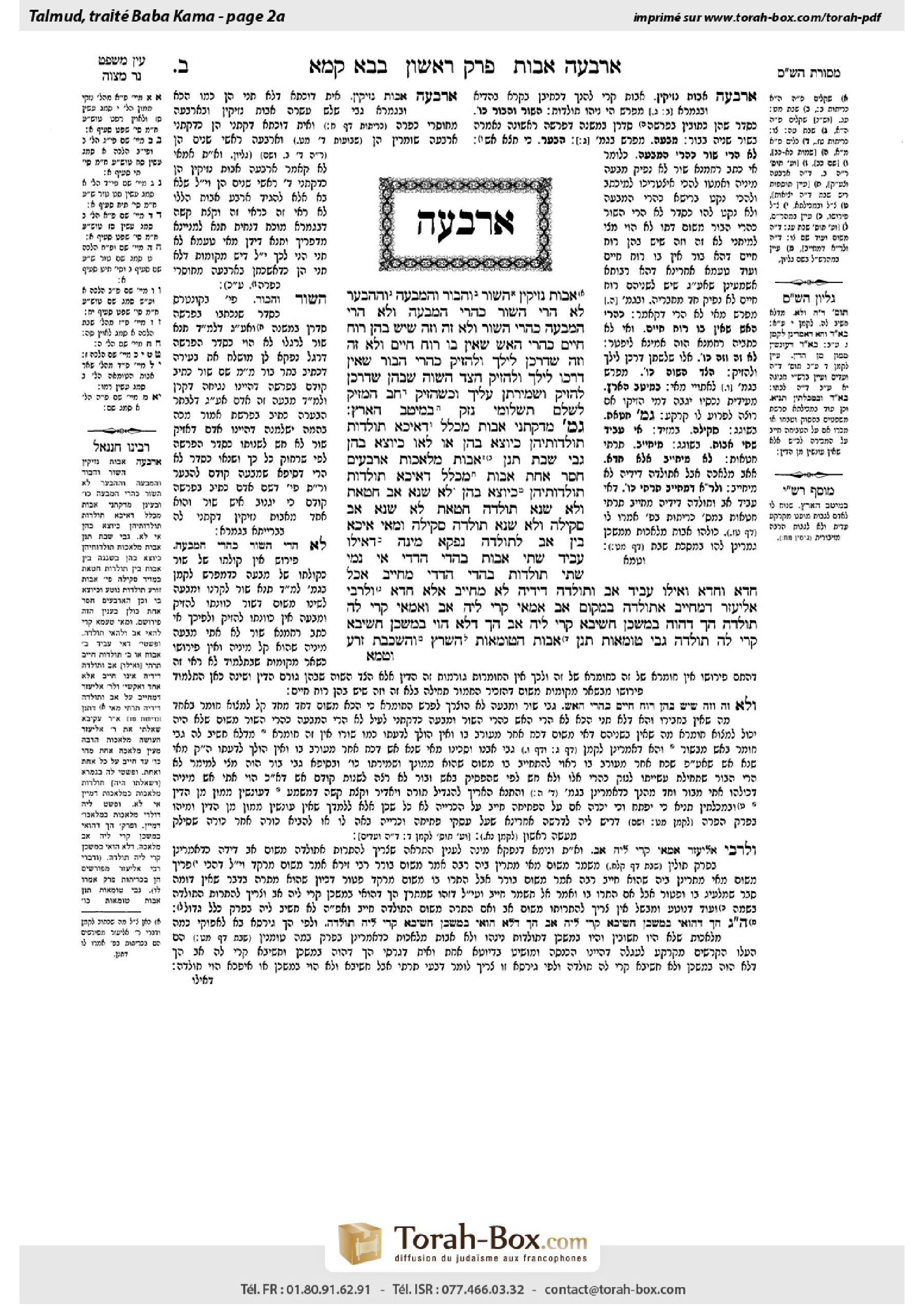
Bava Kamma 2a: Talmud study for Daf Yomi
Study the Talmud for Daf Yomi with scanned pages, Hebrew text, English translations from Sefaria and AI-generated French translations.
Passage selection and English or AI-generated French translation are available where the scan has annotations. Daf Study is independent of Torah-Box and Sefaria.
Browse Bava Kamma · בבא קמא · All tractatesBava Kamma 2a text and translations
This page of Bava Kamma includes the Aramaic text, an English translation and an AI-generated French translation, alongside the scan above.
בבא קמא ב׳ א · Aramaic and Hebrew text
מַתְנִי׳ אַרְבָּעָה אֲבוֹת נְזִיקִין: הַשּׁוֹר, וְהַבּוֹר, וְהַמַּבְעֶה, וְהַהֶבְעֵר.
לֹא הֲרֵי הַשּׁוֹר כַּהֲרֵי הַמַּבְעֶה, וְלֹא הֲרֵי הַמַּבְעֶה כַּהֲרֵי הַשּׁוֹר; וְלֹא זֶה וָזֶה שֶׁיֵּשׁ בָּהֶן רוּחַ חַיִּים, כַּהֲרֵי הָאֵשׁ שֶׁאֵין בּוֹ רוּחַ חַיִּים;
וְלֹא זֶה וָזֶה שֶׁדַּרְכָּן לֵילֵךְ וּלְהַזִּיק, כַּהֲרֵי הַבּוֹר שֶׁאֵין דַּרְכּוֹ לֵילֵךְ וּלְהַזִּיק.
הַצַּד הַשָּׁוֶה שֶׁבָּהֶן – שֶׁדַּרְכָּן לְהַזִּיק, וּשְׁמִירָתָן עָלֶיךָ; וּכְשֶׁהִזִּיק – חָב הַמַּזִּיק לְשַׁלֵּם תַּשְׁלוּמֵי נֶזֶק, בְּמֵיטַב הָאָרֶץ.
גְּמָ׳ מִדְּקָתָנֵי ״אָבוֹת״ – מִכְּלָל דְּאִיכָּא תּוֹלְדוֹת; תּוֹלְדוֹתֵיהֶן כַּיּוֹצֵא בָּהֶן, אוֹ לָאו כַּיּוֹצֵא בָּהֶן?
גַּבֵּי שַׁבָּת תְּנַן: אֲבוֹת מְלָאכוֹת – אַרְבָּעִים חָסֵר אַחַת. ״אָבוֹת״ – מִכְּלָל דְּאִיכָּא תּוֹלָדוֹת,
תּוֹלְדוֹתֵיהֶן כַּיּוֹצֵא בָּהֶן; לָא שְׁנָא אָב – חַטָּאת, וְלָא שְׁנָא תּוֹלָדָה – חַטָּאת; לָא שְׁנָא אָב – סְקִילָה, וְלָא שְׁנָא תּוֹלָדָה – סְקִילָה.
וּמַאי אִיכָּא בֵּין אָב לְתוֹלָדָה? נָפְקָא מִינַּהּ, דְּאִילּוּ עָבֵיד שְׁתֵּי אָבוֹת בַּהֲדֵי הֲדָדֵי, אִי נָמֵי שְׁתֵּי תוֹלָדוֹת בַּהֲדֵי הֲדָדֵי – מִחַיַּיב אַכׇּל חֲדָא וַחֲדָא; וְאִילּוּ עָבֵיד אָב וְתוֹלָדָה דִּידֵיהּ – לָא מִחַיַּיב אֶלָּא חֲדָא.
וּלְרַבִּי אֱלִיעֶזֶר – דִּמְחַיֵּיב אַתּוֹלָדָה בִּמְקוֹם אָב; אַמַּאי קָרֵי לֵיהּ אָב, וְאַמַּאי קָרֵי לַהּ תּוֹלָדָה? הָךְ דַּהֲוָה בְּמִשְׁכָּן חֲשִׁיבָא – קָרֵי לֵיהּ אָב, הָךְ דְּלָא הֲוֵי בְּמִשְׁכָּן חֲשִׁיבָא – קָרֵי לַהּ תּוֹלָדָה.
גַּבַּי טוּמְאוֹת תְּנַן: אָבוֹת הַטּוּמְאוֹת – הַשֶּׁרֶץ, וְהַשִׁכְבַת זֶרַע,
Bava Kamma 2a · English translation
MISHNA: There are four primary categories of damage: The category of Ox; and the category of Pit; and the category of Maveh, which, based on a discussion in the Gemara refers either to the tooth of an animal that causes damage or to a person who causes damage; and the category of Fire.
Each of these categories is unique; therefore, the halakhot of one cannot be derived from another. The defining characteristic of the primary category of Ox is not similar to the defining characteristic of the primary category of Maveh, and the defining characteristic of the primary category of Maveh is not similar to the defining characteristic of the primary category of Ox. And the defining characteristics of this category of Ox and that category of Maveh, in which there is a living spirit that causes damage, are not similar to the defining characteristic of the category of Fire, in which there is no living spirit.
The mishna continues: And the defining characteristics of this primary category of Ox and Maveh and that primary category of Fire, in which the typical manner of their components is to proceed from one place to another and cause damage, are not similar to the defining characteristic of the primary category of Pit, in which the typical manner of its components is not to proceed from one place to another and cause damage; rather, it remains in place and the damage is caused by the injured party proceeding and encountering the obstacle.
The common denominator of the components in all of these primary categories is that it is their typical manner to cause damage, and the responsibility for their safeguarding to prevent them from causing damage is incumbent upon you, the owner of the animal or generator of the fire or the pit. And when a component of any of these categories causes damage, the owner or generator of the component that caused the damage is obligated to pay restitution for damage with best-quality land.
GEMARA: From the fact that the mishna teaches its ruling employing the term: Primary categories, by inference, there are subcategories of those primary categories. The Gemara asks: Are their subcategories similar to them, i.e., to their respective primary categories, so that the same halakhot apply to them, or are they dissimilar to them?
The Gemara cites additional areas of halakha where there are primary categories and subcategories and considers the relationship between them: With regard to Shabbat we learned in a mishna (Shabbat 73a): The primary categories of labor prohibited on Shabbat number forty-less-one. There too, from the fact that the mishna teaches its ruling employing the term: Primary categories, by inference, there are also subcategories.
With regard to the primary categories of labor prohibited on Shabbat, their subcategories are similar to them, as it is no different if one unwittingly performed labor that is a primary category, for which he is liable to bring a sin-offering, and it is no different if one unwittingly performed labor that is a subcategory, for which he is liable to bring a sin-offering. Likewise, it is no different if one intentionally performed labor that is a primary category, for which he is liable to be executed by stoning, and it is no different if one intentionally performed labor that is a subcategory, for which he is liable to be executed by stoning.
And what difference is there between a primary category and a subcategory? The Gemara explains: The practical difference is that if one unwittingly performs two labors classified as different primary categories together, during a single lapse of awareness, or, alternatively, if one unwittingly performs two labors classified as subcategories of two different primary categories together, during a single lapse of awareness, one is liable to bring a sin-offering for each and every labor that he performed. Each primary category of labor is an independent transgression. While if one unwittingly performs a labor that is a primary category and another labor classified as its subcategory during a single lapse of awareness, he is liable to bring only one sin-offering.
The Gemara asks: And according to Rabbi Eliezer, who deems one liable to bring two sin-offerings even if one performs a labor classified as a subcategory together with a labor that is its primary category, why is one labor characterized as a primary category and why is the other labor characterized as a subcategory? The Gemara explains: Of the labors prohibited on Shabbat, that which was a significant labor in the Tabernacle, the Sages characterized it as a primary category, and that which was not a significant labor in the Tabernacle, the Sages characterized it as a subcategory. The labors prohibited on Shabbat are derived from the labors employed in the construction of the Tabernacle; therefore, their classification is also based on their significance in its construction.
With regard to ritual impurities, we learned in the mishna (Kelim 1:1): The primary categories of ritual impurity are as follows: Any of the eight species of the creeping animal enumerated in the Torah (Leviticus 11:29–30), and semen,
Bava Kamma 2a · Traduction française (IA)
MICHNA : Il existe quatre catégories principales de dommages : la catégorie de l'ox ; et la catégorie du trou ; et la catégorie de Maveh, qui, selon une discussion dans la Guemara, désigne soit la dent d'un animal qui cause un dommage, soit une personne qui cause un dommage ; et la catégorie du feu.
Chacune de ces catégories est distincte ; par conséquent, les halakhot d'une ne peuvent être déduites d'une autre. La caractéristique définissante de la catégorie principale de l'ox n'est pas semblable à la caractéristique définissante de la catégorie principale de Maveh, et la caractéristique définissante de la catégorie principale de Maveh n'est pas semblable à celle de la catégorie principale de l'ox. Et les caractéristiques définissantes de cette catégorie de l'ox et de celle de Maveh, dans lesquelles il y a un esprit vivant qui cause un dommage, ne sont pas semblables à la caractéristique définissante de la catégorie du feu, dans laquelle il n'y a pas d'esprit vivant.
La mishna continue : Et les caractéristiques définissantes de cette catégorie principale de l'ox et de Maveh et de celle de feu, dans lesquelles la manière typique de leurs composants est de se déplacer d'un lieu à un autre et de causer un dommage, ne sont pas semblables à la caractéristique définissante de la catégorie du trou, dans laquelle la manière typique de ses composants n'est pas de se déplacer d'un lieu à un autre et de causer un dommage ; plutôt, elle reste en place et le dommage est causé par la personne blessée qui s'approche et rencontre l'obstacle.
Le point commun des composants de toutes ces catégories principales est qu'ils ont pour habitude de causer un dommage, et la responsabilité de leur protection afin de les empêcher de causer un dommage incombe à vous, propriétaire de l'animal ou générateur du feu ou du trou. Et lorsqu'un composant de l'une de ces catégories cause un dommage, le propriétaire ou le générateur du composant qui a causé le dommage est tenu de réparer le dommage avec un terrain de qualité supérieure.
GUEMARA : D'après le fait que la michna enseigne sa décision en utilisant le terme : catégories principales, par déduction, il existe des sous-catégories de ces catégories principales. La Guemara pose la question : Ces sous-catégories sont-elles semblables à elles, c'est-à-dire à leurs catégories principales respectives, de sorte que les mêmes halakhot s'appliquent à elles, ou sont-elles dissimilaires à elles ?
La Guemara cite d'autres domaines de halakha où il existe des catégories principales et des sous-catégories et examine la relation entre elles : En ce qui concerne le Shabbat, nous avons appris dans une mishna (Shabbat 73a) : Les catégories principales des travaux interdits le Shabbat sont quarante moins un. Là aussi, d'après le fait que la mishna enseigne sa décision en utilisant le terme : catégories principales, par déduction, il existe également des sous-catégories.
En ce qui concerne les catégories principales des travaux interdits le Shabbat, leurs sous-catégories sont semblables à elles, car il n'y a pas de différence entre l'accomplissement par inadvertance d'un travail qui est une catégorie principale, pour lequel l'individu est tenu de présenter un sacrifice expiatoire, et l'accomplissement par inadvertance d'un travail qui est une sous-catégorie, pour lequel l'individu est tenu de présenter un sacrifice expiatoire. De même, il n'y a pas de différence entre l'accomplissement intentionnel d'un travail qui est une catégorie principale, pour lequel l'individu est tenu d'être lapidé, et l'accomplissement intentionnel d'un travail qui est une sous-catégorie, pour lequel l'individu est tenu d'être lapidé.
Et quelle différence y a-t-il entre une catégorie principale et une sous-catégorie ? La Guemara explique : La différence pratique est que si l'on accomplit par inadvertance deux travaux classés comme des catégories principales différentes en un seul moment de négligence, ou, alternativement, si l'on accomplit par inadvertance deux travaux classés comme des sous-catégories de deux catégories principales différentes en un seul moment de négligence, l'individu est tenu de présenter un sacrifice expiatoire pour chaque travail qu'il a accompli. Chaque catégorie principale de travail est une transgression indépendante. En revanche, si l'on accomplit par inadvertance un travail qui est une catégorie principale et un autre travail classé comme sa sous-catégorie en un seul moment de négligence, l'individu est tenu de présenter seulement un seul sacrifice expiatoire.
La Guemara pose la question : Et selon Rabbi Eliezer, qui considère que l'individu est tenu de présenter deux sacrifices expiatoires même s'il accomplit un travail classé comme une sous-catégorie ensemble avec un travail qui est sa catégorie principale, pourquoi un travail est-il caractérisé comme une catégorie principale et pourquoi l'autre travail est-il caractérisé comme une sous-catégorie ? La Guemara explique : Parmi les travaux interdits le Shabbat, celui qui était un travail important dans le Tabernacle, les Sages le caractérisent comme une catégorie principale, et celui qui n'était pas un travail important dans le Tabernacle, les Sages le caractérisent comme une sous-catégorie. Les travaux interdits le Shabbat sont dérivés des travaux employés dans la construction du Tabernacle ; par conséquent, leur classification est également basée sur leur importance dans sa construction.
En ce qui concerne les impuretés rituelles, nous avons appris dans la mishna (Kelim 1:1) : Les catégories principales d'impureté rituelle sont les suivantes : tout l'un des huit genres d'animaux rampants énumérés dans la Torah (Lévitique 11:29–30), et le sperme,
Traduction française générée par IA à partir de l’édition anglaise de Sefaria. Vérifie toujours un passage avec le texte source.
Text from Sefaria: William Davidson Edition - Vocalized Aramaic (CC BY NC); William Davidson Edition - English (CC BY NC).