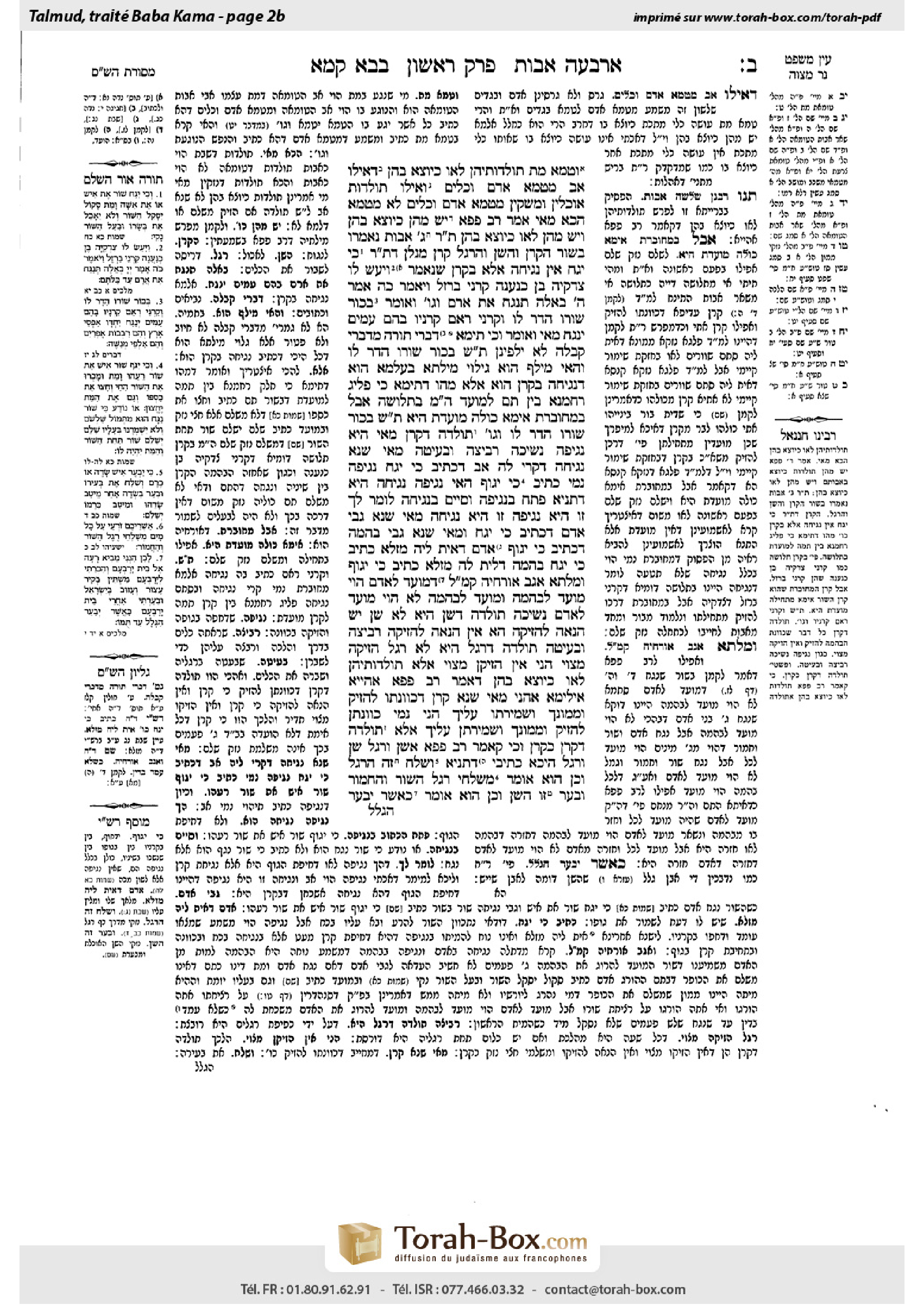
Bava Kamma 2b: Talmud study for Daf Yomi
Study the Talmud for Daf Yomi with scanned pages, Hebrew text, English translations from Sefaria and AI-generated French translations.
Passage selection and English or AI-generated French translation are available where the scan has annotations. Daf Study is independent of Torah-Box and Sefaria.
Browse Bava Kamma · בבא קמא · All tractatesBava Kamma 2b text and translations
This page of Bava Kamma includes the Aramaic text, an English translation and an AI-generated French translation, alongside the scan above.
בבא קמא ב׳ ב · Aramaic and Hebrew text
וּטְמֵא מֵת. תּוֹלְדוֹתֵיהֶן לָאו כַּיּוֹצֵא בָּהֶן; דְּאִילּוּ אָב – מְטַמֵּא אָדָם וְכֵלִים, וְאִילּוּ תּוֹלָדוֹת – אוֹכָלִין וּמַשְׁקִין מְטַמֵּא, אָדָם וְכֵלִים לֹא מְטַמֵּא.
הָכָא מַאי? אָמַר רַב פָּפָּא: יֵשׁ מֵהֶן כַּיּוֹצֵא בָּהֶן, וְיֵשׁ מֵהֶן לָאו כַּיּוֹצֵא בָּהֶן.
תָּנוּ רַבָּנַן: שְׁלֹשָׁה אָבוֹת נֶאֶמְרוּ בְּשׁוֹר – הַקֶּרֶן, וְהַשֵּׁן, וְהָרֶגֶל.
קֶרֶן מְנָלַן? דְּתָנוּ רַבָּנַן: ״כִּי יִגַּח״ – אֵין נְגִיחָה אֶלָּא קֶרֶן, שֶׁנֶּאֱמַר: ״וַיַּעַשׂ לוֹ צִדְקִיָּה בֶן כְּנַעֲנָה קַרְנֵי בַרְזֶל, וַיֹּאמֶר: כֹּה אָמַר ה׳, בְּאֵלֶּה תְּנַגַּח אֶת אֲרָם וְגוֹ׳״. וְאוֹמֵר: ״בְּכוֹר שׁוֹרוֹ הָדָר לוֹ, וְקַרְנֵי רְאֵם קַרְנָיו, בָּהֶם עַמִּים יְנַגַּח״.
מַאי ״וְאוֹמֵר״? וְכִי תֵּימָא דִּבְרֵי תוֹרָה מִדִּבְרֵי קַבָּלָה לָא יָלְפִינַן, תָּא שְׁמַע: ״בְּכוֹר שׁוֹרוֹ הָדָר לוֹ״.
וְהַאי מֵילָף הוּא?! גִּילּוּי מִילְּתָא בְּעָלְמָא הוּא, דִּנְגִיחָה בְּקֶרֶן הוּא!
אֶלָּא מַהוּ דְּתֵימָא, כִּי פַּלֵּיג רַחֲמָנָא בֵּין תָּם לְמוּעָד – הָנֵי מִילֵּי בִּתְלוּשָׁה, אֲבָל בִּמְחוּבֶּרֶת – אֵימָא כּוּלָּהּ מוּעֶדֶת הִיא;
תָּא שְׁמַע: ״בְּכוֹר שׁוֹרוֹ הָדָר לוֹ וְגוֹ׳״.
תּוֹלָדָה דְקֶרֶן מַאי הִיא? נְגִיפָה, נְשִׁיכָה, רְבִיצָה, וּבְעִיטָה.
מַאי שְׁנָא נְגִיחָה דְּקָרֵי לַהּ אָב – דִּכְתִיב ״כִּי יִגַּח״, נְגִיפָה נָמֵי כְּתִיב ״כִּי יִגֹּף״! הַאי נְגִיפָה – נְגִיחָה הִיא. דְּתַנְיָא: פָּתַח בִּ״נְגִיפָה״ וְסִיֵּים בִּ״נְגִיחָה״, לוֹמַר לָךְ: זוֹ הִיא נְגִיפָה זוֹ הִיא נְגִיחָה.
מַאי שְׁנָא גַּבֵּי אָדָם דִּכְתִיב ״כִּי יִגַּח״, וּמַאי שְׁנָא גַּבֵּי בְּהֵמָה דִּכְתִיב ״כִּי יִגֹּף״?
אָדָם – דְּאִית לֵיהּ מַזָּלָא, כְּתִיב ״כִּי יִגַּח״; בְּהֵמָה – דְּלֵית לַהּ מַזָּלָא, כְּתִיב ״כִּי יִגֹּף״.
וּמִלְּתָא אַגַּב אוֹרְחֵיהּ קָא מַשְׁמַע לַן – דְּמוּעָד לְאָדָם הָוֵי מוּעָד לִבְהֵמָה וּמוּעָד לִבְהֵמָה לָא הָוֵי מוּעָד לְאָדָם.
נְשִׁיכָה – תּוֹלָדָה דְשֵׁן הִיא! לָא; שֵׁן – יֵשׁ הֲנָאָה לְהֶזֵּיקָהּ, הָא – אֵין הֲנָאָה לְהֶזֵּיקָהּ.
רְבִיצָה וּבְעִיטָה – תּוֹלָדָה דְרֶגֶל הִיא! לָא; רֶגֶל – הֶזֵּיקָהּ מָצוּי, הָנֵי – אֵין הֶזֵּיקָן מָצוּי.
אֶלָּא ״תּוֹלְדוֹתֵיהֶן לָאו כַּיּוֹצֵא בָּהֶן״ דְּאָמַר רַב פָּפָּא, אַהֵיָיא?
אִילֵּימָא אַהָנֵי; מַאי שְׁנָא קֶרֶן – דְּכַוּוֹנָתוֹ לְהַזִּיק, וּמָמוֹנְךָ וּשְׁמִירָתוֹ עָלֶיךָ; הָנֵי נָמֵי – כַּוּוֹנָתָן לְהַזִּיק, וּמָמוֹנְךָ וּשְׁמִירָתָן עָלֶיךָ!
אֶלָּא תּוֹלָדָה דְקֶרֶן כְּקֶרֶן, וְכִי קָאָמַר רַב פָּפָּא – אַשֵּׁן וָרֶגֶל.
שֵׁן וָרֶגֶל הֵיכָא כְּתִיבִי? דְּתַנְיָא: ״וְשִׁלַּח״ – זֶה הָרֶגֶל, וְכֵן הוּא אוֹמֵר: ״מְשַׁלְּחֵי רֶגֶל הַשּׁוֹר וְהַחֲמוֹר״.
״וּבִעֵר״ – זוֹ הַשֵּׁן, וְכֵן הוּא אוֹמֵר: ״כַּאֲשֶׁר יְבַעֵר
Bava Kamma 2b · English translation
and one who is impure with impurity imparted by a human corpse. A person, a vessel, or food that is rendered impure through contact with an item classified as a primary category of ritual impurity is characterized as a subcategory. In that domain, their subcategories are dissimilar to them, as any person or item classified as a primary category of ritual impurity impurifies a person and impurifies any vessels with which it comes into contact, while a person or item classified as a subcategory of ritual impurity impurifies food or drink, but does not impurify a person or vessels.
After determining that there are instances where the legal status of subcategories is like that of primary categories, e.g., Shabbat, and there are instances where the legal status of subcategories is dissimilar to that of primary categories, e.g., ritual impurity, the Gemara asks: Here, with regard to the laws of damages, what is the relationship between the primary categories and their subcategories? Rav Pappa said: There are, among the primary categories of damage, some whose subcategories are similar to them, and there are, among them, some whose subcategories are dissimilar to them.
§ Seeking to clarify Rav Pappa’s statement, the Gemara cites a baraita that delineates the primary categories of damage. The Sages taught in a baraita: Three primary categories of damage were stated in the Torah with regard to an ox. An ox causes damage in three ways, and each is classified as a distinct primary category of damage represented by a part of the body of the ox: There is the category of Goring [keren], literally, horn. This is referring to an ox goring a person or an animal and causing damage. And there is the category of Eating [shen], literally, tooth. This is referring to one’s ox causing damage by consuming another person’s produce. And there is the category of Trampling [regel], literally, foot. This is referring to an ox trampling another person’s belongings and causing damage. These are classified as primary categories because they are mentioned explicitly in the Torah.
The Gemara elaborates: From where do we derive the primary category of Goring? The source is as the Sages taught in a baraita: The verse states: “And if an ox gores a man or a woman” (Exodus 21:28); and goring is performed only with a horn, as it is stated: “And Zedekiah, son of Chenaanah, made himself horns of iron, and said: So says the Lord: With these shall you gore the Arameans, until they are consumed” (I Kings 22:11). And the verse also states: “His firstborn bull, majesty is his, and his horns are the horns of the wild ox; with them he shall gore the nations” (Deuteronomy 33:17).
The Gemara interrupts its citation of the baraita and asks: What is the purpose of citing the additional verse introduced with the term: And the verse also states? The Gemara answers: And if you would say that the first verse cited is not a legitimate source as it is a verse from the Prophets, and we do not derive Torah matters from the texts of the tradition, i.e., Prophets and Writings, come and hear proof from the Torah: “His firstborn bull, majesty is his.”
The Gemara rejects the possibility that the reason a second verse was cited is that the primary category of Goring cannot be derived from a verse in the Prophets: But is this a halakhic derivation? It is a mere disclosure of the matter, that goring is performed with a horn. A verse in the Prophets can certainly serve as a source for that disclosure.
Rather, the reason the baraita cites a second verse is lest you say, based on the first verse, that when the Merciful One distinguishes between liability for damage caused by an innocuous ox, for which the owner is liable to pay half of the damages for the first three times that it gores, and liability for damage caused by a forewarned ox, which already gored three times and whose owner was cautioned to prevent the ox from goring, for which he is liable to pay the full damages, that statement applies only to damage caused with a detached horn, like the horn of Zedekiah described in the verse, e.g., if an animal held a detached horn in its mouth and caused damage with it; but for damage that an ox caused with a horn attached to its head, say that in all cases the legal status of the ox is that of a forewarned ox and its owner is liable to pay for all of the damage.
Therefore, the baraita says: Come and hear a proof from another verse: “His firstborn bull, majesty is his, and his horns are the horns of the wild ox; with them he shall gore the nations,” where the reference is to a horn attached to the ox’s head. Evidently, when an ox gores with its own horns there is a distinction between an innocuous ox and a forewarned ox.
The Gemara resumes its citation of the baraita: What is a subcategory of Goring? It includes any action that an ox performs with its body with the objective of inflicting damage: Pushing [negifa], biting, crouching upon items with the objective of inflicting damage, and kicking.
The Gemara asks: What is different about goring that it is characterized as a primary category of damage, as it is written explicitly in the verse: “And if an ox gores a man or a woman” (Exodus 21:28); accordingly, negifa should also be characterized as a primary category, as it is written: “If one man’s ox hurts [yiggof ] the ox of another” (Exodus 21:35)? The Gemara answers: This negifa mentioned in the verse, is actually a reference to goring, as it is taught in a baraita that the verses states: “And if one man’s ox hurts [yiggof ] the ox of another…or if it is known that the ox was a goring ox in time past” (Exodus 21:35–36). The verse began its description of the case with the term negifa and it concluded with the term goring to say to you that in this context the two terms describe the same action: This action is negifa and this same action is goring.
The Gemara asks: If the two terms are interchangeable, what is different with regard to an ox goring a person that it is written: “And if an ox gores a man or a woman” (Exodus 21:28), and what is different with regard to an ox goring an animal that it is written: “If one man’s ox hurts [yiggof ] the ox of another” (Exodus 21:35)?
The Gemara explains: With regard to a person, who has the ingenuity to defend himself and is not easily injured, it is written: “If an ox gores,” a term indicating an attack of greater force. With regard to an animal, which does not have the ingenuity to defend itself and is more easily injured, it is written: “If an ox hurts [yiggof ],” a term indicating an attack of lesser force. The term yiggof is related to the term magefa, meaning plague. The Torah employs that term with regard to the goring of an animal to indicate that when an animal is gored, regardless of the force of the blow, it will likely result in its death.
And the Torah’s use of these terms teaches us a matter in passing: Because the effort required for the ox to gore a person to death is greater than the effort required for the ox to gore an animal to death, the halakha is that an ox that is forewarned with regard to goring a person is also forewarned with regard to an animal. But an ox that is forewarned with regard to an animal is not forewarned with regard to a person.
The Gemara questions the classification in the baraita of biting, crouching, and kicking as subcategories of Goring: Isn’t biting a subcategory of Eating, as the animal both eats and bites with its teeth? The Gemara answers: No, in cases included in the primary category of Eating, there is pleasure for the animal in the course of its causing damage. In this case of damage caused by biting, there is no intrinsic pleasure for the animal in the course of the damage that it causes, as when the ox bites forcefully, the exclusive objective of the action is to cause damage.
The Gemara asks: Aren’t crouching upon items and kicking items in order to damage them each a subcategory of Trampling, as the animal crouches by bending its legs and kicks with its feet? The Gemara answers: No, in cases included in the primary category of Trampling, the damage is commonplace, as it is caused in the course of the animal’s walking; in these cases of crouching and kicking, the damage is not commonplace, as animals do not typically kick or crouch upon utensils.
After citing the subcategories listed in the baraita, the Gemara resumes its analysis of the statement of Rav Pappa: But with regard to the statement that Rav Pappa said: There are among them some whose subcategories are dissimilar to them, to which primary category was Rav Pappa referring?
If we say that his reference was to these subcategories of Goring, what is different about Goring that defines it as a unique primary category? What is different is that the objective of the ox’s action is to cause damage, and the ox is your property, and responsibility for its safeguarding, to prevent it from causing damage, is incumbent upon you, its owner. In these subcategories of Goring, i.e., pushing [negifa], biting, crouching, and kicking, as well, the objective of the oxen’s actions is to cause damage, and the oxen are your property, and responsibility for their safeguarding, to prevent your oxen from causing damage, is incumbent upon you.
Rather, it is apparent that the status of a subcategory of Goring is like that of the primary category of Goring, and when Rav Pappa says: There are among them some whose subcategories are dissimilar to them, he was referring to Eating and Trampling.
The Gemara asks: Where are Eating and Trampling written in the Torah that led them to be classified as primary categories? The Gemara answers: The source is as the Sages taught in a baraita: The verse states: “If a man causes a field or vineyard to be eaten, and he sends forth his animal, and it consumed in the field of another” (Exodus 22:4). The two parts of the verse are referring to different categories: “And he sends forth,” this is a reference to the primary category of Trampling, as sending forth results in the animal trampling another’s produce and damaging it, and likewise it states: “Happy are you that sow beside all waters that send forth the feet of the ox and the donkey” (Isaiah 32:20). Clearly the term “send forth” is a reference to trampling by the feet of the animal.
“And it consumed,” this is a reference to the primary category of Eating, and likewise it states: “And I will utterly sweep away the house of Jeroboam, as one consumes with
Bava Kamma 2b · Traduction française (IA)
et celui qui est impur à cause d’une impureté transmise par un corps humain. Une personne, un objet ou un aliment qui devient impur par contact avec un objet classé dans une catégorie principale d’impureté rituelle est considéré comme une sous-catégorie. Dans ce domaine, leurs sous-catégories sont différentes d’eux-mêmes, car toute personne ou objet classé dans une catégorie principale d’impureté rituelle rend impur une personne et rend impur tout objet avec lequel il entre en contact, tandis qu’une personne ou objet classé dans une sous-catégorie d’impureté rituelle rend impur un aliment ou une boisson, mais ne rend pas impur une personne ou des objets.
Après avoir établi qu’il existe des cas où le statut juridique des sous-catégories est semblable à celui des catégories principales, par exemple le Shabbat, et des cas où le statut juridique des sous-catégories est différent de celui des catégories principales, par exemple l’impureté rituelle, la Guemara pose la question : ici, concernant les lois des dommages, quelle est la relation entre les catégories principales et leurs sous-catégories ? Rav Pappa a dit : Parmi les catégories principales de dommages, il en existe certaines dont les sous-catégories sont semblables à elles, et d’autres dont les sous-catégories sont différentes.
§ Pour clarifier l’affirmation de Rav Pappa, la Guemara cite un baraïta qui définit les catégories principales de dommages. Les Sages ont enseigné dans un baraïta : Trois catégories principales de dommages ont été énoncées dans la Torah concernant un bœuf. Un bœuf cause des dommages de trois manières, et chacune est classée comme une catégorie principale distincte de dommages, représentée par une partie du corps du bœuf : il y a la catégorie de l’attaque [keren], littéralement, cornes. Cela fait référence à un bœuf qui attaque une personne ou un animal et cause des dommages. Et il y a la catégorie de la mastication [shen], littéralement, dents. Cela fait référence à un bœuf qui cause des dommages en consommant les récoltes d’un autre. Et il y a la catégorie de l’écrasement [regel], littéralement, pied. Cela fait référence à un bœuf qui écrase les biens d’une autre personne et cause des dommages. Ces catégories sont classées comme principales car elles sont mentionnées explicitement dans la Torah.
La Guemara développe : D’où tirons-nous la catégorie principale d’attaque ? La source est comme les Sages l’ont enseigné dans un baraïta : le verset dit : « Et si un bœuf attaque un homme ou une femme » (Exode 21:28) ; et l’attaque est faite uniquement avec des cornes, comme il est dit : « Et Zédequias, fils de Chanaanah, fit des cornes d’acier, et dit : Ainsi parle l’Éternel : Avec ces cornes, vous attaquerez les Araméens, jusqu’à ce qu’ils soient consumés » (I Rois 22:11). Et le verset dit aussi : « Son premier bœuf, sa majesté, et ses cornes sont les cornes de l’antilope ; avec elles, il attaquera les nations » (Deutéronome 33:17).
La Guemara interrompt sa citation du baraïta et pose la question : Quel est le but de citer le verset supplémentaire introduit par le terme : « Et le verset dit aussi » ? La Guemara répond : Si l’on disait que le premier verset cité n’est pas une source valable car il provient d’un livre des Prophètes, et qu’on ne dérive pas les questions de Torah à partir des textes de la tradition, c’est-à-dire des Prophètes et des Ecritures, viens entendre la preuve à partir de la Torah : « Son premier bœuf, sa majesté, et ses cornes sont les cornes de l’antilope ; avec elles, il attaquera les nations. »
La Guemara rejette la possibilité que la raison d’avoir cité un deuxième verset soit que la catégorie principale d’attaque ne puisse être dérivée d’un verset des Prophètes : Mais est-ce une dérivation halakhique ? C’est simplement une révélation de la chose, que l’attaque est faite avec des cornes. Un verset des Prophètes peut certainement servir de source pour cette révélation.
Plutôt, la raison pour laquelle le baraïta cite un deuxième verset est pour éviter que l’on dise, à partir du premier verset, que l’affirmation concernant la responsabilité pour les dommages causés par un bœuf inoffensif, pour lequel l’propriétaire est responsable de payer la moitié des dommages pour les trois premières fois où le bœuf attaque, et la responsabilité pour les dommages causés par un bœuf averti, qui a déjà attaqué trois fois et dont l’propriétaire a été averti de prévenir l’attaque, pour lequel il est responsable de payer les dommages complets, s’applique uniquement aux dommages causés avec une corne détachée, comme la corne de Zédequias décrite dans le verset, par exemple, si un animal tenait une corne détachée dans sa bouche et causait des dommages avec elle ; mais pour les dommages causés par un bœuf avec une corne attachée à sa tête, disons que dans tous les cas le statut juridique du bœuf est celui d’un bœuf averti et son propriétaire est responsable de payer tous les dommages.
Par conséquent, le baraïta dit : Viens entendre une preuve d’un autre verset : « Son premier bœuf, sa majesté, et ses cornes sont les cornes de l’antilope ; avec elles, il attaquera les nations », où la référence est à une corne attachée à la tête du bœuf. Évidemment, lorsque le bœuf attaque avec ses propres cornes, il y a une distinction entre un bœuf inoffensif et un bœuf averti.
La Guemara reprend sa citation du baraïta : Qu’est-ce qu’une sous-catégorie de l’attaque ? Elle inclut toute action que l’ox effectue avec son corps avec l’objectif d’infliger des dommages : pousser [negifa], mordre, se coucher sur des objets avec l’objectif d’infliger des dommages, et frapper.
La Guemara pose la question : Qu’est-ce qui diffère dans l’attaque pour qu’elle soit caractérisée comme une catégorie principale de dommages, puisque cela est écrit explicitement dans le verset : « Et si un bœuf attaque un homme ou une femme » (Exode 21:28) ; donc negifa devrait aussi être caractérisée comme une catégorie principale, puisque cela est écrit : « Si un bœuf d’un homme blesse [yiggof] le bœuf d’un autre » (Exode 21:35) ? La Guemara répond : Cette negifa mentionnée dans le verset est en réalité une référence à l’attaque, comme il est enseigné dans un baraïta que le verset dit : « Et si un bœuf d’un homme blesse [yiggof] le bœuf d’un autre… ou si on sait que le bœuf était un bœuf attaquant dans le passé » (Exode 21:35–36). Le verset a commencé sa description du cas avec le terme negifa et a terminé avec le terme attaque pour dire à l’auditeur que dans ce contexte, les deux termes décrivent la même action : cette action est negifa et cette même action est attaque.
La Guemara pose la question : Si les deux termes sont interchangeables, qu'est-ce qui diffère concernant un bœuf qui tue un homme ou une femme, tel que dit : « Et si un bœuf charge un homme ou une femme » (Exode 21:28), et qu'est-ce qui diffère concernant un bœuf qui tue un animal, tel que dit : « Si un bœuf d'un homme blesse le bœuf d'un autre » (Exode 21:35) ?
La Guemara explique : Concernant un homme, qui a l'intelligence de se défendre et n'est pas facilement blessé, il est dit : « Si un bœuf charge », un terme indiquant une attaque plus forte. Concernant un animal, qui n'a pas l'intelligence de se défendre et est plus facilement blessé, il est dit : « Si un bœuf blesse », un terme indiquant une attaque plus faible. Le terme « blesse » est lié au terme « magefa », signifiant épidémie. La Torah utilise ce terme concernant la charge d'un animal pour indiquer que lorsque l'animal est blessé, qu'importe la force du coup, il est probable qu'il meure.
Et l'usage de ces termes par la Torah nous apprend une chose par la voie de l'interprétation : Puisque l'effort requis pour que le bœuf tue un homme est plus grand que l'effort requis pour que le bœuf tue un animal, la halakha est que le bœuf averti concernant la charge d'un homme est également averti concernant un animal. Mais un bœuf averti concernant un animal n'est pas averti concernant un homme.
La Guemara questionne la classification dans la baraïta des morsures, des accroupissements et des coups de pied comme sous-catégories de la charge : N'est-ce pas une sous-catégorie de la nourriture, puisque l'animal mange et mord avec ses dents ? La Guemara répond : Non, dans les cas inclus dans la catégorie principale de la nourriture, il y a un plaisir pour l'animal dans le cours de la cause de préjudice. Dans ce cas de préjudice causé par la morsure, il n'y a pas de plaisir intrinsèque pour l'animal dans le cours du préjudice qu'il cause, car lorsque le bœuf mord fortement, l'objectif exclusif de l'action est de causer un préjudice.
La Guemara pose la question : N'est-ce pas l'attouchements sur des objets et les coups de pied visant à endommager des objets une sous-catégorie de l'écrasement, puisque l'animal s'accroupit en pliant ses jambes et frappe avec ses pieds ? La Guemara répond : Non, dans les cas inclus dans la catégorie principale d'écrasement, le préjudice est courant, puisqu'il est causé dans le cours de la marche de l'animal ; dans ces cas d'accroupissement et de coup de pied, le préjudice n'est pas courant, puisque les animaux ne frappent ou ne s'accroupissent pas habituellement sur des ustensiles.
Après avoir cité les sous-catégories listées dans la baraïta, la Guemara reprend son analyse de l'affirmation de Rav Pappa : Mais concernant l'affirmation que Rav Pappa a dite : Il y en a parmi eux dont les sous-catégories sont différentes d'elles, à quelle catégorie principale Rav Pappa faisait-il référence ?
Si nous disons qu'il faisait référence à ces sous-catégories de la charge, qu'est-ce qui diffère concernant la charge qui définit cette catégorie principale ? Ce qui diffère est que l'objectif de l'action du bœuf est de causer un préjudice, et que le bœuf est votre propriété, et que la responsabilité de son entretien, afin de prévenir qu'il cause un préjudice, incombe à vous, son propriétaire. Dans ces sous-catégories de la charge, c'est-à-dire pousser, mordre, s'accroupir et frapper, de même, l'objectif des actions des bœufs est de causer un préjudice, et les bœufs sont votre propriété, et la responsabilité de leur entretien, afin de prévenir vos bœufs de causer un préjudice, incombe à vous.
Plutôt, il est évident que le statut d'une sous-catégorie de la charge est comme celui de la catégorie principale de la charge, et lorsque Rav Pappa dit : Il y en a parmi eux dont les sous-catégories sont différentes d'elles, il faisait référence à la nourriture et à l'écrasement.
La Guemara pose la question : Où sont la nourriture et l'écrasement écrits dans la Torah qui les ont conduits à être classés comme catégories principales ? La Guemara répond : La source est comme les Sages ont enseigné dans une baraïta : Le verset dit : « Si un homme cause un champ ou un vignoble à être mangé, et il envoie son animal, et il a dévoré dans le champ d'autrui » (Exode 22:4). Les deux parties du verset font référence à des catégories différentes : « Et il envoie », cela fait référence à la catégorie principale d'écrasement, puisque l'envoi entraîne que l'animal écrase les récoltes d'autrui et les endomage, et de même il dit : « Heureux es-tu qui sèmes près de toutes les eaux qui envoient les pieds du bœuf et de l'âne » (Yachout 32:20). Évidemment le terme « envoient » fait référence à l'écrasement par les pieds de l'animal.
« Et il a dévoré », cela fait référence à la catégorie principale de la nourriture, et de même il dit : « Et je vais entièrement éradiquer la maison de Jérubbalim, comme on consomme avec »
Traduction française générée par IA à partir de l’édition anglaise de Sefaria. Vérifie toujours un passage avec le texte source.
Text from Sefaria: William Davidson Edition - Vocalized Aramaic (CC BY NC); William Davidson Edition - English (CC BY NC).